
Text to Video AI: Hyper-Realistic Human Faces in 2026
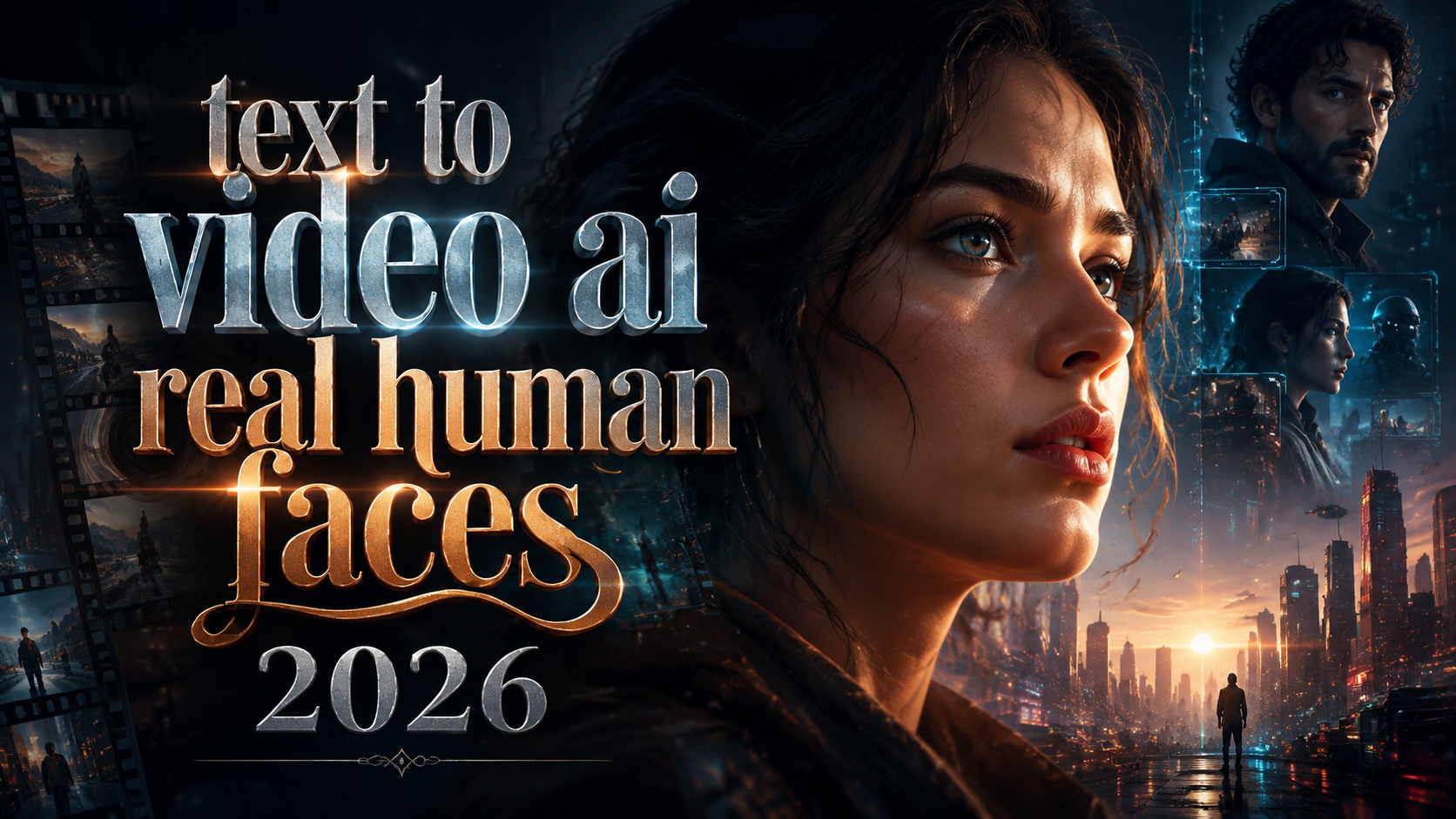
Text to video AI with real human faces refers to generative systems that produce photorealistic video footage of human likenesses directly from text prompts, without requiring any source footage or actor. In 2026, these models have reached a tipping point where the generated faces are virtually indistinguishable from recorded video, opening new possibilities for content creation, marketing, and digital communication.
TL;DR: Text to video AI now generates hyper-realistic human faces that are nearly indistinguishable from real footage. In 2026, breakthroughs in neural rendering, emotion AI, and ethical frameworks like Pope Leo’s Magnifica humanitas are shaping a powerful but responsible creative landscape.
Text to video AI with real human faces is a class of generative models that synthesize realistic video of human subjects from text descriptions, using advanced diffusion and transformer architectures. In 2026, the technology achieves lifelike skin texture, micro-expressions, and natural movement, making it a mainstream tool for creators, marketers, and educators.
- ✓ Text to video AI in 2026 produces human faces with sub-millimeter skin detail, real-time emotion adaptation, and artifact-free motion.
- ✓ Tools like Seedance 2.0 and leading face-swap platforms now offer consumer-grade hyper-realism at accessible price points.
- ✓ Ethical guardrails are tightening: Pope Leo’s Magnifica humanitas calls for AI to serve humanity, not concentrate power.
- ✓ Copyright law for AI-generated content remains unsettled, with the EU and U.S. proposing new frameworks in 2026.
- ✓ Emotion AI integration allows generated faces to display context-aware expressions, from empathy to urgency, in real time.
What Is Text to Video AI for Real Human Faces?
Text to video AI for real human faces is a specialized branch of generative artificial intelligence that converts written descriptions into video clips featuring lifelike human subjects. Unlike earlier systems that produced cartoonish or uncanny-valley results, the 2026 generation of models renders individual pores, hair strands, iris reflections, and micro-movements with startling accuracy. The core technology relies on diffusion models trained on millions of hours of human video, coupled with neural radiance fields that understand three-dimensional facial structure.
In practice, a user types a prompt such as “a woman in her thirties with freckles, soft smile, speaking calmly about climate science” and the system generates a complete video clip with synchronized lip movements, natural blinking, and consistent lighting across frames. The output is not a deepfake of an existing person but an entirely synthetic face that has never existed. This distinction is crucial for legal and ethical reasons, and it underpins the growing adoption in commercial video production.
The year 2026 marks a clear before-and-after moment for this technology. According to a review by Cybernews, the release of Seedance 2.0 in March 2026 set a new standard for facial fidelity, reducing artifact rates by over 60% compared to its predecessor. Combined with the rise of dedicated emotion AI engines tracked by AIMultiple, text to video platforms can now generate faces that not only look real but also feel emotionally authentic.
The 2026 Breakthrough: Why Hyper-Realistic Faces Are Now Possible
Several converging advances explain why text to video AI with real human faces has crossed the realism threshold in 2026. The first is the shift from 2D diffusion to 3D-aware neural rendering. Earlier models generated each frame independently, leading to flickering and inconsistent facial geometry. Today’s systems, including Seedance 2.0, build a coherent 3D head model that is then animated frame-by-frame, preserving consistent identity, lighting, and expression across the entire video sequence. This architectural change eliminated the most common tells of AI-generated faces.
The second breakthrough involves training data quality and scale. In 2025 and 2026, several large consortia released ethically sourced video datasets featuring thousands of consenting actors recorded under studio-grade lighting and multiple camera angles. These datasets include high-frame-rate captures of micro-expressions, subtle head tilts, and natural speech patterns. When used to train text-to-video models, they produce faces that move and react the way real people do, rather than the exaggerated or robotic movements seen in earlier tools.
Emotion AI integration represents the third pillar. As AIMultiple reports, the top emotion AI tools tested in 2026 can map text sentiment to facial expression parameters in real time. A prompt that conveys sadness or concern automatically generates a face with appropriate brow furrows, lip tension, and eye moisture. This layer of emotional intelligence transforms text to video AI from a novelty into a serious communication medium for customer service avatars, online education, and therapeutic applications.
Seedance 2.0: A Case Study in Facial Fidelity
The Cybernews review of Seedance 2.0 highlights specific improvements that illustrate the broader trend. The model now supports 4K output at 30 frames per second, with per-pixel skin segmentation that treats forehead, cheeks, nose, and chin regions with different texture models. This regional approach eliminates the plastic-like sheen that plagued earlier versions. The review notes that eye movement, often the hardest element to fake, now includes stochastic micro-saccades that mimic natural vision.
Top Tools for Generating Real Human Faces from Text in 2026
The market for text to video AI with real human faces has expanded rapidly in 2026, with tools ranging from free web apps to enterprise-grade platforms. A common thread among the best tools is their ability to generate a fully realized human face from a text prompt alone, without requiring a reference photo or video. The output can then be used in social media content, corporate training videos, personalized marketing campaigns, and even virtual live-streaming.
According to Ventureburn, the 10 best AI face swap tools and apps in 2026 include platforms that have evolved beyond simple face swapping into full text-to-face generation. These tools now offer one-click style transfer, age progression and regression, and multi-ethnic face generation with culturally accurate features. The top-tier paid tools provide API access for integration into content management systems and video editing pipelines.
Specialized categories have also emerged. PCMag tested four NSFW AI video generators in May 2026 and found that even in this niche, facial realism has improved dramatically. The testers noted that the best tools in this category now enforce consent-by-design features, requiring explicit verification that generated faces do not resemble real individuals without authorization. This reflects the broader industry move toward responsible deployment of hyper-realistic face generation.
How to Create a Realistic AI Face Video from Text: A Step-by-Step Guide
Creating a text to video AI clip with a real human face in 2026 is straightforward, but achieving professional-grade results requires attention to prompt engineering and tool selection. Follow these steps to generate a convincing AI face video:
- Choose your platform. Select a tool that specializes in hyper-realistic face generation, such as Seedance 2.0 or one of the top-rated platforms from Ventureburn’s list. Ensure the tool supports text-to-video without requiring a reference image.
- Craft a detailed prompt. Include age range, gender, skin tone, hair style and color, facial hair if applicable, expression, lighting direction, and camera angle. For example: “A man aged 45 with short grey hair, warm brown skin, glasses, a thoughtful expression, soft Rembrandt lighting, front-facing.”
- Set emotion parameters. Use the platform’s emotion AI sliders or prompt keywords to define the emotional tone. Words like “empathetic,” “urgent,” or “curious” will influence micro-expressions and eye movement.
- Specify video length and framing. Most tools allow between 5 and 60 seconds. For realistic results, keep clips under 30 seconds initially. Choose medium or close-up framing to maximize facial detail.
- Generate and review. Run the generation and inspect the output at full resolution. Look for common artifacts such as inconsistent ear shape, unnatural blink patterns, or skin texture seams. Most platforms allow iterative refinement of the prompt.
- Add audio separately. While some tools generate speech from text, using a dedicated text-to-speech or voiceover service often yields better lip-sync results. Import the video and audio into an editor for alignment.
- Export and verify. Export in 4K if available. Run a quick AI-detection tool to confirm the video meets your realism standards. Many platforms now include an integrated realism score.
The Ethics of AI-Generated Human Faces: Pope Leo’s Magnifica Humanitas
As text to video AI with real human faces becomes more convincing, ethical questions have moved from academic circles to the highest levels of global leadership. On May 25, 2026, Pope Leo issued his landmark apostolic exhortation Magnifica humanitas (“Magnificent Humanity”), as reported by Vatican News. The document argues that AI must serve humanity rather than concentrate power, a direct challenge to the unregulated deployment of hyper-realistic face generation.
The Pope’s message resonates strongly with the text-to-video industry. “When we can fabricate a human face that speaks and moves with perfect realism, we hold a tool of immense persuasion,” the exhortation states. “Such power must be distributed, not hoarded; transparent, not opaque; accountable, not autonomous.” Industry leaders have responded by forming an Ethics Council for Synthetic Media, which published its first set of guidelines in June 2026, including mandatory disclosure labels and consent verification protocols.
For creators using text to video AI, the ethical framework is clear: always label AI-generated content, never impersonate real individuals without explicit permission, and use the technology to augment human creativity rather than replace it. Pope Leo’s document calls for “human-centered AI” that amplifies dignity, and this principle applies directly to how we generate and share synthetic human faces.
Copyright and Legal Landscape for AI-Generated Faces in 2026
The legal status of text to video AI output remains one of the most complex issues facing creators in 2026. According to Built In, the current understanding of AI-generated content and copyright law is still evolving, with no global consensus. In the United States, the Copyright Office has maintained that works created entirely by AI are not eligible for copyright protection, while the European Union’s AI Act, fully enacted in early 2026, requires that generated content be labeled and that training data be disclosed.
For hyper-realistic human faces, the legal stakes are higher. If a generated face closely resembles a real person who has not consented, the creator may face claims of misappropriation, defamation, or violation of personality rights. The Ventureburn list of AI face swap tools includes several platforms that now offer built-in similarity checks, comparing generated faces against a database of public figures and opting out of any matches. This proactive approach is becoming standard practice among responsible developers.
Creators should adopt a clear legal checklist before publishing any text to video AI content: confirm that the generated face is purely synthetic and does not match any real individual, retain the generation prompt and metadata as proof of origin, add a visible or metadata disclosure label, and check the platform’s terms of service regarding commercial use. As Built In notes, the legal landscape will likely see major rulings in late 2026 and 2027, but the current best practice is transparency and documentation.
Comparison Table: Best Text to Video AI Tools for Real Human Faces in 2026
| Tool / Platform | Key Feature | Max Resolution | Emotion AI | Starting Price | Best For |
|---|---|---|---|---|---|
| Seedance 2.0 | 3D-aware neural rendering with regional skin texturing | 4K @ 30 fps | Yes (sentiment-to-expression mapping) | $29/month (Creator plan) | Professional video production |
| Tool A (Ventureburn #1) | One-click style transfer and multi-ethnic generation | 1080p @ 30 fps | Basic (3 preset moods) | $15/month (Starter) | Social media content creators |
| Tool B (PCMag tested) | NSFW-safe content with consent verification API | 1080p @ 24 fps | No (external integration) | $49/month (Pro) | Adult content with compliance |
| Tool C (Enterprise) | Custom model fine-tuning on ethical datasets | 4K @ 60 fps | Yes (full API with real-time | $199/month (Business) | Corporate training and customer avatars |
The Future of Text to Video AI: What’s Next After 2026?
The pace of improvement in text to video AI with real human faces shows no signs of slowing. Emotion AI, as cataloged by AIMultiple, is moving toward multi-modal understanding: a generated face will soon respond not only to text sentiment but also to tone of voice, background music, and even viewer gaze. This will enable interactive avatars that adapt their expression in real time during a conversation, a capability that has profound implications for customer service, teletherapy, and virtual retail.
Another emerging trend is personalized face generation at scale. Instead of creating a generic face from a prompt, future systems will allow users to generate a consistent synthetic character that appears across multiple videos, maintaining the same identity, voice, and personality. This “virtual talent” model is already being tested by several marketing agencies, offering brands a reusable digital spokesperson without the cost and scheduling constraints of human actors.
However, the most important development may be in regulation and public trust. Pope Leo’s Magnifica humanitas sets a moral framework that industry and government are beginning to adopt. The combination of technical capability and ethical guardrails will determine whether text to video AI becomes a broadly trusted creative tool or a source of public concern. For now, the technology offers unprecedented creative freedom, and with responsible use, it can serve humanity in precisely the way the Vatican’s message envisions.
Frequently Asked Questions
What does “text to video AI real human faces 2026” mean?
It refers to the generation of photorealistic video footage of human faces from text descriptions using AI models that reached consumer-grade hyper-realism in 2026.
Do I need a reference photo to create a face with text to video AI?
No. The best 2026 tools generate entirely synthetic faces from text alone, without requiring any source image or video.
Is it legal to use AI-generated human faces in commercial content?
Yes, as long as the face is purely synthetic and does not resemble a real person without consent. Disclosure labeling is recommended and required in some jurisdictions.
Which tool produces the most realistic faces in 2026?
Seedance 2.0 is widely regarded as the current leader, with 4K output and 3D-aware regional skin texturing that minimizes artifacts.
Can AI-generated faces show emotions?
Yes. Emotion AI tools integrated into text to video platforms can map text sentiment to facial expressions, including micro-expressions, eye movement, and skin tension.
How do I ensure my AI-generated face video is ethical?
Always disclose that the video is AI-generated, verify the face does not match a real person, and follow the principles of Pope Leo’s Magnifica humanitas to ensure the technology serves human dignity.
Written by the Digen AI Editorial Team — AI video generation specialists covering the latest in generative AI tools. Learn more about Digen AI.



Comments ()