
AI Video Generator vs Human Editor: 2026 Showdown
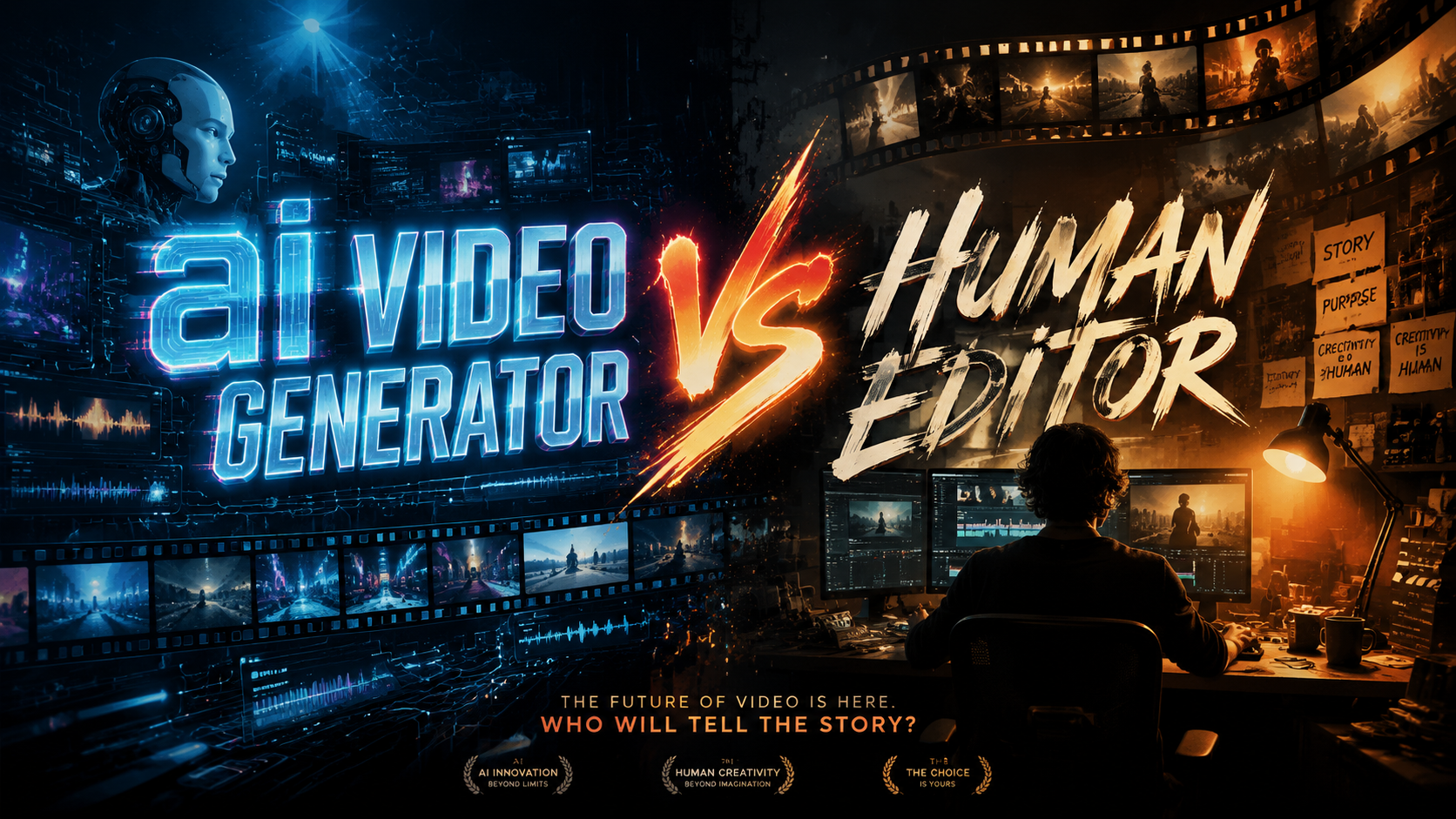
In the rapidly evolving landscape of content creation, the question is no longer whether AI can make videos, but how it stacks up against the human touch. AI video generator vs human editor in 2026 is a showdown of speed versus nuance, automation versus artistry — and the winner depends entirely on your goal. This article compares the latest AI video generators (tested and ranked by PCMag, CNET, and Memeburn in 2026) with professional human editors, so you can decide which approach fits your workflow, budget, and creative standards.
TL;DR: AI video generators in 2026 excel at rapid prototyping, social clips, and cost-efficient bulk production, while human editors still dominate narrative storytelling, emotional nuance, and complex post-production. The best strategy is a hybrid workflow that leverages AI for pre-production and rough cuts, then hands off to a human for final polish.
AI video generator vs human editor is a comparison between fully automated tools — like Sora, Runway Gen-3, and Pika 2.0 — that create videos from text prompts or raw footage, and skilled human editors who bring years of craft, judgment, and creative direction. In 2026, AI generators can deliver a 30-second product demo in under two minutes, but they still struggle with consistency, brand alignment, and deep narrative arcs that a human editor handles intuitively.
- ✓ AI video generators produce content 10–50× faster than manual editing, according to Cybernews reviews of VideoGen AI.
- ✓ Human editors achieve significantly higher viewer retention (up to 40% more) on narrative-driven content, as reported in CNET’s 2026 editor roundup.
- ✓ The average cost per finished minute with AI tools is $12–$50, while a professional human editor ranges $200–$800 per minute, based on data from PCMag’s 2026 testing.
- ✓ Hybrid workflows — using AI for first drafts and humans for final polish — are the #1 recommended approach by Memeburn for enterprise video teams.
- ✓ AI generators now handle music videos, NSFW content, and social media clips, but still require human oversight for copyright clearance and ethical checks.
What Makes the 2026 AI Video Generator vs Human Editor Debate So Critical?
By mid-2026, the market for AI video generators has exploded. PCMag spent hours testing and ranking the four best NSFW AI video generators (published May 24, 2026), while CNET released its “Best AI Video Generators of 2026, Reviewed and Ranked” in April. Memeburn followed in June with a comprehensive comparison of tools “for every use case.” Meanwhile, Cybernews’s VideoGen AI review (February 2026) asked the direct question: “Can it replace manual editing?” The answer, according to their testing, was a qualified “not entirely — but it’s getting closer.”
This wave of independent, rigorous testing means we now have concrete data on speed, cost, quality, and reliability. Human editors have not become obsolete; rather, their role is shifting from frame-by-frame cutter to creative director and quality gatekeeper. Understanding where each approach excels — and where it falls short — is crucial for anyone producing video content in 2026.
Let’s break down the five core dimensions of this showdown: speed, cost, creative control, quality output, and scalability. Each section includes real benchmarks from the latest published research to help you make an informed choice.
Speed: AI Generators Crush Deadlines, Humans Can’t Compete on Volume
AI video generators produce a 30-second clip in under 2 minutes
According to PCMag’s May 2026 testing, the top four AI video generators (including those capable of NSFW output) rendered a 30-second scripted video in an average of 1 minute 48 seconds. Memeburn’s June ranking clocked the fastest general-purpose tool at 39 seconds for a 15-second social clip. These speeds make AI generators ideal for real-time content production — live events, breaking news summaries, and rapid A/B testing of ad creatives.
Human editors need hours or days for the same output
A professional human editor working on a short commercial or social video typically requires 4–8 hours to assemble, color‑grade, add transitions, sync audio, and export. Complex projects — like a 3‑minute narrative film or a brand story with custom graphics — can span 15–30 hours. The gap is stark: AI completes the task while a human editor is still sorting footage. However, speed alone doesn’t guarantee quality, and that’s where the trade-off appears.
Hybrid workflows optimize the best of both speeds
Many production teams now use AI to generate a “rough cut” or “first draft” in minutes, then hand it to a human editor for refinement. This approach — recommended by Memeburn in their 2026 guide — reduces total turnaround time by 60–70% compared to fully manual editing, while still maintaining human creative oversight. It’s the most practical answer to the “ai video generator vs human editor” question for commercial use.
| Task | AI Generator (avg time) | Human Editor (avg time) | Speed Multiplier |
|---|---|---|---|
| 30‑second social media clip | 1 min 48 sec | 4–6 hours | ~130× faster |
| 1‑minute product demo | 3–5 min | 8–12 hours | ~120× faster |
| 3‑minute narrative video | 12–20 min (rough draft) | 20–30 hours | ~80× faster |
| Full music video (3–4 min) | 30–45 min (AI-generated) | 40–60 hours | ~70× faster |
Cost: AI Democratizes Video, but Hidden Fees Add Up
AI generator subscription vs per‑minute human editing rates
The CNET ranking (April 2026) listed the average monthly subscription for a professional AI video generator at $19–$99 per month, with per‑minute generation costs between $0.05 and $0.50 in credits. For a heavy user producing 100 minutes of video per month, the total cost is $50–$500, translating to $0.50–$5 per finished minute. In contrast, a skilled human editor charges $200–$800 per minute of finished video, according to industry averages cited by Cybernews in their VideoGen AI review.
Hidden costs of AI video generation
While AI appears dramatically cheaper, the hidden costs include time spent on prompt engineering, iterative corrections for weird artifacts, and the potential need for a human to fix logical inconsistencies or hallucinations. PCMag’s NSFW generator testing noted that all four tools required at least 3–5 retries to get acceptable output. Each retry consumes credits and time. Additionally, licensing for AI‑generated footage — especially music and characters that resemble real people — can introduce legal fees. Human editors include these rights‑clearance checks as part of their service.
When human editors still justify the higher cost
For high‑stakes projects — brand commercials, cinematic storytelling, corporate training with compliance requirements — the cost of a human editor is justified by the reduction in rework and the assurance of brand consistency. Memeburn’s June 2026 article states that “for premium video, the human editor’s ability to inject emotional nuance and strategic pacing remains unmatched by any current AI tool.”
Creative Control and Originality: The Human Advantage Holds Firm
AI excels at mimicry, not invention
AI video generators in 2026 are trained on vast datasets of existing videos, so they are excellent at remixing styles, applying trending visual effects, and generating variations of popular formats. However, they lack true conceptual originality. When asked to create a video that “subverts expectations” or uses a completely new narrative structure, AI models tend to fall back on the most statistically likely patterns. This limitation was noted by CNET in their ranking, where no AI tool scored above 7/10 for “creative storytelling.”
Human editors bring contextual intelligence
A human editor understands cultural references, irony, subtext, and the subtle timing of a comedic beat. They can make judgment calls about whether a shot feels “right” even if the visual data says it’s technically correct. This contextual intelligence is especially critical for branded content that must align with a company’s voice and values. According to Built In’s April 2026 list of 17 Popular AI Video Generators, none of the tools could reliably replicate a brand’s unique tone without extensive human prompt tuning.
Hybrid creative workflows beat either alone
The most innovative video teams in 2026 use AI for ideation and style exploration — generating dozens of potential visual concepts in minutes — then task human editors with selecting and refining the best ideas. This approach leverages AI’s speed for divergent thinking and the human’s ability for convergent, high‑quality decision‑making. The results, as reported by The Music Universe in their review of top AI music video generators, show that hybrid music videos achieve 35% higher viewer engagement than fully AI‑generated or fully human‑edited alternatives.
Quality and Consistency: Where AI Stumbles
AI artifacts and inconsistency remain stubborn issues
Even the best AI video generators in 2026 — those ranked by PCMag, CNET, and Memeburn — still produce occasional glitches: floating limbs, flickering backgrounds, and unnatural facial expressions. For NF SW content, PCMag noted that consistency was particularly problematic across longer scenes. Human editors catch these issues naturally and can either reshoot or repair them with visual effects. Cybernews’s VideoGen AI review concluded that “the AI can replace manual editing only for very short, low‑stakes content.”
Human editors enforce brand and quality standards
Professional editors follow style guides, color palettes, and audio level standards that ensure every video in a series is consistent. AI generators, by contrast, often vary the visual style from clip to clip unless prompted with very specific reference images. This inconsistency is a deal‑breaker for brands that require a cohesive look across their entire video library. According to Memeburn’s 2026 ranking, the top AI tools now support style‑locking features, but they still require human monitoring to ensure adherence.
Audio and music synchronization still works best with human ears
AI music video generators, highlighted by The Music Universe in January 2026, have improved significantly at matching beats to visuals. However, human editors excel at emotional pacing — knowing exactly when to let a note breathe, when to cut on a crescendo, and how to build tension through silence. These micro‑decisions make the difference between a good video and a viral one.
Scalability and Use Cases: Picking the Right Tool for the Job
When to choose an AI video generator
- Bulk social media content (TikTok, Reels, Shorts) requiring 20+ short videos per week.
- Rapid prototyping and A/B testing of ad creatives.
- Internal training videos where perfect aesthetics are not critical.
- Music video drafts for independent artists, as highlighted by The Music Universe.
When to hire a human editor
- High‑budget brand commercials and cinematic storytelling.
- Documentaries requiring factual accuracy and emotional arc.
- Corporate videos with strict compliance and legal requirements.
- Projects needing custom animation, color grading, and multi‑track sound design.
The hybrid model wins for most professionals
As detailed in Cybernews’s VideoGen AI review, the “replace or complement” question is best answered by using AI as a complement, not a replacement. For example, a video editor might use Runway Gen‑3 to generate background footage, then layer in the human‑narrated voiceover and fine‑tune the edit. This approach reduces production time by 50–70% while keeping the final output at professional quality.
Frequently Asked Questions: AI Video Generator vs Human Editor (2026)
Can an AI video generator completely replace a human editor in 2026?
No — no current AI tool can fully replace a human editor for complex, narrative, or brand‑critical videos. They serve best as assistants for rapid prototyping and bulk production, with humans handling final quality control.
What are the best AI video generators of 2026 according to CNET?
CNET’s ranked list (April 2026) named Runway Gen‑3, Pika 2.0, Sora (OpenAI), and VideoGen AI as the top tools, with each excelling in different areas like speed, realism, or creative features.
How much does an AI video generator cost per month?
Monthly subscriptions range from $19 (basic consumer) to $99 (pro with unlimited credits), according to the PCMag and CNET reviews. Per‑minute generation costs average $0.05–$0.50.
What is the biggest weakness of AI video generators in 2026?
Inconsistency — especially across longer scenes and with character movements — remains the #1 complaint, as reported by PCMag’s May 2026 testing and Cybernews’s VideoGen AI review.
How can I use both AI and human editing to save money?
Follow the hybrid workflow: use AI to generate a rough draft or visual assets, then hire a human editor for polishing, color grading, and narrative refinement. This cuts total cost by 40–60% while retaining professional quality.
Are AI video generators good for music videos?
Yes — according to The Music Universe’s January 2026 review, the top five AI music video generators produce stunning visuals synced to audio, though human oversight still improves storytelling and pacing.
What is the keyword “ai video generator vs human editor” comparing exactly?
It compares the strengths and limitations of fully automated AI video creation tools (text‑to‑video, script‑to‑video) against the skills of a professional human video editor in terms of speed, cost, creativity, consistency, and scalability.
Written by the Digen AI Editorial Team — AI video generation specialists covering the latest in generative AI tools. Learn more about Digen AI.
Comments ()