
Best Text to Video AI for Documentary Film in 2026
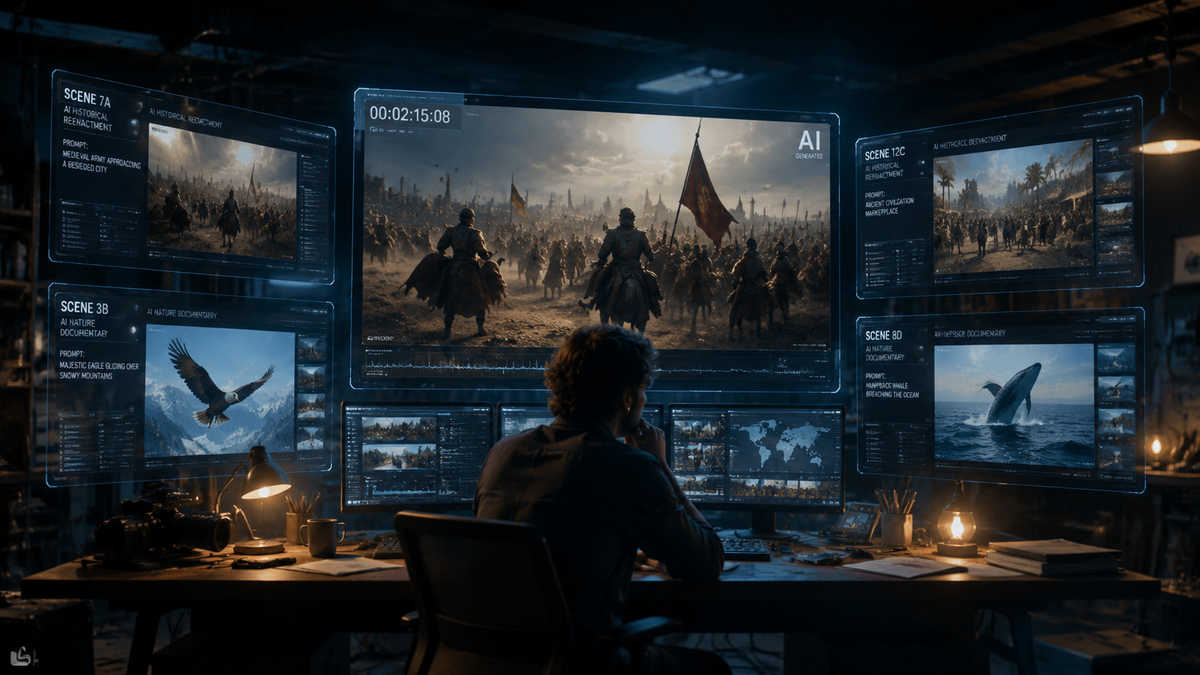
The best text to video AI for documentary film in 2026 is defined by its ability to maintain historical accuracy, visual consistency, and cinematic resolution. Leading platforms such as Runway Gen-4.5 and Meta’s integrated creative tools are currently the industry standards, offering documentarians the ability to reconstruct archival footage or visualize abstract concepts with unprecedented photorealism. As of May 2026, these tools are being utilized by Academy Award-winning directors to blend generative synthetic media with traditional investigative storytelling.
Text to video AI for documentary film is a generative technology that transforms written prompts into high-fidelity cinematic sequences, specifically optimized for factual storytelling. In 2026, this technology is primarily used for B-roll generation, historical recreations, and archival restoration, provided the output adheres to the strict ethical guidelines and "Human-in-the-Loop" requirements set by major film festivals and the Academy.
- ✓ Runway Gen-4.5 remains the top choice for professional documentarians due to its advanced temporal consistency and physics engine.
- ✓ Meta’s AI integration, as seen in Steven Soderbergh’s latest projects, allows for seamless blending of historical data and generative imagery.
- ✓ The Academy of Motion Picture Arts and Sciences (Oscars) has officially ruled that AI-generated actors and scripts are ineligible for awards, emphasizing AI's role as a tool rather than a creator.
- ✓ Luma’s new AI-powered production studio is revolutionizing faith-based and niche documentary filmmaking through specialized thematic models.
- ✓ Ethical transparency is now mandatory, with "Ghost in the Machine" serving as a cultural benchmark for the critique of AI’s role in modern media.
How to Use Text to Video AI for Documentary Film Production
Integrating generative AI into a documentary workflow requires a meticulous approach to ensure the final product maintains journalistic integrity. In 2026, the process has moved beyond simple "prompting" and into a sophisticated pipeline of "directing" the AI through multi-modal inputs, including sketches, reference photos, and historical descriptions. The goal is not to replace the camera, but to capture what the camera cannot—such as events from the distant past or internal psychological states.
For filmmakers looking to adopt these tools, the focus should be on "Generative B-Roll." This involves using AI to create atmospheric shots that bridge the gap between interviews. By using specific text-to-video parameters, directors can ensure that the lighting, grain, and color science of the AI footage match the physical footage shot on location. This creates a cohesive visual narrative that does not distract the viewer with "uncanny valley" artifacts.
- Script Segmentation: Break down your documentary script into visual beats that require archival or conceptual footage that is currently unavailable.
- Platform Selection: Choose a tool like Runway Gen-4.5 for high-action sequences or Meta’s creative tools for character-driven historical recreations.
- Prompt Engineering with Metadata: Input detailed prompts that include specific camera lenses (e.g., "35mm anamorphic"), lighting conditions, and historical period details to ensure accuracy.
- Consistency Tuning: Use "Seed" values and reference images to ensure that a person or location looks the same across multiple generated clips.
- Ethical Labeling: Following the 2025 guidelines highlighted by The New York Times, ensure all AI-generated sequences are watermarked or disclosed in the credits to maintain audience trust.
Top Platforms for Text to Video AI for Documentary Film in 2026
The landscape of 2026 is dominated by a few key players who have moved past the "experimental" phase into professional-grade production environments. Runway, having released Gen-4.5 in late 2025, continues to lead the pack with features specifically designed for the film industry. Their latest update focuses on "Director Mode," which allows for granular control over camera movement and object permanence, a critical requirement for documentary continuity.
Meta has also emerged as a powerhouse in the documentary space. According to NME, legendary director Steven Soderbergh has utilized Meta’s AI tools for an upcoming John Lennon documentary. This partnership signals a shift where AI is used to "resurrect" historical figures or moments with a level of detail that traditional CGI could not achieve within a documentary budget. Meta’s deep integration with historical archives makes it an invaluable asset for researchers and filmmakers alike.
Runway Gen-4.5: The Industry Standard
Runway Gen-4.5, introduced in December 2025, remains the most versatile text to video AI for documentary film. It features a "Historical Preset" library that automatically adjusts the frame rate, color grading, and film grain to match specific eras, such as the 1940s or the 1970s. This allows filmmakers to generate "lost" footage that feels authentic to the time period being documented.
Luma and The Wonder Project
Luma has carved out a unique niche by launching an AI-powered production studio in collaboration with The Wonder Project. As reported by TechCrunch in April 2026, this initiative focuses on faith-based and values-driven storytelling. For documentary filmmakers in these genres, Luma offers specialized models that are trained on vast libraries of theological and historical art, making it easier to visualize complex historical narratives with reverent accuracy.
| Feature | Runway Gen-4.5 | Meta AI (Creative Suite) | Luma Production Studio |
|---|---|---|---|
| Primary Use | Professional B-Roll & VFX | Historical Recreations | Thematic & Faith-Based Docs |
| Control Level | High (Multi-brush, Camera Control) | Moderate (Guided by Metadata) | High (Scene-based generation) |
| Output Quality | 8K Cinematic | 4K Photorealistic | 4K Stylized |
| Key Strength | Temporal Consistency | Archive Integration | Thematic Visual Cohesion |
Ethical Considerations and the "Believe Your Eyes" Crisis
As AI tools become more sophisticated, the documentary community faces a reckoning regarding truth and authenticity. A December 2025 report by The New York Times titled "Can You Believe the Documentary You’re Watching?" highlighted the growing concern over "synthetic truth." If a documentary uses text to video AI to recreate a scene without a disclaimer, does it cease to be a documentary? This question has led to new industry standards for transparency.
The 2026 documentary "Ghost in the Machine" serves as a searing critique of this technological shift. According to TheWrap, the film delivers a takedown of "techno-fascism" and the potential for AI to be used as a tool for misinformation. For filmmakers, this means that using text to video AI for documentary film is now a balancing act between visual innovation and ethical responsibility. Most major distributors now require a "Statement of AI Usage" as part of their delivery requirements.
The Academy’s Stance on AI in Documentary Filmmaking
The legal and prestigious landscape for AI-assisted films was solidified in May 2026. According to the BBC, the Academy of Motion Picture Arts and Sciences (Oscars) has officially stated that AI-generated actors and AI-written scripts cannot win awards. This ruling is particularly relevant for the "Best Documentary Feature" category, where the "human element" of the subjects and the perspective of the director are paramount.
However, the Academy does not prohibit the use of AI as a visual aid. Much like the transition from film to digital, or the introduction of CGI, text to video AI is viewed as a "technical achievement." This means a documentary can still win for its direction or cinematography even if it utilizes Runway Gen-4.5 for B-roll, provided the core narrative and "performances" (in the case of interviews) remain human-led. This distinction has encouraged directors like Steven Soderbergh to continue pushing the boundaries of the medium.
Navigating Award Eligibility
To remain eligible for major awards in 2026, documentary filmmakers must ensure that the "creative spark" remains human. This involves documenting the prompt-to-video process and demonstrating how the AI was used to enhance, rather than replace, the filmmaker's vision. The use of AI for upscaling old footage or cleaning up audio (as Meta is doing with the John Lennon doc) is widely accepted and even praised as a form of digital preservation.
Future Trends: The Evolution of Text to Video AI
Looking toward the latter half of 2026 and into 2027, we expect to see "Real-Time Documentary Synthesis." This technology will allow filmmakers to input live interview transcripts and have the AI generate corresponding visual metaphors in real-time. This will drastically reduce the time spent in the edit suite, allowing for more "rapid-response" documentaries that can react to world events as they happen.
Another emerging trend is the "Personalized Documentary." Using text to video AI, filmmakers can create multiple versions of a film that adapt their visual style based on the viewer's preferences or historical knowledge. While this remains experimental, the foundations laid by Runway and Luma in early 2026 suggest that the "static" documentary may soon be a thing of the past. The focus is shifting from "what happened" to "how can we best visualize what happened."
Is text to video AI allowed in Oscar-contending documentaries?
Yes, but with limitations. According to the BBC (May 2026), while AI-generated actors and writing cannot win awards, AI can be used as a tool for visual effects, B-roll, and archival restoration without disqualifying the film.
Which AI tool is best for historical documentary recreations?
Meta’s AI creative tools are currently the leader for historical recreations, as demonstrated by Steven Soderbergh's work. It excels at integrating with historical data to create photorealistic versions of past figures and events.
How does Runway Gen-4.5 improve documentary workflows?
Runway Gen-4.5 offers "Director Mode" and advanced temporal consistency, allowing filmmakers to create B-roll that maintains the same visual style and physics across multiple shots, ensuring the documentary looks professional and cohesive.
Do I need to disclose the use of AI in my documentary?
Yes. Following the 2025 "Believe Your Eyes" report by The New York Times, industry standards and most major festivals now require clear disclosure and watermarking for any synthetic or AI-generated sequences to maintain journalistic integrity.
Can AI be used to "resurrect" deceased people in documentaries?
Technically, yes, but it is ethically sensitive. While tools like Meta’s AI allow for this (as seen in the John Lennon project), filmmakers must navigate strict estate laws and ethical critiques, such as those presented in the 2026 film "Ghost in the Machine."



Comments ()