
Best AI Video Generator for Documentary Films in 2026
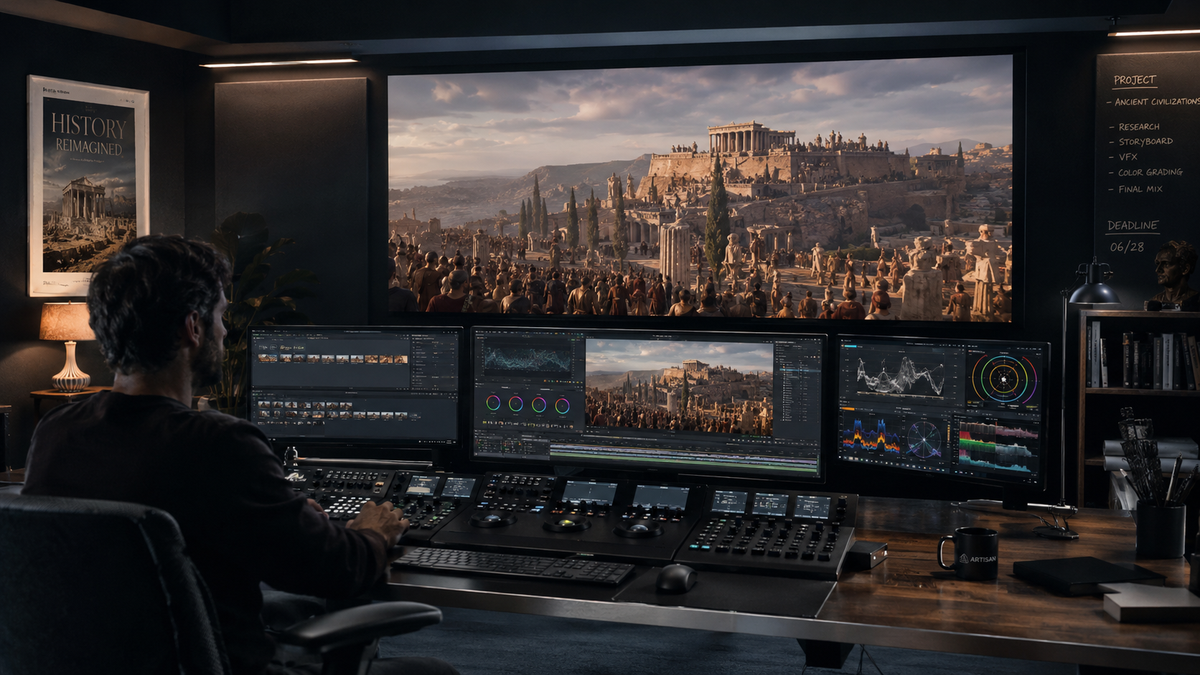
Choosing the best ai video generator for documentary films in 2026 requires a balance between cinematic visual fidelity and historical accuracy. As of early 2026, the industry standard for documentary filmmaking has shifted toward generative tools that can recreate lost historical footage or visualize abstract concepts with high temporal consistency. Filmmakers are increasingly utilizing these platforms to bridge gaps in archival records while maintaining the ethical standards required for non-fiction storytelling.
The best AI video generator for documentary films is a tool that prioritizes "factual grounding" and high-resolution temporal consistency, such as the latest models utilized in high-profile 2026 productions. These generators allow documentarians to synthesize photorealistic historical recreations from text or image prompts while integrating specific archival data to ensure visual authenticity in period-specific narratives.
- ✓ Prioritize generators with "Temporal Consistency" to avoid the common AI flickering artifacts noted by the BBC.
- ✓ Use AI video generators primarily for historical recreations where archival footage is non-existent.
- ✓ Ensure ethical transparency by disclosing AI-generated segments to maintain audience trust, as highlighted by recent New York Times reports.
- ✓ Look for tools that allow for specific "character seeding" to maintain likeness across multiple documentary scenes.
The Evolution of AI Video Generators for Documentary Films in 2026
The landscape of non-fiction media has been radically transformed in 2026. Documentary filmmakers no longer view AI as a mere novelty but as a critical component of the post-production and recreation pipeline. The primary challenge remains the "truth gap"—the tension between synthetic imagery and journalistic integrity. According to The New York Times in their December 2025 analysis "Can You Believe the Documentary You’re Watching?", the industry is currently grappling with how to label these visual assets so that audiences can distinguish between captured reality and generated reconstruction.
Despite these ethical hurdles, the technical capabilities of an ai video generator for documentary films have reached a point where they can mimic specific film stocks from the 1940s, 50s, or 60s with startling accuracy. This has led to a surge in "historical docudramas." For example, Ars Technica recently detailed why director Darren Aronofsky utilized an AI-generated historical docudrama approach in early 2026, citing the ability to visualize complex historical events that were never captured on camera. This shift allows for a more immersive educational experience, provided the data used to "seed" the AI is historically accurate.
Step-by-Step: Using an AI Video Generator for Documentary Recreations
- Source Authentic Reference Material: Gather historical photographs, sketches, or descriptions to use as "image prompts" to ensure the AI maintains period-accurate architecture and clothing.
- Select a High-Consistency Model: Choose an AI video generator that supports "motion brushes" or "camera control" to ensure the generated footage matches the cinematography of your live-action interviews.
- Generate and Refine: Use iterative prompting to remove "hallucinations." As noted by the BBC in late 2025, the number one sign of an AI video is often unnatural movement in the background; refine these until the motion is fluid.
- Apply Film Grain and Color Grading: To blend AI footage with real archival clips, apply a unified LUT (Look-Up Table) and grain structure in your editing suite.
- Ethical Labeling: Include a disclaimer in the credits or an on-screen watermark during the AI-generated segments to comply with 2026 transparency standards.
Top AI Video Generation Features for Filmmakers
When selecting an ai video generator for documentary films, the feature set must go beyond simple "text-to-video" capabilities. Documentarians require "Image-to-Video" (I2V) and "Video-to-Video" (V2V) workflows. These allow a filmmaker to take a single authentic 19th-century photograph and animate it into a 10-second b-roll clip. This technique was notably used in the "Original Psycho" documentary, where Deadline reported that AI was used to bring the historical figure Ed Gein to life, providing a hauntingly realistic look at a figure with limited surviving footage.
However, the rapid adoption of these tools has not been without controversy. The Hollywood Reporter noted in February 2026 that a new AI video generator sparked major Hollywood backlash due to concerns over the unauthorized use of actor likenesses and the displacement of traditional VFX artists. For documentary filmmakers, this means the "best" tool is often the one that offers the most robust copyright protections and ethical "opt-in" datasets for its training models.
| Feature | Standard AI Generator | Documentary-Grade AI (2026) |
|---|---|---|
| Resolution | 1080p Upscaled | Native 4K / 8K Output |
| Temporal Consistency | Low (Flickering) | High (Fluid Motion) |
| Historical Accuracy | Randomized Details | Reference-Image Guided |
| Length of Clips | 3-5 Seconds | 60+ Seconds Continuous |
| Ethical Compliance | Minimal | C2PA Metadata Integration |
The Role of Generative AI in Historical Docudramas
The rise of the "AI-generated historical docudrama" represents a new sub-genre in 2026. Directors are finding that they can tell stories that were previously "unfilmable" due to budget or lack of visual evidence. By using a specialized ai video generator for documentary films, creators can reconstruct ancient civilizations or specific historical moments like the signing of a treaty with photorealistic detail. This isn't just about aesthetics; it's about accessibility. According to Ars Technica, Darren Aronofsky’s move into AI docudrama was driven by the desire to create high-impact visuals that educate the public on complex histories without the massive overhead of traditional period-piece production.
However, the industry is seeing a pushback against "lazy" AI use. Futurism reported in January 2026 that the Duffer Brothers were accused of using ChatGPT and similar generative tools for the final season of "Stranger Things," leading to a debate about the "soul" of the writing and visual effects. In the documentary world, this translates to a need for "Human-in-the-loop" workflows. The AI should be a brush, not the painter. The most successful documentary films of 2026 are those where the director uses AI to enhance a vision grounded in deep research, rather than letting the AI dictate the narrative flow.
Maintaining Journalistic Integrity with Synthetic Media
The primary concern for any documentarian using an ai video generator for documentary films is the potential for misinformation. If a viewer cannot tell the difference between a real clip from 1968 and a generated one, the documentary risks losing its status as a "record of truth." The BBC has highlighted that the "number one sign" of an AI video—often unnatural eye movement or gravity-defying hair—is becoming harder to spot as models improve. This makes the filmmaker's responsibility even greater.
To combat this, many 2026 documentary festivals have introduced "Synthetic Media Disclosures." These require filmmakers to provide a "manifest" of all AI-generated shots. This transparency actually builds trust with the audience, as it shows the filmmaker is using the ai video generator for documentary films as a tool for visualization rather than deception. Leading platforms now automatically embed C2PA metadata into every frame, proving the origin of the video and whether it was modified by AI.
Technical Requirements for 2026 AI Cinematography
What makes a specific platform the "best" for documentary work? In 2026, it comes down to three technical pillars: character consistency, lighting control, and metadata tagging. For a documentary like the Ed Gein project mentioned by Deadline, the AI must be able to keep the subject's face identical across different lighting conditions and camera angles. Early AI tools struggled with this, but the 2026 generation of tools uses "LoRA" (Low-Rank Adaptation) weights that allow filmmakers to train the AI on a specific person's likeness using just a few archival photos.
Character Consistency and Deepfake Ethics
The use of AI to bring deceased individuals back to life is a sensitive subject. While Global Breakouts on Deadline highlighted the success of the Ed Gein documentary, other projects have faced "Major Hollywood Backlash," as reported by The Hollywood Reporter in February 2026. The best AI video generators for documentary films now include "Ethical Guardrails" that prevent the generation of content involving living public figures without consent, while providing frameworks for the legal recreation of historical figures with estate approval.
Lighting and Environmental Control
Documentaries often require a "gritty" or "naturalistic" look. Standard AI generators often produce images that are "too perfect" or "too plastic." The top-tier ai video generator for documentary films in 2026 allows for manual control over virtual lighting rigs. Filmmakers can specify "Golden Hour" lighting or "Kodak Tri-X 400" film stock characteristics to ensure the generated footage matches the aesthetic of the era being depicted. This level of granular control is what separates professional tools from consumer-grade apps.
Future Outlook: AI and the Documentary Genre
Looking ahead into the remainder of 2026 and into 2027, we expect to see even deeper integration of AI in the documentary space. The backlash reported by The Hollywood Reporter is likely to lead to better union agreements and clearer industry standards regarding the use of AI. For the independent documentarian, these tools are an equalizer, allowing a small team to produce visuals that would have previously required a multi-million dollar budget for location shoots and period-accurate costuming.
Ultimately, the "best" ai video generator for documentary films is the one that serves the story without overshadowing the truth. As the New York Times suggested, the question of "Can you believe what you're watching?" will become the defining question of the decade. Filmmakers who use AI responsibly—to illuminate history, visualize the invisible, and enhance the narrative—will be the ones who define the future of the medium.
Is it ethical to use AI video generators in documentaries?
Yes, provided there is full transparency. Most industry experts and organizations like the BBC suggest that as long as AI-generated recreations are clearly labeled, they serve as a valuable tool for visualizing historical events where no footage exists.
What is the most common sign of an AI-generated video in 2026?
According to the BBC, the most common signs are subtle "temporal artifacts," such as unnatural movements in background textures, flickering in complex patterns like water or hair, and inconsistent physics during rapid motion.
Can AI recreate specific historical figures for documentaries?
Yes, technologies like those used in the Ed Gein documentary allow filmmakers to use archival photos to "seed" an AI model, creating a consistent and photorealistic likeness for use in historical recreations.
Are there legal risks to using AI video generators in film?
As of February 2026, there is significant legal and union backlash regarding the training data used by AI companies. Filmmakers should use platforms that guarantee their models are trained on licensed or public-domain datasets to avoid copyright infringement.
How do I make AI video look like real film?
The best results come from using an AI video generator that supports specific film stock prompts, followed by professional color grading and the addition of authentic film grain in post-production to match the AI footage with real archival clips.



Comments ()