
Text to Video AI Educational: 2026 Guide & Tools
Text to video AI educational technology transforms written educational content into engaging video lessons using artificial intelligence. By converting text prompts, lecture notes, or textbooks into polished videos with visuals, narration, and animations, this innovation allows educators to produce high-quality learning materials without traditional video production skills or expensive equipment.
Text to video AI educational is a generative AI technology that converts written educational content — such as lesson plans, articles, or textbooks — into professional video format with synchronized visuals, narration, and animations. It enables teachers, trainers, and content creators to produce engaging learning videos from text alone, leveraging multimodal models trained on text, image, video, and audio data.
- ✓ Text-to-video AI educational tools allow educators to create video content from text inputs without requiring video production expertise or expensive software
- ✓ In 2026, advanced systems like AWS V-RAG and multimodal knowledge graphs such as SciMKG are setting new standards for accuracy and contextual relevance in educational videos
- ✓ Research from Nature and the World Bank confirms that AI-generated educational content is being validated for quality across fields from ophthalmology to general science instruction
- ✓ The technology supports multiple modalities — text, image, video, and audio — enabling richer, more inclusive learning experiences for diverse student populations
- ✓ Educational video platforms are rapidly integrating text-to-video AI capabilities, making it easier than ever for institutions to scale video content creation
What Is Text to Video AI Educational?
Text to video AI educational refers to the application of generative artificial intelligence that converts written educational material into video format. Instead of manually scripting, recording, and editing a lesson, an educator can input a text description — such as a science explanation, a historical summary, or a set of mathematical instructions — and the AI generates a complete video with appropriate visuals, voiceover, transitions, and even background music. According to the World Bank Group in its August 2025 report on the artificial intelligence revolution in education, these tools are part of a broader shift toward personalized, scalable, and accessible learning resources that can be deployed across diverse educational settings worldwide.
The core technology relies on large language models combined with multimodal generation capabilities. These models are trained on vast datasets containing text, images, video clips, and audio, allowing them to understand not just the words in a prompt but also the visual and auditory context needed to produce coherent educational content. The result is a tool that can take a teacher's lesson plan and turn it into a complete video lecture in minutes, with accurate visuals that match the topic — whether that's a diagram of the water cycle, a historical reenactment, or a step-by-step lab procedure.
What makes text to video AI educational particularly powerful is its ability to maintain pedagogical quality. Rather than simply generating generic videos, these systems are increasingly designed with educational principles in mind, ensuring that the pacing, visual cues, and narration style support learning objectives. As noted in Trend Hunter's February 2026 report on educational video platforms, the market is seeing a surge in platforms that combine AI generation with curriculum alignment features, making it easier for schools and universities to adopt the technology at scale.
How It Works in Practice
When an educator uses a text to video AI educational tool, the process typically begins with a text input — a script, bullet points, or even a full textbook chapter. The AI analyzes the content and selects relevant visuals from its training data or generates new images and animations. It then creates a voiceover using text-to-speech technology, synchronizes the narration with the visuals, and adds transitions and effects. The entire pipeline from text to finished video can take anywhere from a few seconds to several minutes, depending on video length and complexity.
Advanced systems in 2026, such as those highlighted by Amazon Web Services in its March 2026 introduction of V-RAG, now incorporate Retrieval Augmented Generation to improve accuracy. Instead of relying solely on the model's internal knowledge, V-RAG retrieves relevant information from external knowledge bases — such as textbooks, academic papers, or institutional repositories — and uses that to inform the video generation process. This reduces hallucinations and ensures that the educational content is factually correct and contextually appropriate.
The 2026 Landscape of Educational AI Video Tools
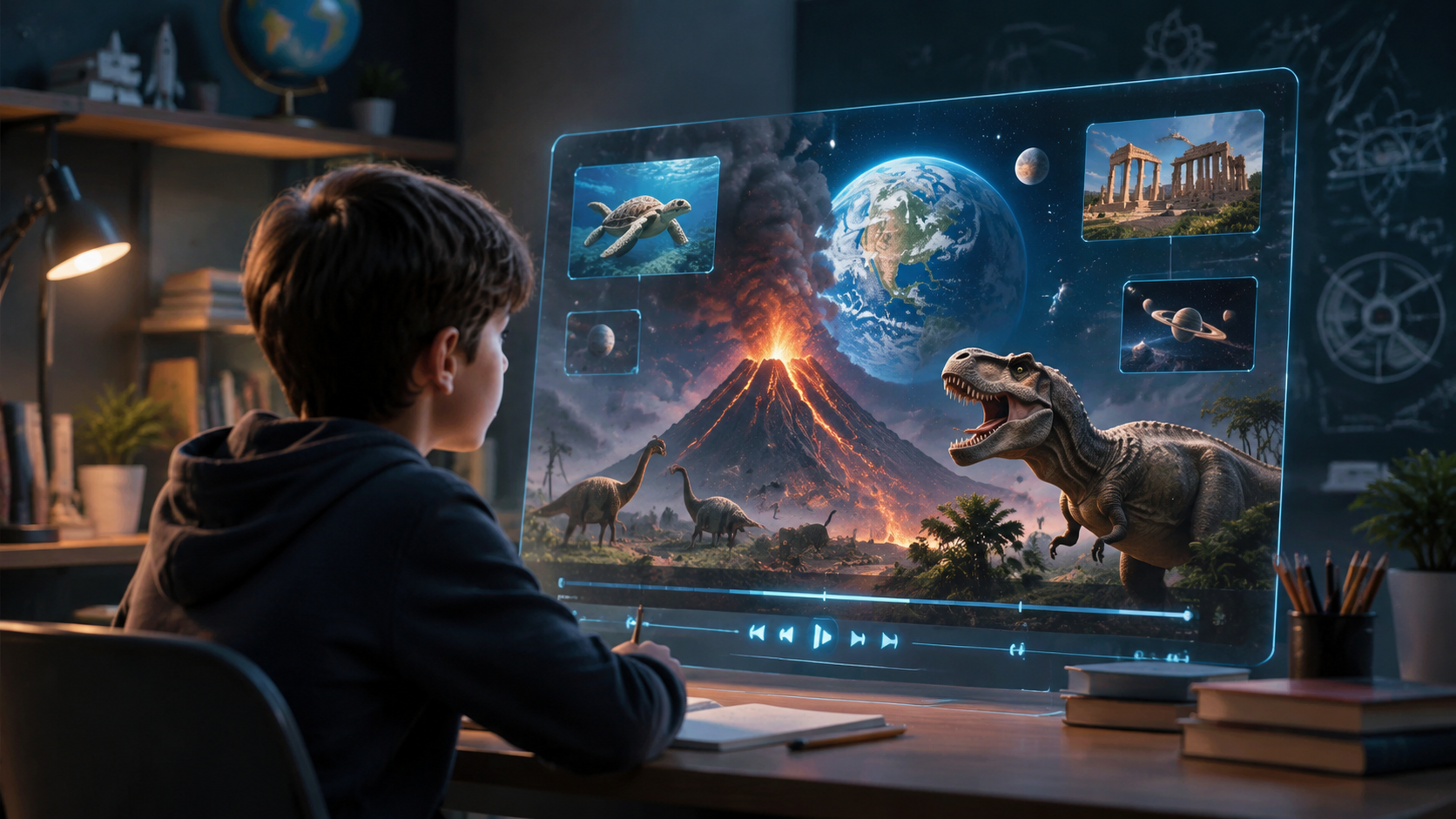
The year 2026 marks a significant maturation point for text to video AI educational technology. According to Cybernews in its June 2026 feature on the rise of AI video generators, the tools available today are dramatically more sophisticated than those of even a year ago. Video quality has improved from rough, artifact-laden clips to smooth, high-resolution productions that can rival professionally edited content. Audio synchronization has become nearly seamless, and the variety of visual styles — from realistic footage to animated explainers — has expanded to suit different educational contexts.
Several key developments are shaping this landscape. First, the integration of multimodal knowledge graphs, such as the SciMKG system presented by the Association for the Advancement of Artificial Intelligence in March 2026, allows AI models to access structured relationships between concepts across text, images, videos, and audio. This means that when a biology teacher inputs a prompt about cellular respiration, the system doesn't just generate a generic video — it pulls from a knowledge graph that connects diagrams, animations, audio explanations, and text definitions, creating a cohesive and educationally sound presentation.
Second, the trend toward specialized educational video platforms, as identified by Trend Hunter in February 2026, means that tools are being purpose-built for academic settings. These platforms often include features like curriculum mapping, assessment integration, multilingual support, and accessibility options such as closed captions and sign language avatars. They are designed to meet the needs of K-12 schools, universities, corporate training departments, and online course creators alike.
Validation Through Research
A notable example of the push toward quality assurance comes from the field of medical education. A study published in Nature in November 2025 assessed the quality and educational applicability of AI-generated anterior segment images in ophthalmology. The researchers found that AI-generated images could effectively supplement traditional educational materials, provided that human experts reviewed the output for accuracy. This research underscores an important principle for all text to video AI educational applications: the technology is a powerful assistant, but human oversight remains essential, especially in specialized or high-stakes fields.
The World Bank Group's August 2025 expert answers on the AI revolution in education further reinforce this perspective, noting that successful implementation requires a balanced approach. Institutions must invest in teacher training, infrastructure, and quality assurance processes to maximize the benefits of AI-generated content while mitigating risks such as misinformation, bias, and over-reliance on automated systems.
Top Text to Video AI Educational Tools Compared
While the market for text to video AI educational tools is expanding rapidly, a handful of platforms stand out in 2026 for their features, reliability, and educational focus. The following table compares several leading solutions based on key criteria relevant to educators and institutions.
| Tool / Platform | Core Technology | Educational Features | Output Quality | Pricing Model | Best For |
|---|---|---|---|---|---|
| V-RAG (AWS) | Retrieval Augmented Generation + multimodal LLM | External knowledge base integration, citation support, customizable avatars | High-resolution, smooth transitions, accurate visuals | Pay-per-video usage with volume discounts for institutions | Universities and large training programs requiring factual accuracy |
| SciMKG-powered platforms | Multimodal knowledge graph with text, image, video, and audio nodes | Cross-modal concept linking, curriculum alignment, interactive elements | Very high for science and technical subjects; animated and real styles | Subscription-based with tiered plans for schools and districts | STEM education and multidisciplinary courses |
| General-purpose AI video generators (2026 edition) | Standard text-to-video diffusion models with narration | Basic text input, style presets, template library | Good for general topics; may need human review for specialized content | Free tier with watermarks; premium plans from $15/month | Individual teachers and small content creators |
| Enterprise e-learning platforms with AI integration | Custom LLMs trained on institutional content + video generation | LMS integration, assessment hooks, analytics dashboard, multilingual support | High, with institutional branding and consistent quality | Annual enterprise licensing, typically $10,000+ per institution | Corporate training, large school districts, online universities |
Each tool category serves a different segment of the educational market. V-RAG from AWS is particularly notable for its ability to pull in real-time data from trusted sources, making it ideal for subjects that require up-to-date information, such as current events, science, and technology. SciMKG-based platforms excel in science education because their knowledge graph structure inherently respects the relationships between concepts, reducing the likelihood of generating misleading visuals or incorrect sequences.
General-purpose tools are attractive for individual educators who need quick, low-cost solutions — though they may require editing for specialized topics. Enterprise platforms, while expensive, offer the deepest integration with existing learning management systems and analytics, making them suitable for institutions that need to track student engagement and learning outcomes at scale.
How V-RAG and Multimodal Knowledge Graphs Are Shaping Education
The introduction of V-RAG by Amazon Web Services in March 2026 represents a significant milestone for text to video AI educational technology. V-RAG, or Video Retrieval Augmented Generation, combines the generative power of large language models with the accuracy of retrieval-based systems. Instead of generating a video solely from the model's internal parameters, V-RAG first retrieves relevant text, images, and video clips from a curated knowledge base — such as a textbook library, academic database, or institutional repository — and then uses those retrieved assets to construct the final video. This approach dramatically reduces factual errors and ensures that the content is grounded in authoritative sources.
For educators, this means that a video generated about photosynthesis, for example, will reference the correct chemical equations, appropriate diagrams, and accurate descriptions — because the system pulls that information from verified educational materials rather than generating it from scratch. The result is a video that is not only visually engaging but also pedagogically sound and academically reliable. As the Cybernews feature from June 2026 notes, this retrieval-based approach is quickly becoming the gold standard for educational AI video production, especially in contexts where accuracy is non-negotiable.
Simultaneously, the development of multimodal knowledge graphs like SciMKG — presented at AAAI in March 2026 — is transforming how AI understands and represents educational content. SciMKG structures knowledge across four modalities: text, image, video, and audio. This means that when an educator creates a video prompt, the AI can navigate a rich web of interconnected resources: a text definition of a concept, an image or diagram illustrating it, a video clip showing it in action, and an audio narration explaining it in context. The knowledge graph ensures that all these elements are semantically aligned and pedagogically coherent.
According to the AAAI presentation, SciMKG has shown particular promise in science education, where complex concepts often require multiple representations to be fully understood. A student studying the human circulatory system, for instance, might benefit from a text explanation of blood flow, a diagram of the heart chambers, a video animation of circulation, and an audio description of the pathway — all presented in a unified, synchronized format. The knowledge graph makes this kind of rich, multimodal learning experience feasible at scale.
Practical Applications in Classrooms and E-Learning
Text to video AI educational tools are finding applications across a wide range of educational settings in 2026. In K-12 classrooms, teachers use the technology to create quick video explanations for topics that students find challenging — turning a text description of a math formula or a historical event into a visual narrative that captures attention and aids comprehension. Special education teachers appreciate the ability to generate videos with multiple accessibility features, such as adjustable narration speed, closed captions in multiple languages, and visual supports for students with learning disabilities.
In higher education, professors are using text to video AI to create lecture previews, review materials, and supplementary content for flipped classroom models. Instead of spending hours recording and editing lecture videos, faculty can input their lecture notes and receive a polished video in minutes. This frees up time for more interactive, discussion-based class sessions. The Trend Hunter report from February 2026 highlights that universities are also using these tools to create orientation videos, lab safety demonstrations, and research explainers for public audiences.
Corporate training departments are another major adopter. According to Cybernews, companies use text to video AI educational tools to produce consistent, on-brand training content for employees across multiple locations. A single training module can be generated from a text script and then localized into different languages with appropriate cultural adaptations — all without re-recording video or hiring voice actors. This scalability is driving adoption in industries such as healthcare, finance, and manufacturing, where training compliance and consistency are critical.
Online course creators and edtech startups are also leveraging the technology to rapidly produce course content. A single creator can now develop an entire video-based curriculum in days rather than months, dramatically reducing the time and cost of course production. The World Bank's August 2025 analysis notes that this democratization of content creation is especially important in developing regions, where access to video production resources is limited but the demand for quality educational content is high.
How to Start Using Text to Video AI Educational in Your Teaching
Getting started with text to video AI educational tools is straightforward, but following a structured approach ensures the best results. The steps below outline a practical workflow for educators who want to begin creating AI-generated videos for their students.
- Identify your learning objective. Start with a clear goal: what should students understand or be able to do after watching the video? This guides the content and structure of your text input.
- Write a focused text script. Keep it concise — 200 to 500 words for a short explainer video. Use clear language, break complex ideas into steps, and include specific terms or concepts you want the AI to highlight visually.
- Choose the right tool for your context. Select from the options in the comparison table above based on your subject matter, audience, and budget. For science topics, consider a SciMKG-powered platform; for general subjects, a general-purpose tool may suffice.
- Review and refine the generated video. Watch the output carefully. Check for factual accuracy, visual appropriateness, and narrative flow. Make adjustments to your text input and regenerate if needed.
- Add supplementary materials. Pair the video with discussion questions, quizzes, or hands-on activities to deepen student engagement. Most platforms allow you to export the video for upload into your LMS.
- Gather student feedback and iterate. Ask students what worked and what didn't. Use their input to refine your prompts and improve future videos. This iterative process helps you get the most value from the technology over time.
For educators who are new to AI video generation, it is wise to begin with a pilot project — create a single video for a topic you already teach well and compare student outcomes with your existing materials. This allows you to assess the technology's impact before scaling up. The World Bank's guidance emphasizes that teacher training and support are critical: institutions should provide professional development opportunities so that educators feel confident using these tools effectively.
Quality Assurance Tips
Even with advanced tools like V-RAG and SciMKG, human oversight remains essential. Always verify that the visuals match the educational content — a video about the American Revolution should not show images from a different century or country. Check that the narration is clear and at an appropriate pace for your students. If the AI generates any factual errors, note them and refine your prompt or the output manually. According to the Nature study from November 2025, the best results come from a collaborative process where AI handles production and humans ensure pedagogical quality.
Additionally, consider accessibility from the start. Most text to video AI educational tools in 2026 include options for closed captions, adjustable speed, and screen-reader-friendly metadata. Enable these features to ensure that your content serves all learners, including those with disabilities. The multimodal nature of platforms like SciMKG — which integrates text, image, video, and audio — inherently supports multiple learning modalities, but you should still verify that each mode is fully functional and accessible.
Challenges and Considerations for Educational Use
While text to video AI educational technology offers enormous potential, it is not without challenges. One significant concern is the risk of generating misleading or inaccurate content, particularly in specialized fields where the AI's training data may be incomplete or outdated. The Nature study on ophthalmology images found that while AI-generated visuals were generally acceptable for educational purposes, they occasionally contained subtle inaccuracies that could mislead novice learners. This underscores the need for expert review, especially in medical, legal, or technical education.
Another challenge is bias. AI models are trained on data from the internet, which may contain cultural, gender, or racial biases. When generating educational videos, these biases can manifest in the choice of visuals, the tone of narration, or the examples used. The World Bank's August 2025 analysis emphasizes that institutions must proactively audit AI-generated content for bias and ensure that diverse perspectives are represented. Some platforms now include bias detection tools, but human judgment remains the best safeguard.
Privacy and data security are also important considerations. When educators input text into cloud-based AI systems, that text — which may include student data, proprietary curriculum materials, or institutional knowledge — is processed on external servers. Schools and universities should review the data handling policies of any tool they adopt and ensure compliance with regulations such as FERPA, GDPR, and local privacy laws. Enterprise platforms like those integrated with AWS often provide stronger data protection guarantees than free consumer tools.
Finally, there is the question of over-reliance. If educators and students come to depend too heavily on AI-generated video content, there is a risk that critical thinking, creativity, and deep engagement with source materials may decline. The most effective use of text to video AI educational tools is as a supplement to, rather than a replacement for, active learning methods. The Cybernews article from June 2026 advises that the best educational outcomes occur when AI-generated videos are embedded within a broader pedagogical framework that includes discussion, inquiry, and hands-on activities.
Frequently Asked Questions
What is text to video AI educational technology?
Text to video AI educational technology is a generative AI system that converts written educational content — such as lesson plans, textbooks, or lecture notes — into video format with visuals, narration, and animations. It allows educators to create professional-quality learning videos without requiring video production skills.
How accurate are AI-generated educational videos in 2026?
Accuracy has improved significantly with tools like V-RAG from AWS, which retrieves information from external knowledge bases to reduce errors. However, studies such as the November 2025 Nature research on ophthalmology images confirm that human expert review is still necessary, especially for specialized or high-stakes subjects.
Can text to video AI replace teachers?
No. Text to video AI educational tools are designed to assist teachers by automating video production, not to replace human instruction. The World Bank's August 2025 report emphasizes that successful implementation requires teacher training and oversight, and that AI works best as a supplement to active, discussion-based learning.
What subjects benefit most from text to video AI?
STEM subjects benefit particularly well, thanks to multimodal knowledge graphs like SciMKG that connect text, images, videos, and audio. However, any subject that benefits from visual explanation — history, language arts, geography, and vocational training — can be enhanced with AI-generated videos.
How do I choose the right text to video AI tool for my classroom?
Consider your subject matter, budget, and institutional requirements. For science and technical subjects, SciMKG-powered platforms offer strong accuracy. For general use, a general-purpose tool with a free tier works well. For large institutions, enterprise platforms with LMS integration and analytics provide the best value. Refer to the comparison table above for detailed guidance.
Is text to video AI affordable for individual teachers?
Yes. Many general-purpose AI video generators offer free tiers with watermarks, and premium plans start around $15 per month. Enterprise solutions are more expensive but often provide institutional licenses. The cost per video is typically very low compared to traditional video production, making it accessible for most educators.
How do I ensure my AI-generated videos are accessible to all students?
Most 2026 text to video AI educational tools include accessibility features such as closed captions, adjustable narration speed, and screen-reader metadata. Enable these features by default and test the output with assistive technology to ensure compatibility. Multimodal tools like SciMKG also support multiple learning styles by design.
What is V-RAG and why is it important for education?
V-RAG (Video Retrieval Augmented Generation) is an AWS technology introduced in March 2026 that combines AI video generation with retrieval from external knowledge bases. It improves factual accuracy by grounding the video content in trusted sources such as textbooks and academic papers, making it particularly valuable for educational applications where accuracy is critical.



Comments ()