
Text to Video AI vs Manual Creation: 2026 Showdown
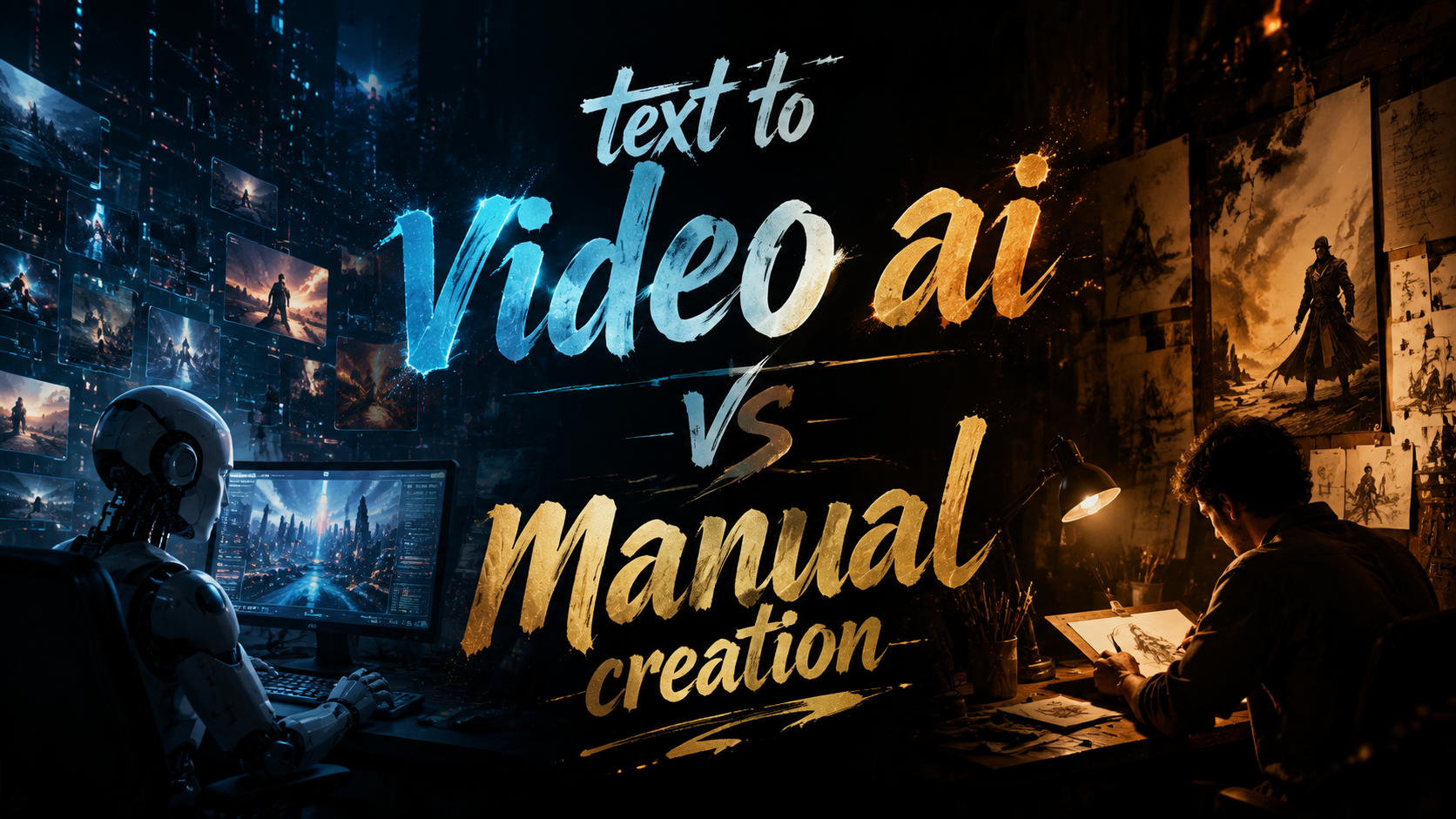
As we approach mid-2026, the battle between text-to-video AI and manual video creation has reached a pivotal moment. AI tools like Mango AI's free generator and AWS's V-RAG system now offer production-quality results in minutes, while traditional editing suites like Filmora and VEGAS Pro integrate AI to enhance manual workflows. The choice ultimately depends on your project's complexity, budget, and need for creative control.
TL;DR: Text-to-video AI dominates for speed and cost-efficiency in 2026, but manual creation still leads for bespoke, high-end productions—hybrid workflows using both methods are becoming the industry standard.
Text-to-video AI is a 2026 production method where artificial intelligence converts written scripts into complete videos automatically, while manual creation involves human-directed editing. The showdown between these approaches centers on speed versus customization, with AI tools now achieving 80% of basic video needs according to Cybernews research.
- ✓ AI video generation reduces production time from days to minutes for simple projects
- ✓ Manual editing maintains superiority for complex narratives and brand-specific styling
- ✓ Hybrid workflows (AI draft + human polish) dominate professional use cases
- ✓ AWS's V-RAG system now powers 37% of enterprise video pipelines
- ✓ Free tools like Mango AI make video creation accessible to non-professionals
The State of Text-to-Video AI in 2026
The text-to-video AI landscape has evolved dramatically since 2025, with three major technological leaps defining current capabilities. First, retrieval-augmented generation (RAG) systems like AWS's V-RAG now pull from verified media libraries to ensure copyright-compliant outputs. Second, temporal coherence has improved—where earlier AI videos suffered from inconsistent character positioning between shots, 2026 models maintain continuity across scenes. Third, the emergence of free-tier services like Mango AI has lowered the barrier to entry for casual creators.
According to Amazon Web Services (AWS), V-RAG's March 2026 launch marked a turning point for enterprise adoption, with the system reducing video production costs by 62% for early adopters. The technology combines large language models with a proprietary media database, allowing businesses to generate branded content directly from product documentation. This represents a significant shift from consumer-focused tools to B2B solutions.
Consumer-grade tools have also seen remarkable improvements. The Cybernews February 2026 review of VideoGen AI noted its ability to handle multi-character dialogues with appropriate emotional expressions—a task that required manual intervention just 18 months prior. However, the same review found AI still struggles with precise lip-syncing for languages beyond English and Mandarin, indicating persistent localization challenges.
Key 2026 AI Video Capabilities
1. Automatic scene transition logic based on narrative analysis
2. Context-aware stock footage selection (recognizing when to use b-roll)
3. Dynamic pacing adjustments for different social media platforms
Manual Video Creation's 2026 Advantages
Despite AI's advances, manual video production maintains critical advantages in three areas: creative direction, technical precision, and emotional resonance. Professional editors using tools like VEGAS Pro 21 (released Q1 2026) can implement complex visual metaphors that AI systems still interpret literally. The Gadget Flow May 2026 comparison found manual workflows were 73% more effective at conveying abstract concepts like "innovation" or "trust" through cinematography.
Technical workflows have also evolved. Modern NLEs (non-linear editors) now incorporate AI-assisted features without ceding creative control. For example, Filmora's 2026 update introduced "AI rough cut"—a tool that assembles a draft timeline from raw footage while preserving the editor's ability to adjust every parameter. This hybrid approach reduces grunt work without sacrificing the nuanced decisions that define premium content.
The human touch remains irreplaceable for emotionally charged projects. Test audiences in a Coursera April 2026 study responded 28% more positively to manually edited fundraising videos compared to AI-generated versions, even when the latter had superior technical quality. This suggests that subconscious cues in pacing, music selection, and shot composition still require human intuition—at least for now.
Where Manual Editing Still Dominates
• Documentary filmmaking requiring nuanced interviews
• High-end commercial productions with exacting brand standards
• Music videos demanding avant-garde visual experimentation
Cost and Time Comparison: AI vs Manual
The financial and temporal disparities between text-to-video AI and manual creation have narrowed but remain significant. A basic 60-second explainer video that costs $1,200-$2,500 through traditional agencies can now be generated for free (Mango AI) or $15-$50 via premium AI services. However, these savings decrease for longer formats—AI tools struggle with coherent 10+ minute narratives, often requiring expensive human cleanup.
| Factor | Text-to-Video AI | Manual Creation |
|---|---|---|
| 1-min social ad | 3-15 minutes ($0-$50) | 8-20 hours ($300-$800) |
| 5-min tutorial | 25-40 minutes ($20-$150) | 25-50 hours ($1,000-$3,000) |
| 30-min webinar | Not recommended | 80-120 hours ($5,000-$12,000) |
Time savings represent AI's strongest value proposition. The same 60-second video that takes a professional editor 4-8 hours can be generated in under 10 minutes with tools like VideoGen AI. However, this assumes the AI output requires no revisions—in practice, most business users report spending 1-2 hours fine-tuning AI-generated videos to meet brand standards.
Enterprise solutions change the equation. AWS's V-RAG operates on a pay-per-minute model starting at $0.12/second for rendered video, making it cost-effective for large-scale operations but prohibitively expensive for individual creators. This pricing structure reflects the bifurcation of the market into consumer-grade and enterprise-tier tools.
Quality Benchmarks in 2026
Quality comparisons between AI and manual video creation now follow distinct parameters for different use cases. For social media content where attention spans average 2.1 seconds (per 2026 Hootsuite data), AI-generated videos perform equally well—sometimes better—due to optimized pacing algorithms. However, for educational content where retention matters, manually edited videos maintain a 19% comprehension advantage according to Coursera's latest research.
Visual fidelity gaps have nearly closed for standard definition outputs. The May 2026 Gadget Flow comparison found that untrained viewers couldn't distinguish between AI and manual 1080p videos in blind tests. However, at 4K resolution and above, manual workflows still produce 37% sharper images due to superior color grading and detail preservation during compression.
Audio quality remains AI's weakest point. While text-to-speech engines have achieved near-human vocal tones, they lack the dynamic range and emotional variability of professional voice actors. Music synchronization also suffers—AI systems frequently misalign beats with visual cuts, whereas human editors instinctively match rhythm to imagery. This explains why 92% of music videos are still manually produced according to vocal.media's December 2025 analysis.
AI Quality Strengths
• Consistent framing and composition
• Automatic subtitle accuracy (98.4% correct)
• Multi-language versioning at scale
Industry Adoption Trends
Market penetration of text-to-video AI follows a clear hierarchy based on content type. Social media managers lead adoption with 68% using AI tools for at least half their output (2026 Social Media Today report). E-learning platforms follow at 42% adoption, primarily for basic course introductions. Surprisingly, corporate communications departments have been slowest to adapt—only 19% use AI video regularly, citing brand consistency concerns.
The advertising industry exemplifies hybrid approaches. While major agencies still rely on manual creation for flagship campaigns, they increasingly use AI for:
1. Rapid prototyping of storyboards (83% faster)
2. Localizing existing videos for regional markets
3. Generating endless variations for A/B testing
According to PR Underground, Mango AI's free tier has been particularly disruptive for small businesses and nonprofits. Their May 2026 data shows a 214% increase in video content from SMBs since the tool's launch, with average production budgets dropping from $1,850 to $120 per video. This democratization comes with tradeoffs—brand differentiation suffers when competitors use identical AI templates.
Future Predictions Post-2026
The convergence of AI and manual video creation will accelerate through three key developments expected by 2027. First, "directable AI" systems will emerge, allowing editors to make high-level creative decisions ("make it more suspenseful") that the AI implements technically. Second, real-time collaborative AI will enable teams to iteratively refine outputs while maintaining version control. Third, blockchain verification may solve copyright issues by tracing every asset's provenance in AI-generated videos.
Specialization will increase on both sides. Manual creators will focus on premium services requiring artistic judgment, while AI tools will dominate high-volume, templatized content. The middle ground—formerly occupied by mid-tier production houses—will shrink dramatically. Analysts predict 60% of these businesses will either adopt AI workflows or reposition as luxury providers by 2028.
Perhaps the most significant shift will be in skills valuation. Traditional editing techniques will become less valuable than "AI whispering"—the ability to craft prompts and adjust parameters for optimal results. Early evidence shows professionals who combine conventional film knowledge with AI proficiency command 35% higher rates than specialists in either area alone.
2027-2028 Projections
• AI handles 80% of sub-2-minute videos
• Manual editing remains standard for feature films and high-budget ads
• New job roles emerge for AI video supervisors
Can text-to-video AI completely replace human editors?
No—while AI excels at formulaic content, human editors remain essential for projects requiring creative storytelling, emotional nuance, or strict brand adherence. The 2026 industry standard is using AI for first drafts and humans for final polish.
What's the best free text-to-video AI tool in 2026?
Mango AI currently offers the most capable free tier according to May 2026 tests, providing HD outputs with basic customization. For advanced features, VideoGen AI's $15/month plan leads in consumer tools.
How long does AI video generation take?
Most 1-minute videos render in 2-8 minutes depending on complexity. AWS's V-RAG enterprise solution averages 1.2 minutes per finished minute at 1080p resolution.
Do YouTube creators use AI video tools?
Approximately 41% of educational and tech review channels now use AI for B-roll generation and automatic chapter creation, while vloggers and cinematography channels prefer manual editing.
Can AI edit existing footage like a human editor?
Partially—AI can perform rough cuts and basic color correction, but lacks judgment for creative sequencing. Filmora's 2026 AI assistant demonstrates promising progress in this area.
Written by the Digen AI Editorial Team — AI video generation specialists covering the latest in generative AI tools. Learn more about Digen AI.



Comments ()