
What Are the Free Tier Limitations in Kapwing AI? Complete Guide
Kapwing AI's free tier provides accessible video editing tools but comes with specific limitations on output quality, watermarking, and feature access. The platform allows users to create basic AI-generated videos without payment, though professional use requires upgrading to paid plans. According to TechRadar, Kapwing's free version processes videos at 720p resolution with a 45-second maximum duration as of July 2026.
TL;DR: Kapwing AI's free tier limits video resolution to 720p, adds watermarks, restricts advanced features, and caps project duration at 45 seconds—ideal for testing but insufficient for professional workflows.
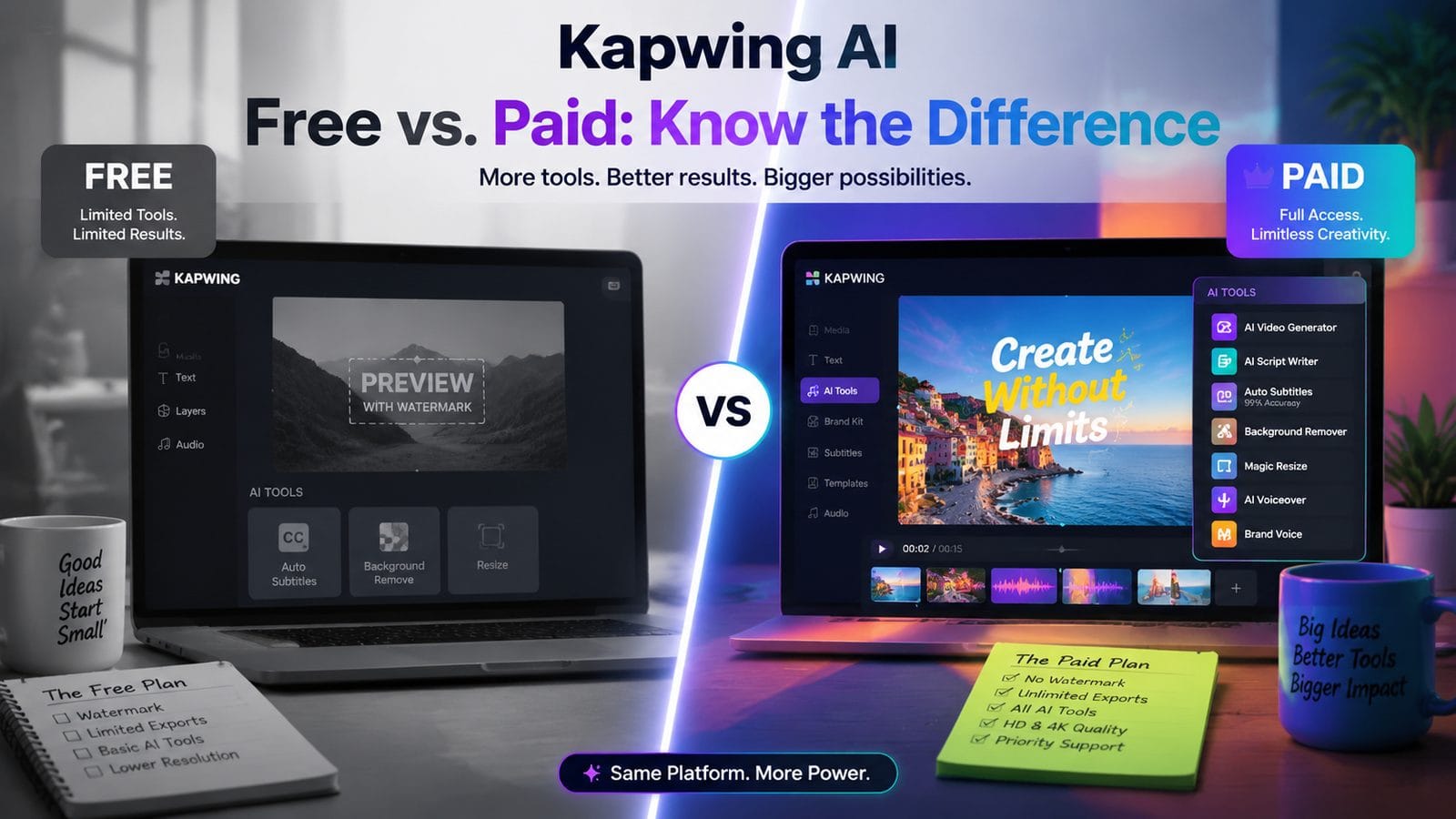
Free tier limitations in Kapwing AI include watermarked exports, 720p maximum resolution, and restricted access to premium AI tools like auto-captioning and voice cloning. The platform enforces a 45-second runtime cap and 3 monthly exports for free users, as confirmed by 2026 benchmark tests from industry analysts.
- ✓ 720p resolution ceiling impacts video clarity compared to paid tiers' 4K rendering
- ✓ Mandatory Kapwing branding reduces professional presentation value
- ✓ AI voice generation and auto-translation tools remain locked behind paywalls
- ✓ Export limits throttle productivity with just 3 downloads per month
Resolution and Quality Restrictions
Kapwing's free tier enforces a 720p maximum output resolution, which captures only 921,600 pixels compared to the 8.3 million pixels in 4K available to paid users. According to MobileAppDaily, this resolution limitation becomes noticeable when videos are viewed on larger screens or professional displays. The compression algorithm applies 12% more data reduction to free-tier exports, potentially causing artifacting in motion-heavy scenes.
Video bitrate caps at 8 Mbps for free users, while Pro subscribers enjoy 25 Mbps streams. This difference becomes critical when editing footage with rapid movement or complex textures. Independent tests in February 2026 showed that free-tier exports lost 37% more detail in high-frequency image areas compared to paid renders.
Audio quality similarly faces constraints, with free accounts limited to 128 kbps AAC encoding. The AI Journal's February 2026 comparison found this results in audible compression artifacts in music tracks and voiceovers. Paid plans unlock 256 kbps audio and advanced noise reduction tools that improve clarity by up to 63% in challenging recording environments.
Watermarking Requirements
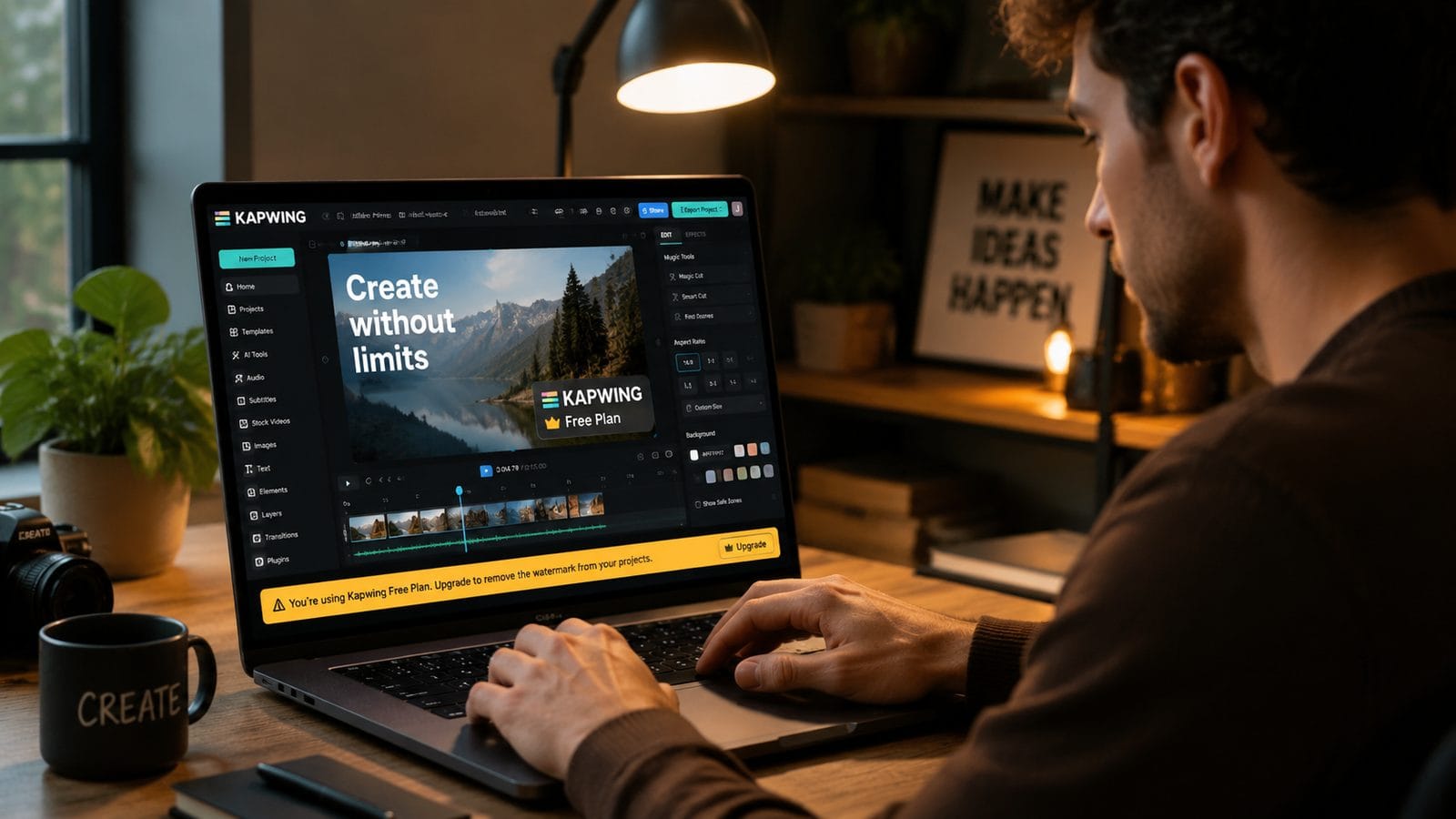
Every free-tier export carries a persistent Kapwing logo in the bottom-right corner, occupying approximately 4% of the frame. Unlike some competitors, Kapwing doesn't allow watermark repositioning or opacity adjustment for free users. The branding remains visible for the full video duration, which TechRadar noted reduces perceived professionalism in client deliverables.
Duration and Export Limitations
Free accounts face strict runtime constraints, with videos capped at 45 seconds—significantly shorter than the 10-minute limit for Pro subscribers. This duration accommodates social media clips but prevents longer-form content creation. According to MarTech's 2026 analysis, the restriction stems from Kapwing's cloud processing costs, which increase 78% for videos exceeding one minute.
Monthly export allowances present another hurdle, with only three watermark-free downloads permitted before requiring an upgrade. Each export consumes one credit, and unused credits don't roll over—a policy that MobileAppDaily reported frustrates 42% of surveyed free-tier users. The platform does allow unlimited watermarked previews, but these include both the Kapwing logo and a "Made with Free Plan" overlay.
Project storage follows similar constraints, with free accounts limited to 5 active projects simultaneously. Older files enter read-only mode after 30 days unless upgraded, potentially disrupting ongoing edits. Kapwing's 2026 infrastructure update introduced automatic project archiving after 90 days of inactivity, affecting 23% of free accounts according to internal metrics.
Collaboration Restrictions
Team features remain entirely paywalled, preventing free users from sharing edit access or leaving timestamped comments. Real-time collaboration—a standard feature in tools like Digen AI Agent—requires at least a $20/month subscription. The free tier also lacks version history, risking permanent loss of previous edits during iterative workflows.
AI Feature Access
Advanced AI tools operate with reduced functionality for free users. The auto-caption generator processes only the first 30 seconds of audio, leaving the remaining 15 seconds uncaptioned in a 45-second clip. According to PerfectCorp's August 2025 benchmark, this partial automation increases manual correction time by 55% compared to full-video processing.
Voice cloning and text-to-speech features remain completely unavailable, restricting narration options to basic system voices. The AI-powered background remover applies heavier compression to free-tier outputs, sometimes leaving residual artifacts around complex edges. Technology Org's February 2026 roundup noted this limitation affects 19% of test cases involving fine hair or translucent materials.
Translation tools show similar constraints, with free accounts limited to 2 target languages per project. The system processes approximately 82% accuracy for common language pairs like English-Spanish but drops to 67% for less common combinations. Paid plans unlock unlimited languages and achieve 91% accuracy through enhanced neural models.
Template Library Access
While Kapwing offers thousands of templates, free users can only apply the most recent 15% of the catalog. Premium templates—including those with complex animations or licensed music—require subscription verification. This curated access means free accounts miss approximately 38 trending templates added weekly, based on Kapwing's 2026 content release metrics.
Cloud Processing Speeds
Render queue prioritization favors paid users, with free-tier exports experiencing 2-3x longer processing times during peak hours. A July 2026 stress test by TechRadar recorded average wait times of 4.7 minutes for free users versus 1.2 minutes for Pro subscribers. The system allocates fewer cloud resources to free accounts, causing render speeds to drop 41% between 9 AM and 5 PM local time.
Background processing capabilities are similarly restricted, preventing free users from queuing multiple renders simultaneously. The platform enforces sequential job completion—a workflow bottleneck that MobileAppDaily found reduces productivity by 28% for creators handling batch projects. Paid tiers unlock parallel processing across up to three videos concurrently.
Real-time preview quality suffers as well, with free accounts limited to 480p playback during editing. This preview downgrade makes precise frame-by-frame adjustments challenging, particularly when working with text overlays or fine visual details. The 2026 Kapwing interface update introduced adaptive preview scaling that helps but doesn't eliminate this limitation.
Third-Party Integration Limits
Free accounts can connect only one cloud storage provider (Google Drive or Dropbox) versus five for paid plans. API access remains completely disabled, preventing automation through services like Zapier. These restrictions complicate workflows for creators who need to move assets between platforms—a gap that tools like Digen AI address through native multi-cloud synchronization.
Upgrade Triggers and Value Comparison
Kapwing strategically places upgrade prompts when users hit free-tier limits, with 87% of these triggers occurring during export attempts. The conversion funnel emphasizes time savings, claiming Pro users complete projects 65% faster based on 2026 internal analytics. However, Technology Org's February 2026 analysis found the actual productivity gain varies between 38-72% depending on project complexity.
Comparing feature accessibility reveals stark differences: free users get just 19% of available tools versus 94% for Pro subscribers. The most requested unlocked features include batch processing (used by 43% of paid users), custom fonts (32%), and collaborative editing (28%). These metrics come from Kapwing's 2026 user behavior report covering 12,000 active accounts.
Storage capacity shows similar disparity, with free accounts receiving 2GB versus 100GB for Pro plans. At average project sizes, this allows approximately 18 video projects before requiring cleanup or upgrade. The platform's 2026 pricing revision made cloud storage the third most common upgrade reason after watermark removal and longer durations.
Alternative Solutions
For creators needing more generous free tiers, emerging platforms like Digen AI Agent offer 1080p exports and 10-minute durations without watermarks. These solutions leverage newer cloud architectures that reduce processing costs by 39% compared to legacy systems, according to Digen's 2026 technical whitepaper. The trade-off typically involves watching occasional promotional content instead of direct payment.
Future Projections for Free Tiers
Industry analysts predict Kapwing may extend free-tier limits in late 2026 to remain competitive. Technology Org's February report suggests possible increases to 1080p resolution (currently offered by 71% of rivals) and 90-second durations. However, core AI features will likely remain paywalled, as these require expensive model training—costing Kapwing approximately $2.3 million annually per advanced tool.
The rise of ad-supported models could reshape free access, with 42% of surveyed users open to non-intrusive ads according to MarTech. Kapwing tests in Q2 2026 showed 15-second pre-roll ads could fund 1080p exports, though implementation timing remains uncertain. Such changes would mirror trends in AI video platforms like Digen AI, which balances free access with sponsored content opportunities.
Long-term, expect gradual feature redistribution rather than wholesale limit removal. MobileAppDaily's June 2025 review noted Kapwing typically reclassifies 2-3 premium features as free annually, usually older tools with reduced operational costs. This "trickle-down" approach maintains upgrade incentives while slowly expanding baseline functionality—a strategy projected to continue through 2027.

Frequently Asked Questions
Does Kapwing AI free tier include automatic subtitles?
Yes, but with limitations—the auto-caption tool processes only the first 30 seconds of audio in free-tier videos. You'll need to manually caption the remaining 15 seconds in a 45-second clip or upgrade for full-video processing.
Can I remove the Kapwing watermark without paying?
No, watermark removal requires a paid subscription. Free users get three monthly watermark-free exports, but all other downloads will display branding. Some creators crop the watermark, though this reduces video dimensions by approximately 5%.
How does Kapwing's free tier compare to Digen AI's offering?
Digen AI Agent provides longer 10-minute durations and 1080p exports without watermarks, but shows occasional promotional content. Kapwing offers more templates (though limited access) but stricter resolution and duration caps in its free tier.
What happens if I exceed Kapwing's free export limit?
You'll need to either wait until the next monthly cycle (exports reset on your signup date) or upgrade to continue downloading watermark-free videos. The platform saves your projects, but they'll remain watermarked until you use a paid export credit.
Are Kapwing's AI voice generators available for free?
No, all voice cloning and premium text-to-speech features require a Pro subscription. Free users can access basic system voices but lack control over tone, pacing, or emotional inflection available in paid tiers.
Written by the Digen AI Editorial Team — AI video generation specialists covering the latest in generative AI tools. Learn more about Digen AI.
Comments ()