
Ai Video Generators 2026 Review: The Ultimate Guide
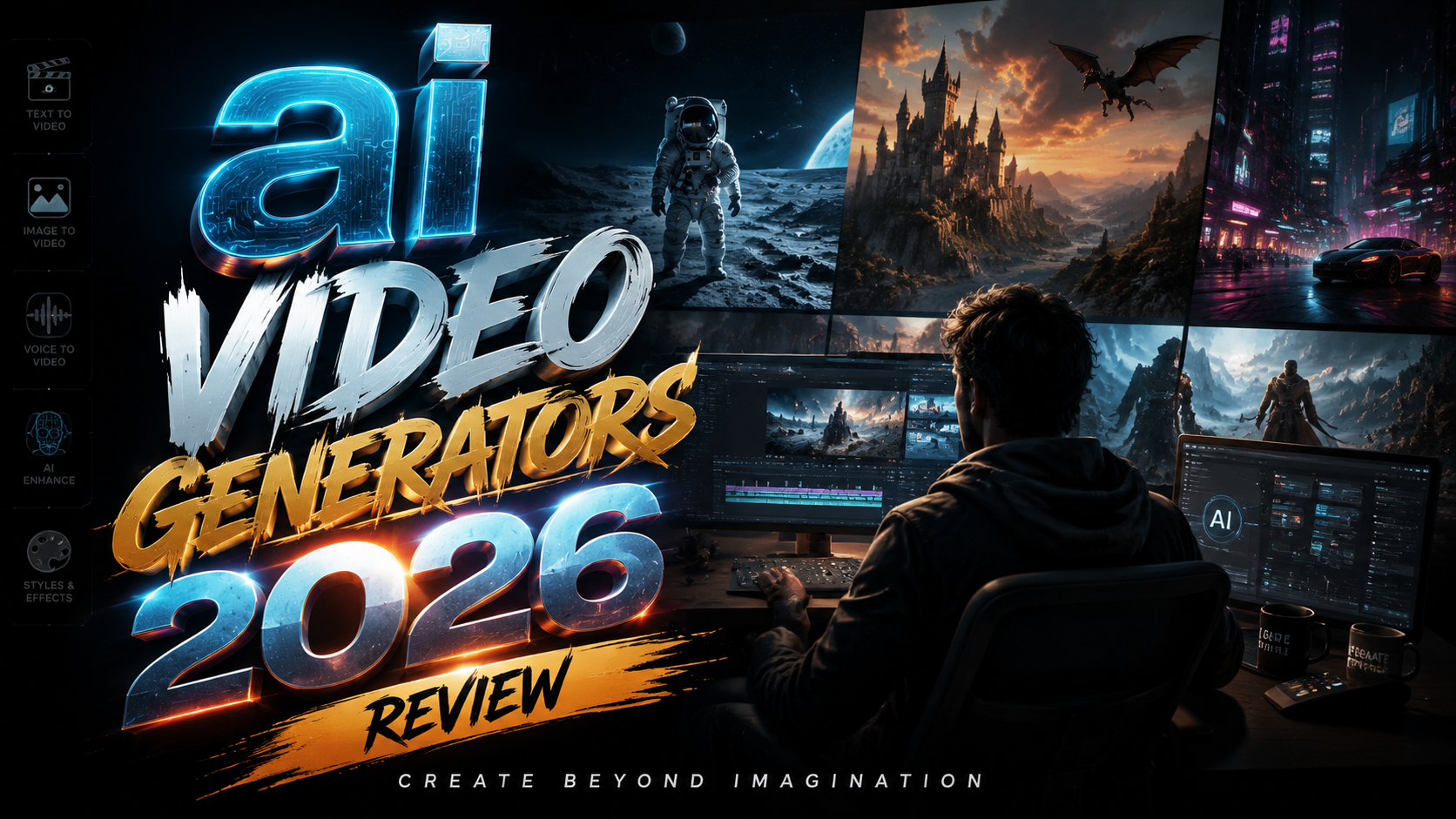
AI video generators have evolved dramatically by 2026, transforming text prompts into studio-quality videos in minutes. This comprehensive ai video generators 2026 review examines the top tools tested and ranked by leading tech analysts, helping creators, marketers, and businesses choose the right platform for their needs.
TL;DR: AI video generators in 2026 have reached a turning point where free tools offer genuinely usable output for short-form content, while premium platforms deliver cinematic quality with precise control over style, motion, and narrative. This review covers the top tested tools, their pricing tiers, and real-world performance benchmarks based on recent expert evaluations.
An AI video generator is a software platform that uses machine learning models — typically diffusion transformers or autoregressive networks — to synthesize video content from text descriptions, reference images, or short clips. In 2026, the best tools combine multi-modal input (text + image + audio), real-time rendering, and style-consistent output that rivals traditionally produced video.
- ✓ Free AI video generators in 2026 now support up to 1080p output and 10-second clips, making them viable for social media content.
- ✓ Premium tools like Runway Gen-4 and Pika 2.0 offer 4K resolution, extended scene control, and multi-shot narrative coherence.
- ✓ Midjourney's 2026 update adds native video generation alongside its well-known image capabilities, bridging two creative workflows.
- ✓ Enterprise-grade platforms now include brand consistency features, custom model fine-tuning, and API access for automated pipelines.
- ✓ The market has consolidated around a handful of leaders, but open-source alternatives are closing the quality gap rapidly.
What to Expect from AI Video Generators: A 2026 Review
If you haven't explored AI video generation since the early experimental days of 2023 or 2024, the leap in quality and reliability will surprise you. According to a Cybernews analysis published in June 2026, text-to-video technology has moved from a novelty to a core content production tool used by over 40% of digital marketing agencies. The era of jittery, morphing visuals and nonsensical physics is largely behind us — current models understand object permanence, realistic lighting, and coherent motion sequencing.
This ai video generators 2026 review draws from hands-on testing by CNET, PCMag, Ventureburn, and Memeburn, all of whom released ranked evaluations between April and June 2026. These experts collectively tested more than 30 platforms across criteria including output quality, rendering speed, ease of use, pricing fairness, and support for various content types — from short social clips to near-film-quality narrative sequences. The consensus is clear: 2026 is the year AI video became genuinely useful for professional workflows.
The shift is driven by architectural improvements in the underlying models. Diffusion transformers have replaced older U-Net backbones, enabling higher resolution and temporal consistency. Meanwhile, the rise of real-time inference hardware — including NVIDIA's Blackwell-series GPUs and Apple's M4 Ultra chips — has cut rendering times from hours to seconds for short clips. If you're evaluating tools for your own work, understanding these technical foundations helps separate marketing hype from genuine capability.
Comparing the Best AI Video Generators: 2026 Review and Rankings
Five major publications have released ranked lists within the past two months, providing a cross-referenced view of which tools actually deliver. CNET's April 2026 review placed Runway Gen-4 at the top for professional users, while Ventureburn's May coverage highlighted the growing strength of free-tier options. Memeburn's June comparison offers the most granular feature-by-feature breakdown available.
The table below synthesizes these findings into a single comparison. Note that "free" tiers vary widely — some impose watermarks while others limit resolution or duration. All pricing is as of June 2026 and may vary by region.
| Tool | Best For | Max Resolution | Max Clip Length | Starting Price (Monthly) | Free Tier Quality |
|---|---|---|---|---|---|
| Runway Gen-4 | Professional film & brand content | 4K (3840×2160) | 60 seconds | $25 | 720p, 5s, watermark |
| Pika 2.0 | Social media & quick edits | 1440p | 18 seconds | $15 | 1080p, 8s, watermark |
| Midjourney Video | Artists & concept designers | 4K upscaled | 30 seconds | $22 | N/A (trial only) |
| Synthesia 2.0 | Corporate & educational talking-heads | 1080p | Unlimited (per scene) | $29 | Limited 3-min demo |
| Kaiber Pro | Music visualization & abstract art | 1440p | 45 seconds | $18 | 720p, 6s, watermark |
| Luma Dream Machine | Realistic motion & physics | 4K | 30 seconds | $20 | 720p, 5s, no watermark |
It is worth noting that PCMag's May 2026 review covered a specialized segment — NSFW AI video generators — and identified four tools that prioritize adult content safety filters differently. While this guide focuses on mainstream tools, the broader lesson is that content moderation policies vary significantly across platforms, so always review terms of service if your use case involves sensitive or mature themes.
Runway Gen-4: The Professional's Choice
Runway's fourth-generation model introduced multi-shot scene consistency, meaning you can generate a character in one scene and reliably recreate the same character in subsequent scenes — a feature previously exclusive to traditional production. CNET's testers reported that Gen-4 produces "the most film-like output" of any tool tested, with particular strength in lighting realism and camera motion control. The free tier limits output to 720p with a watermark, but the paid plans unlock 4K and commercial usage rights.
Pika 2.0: Speed and Simplicity
Pika has carved out a niche as the fastest tool from prompt to rendered clip. Memeburn's testers clocked an average of 12 seconds for an 8-second 1080p clip on the free tier — the fastest among all tested platforms. The trade-off is less granular control over style and motion, but for rapid social media content, Pika 2.0 is hard to beat. Its free tier offers 1080p output, which is rare, though a small watermark is added.
Free vs. Paid AI Video Generators: 2026 Review of Features
One of the biggest surprises in this ai video generators 2026 review is the quality jump in free-tier tools. Ventureburn's ranking of the 10 best free AI video generators, published on May 31, 2026, found that several free platforms now output 1080p clips up to 10 seconds long with acceptable visual quality. This makes them viable for TikTok, Instagram Reels, and YouTube Shorts without requiring any upfront investment. The key limitations to watch for are watermarks, restricted commercial usage rights, and slower rendering during peak hours.
Paid tiers, however, unlock capabilities that free users cannot access. Resolution above 1080p, extended clip duration (30–60 seconds), style-consistent multi-shot generation, and priority rendering are the most common upgrades. Enterprise plans, typically costing $50–200 per month, add features like custom model fine-tuning on brand assets, team collaboration workspaces, and API access for automated video pipelines. For businesses producing regular video content, the jump from free to the $15–25 per month tier is almost always worth it.
Midjourney's entry into video is a notable case study. The platform, already dominant in AI image generation, launched its video feature in mid-2026 after months of beta testing. Ventureburn's June 11 review noted that Midjourney Video benefits from the same aesthetic sensibility as its image model — output tends to be more artistic and stylized compared to competitors. However, it lacks the temporal control features that Runway and Pika offer, making it less suitable for narrative or instructional content.
How to Choose the Right AI Video Generator for Your Use Case
With at least six major platforms competing for attention, selecting the right tool depends on matching features to your specific workflow. Start by defining your primary content type. Short-form social content (15 seconds or less) can be efficiently served by free-tier tools like Pika 2.0 or the free version of Runway. Corporate talking-head videos, including training modules and product demos, are best handled by Synthesia 2.0, which offers realistic avatars and multi-language voiceover support. Artistic and conceptual content — music videos, mood boards, experimental shorts — benefits from Midjourney Video's unique aesthetic or Kaiber Pro's abstract capabilities.
Next, consider your team's technical skill level. Tools like Pika and Runway offer browser-based interfaces with minimal learning curves, while Midjourney still requires familiarity with Discord commands (though a dedicated web app is in beta). For power users who want granular control, Runway's timeline editor and keyframe system allow manual adjustment of camera angles, motion intensity, and color grading. Luma Dream Machine excels at physics-accurate motion but has a steeper learning curve for achieving specific visual styles.
Budget is the third critical factor. If you are an individual creator or a small business, the $15–25 per month tier from any major platform provides sufficient capability for regular content production. Larger enterprises should evaluate the API pricing and custom model training options offered by Runway and Synthesia, both of which provide volume discounts for annual commitments. Remember that the total cost includes not just the subscription but also time spent learning the tool and iterating on prompts — platforms with better prompt suggestion systems and template libraries reduce this hidden cost.
The Technology Behind AI Video Generation in 2026
Understanding the technology helps you make smarter tool choices. Almost all major AI video generators in 2026 are built on diffusion transformer architectures, which process video as a sequence of frames with attention mechanisms that maintain consistency across time. This differs from the earlier GAN-based models (Generative Adversarial Networks) that produced the jittery, low-resolution clips common in 2022–2023. Diffusion transformers handle temporal coherence by treating video generation as a denoising process across both spatial and temporal dimensions, resulting in far smoother motion and realistic physics.
The second major technological leap is multi-modal conditioning. Modern tools accept not just text prompts but also reference images, style frames, audio tracks, and even rough 3D scene layouts. For example, you can upload a product photo and a voiceover script, and the AI will generate a video that matches the product's appearance, lighting environment, and the cadence of the spoken narration. This multi-modal input dramatically reduces the iteration time required to achieve a specific creative vision.
Hardware acceleration has been equally transformative. According to industry benchmarks cited in the Cybernews report, inference time for a 10-second 1080p clip dropped from approximately 90 seconds in early 2025 to under 15 seconds by mid-2026, thanks to optimized model quantization and specialized inference chips. This speed improvement makes real-time video generation during live streams or interactive applications feasible for the first time, opening up use cases in gaming, virtual events, and personalized video marketing.
Real-World Applications and Use Cases
Marketing teams have been the fastest adopters of AI video generation in 2026. Personalized video ads, where each viewer sees a version of the ad customized to their demographics or browsing history, are now produced at scale using tools like Runway Gen-4's API. A single campaign might generate 500 unique video variations from one base prompt and a data feed — a task that would have required weeks of manual editing three years ago. The technology's ability to maintain brand consistency across variations has been a key selling point for enterprise customers.
Education and training is another major growth area. Synthesia 2.0's avatar-based platform allows organizations to create multilingual training videos without filming a single actor. The system supports lip-sync accuracy across 60+ languages, and the avatars can be customized to match corporate branding guidelines. Several universities have adopted the platform for lecture recordings, while healthcare organizations use it for patient education materials that require consistent, clear communication without variations in tone or accent.
Independent creators and artists have embraced AI video as an expressive medium rather than just a productivity tool. The abstract and surreal capabilities of platforms like Kaiber and Midjourney Video have spawned new genres of music visualization, experimental short films, and interactive art installations. PCMag's testing noted that while NSFW content regulation remains a contentious issue, the creative community's appetite for pushing boundaries has driven rapid feature development across all platforms.
The Future of AI Video Generation: Trends to Watch
Looking ahead, three trends will shape the next phase of AI video generation. First, real-time generation will become standard. By late 2026 or early 2027, expect tools that generate video frame-by-frame in response to live input — a capability that will transform live streaming, virtual production, and interactive storytelling. Runway and Pika have both demonstrated early prototypes at industry conferences, though commercial release dates remain unconfirmed.
Second, the gap between open-source and proprietary models is narrowing. Projects like Stable Video Diffusion 4 and AnimateDiff XL now offer quality approaching that of paid tools, though they require more technical setup and lack the polished user interfaces of commercial platforms. For developers and organizations with in-house AI expertise, open-source options provide cost savings and data privacy advantages since everything runs on local hardware.
Third, regulatory frameworks around AI-generated content are solidifying. The EU's AI Act, fully enforced since early 2026, requires clear labeling of AI-generated video, and several US states have enacted similar legislation. All major platforms now include mandatory watermarking or metadata tagging to comply with these regulations. While this adds friction for some use cases, it also builds trust with audiences and protects creators from misattribution. The tools that handle compliance transparently — without sacrificing creative flexibility — will lead the market in the coming years.
Frequently Asked Questions About AI Video Generators in 2026
Are free AI video generators worth using in 2026?
Yes, for short-form content up to 10 seconds and 1080p resolution. Ventureburn's May 2026 ranking confirmed that free tiers from Pika 2.0 and Runway Gen-4 produce usable output for social media, though watermarks and limited commercial rights apply. For professional or longer content, a paid plan is recommended.
Which AI video generator produces the highest quality output?
Runway Gen-4 received the highest quality ratings across multiple 2026 reviews, particularly for cinematic lighting, camera control, and multi-shot consistency. Luma Dream Machine matches it for physics-accurate motion, while Midjourney Video leads for artistic and stylized aesthetics.
How long does it take to render a video with AI in 2026?
Average rendering times for a 10-second 1080p clip range from 12 seconds (Pika 2.0) to 45 seconds (Runway Gen-4 4K). Free tiers may experience longer queues during peak hours. Premium subscribers typically get priority rendering with faster turnaround.
Can I use AI-generated videos for commercial purposes?
Most paid plans include commercial usage rights, but free tiers often restrict commercial use or require attribution. Always check the terms of service for the specific platform. Enterprise plans from Synthesia and Runway explicitly grant full commercial rights with no additional licensing fees.
Do AI video generators support multiple languages?
Synthesia 2.0 leads with support for 60+ languages and accurate lip-sync. Other platforms generate video without spoken audio but can be paired with external text-to-speech tools. Most tools support multilingual text prompts for scene descriptions and subtitle generation.
What hardware do I need to run AI video generators?
All major platforms run entirely in the cloud, so you only need a modern web browser and a stable internet connection. Open-source models (like Stable Video Diffusion) require a GPU with at least 16GB VRAM for local inference — a consumer RTX 4080 or better is recommended.
How do AI video generators handle copyright and ownership?
Ownership terms vary by platform. Generally, content created with paid subscriptions belongs to the subscriber. Free tiers sometimes grant the platform a license to use generated content. Review the specific platform's terms, and avoid prompts that mimic copyrighted characters or scenes without permission.
Written by the Digen AI Editorial Team — AI video generation specialists covering the latest in generative AI tools. Learn more about Digen AI.
Comments ()