
AI Video Generator vs Traditional in 2026: The Verdict
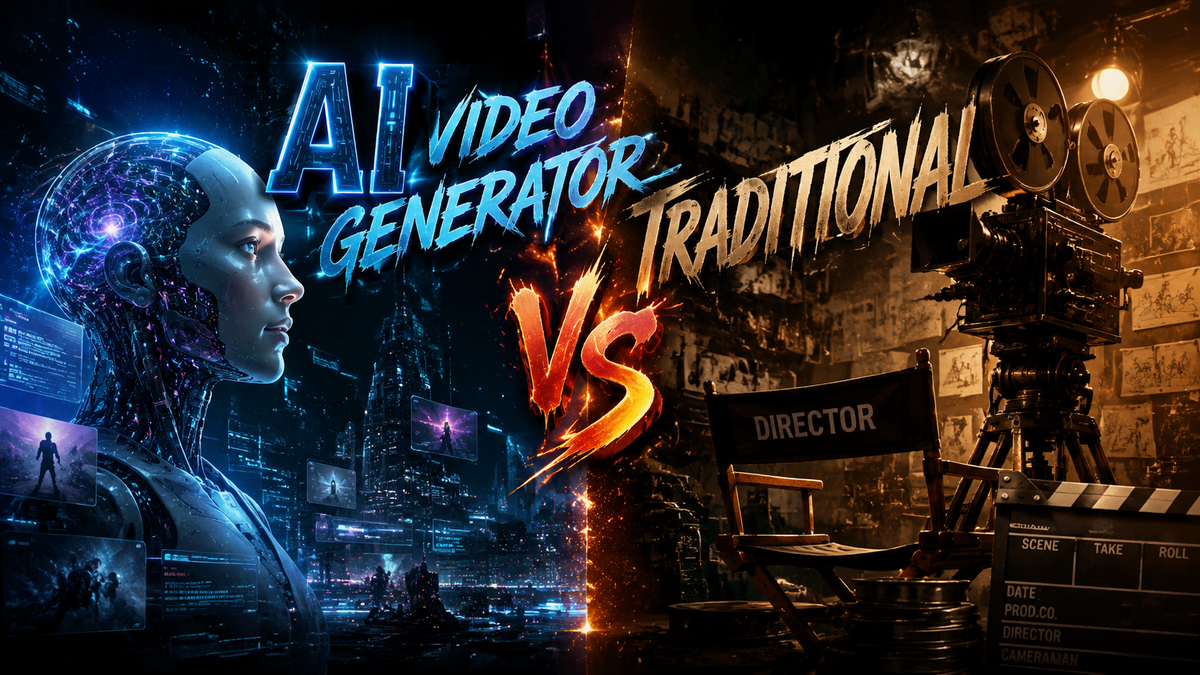
The State of Video Creation in 2026
In 2026, the debate between ai video generator vs traditional production has reached a defining moment: AI wins decisively for speed, cost efficiency, and rapid iteration, while traditional methods retain an unshakable edge in emotional depth, brand safety, and cinematic nuance. The verdict is not a wholesale replacement of one by the other but a strategic partnership where each approach serves distinct use cases and budgets. Creators and brands that understand this split are outperforming those who bet exclusively on one side.
The ai video generator vs traditional production landscape in 2026 is defined by a clear division of labor: AI excels at rapid UGC-style ads, social content, and talking-photo applications, cutting production time from weeks to minutes, while traditional production remains essential for high-stakes brand films, narrative storytelling, and campaigns requiring full creative control and legal certainty.
- ✓ AI video generators now produce usable content in minutes, slashing production timelines from weeks to hours for common formats.
- ✓ The shutdown of Sora in March 2026 signaled a market correction toward specialized, use-case-specific AI tools rather than one-size-fits-all platforms.
- ✓ Traditional production retains the edge in emotional depth, brand alignment, and legal safety, especially for tier-1 campaigns and cinematic storytelling.
- ✓ Hybrid workflows — AI for pre-visualization, rough cuts, and A/B testing, followed by traditional final polish — are emerging as the industry standard for cost-conscious but quality-driven teams.
- ✓ Free AI video generators like Vidnoz AI and AI talking photo tools are democratizing video creation for small businesses, educators, and social media creators who previously had no video budget at all.
The Rise and Fall of AI Video Giants: What the Sora Shutdown Means
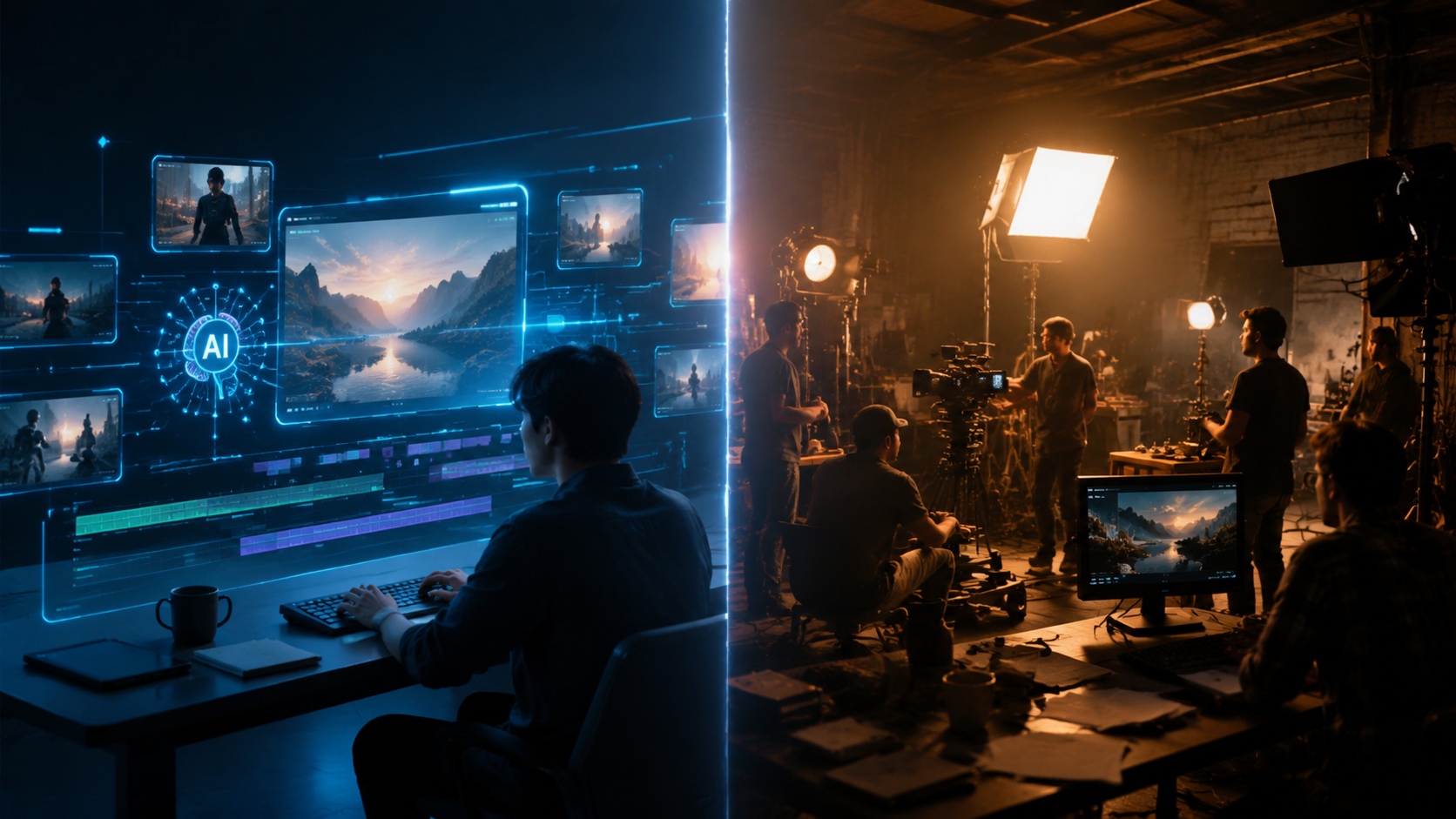
In a move that sent ripples through the content creation industry, the AI video generator that once posed the most significant perceived risk to creators — Sora — shut down in March 2026. According to Digital Camera World, Sora's closure was framed by the industry as a moment for traditional cameras and production methods to reclaim the spotlight. However, the reality is more nuanced. Sora's shutdown reflects not the failure of AI video generation as a category, but the failure of a one-size-fits-all, high-risk platform that tried to replace every flavor of production at once.
The lesson of Sora's departure is that ai video generator vs traditional is not a winner-take-all battle. Sora attempted to cover too broad a spectrum — from cinematic scenes to everyday social clips — without solving the core issues of consistency, brand control, and legal liability that large brands demand. Meanwhile, specialized AI video tools that focus on specific formats — such as AI-generated UGC ads or talking-photo content — are thriving precisely because they stay in their lane. The market has spoken: AI video works best when it augments, not replaces, traditional craft.
What Sora's exit also underscores is the importance of trust. According to Tech Times, AI-powered video creation tools are transforming content production, but the transformation is happening fastest in environments where speed and volume matter more than perfect fidelity — social ads, product demos, and personalized video at scale. For a high-visibility brand launch or a cinematic short film, the traditional production pipeline remains non-negotiable for most advertisers in 2026.
Benchmarking AI Video: A New Framework for 2026
One of the most significant developments in the ai video generator vs traditional conversation came in June 2026, when Nokiamob published a practical framework for benchmarking AI video that moves beyond metadata. The old method of comparing AI video tools — evaluating them solely on resolution, frame rate, or export speed — has given way to a more holistic approach that measures semantic consistency, brand alignment, prompt adherence, and perceptual quality as judged by human viewers.
This new benchmarking framework is crucial because it finally allows production teams to compare AI-generated content against traditionally produced content on an apples-to-apples basis. The framework accounts for factors like object permanence (do objects in the scene remain consistent between shots?), lighting continuity, and the ability to handle complex prompts with multiple actors and actions. According to Nokiamob's findings, no AI tool in 2026 consistently outperforms traditional production across all these dimensions — but several AI tools now match or exceed traditional benchmarks for short-form content of 15 to 60 seconds.
Why Benchmarking Matters for Your Production Choices
Without a robust benchmarking framework, brands risk choosing the wrong production method based on superficial metrics. A 4K AI video that flickers between scenes or fails to maintain character appearance is still a liability, even if it was produced in minutes. Conversely, a 1080p traditionally-shot video with strong lighting, consistent talent, and a clear narrative arc may serve the brand better. The Nokiamob framework gives teams the vocabulary to make this call objectively, moving the debate from "AI vs traditional" to "which tool for which job."
Cost and Speed: AI vs Traditional Production
The most immediate advantage of AI video generation in 2026 is cost and speed. According to 3-mob.com, an AI UGC ad video generator consistently outperforms traditional ad production for direct-to-consumer (DTC) brands, reducing per-ad costs by as much as 80% and compressing production timelines from weeks to hours. For DTC brands that need to test dozens of ad variations weekly — different hooks, different offers, different actors — AI video is not just a nice-to-have; it is a competitive necessity.
Free and freemium AI video generators like Vidnoz AI, reported by findarticles.com in December 2025, further lower the barrier to entry. These tools allow small businesses, educators, and solo creators to generate stunning visual content — including AI talking photo sequences — without any upfront investment. PC Tech Magazine highlighted in May 2026 that the combination of free AI video generators with AI talking photo features is creating a new category of "zero-budget video" that simply did not exist three years ago.
The Hidden Costs of Traditional Production
Traditional video production in 2026 still commands premium budgets for a reason: crew, equipment, location permits, talent fees, post-production, and revision cycles add up quickly. A single 30-second television-quality commercial can cost between $5,000 and $50,000 depending on complexity. However, traditional production also offers something AI cannot yet guarantee: a clear chain of creative ownership, insured talent, and legal clarity around usage rights. For regulated industries — pharmaceuticals, financial services, legal — these factors are non-negotiable, making traditional production the default choice despite the higher cost.
Quality and Creative Control: Where Each Approach Wins
When it comes to quality, the ai video generator vs traditional comparison in 2026 is best understood as a trade-off between consistency and creativity. Traditional production offers unparalleled creative control: a director can adjust a single expression, change the lighting mid-scene, or reshoot a line of dialogue until it lands perfectly. AI video, on the other hand, can generate hundreds of variations of a scene in minutes, but guiding it toward a precise creative vision often requires extensive prompt engineering and post-selection.
The PC Tech Magazine article from May 2026 highlighted how AI talking photo tools are creating stunning visual content that mimics human expression with surprising accuracy. For social media content, educational explainers, and internal communications, the quality gap between AI and traditional is now negligible. However, for narrative storytelling — where a subtle glance or a specific intonation carries meaning — traditional cameras and human actors still deliver a depth that AI struggles to replicate consistently.
Brand Safety and Legal Considerations
One area where traditional production still holds a decisive advantage is brand safety. AI-generated video in 2026 still carries risk around deepfake liability, copyright ambiguity (particularly concerning training data), and the unpredictability of output for sensitive subject matter. Brands with stringent legal requirements — or those operating in highly regulated verticals — continue to prefer traditional production for any content that will appear on television, in cinemas, or in long-term archival campaigns. AI video is increasingly reserved for short-lived, rapidly rotated content such as social ads and test campaigns.
| Dimension | AI Video Generator | Traditional Production |
|---|---|---|
| Production Speed | Minutes to hours | Days to weeks |
| Cost per Finished Minute | $0–$50 (including freemium tools like Vidnoz AI) | $500–$5,000+ |
| Best For | Social ads, UGC-style content, talking photos, rapid A/B testing | Brand films, TV commercials, narrative stories, regulated industries |
| Creative Control | High for short-form; requires prompt engineering for precision | Complete; director and DP control every frame |
| Consistency & Brand Alignment | Improving with new benchmarking frameworks (Nokiamob, June 2026) | Inherently consistent due to human oversight |
| Legal & Regulatory Safety | Evolving; risks around deepfake, copyright, and liability | Well-established; clear ownership and insurance |
| Scalability for Variations | Excellent; 100+ variants in a single session | Poor; each variation requires a new shoot or edit |
| Emotional & Narrative Depth | Acceptable for short clips; limited for complex stories | Superior; built for cinematic and emotional storytelling |
The Verdict: When to Use AI Video vs Traditional in 2026
The verdict on ai video generator vs traditional production in 2026 is not a single answer but a decision framework based on three variables: purpose, audience, and budget. If your goal is to produce high-volume social content for rapid testing — especially for DTC brands or performance marketing — AI video generators are now the clear winner, as confirmed by the 3-mob.com analysis from June 2026. If your project requires cinematic storytelling, brand building, or full regulatory compliance, traditional production remains the gold standard.
Hybrid workflows are increasingly common. A production team might use an AI video generator to create 20 variations of a social ad, test them against a small audience, identify the top-performing hook, and then invest in a traditional shoot for the final version to ensure polish and consistency. This approach combines the speed and cost advantages of AI with the quality and safety of traditional methods.
Ultimately, the creators and brands that win in 2026 are those who treat AI video as a powerful addition to their toolkit — not a replacement for it. The shutdown of Sora in March 2026 was not the death of AI video; it was the end of the idea that a single AI could do everything. Specialized tools, free generators, and a clear-eyed understanding of the ai video generator vs traditional trade-offs are what separate successful content strategies from costly experiments.
Frequently Asked Questions
Is AI video generation cheaper than traditional production in 2026?
Yes, in most cases AI video generation is significantly cheaper — often 80–90% less than traditional production for short-form content. Free tools like Vidnoz AI allow zero-cost creation, while traditional production for a 30-second ad typically starts at several thousand dollars. However, for complex, highly customized content, the cost gap narrows when factoring in prompt engineering time and post-selection.
Can AI video replace traditional filmmaking for high-end commercials?
Not reliably in 2026. While AI can generate impressive short clips and handle UGC-style ads effectively, high-end commercials requiring emotional nuance, brand safety, and precise creative direction still depend on traditional production methods. The Sora shutdown in March 2026 underscored that even the most advanced AI platforms struggle to match the consistency and control of a human-led shoot.
What are the legal risks of using AI video generators for branded content?
The primary risks in 2026 include copyright uncertainty around training data, potential deepfake liability if generated content resembles real individuals without consent, and lack of clear ownership for AI-assisted works. Traditional production offers a cleaner legal chain of title. Brands in regulated industries — pharma, finance, legal — should engage legal counsel before adopting AI-generated content for public distribution.
How do I choose between an AI video generator and a traditional shoot?
Use the decision framework based on three factors: purpose (social testing vs brand building), audience (fast-scrolling social users vs high-consideration purchasers), and budget. If you need 20 variations tested in 24 hours, choose AI. If you need one impeccable 60-second spot for a national campaign, choose traditional. Hybrid workflows — AI for rough cuts, traditional for final polish — offer the best of both worlds.
What does the Sora shutdown mean for the future of AI video generation?
Sora's shutdown in March 2026 signaled a market correction away from generalist, high-risk AI video platforms toward specialized tools designed for specific use cases. The future of AI video is not a single dominant platform but an ecosystem of integrated tools — free generators like Vidnoz AI, talking photo creators, UGC ad engines — each optimized for a narrow set of tasks. Creators should invest in understanding multiple tools rather than betting on one.
Are there free AI video generators that produce professional-quality content?
Yes. Free tools like Vidnoz AI, highlighted by PC Tech Magazine in May 2026 and findarticles.com in December 2025, allow users to generate stunning visual content including AI talking photos at no cost. While free tiers may have limitations on resolution, watermarking, or export options, the quality is sufficient for social media, internal training, and small business marketing. For broadcast-quality output, paid plans or traditional production are still recommended.
How do I benchmark AI-generated video against traditionally produced video?
The practical framework published by Nokiamob in June 2026 recommends moving beyond metadata — resolution, frame rate, file size — and evaluating semantic consistency, prompt adherence, object permanence, lighting continuity, and perceptual quality as judged by human viewers. This framework allows production teams to compare AI and traditional content on the same criteria and make informed decisions based on the specific requirements of each project.
What types of content are best suited for AI video generation in 2026?
AI video generation excels at short-form social media ads (15–60 seconds), UGC-style testimonial videos, product demos, talking photo sequences, educational explainers, and rapid A/B testing variants for performance marketing. It is less suited for narrative storytelling, emotionally complex scenes, content for regulated industries, and any project requiring frame-by-frame creative control over actor expressions and subtle performance details.
Will AI video generators replace video editors and producers?
No — the role is shifting, not disappearing. Video editors and producers in 2026 who adopt AI tools are finding themselves more in demand, as they can offer faster turnaround and more creative iterations. The human role is moving from manual frame-by-frame editing to prompt engineering, curation, quality assurance, and strategic decision-making about when to use AI versus traditional methods. The verdict is clear: AI augments the creator; it does not eliminate them.



Comments ()