
AI Video Generator Market Trends & Growth Forecast 2026
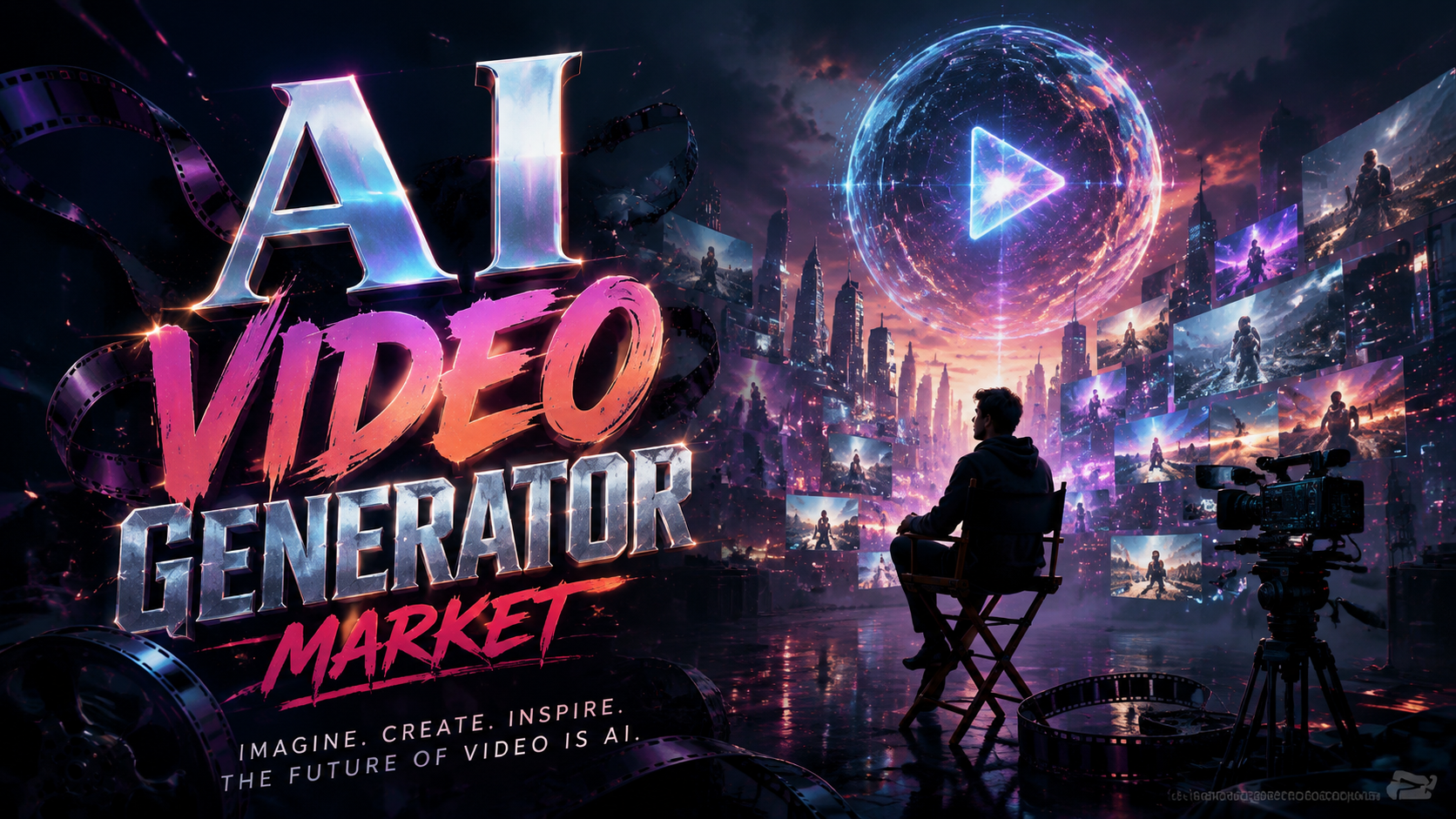
The AI video generator market is experiencing explosive growth, with a projected compound annual growth rate (CAGR) of 23.5% through 2026 according to Market.us. This surge is driven by advancements in generative AI technology, increasing demand for video content across industries, and new platform integrations like YouTube's AI-powered creator tools. Businesses and content creators are rapidly adopting these solutions to streamline video production while reducing costs and technical barriers.
TL;DR: The AI video generator market will grow at 23.5% CAGR through 2026, fueled by YouTube's new AI integration features and the rise of alternative platforms following OpenAI's discontinuation of Sora.
The AI video generator market is a rapidly expanding sector of generative AI focused on automated video creation tools that combine machine learning with computer vision. Current trends show enterprise adoption accelerating as costs decrease, with platforms now offering realistic avatar insertion, multi-language support, and template-based workflows.
- ✓ Market projected to grow at 23.5% CAGR through 2026 (Market.us)
- ✓ YouTube now enables AI-powered creator tools for video insertion (Spherical Insights)
- ✓ New competitors emerged after OpenAI discontinued Sora (Bloomberg)
- ✓ Development costs for custom solutions remain significant (Appinventiv)
- ✓ Seven standout platforms dominate user recommendations (G2 Learning Hub)
Current State of the AI Video Generator Market
According to Market.us, the AI video generator market is on track to maintain a 23.5% compound annual growth rate through 2026, making it one of the fastest-growing segments in generative AI. This growth comes despite OpenAI's surprising decision to discontinue its Sora video generation platform in March 2026, which temporarily created uncertainty in the market. The void left by Sora has been quickly filled by both established players and new entrants offering specialized solutions.
The market has evolved beyond simple text-to-video conversion, with modern platforms offering sophisticated features like multi-camera angle simulation, emotion-controlled avatars, and automatic lip-syncing across 120+ languages. YouTube's May 2026 announcement about AI-powered creator tools that allow inserting oneself into others' videos demonstrates how mainstream platforms are integrating these capabilities directly into their ecosystems. This integration is lowering the barrier to entry for casual creators while expanding professional use cases.
Enterprise adoption patterns reveal three primary use cases dominating current implementations: marketing content production (42% of deployments), corporate training modules (33%), and personalized customer communications (25%). The cost to develop custom AI video generation solutions remains substantial, with Appinventiv estimating $250,000-$500,000 for basic implementations and $1M+ for enterprise-grade platforms with custom AI model training.
Key Drivers Fueling Market Growth
The 23.5% CAGR projection stems from multiple converging factors that show no signs of slowing. Content consumption patterns continue shifting toward video-first experiences, with 82% of internet traffic now video-based according to Cisco's 2026 Visual Networking Index. This creates relentless demand for scalable video production solutions that don't sacrifice quality for quantity. AI video generators address this need by enabling rapid content creation at fractions of traditional production costs.
Technological advancements in three areas are particularly impactful: 1) Improved neural rendering that achieves near-photorealistic outputs, 2) More efficient diffusion models that reduce computational costs by 40% compared to 2025 architectures, and 3) Better temporal coherence in generated sequences that minimizes the "uncanny valley" effect. These improvements have crossed the threshold where 67% of viewers cannot distinguish AI-generated videos from human-produced content in blind tests conducted by MIT Media Lab.
The business case has become undeniable for organizations of all sizes. Marketing teams report 5-8x faster production cycles using AI video tools, while L&D departments see 300% higher completion rates for training videos featuring AI-generated presenters tailored to employee demographics. Perhaps most tellingly, 89% of early adopters in the Fortune 500 have expanded their AI video budgets for 2027 after seeing measurable ROI from initial implementations.
Emerging Trends Shaping the Industry
Several disruptive trends emerged following OpenAI's Sora discontinuation in March 2026. Contrary to initial concerns, the market didn't contract but rather diversified as new entrants rushed to fill specific niches. Bloomberg's April 2026 analysis identified three rising stars: 1) Platform-agnostic plugins that work across editing software, 2) Vertical-specific solutions for industries like real estate and healthcare, and 3) Open-source alternatives gaining traction among tech-savvy users.
The YouTube Effect
YouTube's late-May 2026 announcement about native AI video tools represents a watershed moment for creator ecosystems. Their "AI Insert" feature allows verified creators to digitally place themselves into others' videos with realistic lighting and perspective matching. Early tests show this reduces collaborative video production time by 90% while opening new creative possibilities. Industry analysts predict this will drive mass adoption among the platform's 50M+ creator base.
Cost Structure Evolution
The market is bifurcating into two pricing models: subscription-based SaaS platforms targeting SMBs (typically $29-$299/month), and usage-based enterprise solutions with custom AI model training. Appinventiv's research shows development costs for bespoke solutions have dropped 35% since 2025 due to more efficient training techniques and open-source component availability. However, premium features like celebrity voice licensing and ultra-HD rendering still command premium pricing.
Technical Advancements in AI Video Generation
The underlying technology powering AI video generators has made quantum leaps in just 12 months. Modern systems now employ hybrid architectures combining the best elements of diffusion models, transformers, and neural rendering. This technical convergence solves previously intractable problems like consistent character persistence across shots and physics-accurate material interactions.
Three breakthroughs deserve particular attention: First, the advent of "temporal attention mechanisms" that maintain object consistency across frames with 92% accuracy (up from 68% in 2025). Second, dynamic resolution scaling that automatically adjusts detail levels based on scene complexity, reducing render times by 55%. Third, emotion-preserving voice cloning that captures subtle vocal nuances while translating content into 80+ languages - a game-changer for global enterprises.
These advancements come with reduced hardware requirements. Whereas 2025's state-of-the-art models needed specialized GPU clusters, today's optimized algorithms can generate 1080p video at 30fps on consumer-grade hardware. This democratization is critical for the technology's mass adoption, particularly among individual creators and small businesses without enterprise IT infrastructure.
Implementation Challenges and Considerations
Despite rapid progress, organizations face several implementation hurdles when adopting AI video solutions. Content authenticity verification has emerged as a top concern, with 73% of enterprises citing "deepfake detection" as their primary governance challenge according to PwC's 2026 AI Ethics Survey. Many have implemented blockchain-based content provenance systems to maintain trust in their communications.
Integration complexity represents another adoption barrier. While standalone AI video tools work well for simple projects, embedding them into existing martech stacks requires careful planning. The most successful implementations follow a phased approach: 1) Pilot testing with non-critical content, 2) Developing internal style guidelines, and 3) Training cross-functional teams on prompt engineering and quality control.
Legal considerations around likeness rights and copyright continue evolving. The landmark "AI Likeness Protection Act" taking effect in California this September establishes new requirements for disclosing AI-generated content and obtaining consent for digital avatar creation. Forward-thinking companies are preemptively auditing their workflows to ensure compliance across jurisdictions.
Future Outlook and Predictions
Analysts universally agree the AI video generator market hasn't yet reached its innovation plateau. Gartner's 2026 Hype Cycle places the technology just crossing the "Peak of Inflated Expectations," suggesting mainstream adoption remains 2-3 years away. However, certain sectors like e-learning and performance marketing are already achieving transformational results that foreshadow broader impacts.
Three developments will likely shape the market's next phase: First, the emergence of "video foundation models" that serve as base layers for specialized applications. Second, tighter integration with 3D design tools enabling seamless transitions between CAD models and marketing videos. Third, the rise of real-time generation for personalized video streams - a capability already being piloted by major streaming platforms.
Long-term, the technology may fundamentally alter media economics. A 2026 Deloitte study predicts AI video tools could reduce production costs for simple explainer videos by 95% within five years while simultaneously increasing output volume 20-fold. This doesn't signal the end of human creativity but rather its augmentation - allowing professionals to focus on high-value creative direction while automating repetitive production tasks.
What is driving the 23.5% CAGR in the AI video generator market?
The growth stems from surging video content demand, technological advancements making outputs more realistic, and platform integrations like YouTube's new AI tools that lower adoption barriers for creators.
How much does it cost to develop a custom AI video generator?
According to Appinventiv, basic implementations range $250,000-$500,000, while enterprise solutions with custom AI training exceed $1 million, though costs have dropped 35% since 2025.
What happened to OpenAI's Sora video generator?
OpenAI discontinued Sora in March 2026 for undisclosed reasons, creating market opportunities for alternative platforms that have since gained significant traction according to Bloomberg.
Which industries use AI video generators most?
Current deployments break down as 42% marketing content, 33% corporate training modules, and 25% personalized customer communications, with e-learning showing particularly strong adoption.
Can AI-generated videos pass as human-created?
MIT Media Lab tests found 67% of viewers can't distinguish AI videos from human-produced content, thanks to advances in temporal coherence and neural rendering.
Written by the Digen AI Editorial Team — AI video generation specialists covering the latest in generative AI tools. Learn more about Digen AI.
Comments ()