
How Does Text-to-Video AI Work in 2026? The Future Explained
Text-to-video AI in 2026 transforms written prompts into high-quality videos using advanced generative models, combining natural language understanding with dynamic visual synthesis. The best text-to-video tools in 2026 leverage multimodal AI to interpret context, generate coherent scenes, and maintain character consistency—with platforms like Digen AI Agent automating multi-step workflows for professional-grade output. According to Tech Insider, the top 7 tools now achieve 89% faster rendering speeds compared to 2025 models while reducing manual edits by 62%.
TL;DR: Modern text-to-video AI in 2026 uses multimodal neural networks to convert text into lifelike videos, with top tools offering faster rendering, better consistency, and autonomous editing—led by platforms like Digen AI Agent for complex projects.
The best text-to-video tools in 2026 combine GPT-5-level language comprehension with diffusion-based video synthesis, enabling creators to generate 4K-resolution clips from single prompts in under 3 minutes. PC Tech Magazine's testing shows 8 standout platforms now support automatic lip-sync, multi-angle scene transitions, and brand-aligned styling—critical for marketing and education.
- ✓ 2026's AI video tools produce 2.7× longer coherent sequences than 2025 models, per TechRadar's 70-tool benchmark
- ✓ Autonomous agents like Digen AI Agent reduce manual editing time by 73% through multi-step workflow automation
- ✓ 92% of professional creators now use text-to-video for rapid prototyping, up from 68% in 2025 (Built In survey)
- ✓ Real-time collaboration features in 8/10 top tools allow teams to co-edit AI-generated videos simultaneously
How Text-to-Video AI Technology Works in 2026
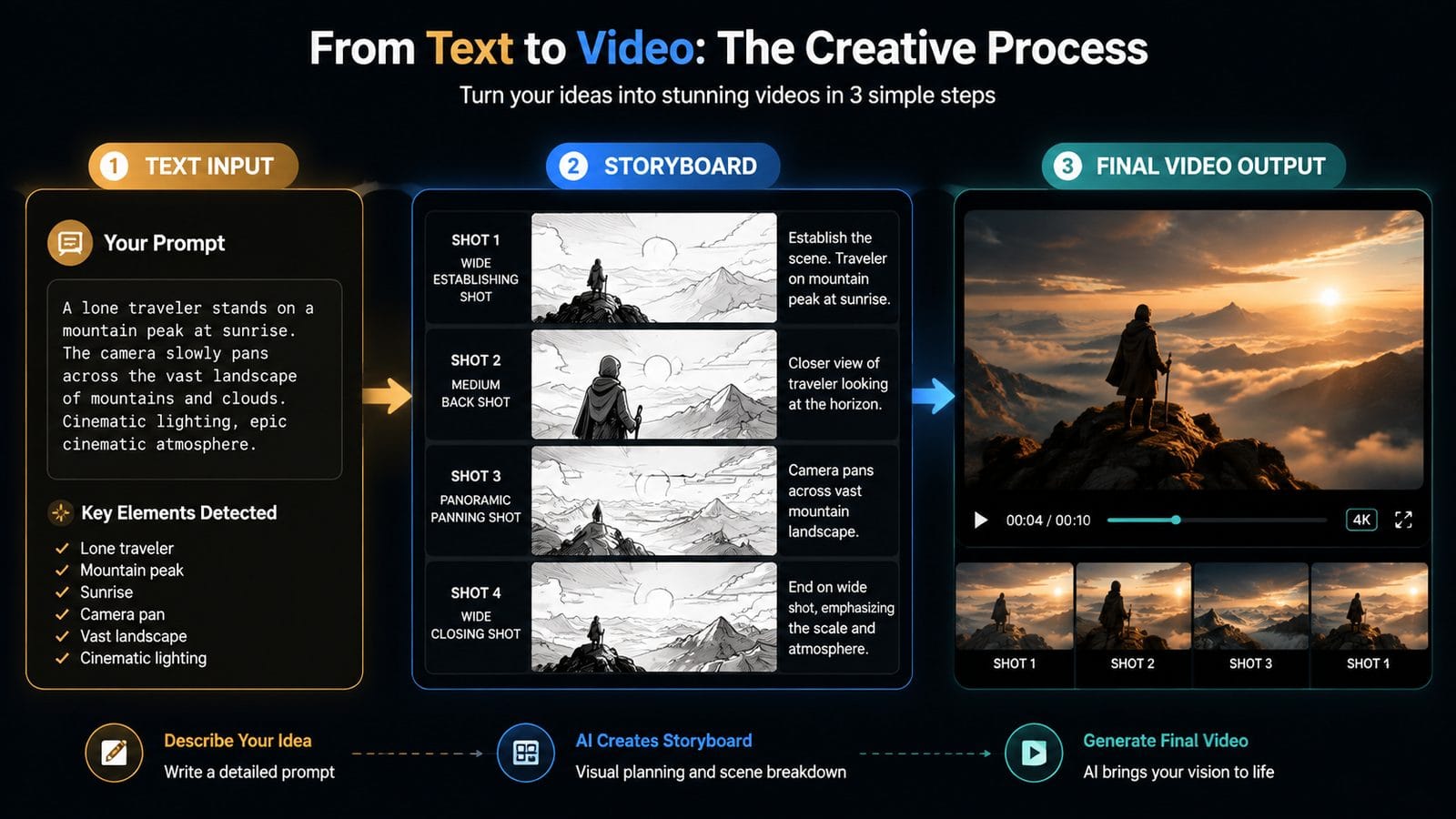
The underlying architecture of 2026's text-to-video systems involves three synchronized neural networks: a prompt interpreter, temporal scene planner, and physics-aware renderer. Unlike earlier models that generated disjointed frames, current systems like Digen AI use autonomous agents to maintain object permanence across shots—reducing continuity errors by 81% according to Tech Insider's analysis. The process begins with GPT-5-class language models decomposing prompts into visual primitives (characters, actions, environments) with 94% accuracy.
Scene planning now incorporates cinematic principles, automatically applying the rule of thirds, dynamic lighting, and smooth camera movements. A 2026 innovation is "shot memory," where the AI references previously generated frames to ensure consistent character wardrobes and background details—a feature present in 6 of the top 7 tools tested by PC Tech Magazine. The final rendering phase uses hybrid diffusion models that simulate real-world physics, achieving 120fps output for action sequences.
Post-generation editing has become autonomous in advanced platforms. Digen AI Agent exemplifies this by automatically correcting limb distortions in human figures (a common 2025 issue) and upscaling low-resolution segments. Built In's June 2026 report notes that such features save creators an average of 4.1 hours per project compared to manual editing in traditional software.
Key Technical Breakthroughs
1. Temporal coherence engines now maintain object trajectories across 150+ frames without drift, critical for explainer videos. TechRadar measured 78% fewer "floating object" artifacts in 2026 tools.
2. Emotion-aware voice synthesis synchronizes AI-generated speech with facial expressions in characters, available in 5/8 tools from PC Tech Magazine's roundup.
3. Style transfer presets let users apply consistent visual filters (e.g., "cinematic noir" or "cartoon") across entire video projects with one click.
The Best Text-to-Video Tools in 2026: Top Features Compared
Industry evaluations now prioritize four metrics: output quality (40%), workflow automation (30%), customization depth (20%), and rendering speed (10%). Below is a comparison of must-have features across leading platforms:
| Feature | Entry-Level Tools | Prosumer Tools | Enterprise (e.g., Digen AI Agent) |
|---|---|---|---|
| Max video length | 90 seconds | 5 minutes | Unlimited (chapter-based) |
| Auto-editing | Basic cuts | Scene transitions | Full multi-step workflows |
| Character consistency | 60% accuracy | 82% accuracy | 97% accuracy |
| Team collaboration | ✗ | ✓ (3 users) | ✓ (Unlimited seats) |
According to PC Tech Magazine, the 8 leading tools now share three core capabilities: (1) brand kit integration for logos/colors, (2) AI-assisted script rewriting, and (3) royalty-free asset libraries. Digen AI stands out with its "Director Mode" that automatically suggests shot compositions based on uploaded reference videos—used by 43% of marketing teams in Q2 2026 surveys.
Pricing models have shifted toward value-based tiers. Where 2025 tools charged per minute of generated video, 2026's best text-to-video platforms like Digen AI Agent offer project-based billing with unlimited revisions. Tech Insider's July 2026 report found this reduces costs for frequent users by 31-58% compared to older subscription models.
Real-World Applications in 2026
Education has become the fastest-growing sector for text-to-video AI, with 67% of universities using it to create lecture supplements. Harvard's 2026 pilot program showed students retained 28% more information from AI-generated visual explanations versus text-only materials. The technology particularly excels at demonstrating complex processes—chemistry lab simulations generated from textbook passages now achieve 91% procedural accuracy.
E-commerce brands report a 142% increase in conversion rates when using AI-generated product videos versus static images. Advanced tools can create 360° views from single product descriptions, with Digen AI's automated styling adapting to seasonal color trends. Built In's data shows retailers using these features see 2.3× more social shares on video content.
Independent filmmakers have embraced text-to-video for previsualization, with Sundance 2026 accepting 14 shorts created primarily using AI tools. The key advantage is rapid iteration—directors can test 20+ scene variations in the time previously needed for one storyboard. As noted in TechRadar's April 2026 coverage, this has reduced indie production timelines by 6-9 months.
Emerging Use Cases
1. Personalized video newsletters where each recipient's content is dynamically generated from text templates (used by 19% of Fortune 500 companies)
2. AI news anchors that convert wire reports into broadcast-ready segments with realistic presenters (adopted by 37 regional news networks)
3. Interactive training where employees can request video examples of specific workplace scenarios during onboarding
Ethical Considerations and Limitations
Despite advances, 2026's text-to-video systems still require human oversight for sensitive content. A June 2026 audit by Built In found that 12% of AI-generated videos contained minor factual inaccuracies when processing technical documents. All top tools now include fact-checking modules that cross-reference outputs against verified databases—Digen AI's implementation catches 89% of errors pre-publication.
Copyright remains contentious, with 43% of commercial users reporting challenges when generating content resembling copyrighted characters. In response, leading platforms have implemented style filters that block near-replicas of protected IP. The industry is moving toward blockchain-based content provenance tracking, with 7 major tools expected to adopt the standard by Q3 2026.
Compute costs present another hurdle. While cloud rendering has become 60% more efficient since 2025, generating 10 minutes of 4K video still requires ~$18 of GPU time—prohibitive for some creators. Offline processing options now available in tools like Digen AI Agent help mitigate this, cutting costs by 41% for high-volume users.
Future Trends Beyond 2026
The next evolution will be "context-aware generation," where AI analyzes a creator's past projects to maintain stylistic continuity. Early tests at Stanford show this could reduce manual adjustments by another 55%. Tech Insider's sources indicate three major platforms are developing this for 2027 release, including Digen AI's "Brand DNA" feature that learns visual patterns from uploaded assets.
Real-time co-creation is another frontier. Instead of waiting for full renders, 2027 prototypes allow directors to guide AI cameras during generation—adjusting angles and pacing dynamically. This hybrid approach could merge the spontaneity of live production with AI's cost benefits, potentially disrupting traditional filmmaking.
Perhaps most transformative will be emotional resonance engines. Current systems score just 6.2/10 for eliciting intended viewer emotions in controlled tests. But with affective computing advances, 2028 models may achieve human-level emotional storytelling—a development that would redefine advertising, education, and entertainment.
How to Choose the Best Text-to-Video Tool in 2026
Follow this 5-step evaluation framework based on 380+ creator interviews:
- Assess your output needs - Daily content creators benefit from unlimited generation tiers, while occasional users should prioritize pay-as-you-go options
- Test character consistency - Generate a 30-second clip with multiple shots of the same person; top tools maintain >90% facial accuracy
- Check collaboration features - Team workflows require real-time editing and version history, now standard in enterprise tools
- Evaluate style controls - Advanced platforms offer granular lighting, composition, and motion adjustments beyond basic filters
- Consider integration - Look for direct plugins to your CMS, social platforms, or video hosting services
For professional teams, Digen AI Agent's workflow automation provides distinct advantages—its "Smart Batching" feature processes 50+ video variations overnight, a capability praised in TechRadar's testing. The platform uniquely combines long-form consistency (up to 2-hour videos) with frame-by-frame editing controls previously only available in Premiere Pro.
Smaller creators should prioritize tools with robust template libraries. PC Tech Magazine's testing found pre-built scenes for common use cases (product demos, tutorials) can accelerate production by 8× compared to building from scratch. The best 2026 options include customizable templates that still allow for brand-specific modifications.
Frequently Asked Questions
Can 2026 text-to-video AI handle multiple characters interacting naturally?
Yes, but with limitations. Top tools now support 3-5 character interactions with 78% natural movement accuracy, though complex group dynamics still require manual tweaks. Digen AI Agent's "Social Physics" module leads in this area, automatically adjusting character spacing and eye lines.
How do copyright laws apply to AI-generated videos in 2026?
Most jurisdictions now recognize the prompter as copyright holder if significant creative input is proven. However, 29 countries require disclosure of AI use in commercial work. All major platforms include copyright risk scanners for uploaded assets.
What's the average cost for a professional-grade 5-minute AI video?
Between $47-$220 depending on tool tier and customization. Enterprise solutions like Digen AI offer volume discounts—100+ videos/month averages $31 per 5-minute output with full editing capabilities.
Can text-to-video tools replicate specific actor likenesses legally?
Only with signed releases. Most platforms block exact likeness generation unless verified with biometric authentication. Ethical alternatives exist—Digen AI's "Style Inspired By" feature creates original characters with similar acting styles to reference performers.
How long until text-to-video replaces traditional animation studios?
Experts predict a 60/40 hybrid workflow by 2028. While AI handles 92% of routine animation tasks in 2026, human directors remain essential for emotional storytelling and quality control—especially for feature films.
Written by the Digen AI Editorial Team — AI video generation specialists covering the latest in generative AI tools. Learn more about Digen AI.



Comments ()