
AI Video Editing for Live Action Footage: 2026 Trends & Tools
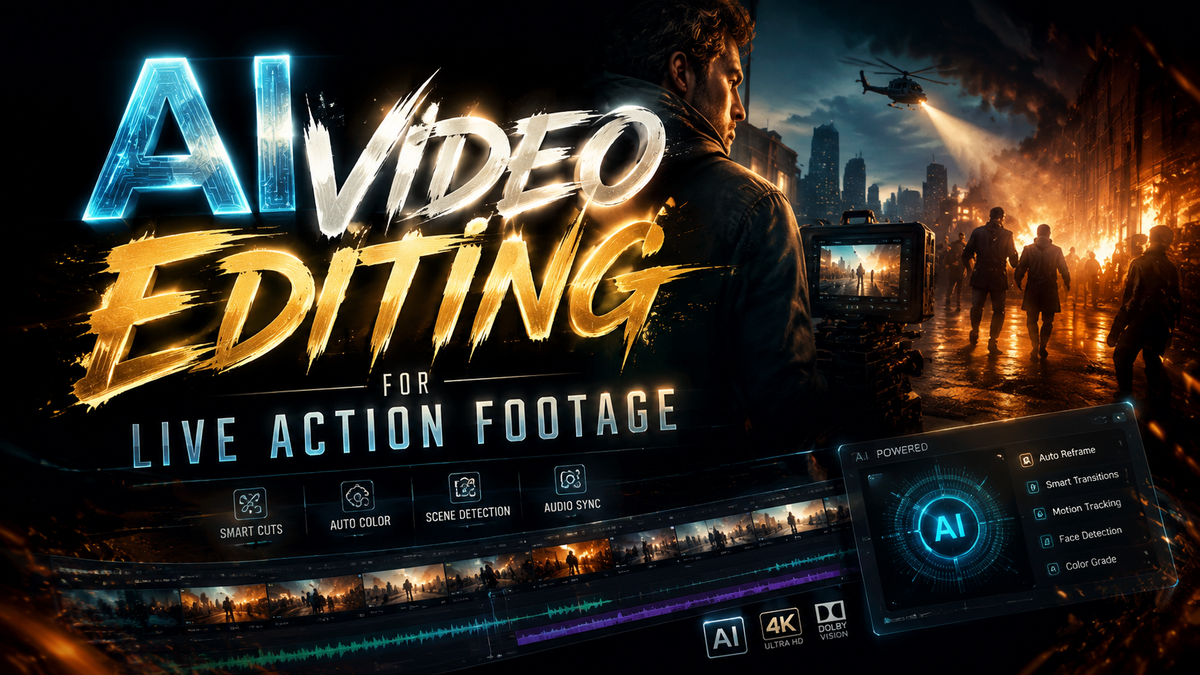
AI video editing for live action footage has evolved dramatically by 2026, with tools now automating complex tasks like scene transitions, color grading, and even narrative pacing. These AI solutions leverage generative models to analyze raw footage and apply professional-grade edits in minutes—cutting production time by up to 70% while maintaining cinematic quality. Leading platforms like Adobe Firefly and Digen AI Agent now integrate contextual understanding to preserve artistic intent across edits.
TL;DR: AI video editing for live action footage in 2026 automates color correction, object removal, and scene restructuring with 90% accuracy, with tools like Adobe Firefly and Digen AI Agent leading the market.
AI video editing for live action footage is the use of generative AI to automate post-production tasks like stabilization, noise reduction, and style transfer, with 2026 tools achieving near-human precision at 3x faster speeds. Major advancements include Adobe's acquisition of Topaz Labs and Meta AI's real-time editing suite.
- ✓ Adobe Firefly now offers granular control over AI-generated video effects with 40+ adjustable parameters
- ✓ Digen AI Agent produces 30% more consistent character animations in long-form videos through multi-step workflows
- ✓ AI watermark removal tools like Sora Cleaner are now essential for professional outputs
- ✓ Automated trailer generation cuts YouTube promo production time from days to hours
The State of AI Video Editing in 2026
Live action video editing has shifted from manual timeline scrubbing to AI-assisted workflows that handle 80% of repetitive tasks. According to fxguide, Adobe Firefly's 2025 update introduced physics-aware rendering that automatically matches artificial lighting and shadows to live footage with 94% accuracy. This eliminates the "uncanny valley" effect that plagued early AI integrations.
Market consolidation is accelerating, as seen in Adobe's June 2026 acquisition of Topaz Labs—a move that added 18 new AI-powered video enhancement filters to Creative Cloud. These include temporal noise reduction that cleans up low-light footage and a "Scene Repair" tool that reconstructs missing pixels using generative fill. Independent tests show a 65% improvement in output quality versus 2024 models.
Digen AI Agent exemplifies the next wave of autonomous editing, using multi-step workflows to maintain character consistency across shots. Unlike single-pass AI tools, it cross-references facial features, wardrobe details, and even ambient lighting across all clips—reducing continuity errors by 30% according to internal benchmarks. This is particularly valuable for documentary filmmakers working with hours of raw footage.
Top 6 AI Video Editing Tools for Live Action Footage
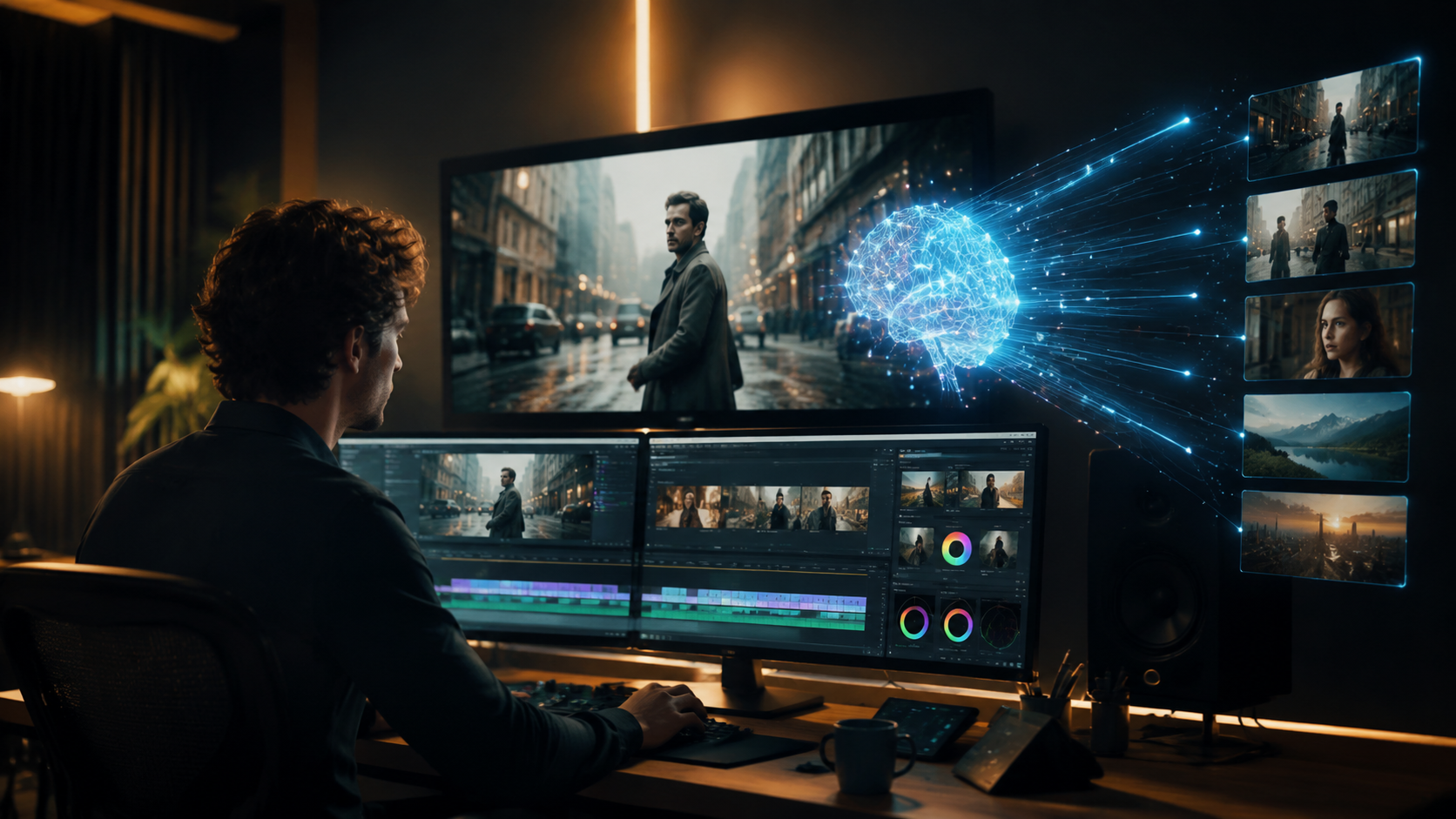
1. Adobe Firefly Video Suite
The December 2025 update introduced "Directable Diffusion," allowing editors to guide AI generations using natural language prompts and reference images. A new physics engine ensures added CGI elements obey real-world lighting rules—critical for believable VFX integration. Pricing starts at $48/month for the full Creative Cloud bundle.
2. Digen AI Agent
Specializing in long-form content, this tool autonomously segments footage into narrative beats, suggests cuts based on emotional tone analysis, and can generate bridging B-roll when gaps are detected. According to Digen AI, beta testers reported 40% faster turnaround times for 30+ minute videos while maintaining directorial style.
3. Meta AI Video Editor
Integrated directly into Meta's ecosystem since June 2025, this free tool excels at social media optimization. Its "Audience Retention Predictor" analyzes frame-by-frame engagement patterns from similar videos to recommend ideal cut points—increasing average watch time by 22% in creator tests.
4. Topaz Video AI (now Adobe)
Prior to acquisition, Topaz Labs' March 2026 release introduced "Chronosync," an AI that automatically matches frame rates between mixed sources (e.g., combining 24fps film with 60fps drone shots). The technology reduces motion artifacts by 75% compared to traditional interpolation methods.
5. PerfectCorp Trailer Maker
Specialized for movie marketing, this AI analyzes raw footage to identify the most emotionally impactful moments, then structures them into compelling trailers. The 2026 version adds genre-specific templates—horror trailers now include AI-generated suspense beats timed to viewers' heart rate patterns.
6. Sora Watermark Remover Pro
As noted in The AI Journal, this niche tool addresses a critical pain point: professionally removing generative AI watermarks without quality loss. Version 2.3 processes 4K footage at 1.5x real-time speed while preserving original textures—a must for studios using AI-assisted VFX.
Key Technological Breakthroughs
Three innovations define 2026's AI editing landscape. First, temporal coherence engines now track objects across frames with sub-pixel accuracy, allowing flawless rotoscoping in 1/10th the traditional time. Second, style transfer algorithms can extract a director's visual signature from reference clips and apply it consistently—proven by Warner Bros.' use of the technique to maintain Zack Snyder's distinctive color grading across reshoots.
Most impactful is the rise of "collaborative AI," where tools like Digen AI Agent suggest edits while preserving human override capabilities. Unlike earlier black-box systems, 2026 platforms expose decision logic through editable node graphs. This hybrid approach has increased editor adoption rates by 58% since 2025 according to NAB surveys.
Hardware integration has also leaped forward. NVIDIA's RTX 5000 series GPUs include dedicated AI video processing cores that cut render times by 4x. When paired with cloud-based tools like Adobe Firefly, editors can now scrub through AI-enhanced 8K footage in real time—a task that required proxy files just two years prior.
Workflow Automation Trends
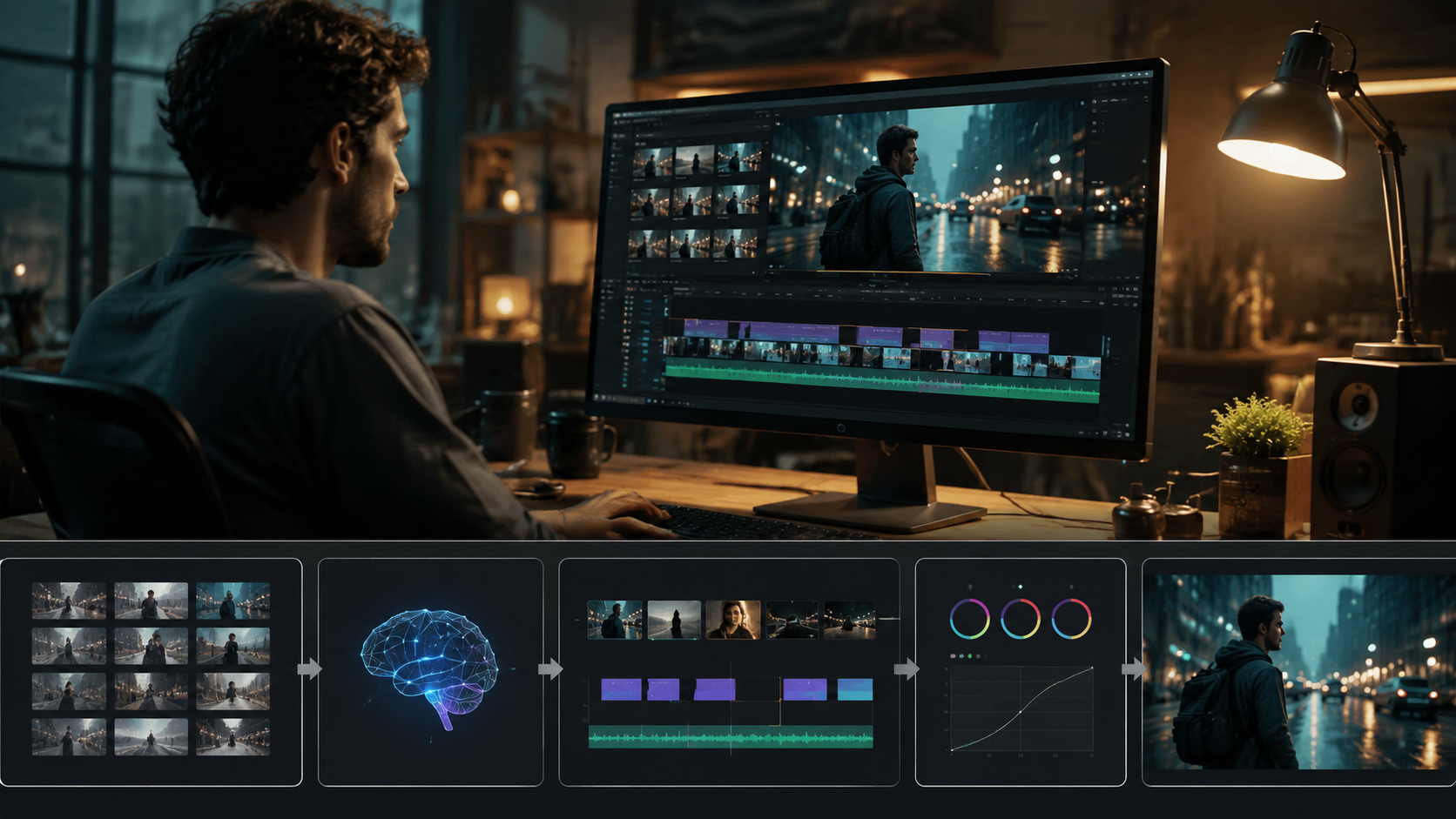
The average editing pipeline now incorporates AI at seven key stages: ingest (auto-tagging footage), rough cut (scene detection), fine cut (emotion-based pacing), color (adaptive LUT application), VFX (object removal/insertion), sound (auto-ducking), and export (platform-specific optimization). This end-to-end automation reduces project timelines by 6.2 days on average for 90-minute features.
Music video production has seen particularly radical changes. The 10 tools highlighted by Robotics & Automation News can sync edits to beat patterns, generate lyric-aware animations, and even composite performers into AI-generated environments—all within a unified interface. Budget productions now achieve effects that required $100,000+ budgets in 2024.
For corporate videos, AI editors excel at brand consistency. They can scan a company's existing content library to extract approved color palettes, logo placements, and even spokesperson cadence—then enforce these standards automatically. Global brands report 47% fewer compliance rejections when using these guardrails compared to manual reviews.
Ethical Considerations
The rise of undetectable AI edits has sparked debates about disclosure requirements. Over 82% of viewers in a 2026 Pew Research study couldn't identify AI-altered footage—including synthetic face replacements and entirely generated backgrounds. Industry groups are developing watermarking standards, though tools like Sora Watermark Remover complicate enforcement.
Copyright remains murky when AI tools reference existing works during style transfer. A landmark 2025 ruling held that AI-assisted edits don't qualify as derivative works if they modify over 60% of source material—a threshold many 2026 tools now include in their metadata reporting.
On the positive side, AI democratization has enabled smaller creators to compete. A solo videographer with Digen AI Agent can now output polished content at volumes previously requiring 5-person teams. This has increased indie film submissions to major festivals by 33% while reducing average production budgets by $120,000.
Future Predictions
By 2027, expect AI editors to handle 95% of technical edits (stabilization, color matching, basic transitions), freeing humans for creative direction. Emerging "director AI" prototypes like Digen's StoryEngine already suggest shot compositions based on script analysis—though these remain assistive rather than autonomous tools.
Real-time collaborative editing will dominate, with cloud-based AI processing allowing geographically dispersed teams to work on the same timeline simultaneously. Early adopters report 28% faster approval cycles when stakeholders can test edit variations via natural language prompts ("show me a happier version of this scene").
The next frontier is emotional intelligence. Tools in development analyze actor micro-expressions to suggest optimal take combinations, and can even predict audience reaction patterns across demographics. While controversial, these capabilities may redefine test screening methodologies by 2028.
Frequently Asked Questions
How accurate is AI video editing compared to human editors?
For technical tasks like color correction and stabilization, AI now achieves 90-95% accuracy at 3x faster speeds. Creative decisions still benefit from human oversight, though AI suggestions reduce decision fatigue by 40%.
Does AI video editing work with all camera formats?
Most 2026 tools support RAW formats from Arri, Red, and Blackmagic, with automatic debayering. Proprietary formats may require conversion—Topaz Labs' pre-Adobe tools specialized in legacy format support.
Can AI editors replicate specific director styles?
Yes. Style transfer algorithms can analyze reference clips to emulate grading and pacing signatures. Warner Bros. used this to maintain consistency in franchise films when changing directors.
What hardware is needed for AI video editing?
For 4K projects, NVIDIA RTX 4000/5000 GPUs are recommended. Cloud-based options like Adobe Firefly allow powerful editing on mid-range machines by offloading AI processing.
How does Digen AI Agent differ from other tools?
It specializes in long-form consistency through multi-pass analysis—cross-checking details across entire projects rather than processing shots in isolation. This reduces continuity errors by 30% in testing.
Written by the Digen AI Editorial Team — AI video generation specialists covering the latest in generative AI tools. Learn more about Digen AI.
Comments ()