
AI Video Creator vs Synthesia: 2026 Comparison Guide
In 2026, the key distinction between generic AI video creators and Synthesia boils down to avatar fidelity, enterprise readiness, and underlying technology. Synthesia leads the market with hyper-realistic avatars and a valuation of $4 billion, while alternative AI video creators often prioritize affordability, speed, and broader template libraries for casual users. This comparison guide examines the factors that matter most when choosing between a multi-purpose AI video creator and Synthesia for your content needs.
AI video creator vs Synthesia is a comparison between versatile, often lower-cost tools and a specialized, high-fidelity avatar platform. Synthesia excels in corporate communication with realistic AI avatars, while alternative AI video creators provide broader template libraries and quicker learning curves for social media and marketing content.
- ✓ Synthesia is the market leader with a $4 billion valuation after a 2026 funding round (The Guardian, Jan 2026).
- ✓ Alternative AI video creators typically offer lower entry prices and free tiers, making them accessible to individuals and small teams.
- ✓ Avatar realism is the strongest differentiator – Synthesia uses deep learning from real actors; competitors often rely on simpler generative models.
- ✓ Customization and integration options vary widely; Synthesia is built for enterprise workflows, while other tools emphasize rapid content creation.
- ✓ Your choice should align with your primary use case: corporate communications (Synthesia) vs. social media and explainer videos (general AI video creators).
Understanding the Landscape: AI Video Creators in 2026
The AI video generation market has matured rapidly by 2026. Tools now allow users to create talking‑head videos, product demos, and training content from simple text prompts. According to appinventiv.com (April 2026), building an AI video generator comparable to Synthesia costs between $50,000 and $150,000, reflecting the complexity of realistic avatar rendering and natural‑language processing. This investment barrier helps explain why Synthesia has attracted significant funding and acquisition interest, while many smaller AI video creators compete on price and ease of use.
Industry reports from quasa.io (June 2026) label Synthesia "the best AI video generator with realistic avatars," setting a high bar for competitors. Meanwhile, platforms like HeyGen (mentioned in a G2 Learn Hub hands‑on review from April 2026) have carved out niches by offering faster turnaround and more affordable plans. The landscape is dynamic, with new entrants and features appearing regularly. Understanding the strengths and limitations of each category is essential for making an informed decision.
AI Video Creator vs Synthesia: Avatar Quality and Customization
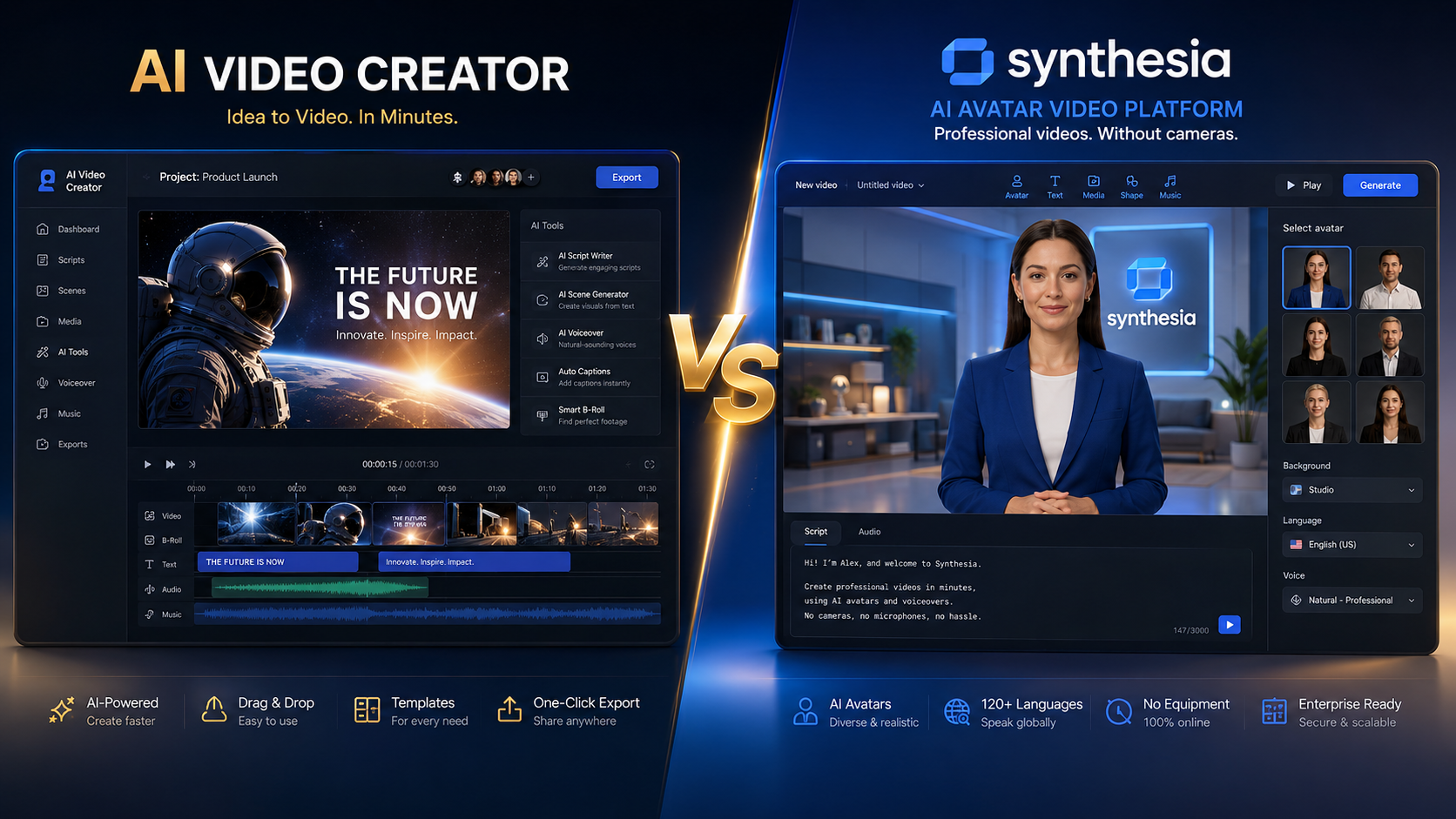
Avatar realism is often the deciding factor in the "AI video creator vs Synthesia" debate. Synthesia uses a proprietary deep‑learning pipeline trained on hundreds of actors, resulting in avatars that display natural lip‑sync, micro‑expressions, and body language. A hands‑on review on G2’s Learn Hub (published April 2026) noted that Synthesia’s avatars feel noticeably more lifelike than those of alternative tools like HeyGen, even after both platforms had updated their underlying models in 2026.
In contrast, many AI video creators rely on generative adversarial networks (GANs) or diffusion models that produce visually acceptable but sometimes less convincing avatars. Some tools offer animated or cartoon‑style characters as an alternative, which can be beneficial for explainer videos or content aimed at younger audiences. Customization also varies: Synthesia provides control over clothing, background, and camera angles, though the avatar’s core appearance is fixed. Other AI video creators may allow users to upload a photo and generate a personalized avatar, but the result is often less polished.
Comparison Table: AI Video Creator vs Synthesia
| Feature | General AI Video Creator (e.g., HeyGen) | Synthesia |
|---|---|---|
| Avatar Realism | Good, but occasional artifacts; less lifelike eye contact | Hyper‑realistic; trained on human actors; natural gestures |
| Number of Avatars | Typically 30–70 stock avatars; custom (photo‑based) available | Over 140 stock avatars; custom avatar service for enterprises |
| Customization Depth | Limited to preset scenes; some allow text‑to‑speech voice swaps | Full control over background, camera angle, avatar clothing, and voice pitch |
| Pricing (Average) | Free tier available; paid plans from $20–$50/month | Starting at $89/month for personal plan; enterprise plans tailored |
| Best For | Social media clips, quick explainers, low‑budget projects | Corporate training, product demos, internal communications |
| Integration & API | Basic integrations (YouTube, LinkedIn); limited REST API | Robust API, SSO, LMS integrations, and enterprise workflow support |
As the table shows, the choice hinges on which features align with your production scale and quality expectations. If you need ultra‑realistic avatars for professional communication, Synthesia is the clear leader. If flexibility and lower cost are more important, an alternative AI video creator may be a better fit.
Pricing and Plans: Which Fits Your Budget?
Pricing is a major factor in the "AI video creator vs Synthesia" comparison. Synthesia’s personal plan starts at around $89 per month, while its business and enterprise tiers can run several hundred dollars monthly. According to The Guardian (January 2026), Synthesia’s $4 billion valuation was achieved after a funding round that signaled strong investor confidence in its premium positioning. This pricing model is designed for organizations that require high‑quality avatars, dedicated support, and compliance features (e.g., data localization).
General AI video creators, on the other hand, often offer free tiers (limited watermark or duration) and paid plans between $20 and $50 per month. For example, the G2 review from April 2026 highlighted that HeyGen’s free plan allows users to create up to five minutes of video per month, making it an attractive entry point for solopreneurs and small teams. However, these lower‑cost tools typically restrict advanced features like custom avatars, full HD export, or private cloud deployment. The cost to build an AI video generator like Synthesia—$50k to $150k (appinventiv.com, April 2026)—also explains the pricing gap: building such a system is capital‑intensive, and Synthesia passes on the R&D costs accordingly.
Use Cases: Corporate Communication vs. Social Media Content
Bloomberg (August 2025) covered Synthesia’s role in rethinking corporate communication, highlighting its use by global firms for internal announcements, compliance training, and multilingual onboarding. The platform’s ability to clone a presenter’s voice and appearance ensures consistent messaging across offices worldwide. This enterprise focus is a core differentiator: Synthesia is built from the ground up to handle sensitive content, with ISO 27001 certification and granular permission controls.
In contrast, general AI video creators are optimized for speed and simplicity. They thrive in social media contexts where a quick turnaround, catchy visuals, and lower‑cost production are paramount. Content creators, marketers, and educators use these tools to produce explainer videos, TikTok‑style shorts, and product highlights without the need for expensive studio time. The G2 Learn Hub review (April 2026) noted that HeyGen’s interface is more intuitive for first‑time users, allowing them to generate a 30‑second video in under five minutes. For use cases where avatar realism is secondary—such as a casual “how‑to” video—a general AI video creator may be the more practical choice.
The Acquisition Interest and Market Position
The market dynamics of the AI video creator space were further validated in 2025 when Adobe reportedly discussed a $3 billion acquisition of Synthesia, according to The Information (October 2025). While the deal did not materialize, the discussion underscores the strategic value that incumbents see in high‑fidelity avatar technology. Synthesia’s valuation then nearly doubled to $4 billion in early 2026 (The Guardian), cementing its status as the category leader. This financial momentum allows Synthesia to invest heavily in research, expanding its avatar library and language support (now over 120 languages as of mid‑2026).
For alternative AI video creators, the landscape remains fragmented. Many are smaller startups or features within larger design platforms (e.g., Canva’s AI video tool). While they may not attract billion‑dollar valuations, they fill a vital role in democratizing video production. A user considering the "AI video creator vs Synthesia" question should weigh the maturity and support of a platform like Synthesia against the flexibility and low cost of newer entrants.
Making Your Choice: A Decision Framework
When deciding between a general AI video creator and Synthesia, follow these steps to align your tool with your goals:
- Define your primary use case: Corporate training and internal comms -> Synthesia. Social media or marketing -> consider a lower‑cost alternative.
- Assess avatar requirements: Need hyper‑realistic avatars with consistent branding? Synthesia is the benchmark. Is a “good enough” avatar acceptable? An alternative will save you money.
- Evaluate your budget: If you can invest $89+/month and value professional support, choose Synthesia. If you are a freelancer or small team, start with a free trial of an alternative.
- Check integration needs: Does your workflow require an API, SSO, or LMS compatibility? Synthesia offers enterprise‑grade integrations. Simpler tools integrate with basic social media platforms.
- Test both on a pilot project: Use free trials to create a short video. Compare output quality, editing time, and team feedback before committing.
By following this framework, you can confidently answer the “AI video creator vs Synthesia” question for your specific scenario.
What is an AI video creator?
An AI video creator is a software tool that uses artificial intelligence to generate videos from text, voice, or images. In 2026, most tools offer pre‑built avatars, text‑to‑speech, and editing capabilities to create talking‑head videos without filming.
Is Synthesia better than other AI video creators?
For avatar realism and enterprise features, Synthesia is widely considered the best option. According to a G2 review (April 2026) and quasa.io (June 2026), Synthesia outperforms alternatives in avatar quality, but alternatives offer lower pricing and faster time‑to‑video for simple projects.
How much does Synthesia cost in 2026?
Synthesia’s personal plan starts at about $89 per month. Business and enterprise plans are priced higher and include custom avatars, dedicated support, and advanced integrations. The cost reflects the investment in realism and security.
Can I create custom avatars with AI video creators?
Some AI video creators allow you to upload a photo to generate a custom avatar, but the quality is usually lower than that of a professional studio avatar. Synthesia offers a custom avatar service for enterprises, producing highly realistic clones from real human actors.
Which AI video tool is best for beginners?
For absolute beginners, tools like HeyGen or other lower‑cost AI video creators offer more intuitive interfaces and free trials. Synthesia, while still user‑friendly, has a steeper learning curve due to its advanced customization options.
What happened with Adobe and Synthesia?
In October 2025, Adobe discussed acquiring Synthesia for $3 billion, according to The Information. The deal did not close, but it highlighted Synthesia’s position as a leading AI avatar platform and its potential strategic value.
How realistic are Synthesia avatars compared to other tools?
Synthesia avatars are considered the most realistic in the market, thanks to deep learning models trained on hundreds of performers. Competitors use different generative AI techniques that can produce good results but often lack the micro‑expressions and natural eye movement seen in Synthesia outputs.



Comments ()