
AI Video Creator vs Human Editor: 2026 Showdown
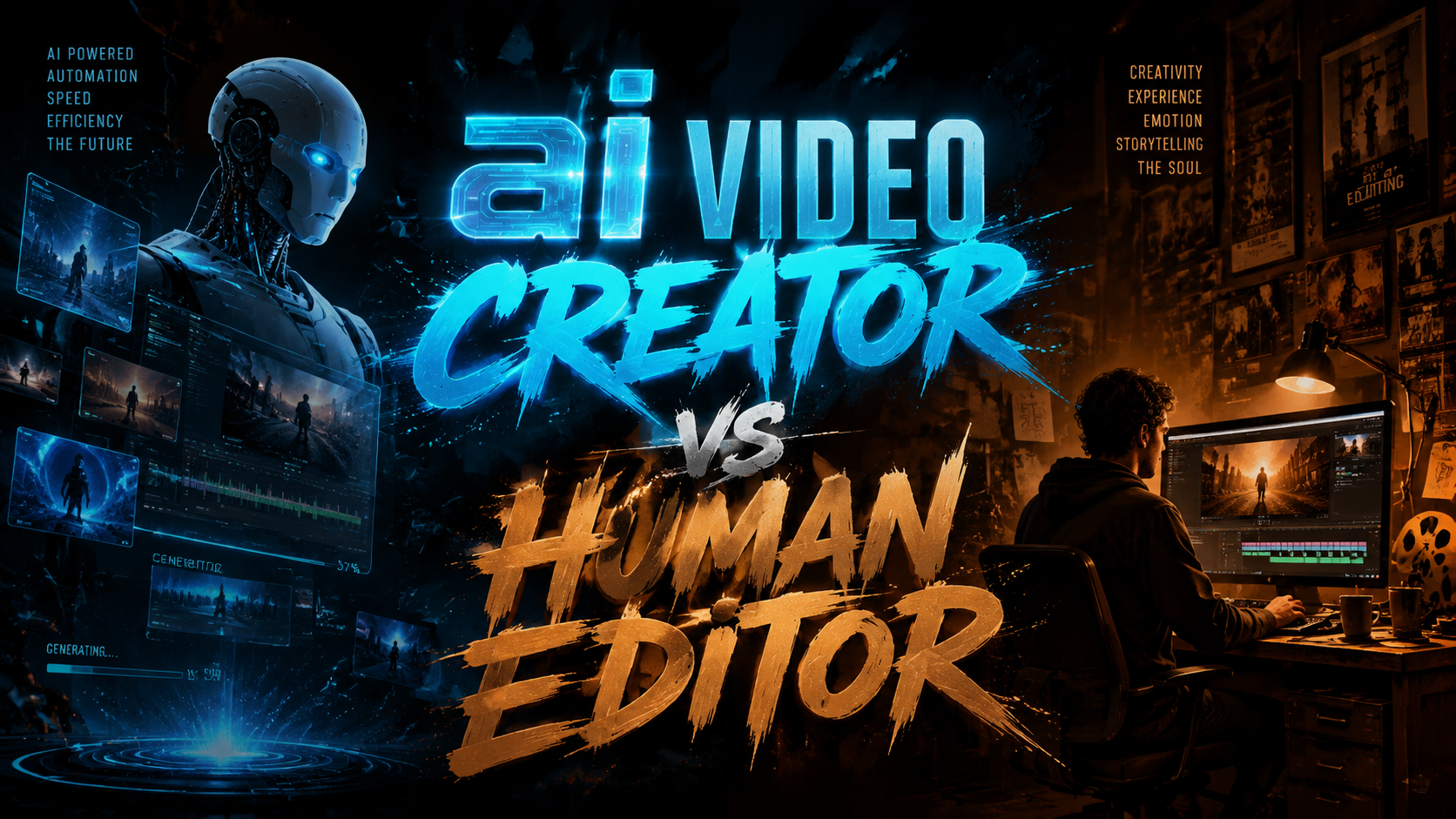
By 2026, the debate between AI video creators and human editors has evolved from "will AI replace humans?" to "how can they work together most effectively?" While AI video creator tools have seen a 66% surge in demand as businesses race to scale their marketing campaigns, human editors remain irreplaceable for creative storytelling, emotional nuance, and strategic oversight. The AI video creator vs human editor showdown isn't about choosing one over the other—it's about understanding the distinct strengths each brings to modern video production.
TL;DR: The AI video creator vs human editor showdown in 2026 isn't about replacement—it's about collaboration. AI tools handle speed and scale for social media content, while human editors provide creative direction, emotional depth, and quality control that algorithms cannot replicate.
AI video creator vs human editor is a false dichotomy in 2026. AI video creators excel at rapid content generation, repurposing long-form footage into short clips, and scaling production for platforms like TikTok and Instagram. Human editors bring creative vision, emotional storytelling, brand strategy, and the nuanced judgment that separates viral content from forgettable filler. The smartest businesses use both in tandem.
- ✓ AI video creator demand surged 66% in late 2025, driven by social media marketing needs and platforms like TikTok
- ✓ Human editors are not being replaced—businesses that harness both AI and human talent see the strongest ROI
- ✓ Hybrid workflows combining AI speed with human creativity deliver the highest-quality content at scale
- ✓ UGC-style video content remains the dominant format for high-performing social ads in 2026
- ✓ Specialized AI tools for music video generation are emerging, but human directors still guide the creative vision
The Rise of AI Video Creators: A 2026 Perspective
The landscape of video production has shifted dramatically over the past 18 months. According to AI Magazine, demand for AI video creators surged 66% as businesses raced to scale their marketing campaigns in late 2025. This wasn't a fleeting trend—it marked a fundamental change in how companies approach content production. The ability to generate short-form video content in minutes rather than days has proven irresistible for marketing teams operating on tight deadlines and even tighter budgets.
Platforms like TikTok, Instagram Reels, and YouTube Shorts have driven much of this growth. Stock Titan reported that Fiverr saw AI video creator searches increase by 66%, with TikTok-related work being a primary catalyst. Freelancers and agencies alike are now expected to produce more video content faster than ever before, and AI tools have become essential for meeting those demands without burning out creative teams.
However, this surge doesn't tell the whole story. The same research that highlights AI's explosive growth also reveals a more nuanced reality: businesses are not abandoning human editors. Instead, they are integrating AI video creators into existing workflows to handle repetitive tasks—transcription, captioning, clip extraction, and basic assembly—while freeing human editors to focus on higher-value creative work. The AI video creator vs human editor dynamic in 2026 is fundamentally collaborative, not competitive.
What AI Video Creators Do Best
AI video creators excel at tasks that require speed, pattern recognition, and data processing. They can ingest hours of raw footage and automatically identify the most engaging moments, generate captions in multiple languages, and repurpose long-form content into dozens of short clips optimized for different platforms. Tools like OpusClip have been at the forefront of this movement, prompting industry discussions about whether AI will ultimately replace creators altogether—a question that Tubefilter explored in depth in late 2025.
Human Video Editors: The Irreplaceable Creative Force
Despite the rapid advancement of AI video creation tools, human editors continue to hold a critical role in the production pipeline. As entrepreneur.com made clear in its October 2025 analysis, AI is not replacing human video editors—and businesses that try to go fully automated often end up with content that lacks soul. The emotional intelligence, cultural awareness, and creative intuition that human editors bring to a project cannot be replicated by algorithms, no matter how sophisticated they become.
Human editors understand context in ways that AI cannot. They know when a particular cut will evoke laughter, when a pause will build tension, and when a specific color grade will reinforce a brand's identity. They can interpret feedback from stakeholders and translate abstract creative direction into concrete editorial decisions. In the AI video creator vs human editor comparison, this ability to understand and manipulate emotional response remains the human editor's strongest advantage.
Moreover, human editors provide accountability and quality control. AI tools can sometimes produce artifacts, misinterpret content, or generate outputs that are technically correct but creatively off-brand. A human editor catches these issues before they reach the audience. They also bring strategic thinking to the editing process, ensuring that every video aligns with broader marketing goals, campaign messaging, and audience expectations. This strategic layer is something that no AI video creator can currently replicate.
The Creative Nuance Gap
The gap between AI-generated and human-edited video is most apparent in narrative-driven content. Documentaries, brand stories, and emotional testimonials all require a human touch to land effectively. AI can assemble clips, but it cannot craft a narrative arc that resonates on a deep emotional level. This is why high-end production houses and major brands continue to invest in human editorial talent, even as they adopt AI tools for efficiency.
AI Video Creator vs Human Editor: Head-to-Head Comparison
To understand where each option shines, let's examine the key capabilities side by side. The table below breaks down the most important factors in the AI video creator vs human editor decision.
| Capability | AI Video Creator | Human Editor |
|---|---|---|
| Speed of Production | Minutes to hours | Hours to days |
| Scalability | Unlimited (batch processing) | Limited by team size |
| Emotional Storytelling | Basic to moderate | Exceptional |
| Brand Consistency | Requires careful prompt engineering | Innate understanding |
| Cost for High Volume | Low per video | High per video |
| Creative Flexibility | Constrained by training data | Unlimited imagination |
| Quality Control | Requires human oversight | Built-in expertise |
| Best For | Social clips, captions, repurposing | Narrative content, branding, campaigns |
As the table illustrates, the AI video creator vs human editor decision depends entirely on the use case. For rapid content production at scale—think daily social media posts, ad variants, or multi-language versions—AI tools deliver unmatched speed and cost efficiency. For projects that require emotional depth, creative vision, or strategic alignment, human editors remain the gold standard.
Businesses that try to force all content through one channel or the other inevitably hit limitations. An all-AI approach produces content that feels generic and lacks emotional resonance. An all-human approach struggles to keep up with the volume demands of modern multi-platform publishing. The winning strategy is a hybrid model that leverages the strengths of both.
When to Use an AI Video Creator (and When to Stick with a Human)
The decision to use an AI video creator vs human editor should be guided by the specific requirements of each project. For high-volume, template-driven content, AI is the clear winner. Social media managers who need to produce 30 TikTok-style videos per week can use AI tools to repurpose existing long-form content, generate captions, and create platform-optimized exports in a fraction of the time it would take a human editor. Influencer Marketing Hub highlighted that UGC video makers are particularly effective for high-performing social ads in 2026, and many of these tools now incorporate AI to accelerate production without sacrificing the authentic, user-generated feel that audiences respond to.
For brand-defining content, however, human editors are non-negotiable. Your flagship product launch video, your annual brand film, and any content intended to build deep emotional connections with your audience should be crafted by skilled human editors. These projects require the kind of creative judgment, cultural sensitivity, and narrative craftsmanship that AI has not yet mastered—and may never fully achieve. The cost of producing these videos is higher, but the return on investment in terms of brand equity and audience engagement justifies the expense.
There is also a middle ground where AI and humans can work together on the same project. For example, an AI video creator can generate a first pass of a video by selecting the best clips, adding transitions, and syncing to music. A human editor then refines that rough cut, adjusting pacing, adding creative effects, and ensuring the final product meets quality standards. This collaborative workflow delivers the best of both worlds: AI speed for the heavy lifting and human artistry for the polish.
Specialized AI Tools in 2026
The AI video creation landscape has become increasingly specialized. The Music Universe recently profiled the five best AI music video generators, highlighting tools that can automatically synchronize visuals to music, generate abstract animations, and even create lyric videos. These tools are transforming the music industry by allowing independent artists to produce professional-quality music videos without a large production budget. However, even here, human directors and editors remain essential for conceptualizing the artistic vision and ensuring the final video feels cohesive and intentional.
The Hybrid Workflow: How AI and Humans Can Collaborate
The most effective video production teams in 2026 have abandoned the "AI vs human" framing entirely. Instead, they have developed hybrid workflows that assign tasks based on each party's strengths. In a typical hybrid workflow, the AI video creator handles the initial stages of production: ingesting raw footage, generating transcripts, identifying key moments, and producing a rough cut with basic transitions and captions. The human editor then takes over for the creative stages: refining the edit, adjusting pacing, adding color grading, integrating brand elements, and ensuring the final video tells a compelling story.
This division of labor yields significant efficiency gains. According to the same AI Magazine report, businesses that adopted hybrid workflows reported producing 2.5x more video content per month while maintaining or improving quality. The AI handles the repetitive, time-consuming tasks that previously ate up 60-70% of an editor's time, allowing human talent to focus on the 30-40% of work that actually drives creative impact.
Hybrid workflows also scale more effectively than all-human teams. When a campaign requires 50 video variants for A/B testing across multiple platforms, the AI video creator can produce all 50 in a matter of hours. The human editor then reviews and refines the top performers, ensuring that the final set of videos is both high-quality and strategically aligned. This approach allows businesses to test more creative directions without increasing editorial headcount, making it ideal for the fast-paced, data-driven marketing environment of 2026.
Tools and Platforms Supporting Hybrid Workflows
Several platforms have emerged specifically to support hybrid AI-human video production. These tools are designed with collaboration in mind, allowing editors to take AI-generated rough cuts and refine them using familiar editing interfaces. The best tools in this category offer API access, version control, and seamless integration with existing production pipelines. As the AI video creator vs human editor debate continues to evolve, the tools that bridge the gap between automation and artistry will become increasingly important.
The Future of Video Production: Predictions for 2027 and Beyond
Looking ahead, the AI video creator vs human editor dynamic will continue to evolve as AI technology improves. We can expect AI tools to become better at understanding context, emotional nuance, and brand voice, potentially closing the gap in areas where humans currently hold the advantage. However, complete replacement is unlikely for the foreseeable future. The most probable scenario is one of deepening collaboration, where AI handles increasingly sophisticated tasks and human editors focus on the highest levels of creative strategy and quality assurance.
Several trends are worth watching. First, the specialization of AI video tools will accelerate, with tools designed for specific verticals—music videos, educational content, e-commerce product demos, and more—offering increasingly tailored capabilities. Second, the role of the human editor will shift from hands-on editing to creative direction and AI oversight. Editors will spend less time cutting footage and more time training AI models on brand preferences, reviewing AI-generated outputs, and applying strategic corrections. Third, the demand for video content will continue to grow, driven by social media, streaming platforms, and immersive technologies like AR and VR, ensuring that both AI and human editors remain in high demand.
The ultimate lesson from the AI video creator vs human editor showdown is that technology is a tool, not a replacement. Businesses that understand this distinction and build workflows that leverage the unique strengths of both AI and human talent will be the ones that produce the most engaging, effective, and memorable video content. The future of video production is not AI versus human—it is AI and human, working together to create content that neither could produce alone.
Frequently Asked Questions About AI Video Creator vs Human Editor
Will AI video creators replace human editors entirely in 2026?
No. According to multiple industry reports, including analysis from entrepreneur.com, AI is not replacing human video editors. Instead, businesses are adopting hybrid workflows where AI handles repetitive tasks and humans focus on creative direction, emotional storytelling, and quality control. Complete replacement is not expected in the near future.
How much faster is an AI video creator compared to a human editor?
AI video creators can produce a basic edited video in minutes, compared to hours or days for a human editor. For tasks like clip extraction, captioning, and multi-platform repurposing, AI can be 10-20x faster. However, the final quality and creative polish still require human oversight in most cases.
What types of content are best suited for AI video creators in 2026?
AI video creators excel at short-form social media content, TikTok videos, Instagram Reels, YouTube Shorts, ad variants, repurposed long-form content, auto-captioned videos, and multi-language versions. They are also increasingly used for UGC-style social ads and basic music video generation.
What types of content still require a human video editor?
Brand films, product launch videos, documentary-style content, emotional testimonials, narrative storytelling, and any content that requires deep brand alignment or creative vision still benefit greatly from human editors. Projects where emotional resonance is critical are best handled by experienced human talent.
How can businesses balance cost and quality when choosing between AI and human editors?
The most cost-effective approach in 2026 is a hybrid model. Use AI video creators for high-volume, template-based content to keep costs low, and invest in human editors for high-impact, brand-defining projects. This balance allows businesses to scale production without sacrificing quality where it matters most.
What skills should human editors develop to stay relevant in an AI-driven industry?
Human editors should focus on creative direction, AI tool management, brand strategy, emotional storytelling, and quality assurance. The ability to train and oversee AI models, interpret data-driven insights, and apply creative judgment will become more valuable than traditional hands-on editing skills alone.
Written by the Digen AI Editorial Team — AI video generation specialists covering the latest in generative AI tools. Learn more about Digen AI.



Comments ()