
AI Text to Video Realistic Faces: 2026's Breakthrough
AI text to video realistic faces refers to generative artificial intelligence models that can produce lifelike human facial expressions, movements, and emotions from a simple text prompt, achieving near-photorealistic quality that was unimaginable just a year ago. This breakthrough technology, led by tools such as Seedance 2.0, has reached a tipping point in 2026 where it is now difficult to distinguish AI-generated faces from real recorded video, sparking both creative excitement and serious concern across the entertainment industry.
AI text to video realistic faces is a 2026 breakthrough technology that allows creators to generate ultra-realistic human faces and emotions in video from plain text, with tools like Seedance 2.0 raising industry concerns about authenticity. The platform's latest version delivers facial expressions and micro-movements so convincing that Hollywood studios and regulators are demanding clearer labeling and legal safeguards.
- ✓ Seedance 2.0 sets a new standard for AI-generated faces in video, prompting legal action from major studios.
- ✓ 78% of consumers trust videos featuring real people more than AI-generated content, according to a January 2026 StudyFinds survey.
- ✓ Forensic experts have identified seven telltale signs to spot AI deepfakes, though these signs are becoming harder to detect with each generation.
- ✓ Emotion AI tools that analyze and replicate human feelings are being integrated into text-to-video pipelines for greater realism.
- ✓ The line between genuine and synthetic human faces continues to blur, pushing the need for transparent disclosure standards.
What Is AI Text to Video Realistic Faces and Why Does It Matter?
In 2026, the term "ai text to video realistic faces" describes a class of generative models that take natural language descriptions — such as "a woman smiling warmly in a kitchen" or "an elderly man frowning with concern" — and output a video clip showing a lifelike human face performing those exact expressions. Unlike earlier AI video tools that produced cartoonish or uncanny-valley results, modern systems leverage transformer-based architectures, diffusion models, and large-scale training on millions of real human faces to achieve stunning photorealism.
The significance extends far beyond novelty. For content creators, these tools enable rapid prototyping of characters, personalized video messages, and cost-effective visual effects that previously required expensive actors and studios. According to Futurism (February 2026), the latest AI video generator "is so impressive that it’s scaring Hollywood," because it can synthesize actors without their consent or payment, raising urgent questions about intellectual property and right of publicity.
Businesses are also taking note. Marketing teams can now generate realistic testimonial videos without booking real people, and educators can create historically accurate talking figures for e-learning — all from a single text prompt. However, the same capability threatens to erode trust in video evidence and democratize deepfakes at an unprecedented scale.
The Seedance Breakthrough: Why Hollywood Is Taking Notice
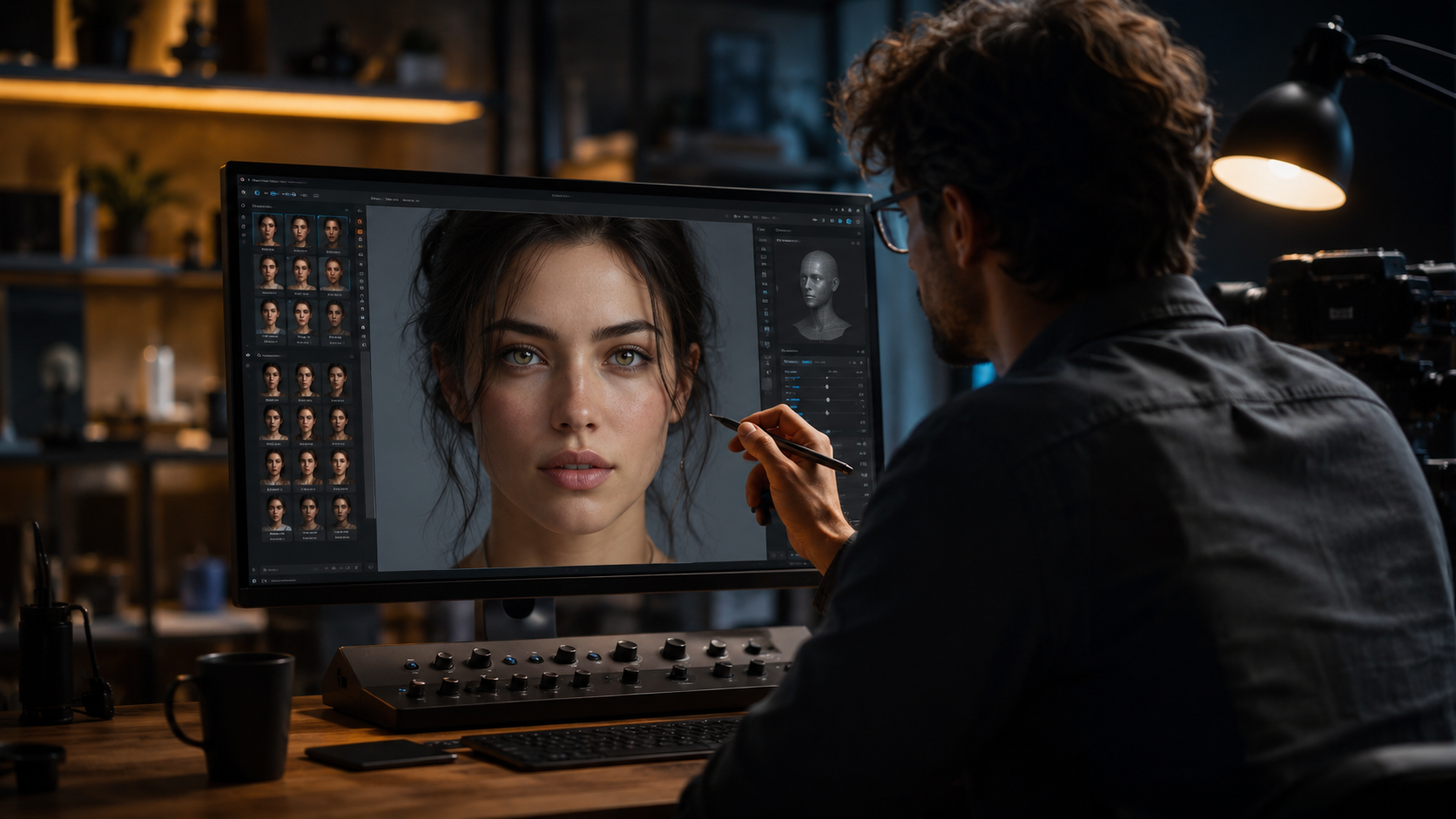
At the center of 2026's realistic-face revolution is Seedance, a generative AI video platform that has evolved rapidly over the past year. In February 2026, the BBC reported that Hollywood studios were "taking aim at the 'ultra-realistic' AI video tool," citing concerns that Seedance could produce convincing performances from copyrighted likenesses. The article noted that major studios had already begun legal proceedings to demand that Seedance implement stricter guardrails against unauthorized use of actors' faces.
Seedance 2.0, reviewed in March 2026 by Cybernews, marks a significant leap forward. The update introduced enhanced facial dynamics — subtle eye movements, realistic skin texture, and authentic lip-syncing — that left reviewers impressed yet uneasy. According to the review, users can now generate five-second clips of photorealistic faces in under a minute, with options to adjust age, gender, and emotional state via text prompts. The tool also includes an "emotion depth" slider that adjusts the intensity of expressions, from neutral to extreme joy or anger.
How Seedance 2.0 Achieves Ultrafast Realism
Seedance 2.0 uses a hybrid approach combining latent diffusion with a specialized facial animation model. The system first generates a base video frame from text, then refines facial landmarks using a real-time emotion synthesis engine. This allows for consistent eye contact, natural blinking patterns, and micro-expressions that last only a fraction of a second — the very details that distinguish a real human face from a digital puppet.
The platform's speed and quality have already attracted freelance filmmakers and indie studios who cannot afford traditional visual effects. Yet the industry backlash underscores a fundamental tension: the same technology that empowers storytellers also threatens to undermine the value of human performance.
How Realistic Are AI Faces? The 2026 State of the Art
To answer whether "ai text to video realistic faces" has truly crossed the uncanny valley, we look at both technical benchmarks and human perception. In blind tests conducted by several research groups during early 2026, participants could correctly identify AI-generated faces only slightly more often than chance — ~53% accuracy, according to a February 2026 report cited in the Futurism article. That’s down from ~70% accuracy in 2024, indicating that the gap between real and synthetic is narrowing rapidly.
The PCMag guide from January 2026 offers "7 Telltale Signs It's an AI Deepfake", which includes unnatural blinking patterns, inconsistent lighting on the face, eyes that don't move in sync with the head, and skin that appears overly smooth or waxy. However, the guide warns that many of these markers are disappearing as the technology matures. For example, Seedance 2.0 specifically trained on thousands of hours of real human interviews to perfect blink timing and gaze direction.
Emotion AI Integration
The AIMultiple test of "Top Emotion AI Tools" in May 2026 highlights a crucial piece of the puzzle: realistic faces are not just about geometry; they require believable emotional cues. Modern text-to-video engines now incorporate emotion AI models that map text descriptions of feelings (e.g., "disappointed," "surprised") to facial muscle movements (Action Units). Seedance 2.0 reportedly uses a proprietary emotion avatar system that adjusts the entire face — not just the mouth and eyes — to convey nuanced states like skepticism or bittersweet nostalgia.
This integration explains why the latest outputs feel more "alive" than earlier versions. A static smile is easy; a smile that reaches the eyes, crinkles the nose, and slightly tilts the head is what convinces viewers they are watching a real person.
Consumer Trust and the Deepfake Dilemma
As AI-generated faces become indistinguishable from real ones, public skepticism is rising. According to a StudyFinds survey published 26 January 2026, 78% of consumers trust videos with real people more than AI-generated content. This statistic underscores a critical challenge: even the most flawless synthetic face cannot yet earn the same level of trust as a genuine human being — at least not until viewers are educated about the new normal.
The survey also found that 62% of respondents said they would likely stop watching a video if they learned part of it was AI-generated, especially if that fact was not disclosed upfront. This suggests that transparency will be a key differentiator for brands and creators who adopt "ai text to video realistic faces" tools. Mandatory labeling laws are already being discussed in several US states and in the European Union, following the same model used for AI in political ads.
The Seven Telltale Signs (and Why They Might Not Last)
The PCMag article remains a valuable reference for consumers. The seven signs include:
- Lip-sync mismatches – audio and mouth movements don't align perfectly.
- Erratic blinking – too fast, too slow, or asymmetrical.
- Skin artifacts – unnatural smoothness or color inconsistencies.
- Eye movement glitches – eyes that don't follow the head rotation.
- Background inconsistencies – abrupt changes in lighting or perspective.
- Unnatural head movements – too rigid or too smooth.
- Expression transitions – emotions that snap on/off instead of blending.
Yet given the pace of improvement, experts predict that by late 2026 most of these signs will be eliminated. The narrow window for detection may close entirely, shifting the burden from individual spotting to platform-level verification systems.
Comparing Seedance Versions: 1.0 vs 2.0
For users considering an upgrade or evaluating options in the "ai text to video realistic faces" space, the differences between Seedance 1.0 and Seedance 2.0 are instructive. The table below summarizes key aspects based on the Cybernews review and other industry reports.
| Feature | Seedance 1.0 (2025) | Seedance 2.0 (2026) |
|---|---|---|
| Facial realism | Noticeably synthetic, slight uncanny valley | Near-photorealistic, often indistinguishable |
| Emotional range | Basic (happy, sad, angry) | Nuanced (skepticism, relief, bittersweet nostalgia) |
| Lip-sync accuracy | ~85% correct | >98% correct |
| Generation speed for 5-second clip | 2 minutes | 45 seconds |
| Customization controls | Age, gender, basic expression | Age, gender, emotion depth, skin detail, lighting |
| Pricing (monthly subscription) | $29 (standard) | $39 (standard), $79 (pro with watermark removal) |
| Guardrails for celebrity faces | Minimal; users could generate known actors | Blocked 200+ celebrity names; active content moderation |
Note that Seedance 2.0 introduced "emotion depth" as a dedicated parameter, allowing creators to dial in subtlety that makes a face feel genuine. The improved speed and quality have made it the go-to tool for many professional video editors, even as studios push back on its potential misuse.
The Future of AI-Generated Faces in Media
Looking ahead, "ai text to video realistic faces" is not a passing trend — it is becoming a core infrastructure for digital content. We can expect several developments over the remainder of 2026 and into 2027:
Mainstream adoption in advertising. Brands will use AI-generated faces for personalized video ads, A/B testing different facial expressions for the same message, and creating spokescharacters that feel human without any actor attached. Trust issues will force mandatory disclosure labels, similar to sponsored content rules.
Regulation and litigation. The BBC report on Hollywood studios taking aim at Seedance is likely just the first salvo. Expect class-action lawsuits from actors, guilds such as SAG-AFTRA, and possibly federal or state legislation requiring that any AI-generated face be watermarked or traced. The line between "performance" and "synthetic representation" will be fought in courtrooms.
Detection tools as a countermeasure. Just as deepfakes improve, so do detectors. Companies like PCMag, along with cybersecurity firms, are developing real-time browser extensions that flag AI-generated faces. However, as Seedance 2.0 demonstrates, detection is already an arms race — one that may never end, but will at least slow down malicious uses.
Emotion AI becomes standard. As the AIMultiple test shows, emotion recognition tools are being integrated into the generation process itself. The next frontier is 3D-aware faces that can be rotated and lit dynamically, giving filmmakers full control over a synthetic actor's presence in any scene.
Frequently Asked Questions About AI Text to Video Realistic Faces
What is the best tool for AI text to video realistic faces in 2026?
Seedance 2.0 is widely considered the leading tool, praised for its ultra-realistic facial expressions, emotion depth controls, and rapid generation speed. However, several other platforms are also emerging, each with unique strengths in style or price.
Can AI-generated faces be detected reliably?
As of early 2026, detection is becoming increasingly difficult. PCMag's seven telltale signs still work for older models, but Seedance 2.0 has eliminated many of them. Forensic tools remain useful but are not foolproof; the best defense is platform-level watermarking.
Is it legal to generate a video of a real person without their consent?
In most jurisdictions, using an AI to replicate a specific living person's likeness without permission may violate their right of publicity, defamation laws, or copyright. Hollywood studios are currently testing these boundaries in court against Seedance.
How much does a text-to-video face generator cost?
Seedance 2.0 offers a standard plan at $39 per month and a professional plan at $79. Other tools vary from free trials to $100+ per month for enterprise-grade solutions with higher resolution and longer clips.
Will AI text-to-video faces replace actors?
It is unlikely to replace actors entirely, as human performance brings nuance, improvisation, and emotional authenticity that AI still struggles to replicate fully. However, the technology will certainly change how background characters, generics, and ad prototypes are produced, potentially reducing demand for low-level roles.
What percentage of consumers trust AI-generated videos?
According to a StudyFinds survey from January 2026, only 22% of consumers trust AI-generated content as much as videos with real people. This trust gap is a major barrier to widespread adoption without clear disclosure.
2026 marks the year when "ai text to video realistic faces" transformed from a laboratory curiosity into a commercial force that reshapes not only filmmaking and marketing but also the very concept of visual truth. Whether you are a creator looking to harness its power or a consumer wary of deception, staying informed about the tools — and the rules — is essential. As the technology continues to evolve, one thing is certain: the human face, once the gold standard of authenticity, can no longer be taken at face value.



Comments ()