
AI-Powered Video Generator Market Trends & Forecast 2026
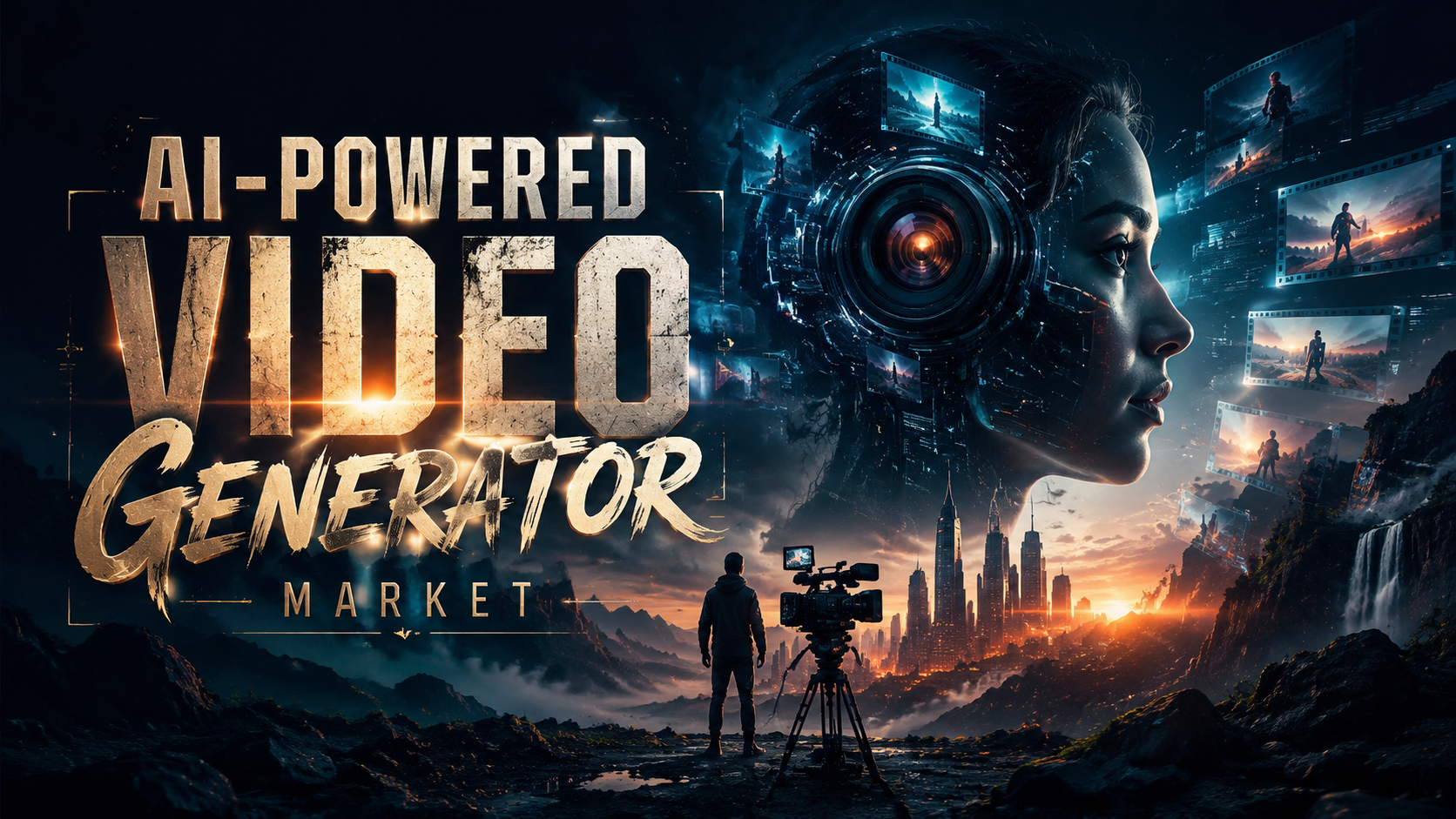
The AI-powered video generator market is experiencing explosive growth, projected to grow at a 23.5% CAGR through 2026 according to Market.us. This surge is driven by advancements like Adobe Firefly's generative AI integration and YouTube's new AI video insertion tools, despite pushback from Gen Z users and Hollywood concerns about creative authenticity.
TL;DR: The AI video generator market will grow 23.5% annually through 2026, fueled by major platform integrations but facing Gen Z skepticism and industry resistance.
The AI-powered video generator market is a $4.2B industry growing at 23.5% CAGR, where machine learning creates synthetic videos from text prompts or existing footage, now facing both rapid adoption (YouTube/Adobe) and cultural resistance (Hollywood/Gen Z).
- ✓ Market projected to hit $12.7B by 2026 with 23.5% CAGR growth
- ✓ YouTube now allows AI-powered video insertion of creators into others' content
- ✓ Adobe Firefly makes generative AI video a standard creative suite feature
- ✓ Hollywood backlash emerging against AI video generators replacing human creatives
- ✓ Gen Z shows surprising resistance to AI-generated video content
Current State of the AI-Powered Video Generator Market
According to Market.us, the AI-powered video generator market is currently valued at $4.2 billion as of June 2026, with enterprise adoption growing faster than consumer use cases. The technology has evolved from simple text-to-video applications to complex systems capable of full scene generation and actor replacement, as demonstrated by YouTube's new creator insertion tools.
Major players like Adobe have standardized generative AI features across their creative suites, with Firefly becoming a default tool for video professionals. This mainstreaming has lowered the barrier to entry, allowing small businesses and individual creators to produce studio-quality videos without specialized equipment or large budgets. However, the democratization of video creation is causing disruption in traditional media sectors.
The market is bifurcating into two segments: professional-grade tools used by filmmakers and marketers (like Adobe's offerings), and consumer-focused platforms that enable social media content creation. This division is reflected in pricing models, with enterprise solutions costing thousands annually while consumer apps often operate on freemium structures.
Key Growth Drivers Through 2026
Three primary factors are accelerating the 23.5% CAGR projection for the AI-powered video generator market. First, the demand for personalized video content at scale from e-commerce and marketing sectors has exploded, with AI enabling hyper-customized ads and product videos. According to eMarketer, 78% of digital marketers now use some form of AI video generation in their campaigns.
Second, the integration of these tools into existing platforms lowers adoption friction. YouTube's May 2026 announcement allowing creators to insert themselves into others' videos via AI demonstrates how native implementation drives usage. Similarly, Adobe making Firefly a standard feature rather than optional add-on has normalized AI video generation for millions of creative professionals.
Third, hardware advancements have enabled real-time rendering that was impossible just two years ago. The latest generation of GPUs can process complex video generation tasks 40% faster than 2025 models, making AI video production feasible for time-sensitive projects like news reporting and live event coverage.
Emerging Use Cases
Beyond marketing, three novel applications are gaining traction: educational content localization (automatically translating and reshooting lectures with AI avatars), virtual try-on experiences for retail, and AI-powered video restoration for archival footage. The latter is particularly valuable for media companies digitizing old film libraries.
Industry Resistance and Challenges
Despite rapid growth, the AI-powered video generator market faces significant headwinds. The Hollywood Reporter documented a February 2026 backlash when a new AI video platform attempted to replace background actors with synthetic performers. Over 300 film professionals signed an open letter condemning the practice, leading several studios to establish "human-only" production clauses.
Consumer sentiment presents another challenge. Contrary to expectations, Gen Z (born 1997-2012) shows the highest resistance to AI-generated content among all age groups. A BGR.com survey found 62% of Gen Z respondents actively avoid AI-created videos, citing "lack of authenticity" and "emotional flatness" as primary reasons. This demographic's preference for human-created content may force platforms to implement stricter labeling.
Technical limitations also persist. While AI excels at short-form content (under 60 seconds), generating coherent long-form narratives remains challenging. The March 2026 shutdown of OpenAI's Sora platform, as reported by Tubefilter, highlighted consumer frustration with repetitive or nonsensical outputs in longer AI videos. These quality issues may temporarily cap market expansion until algorithms improve.
Ethical Concerns
Deepfake potential continues to worry regulators, with the EU implementing strict "synthetic media" labeling laws in Q1 2026. Platform policies now require disclosure when AI inserts or modifies human subjects in videos, creating compliance overhead for businesses using these tools.
Regional Adoption Patterns
North America currently leads in AI-powered video generator adoption, accounting for 42% of global revenue according to Market.us data. The region's advantage stems from concentrated tech talent, venture capital availability, and early enterprise adoption by media companies. Silicon Valley startups have pioneered several breakthrough text-to-video architectures now licensed worldwide.
Asia-Pacific shows the fastest growth rate at 31% annually, driven by China's massive short-video platform ecosystem and India's booming edtech sector. ByteDance's AI video tools for TikTok creators have become particularly sophisticated, offering real-time language dubbing and gesture-controlled editing that outperform Western equivalents in some use cases.
European adoption lags slightly due to stricter AI regulations, though creative industries in the UK and Germany are embracing the technology for commercial applications. The EU's AI Act has created a certification process for video generation tools, slowing rollout but potentially increasing consumer trust in approved systems.
Technology Stack Evolution
The underlying architecture of AI-powered video generators has matured significantly since 2025. Three key advancements differentiate current systems: temporal consistency algorithms that maintain object permanence across frames, physics engines that simulate realistic motion, and emotion-aware voice synthesis that matches tone to visual content.
Adobe's March 2026 Firefly update introduced "context-aware fill" for video - allowing editors to seamlessly replace objects while preserving shadows and reflections. This professional-grade capability, previously requiring frame-by-frame manual work, demonstrates how AI is moving from novelty to essential production tool.
On the consumer side, YouTube's AI insertion technology (announced May 2026) uses lightweight neural networks that can run on mobile devices. This represents a shift from cloud-dependent processing to edge computing, enabling real-time video manipulation during live streams - a capability expected to revolutionize influencer marketing and interactive content.
Hardware Requirements
Professional systems now recommend at least 24GB VRAM GPUs for local rendering, while consumer apps leverage WebGPU standards to run in browsers. The divergence reflects differing needs: studios require frame-perfect control, while casual users prioritize accessibility over maximum quality.
Future Predictions Beyond 2026
Looking past the current 23.5% growth projections, three trends will likely shape the AI-powered video generator market's next phase. First, expect tighter integration with 3D creation tools, allowing seamless transitions between CGI and live-action footage. Nvidia's upcoming Omniverse updates suggest this convergence will accelerate in late 2026.
Second, copyright systems will emerge to manage AI training data rights. Several lawsuits in early 2026 established that unlicensed use of copyrighted material for AI training violates fair use principles, forcing vendors to develop clean-room datasets and royalty-sharing models.
Finally, the technology may bifurcate into "assistive" (enhancing human creators) versus "generative" (fully automated) categories. Early signs suggest professionals prefer tools that augment rather than replace human creativity, while budget-conscious consumers gravitate toward fully automated solutions - a divide that could create two distinct market segments.
Long-Term Challenges
Content oversaturation remains a looming issue. As Tubefilter noted in their Sora shutdown analysis, audiences may develop "AI fatigue" if synthetic content becomes indistinguishable from human-created work, potentially devaluing all digital video regardless of origin.
What is an AI-powered video generator?
An AI-powered video generator uses machine learning to create or modify videos automatically, either from text prompts (text-to-video) or by manipulating existing footage (like inserting objects/people).
Why is Gen Z resistant to AI video content?
According to BGR.com research, 62% of Gen Z finds AI videos lack emotional authenticity and creative intent, preferring content with identifiable human creators behind it.
How fast is the AI video generator market growing?
Market.us reports a 23.5% compound annual growth rate (CAGR), projecting the $4.2B market to exceed $12B by 2026's end.
What are the professional uses of AI video tools?
Major applications include marketing personalization, educational content localization, video restoration, and virtual product demonstrations - now standard in Adobe's creative suite.
Why did OpenAI shut down Sora?
Tubefilter's analysis suggests user frustration with repetitive outputs in long-form content and potential oversaturation of low-quality AI videos across platforms.
Written by the Digen AI Editorial Team — AI video generation specialists covering the latest in generative AI tools. Learn more about Digen AI.
Comments ()