
Add Subtitles to AI Video 2026: Step-by-Step Guide
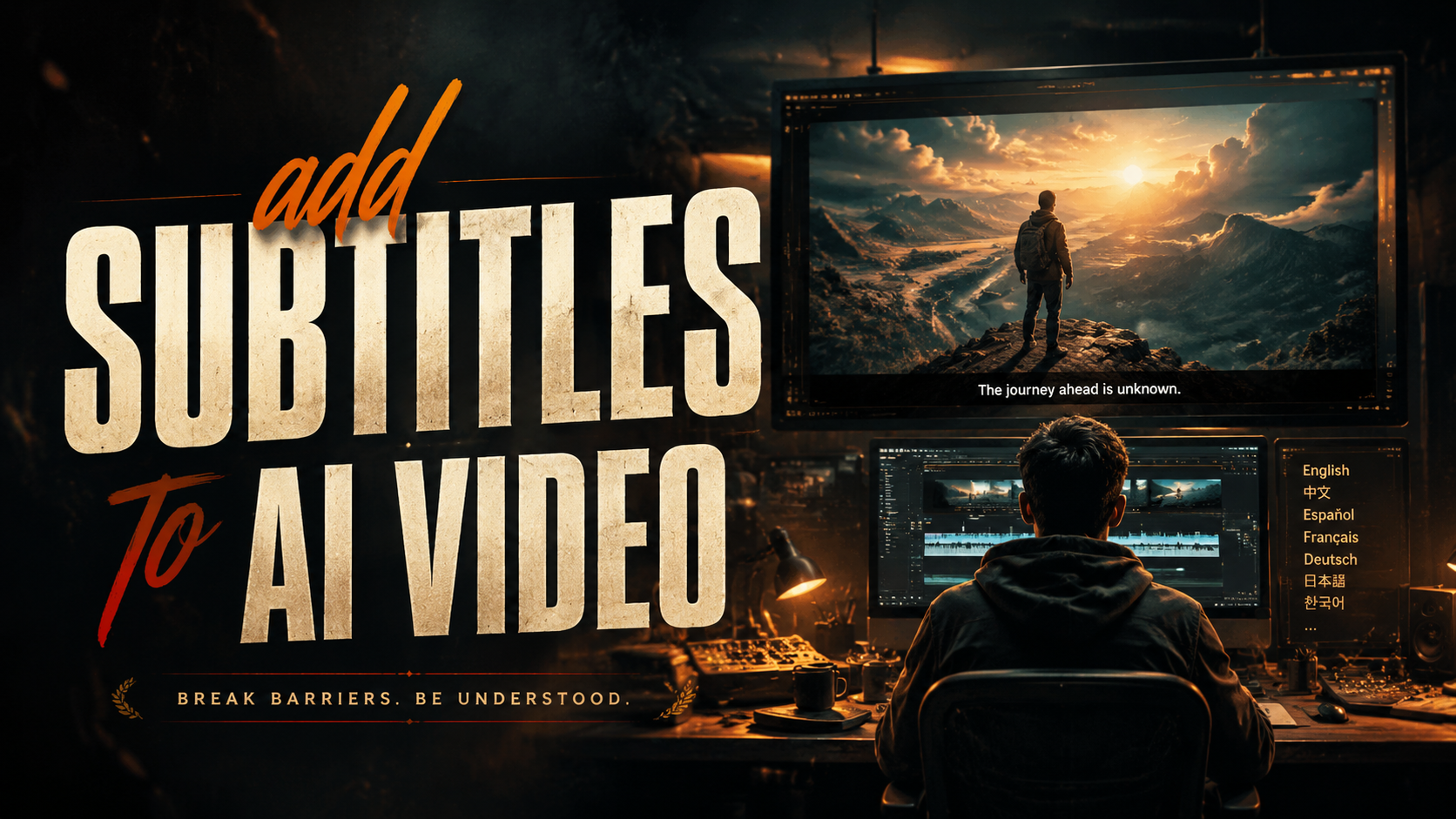
Adding subtitles to AI-generated video is no longer an optional accessibility feature — it's a core requirement for viewer retention, multilingual reach, and search engine visibility in 2026. To add subtitles to AI video, you typically export your AI-generated footage into a dedicated captioning tool or use the built-in subtitle generator inside modern AI video platforms, then review and export the final file with embedded or sidecar subtitle tracks.
TL;DR: In 2026, adding subtitles to AI video is faster and more accurate than ever thanks to native AI captioning tools, auto-sync features, and platform-specific updates like YouTube's new auto captions when muted. This guide walks you through the exact steps, the best tools, and expert best practices.
Adding subtitles to AI video is the process of automatically generating, editing, and embedding text captions onto AI-generated video content using speech recognition, natural language processing, and timecode alignment tools — all of which have become significantly more powerful in 2026.
- ✓ YouTube now auto-generates captions when a video is muted, making subtitle integration more critical than ever for engagement.
- ✓ Most AI video generators in 2026 include native subtitle tools, reducing the need for third-party software.
- ✓ Adding subtitles can improve watch time by up to 40% and boost SEO performance for video content.
- ✓ AI lip-syncing tools like Vozo can synchronize subtitle timing with on-screen speech for near-perfect accuracy.
- ✓ The BBC World Service now publishes AI-animated history videos with full subtitles on YouTube, setting a new industry standard.
Why Adding Subtitles to AI Video Matters in 2026
The landscape of video consumption has shifted dramatically in 2026. With platforms like YouTube introducing auto captions that appear the moment a user mutes a video — as reported by Social Media Today on February 10, 2026 — subtitles have become a primary driver of engagement rather than an afterthought. Viewers now expect captions to be present, accurate, and well-timed, especially for AI-generated content that may have unique speech patterns or synthetic voices.
Beyond engagement, subtitles directly impact accessibility. According to the W3C Web Accessibility Initiative, over 5% of the global population has some form of hearing impairment, making captions a legal and ethical requirement for public-facing video content. AI video creators who skip this step risk alienating a significant portion of their audience and potentially facing compliance issues in regulated industries.
From an SEO perspective, subtitle text is indexable by search engines, meaning every word you caption becomes searchable content. This can dramatically improve the discoverability of your AI videos. A study referenced by WikiHow found that videos with complete captions receive 13% more views on average than those without. In 2026, with AI-generated video flooding every platform, subtitles are one of the few remaining differentiators that can boost your content above the noise.
The Complete Step-by-Step Guide to Add Subtitles to AI Video
Below is a numbered, actionable workflow that works across the most popular AI video platforms in 2026. Whether you're using a text-to-video generator, an AI avatar tool, or a lip-sync model, these steps will help you produce professional-grade subtitles every time.
- Export your AI video with a clean audio track. Before adding subtitles, ensure your AI-generated video has a clear, isolated vocal track. Most AI video generators allow you to export the voiceover separately. This step dramatically improves automatic speech recognition accuracy later.
- Choose a subtitle generation method. You have three options: use the built-in subtitle tool inside your AI video platform, upload the video to a dedicated captioning service, or use a browser extension. For 2026, native tools are recommended because they maintain timecode precision.
- Run automatic speech recognition (ASR). Trigger the auto-caption feature in your chosen tool. Modern ASR engines in 2026 support over 100 languages with accuracy rates above 95% for clean audio. Let the tool process the full video length.
- Review and edit the generated captions. Manually scan every caption block. Pay special attention to proper nouns, technical terms, and speaker changes. AI-generated speech can sometimes produce homophone errors or misspellings that need correction.
- Set timing and duration. Adjust the in/out points so each caption stays on screen long enough to be read comfortably — generally 1.5 to 3 seconds per line. Most tools allow you to drag timecodes directly on a timeline.
- Choose your output format. Export as SRT (most common), VTT (for web), or burn the subtitles directly into the video file (hardcoding). For social media platforms, hardcoded subtitles are often preferred because they play automatically.
- Test on multiple devices. Play the final video on mobile, desktop, and tablet to confirm that subtitle font sizes, positions, and colors are readable across screen sizes. Make adjustments as needed.
Top AI Tools for Adding Subtitles to Your Videos in 2026
The AI video ecosystem in 2026 is rich with tools that either generate video with subtitles built in or offer seamless post-production captioning. According to the G2 Learning Hub, the seven best AI video generators tested in 2026 all include native subtitle capabilities. This integration means creators can go from script to captioned video in a single workflow, saving hours of manual labor.
One standout is the Vozo AI platform. As reviewed by Unite.AI on January 26, 2026, Vozo offers the most realistic AI lip-syncing currently available, which directly benefits subtitle accuracy. When the AI-generated mouth movements match the spoken words precisely, the auto-captioning engine can lock onto speech patterns with higher confidence. This synergy between lip-sync and captioning is a major 2026 trend.
On the platform side, YouTube's February 2026 update — auto captions when muted — changes the game for anyone publishing AI video to the platform. As noted by Social Media Today, this feature means that even users who browse with sound off will see your subtitles. Creators using AI-generated content should verify that their uploaded videos have clean, accurate caption tracks to take full advantage of this feature.
Comparison of Subtitle Features Across Popular AI Video Tools
| Tool | Native Subtitle Generator | Languages Supported | Export Formats | Lip-Sync Alignment |
|---|---|---|---|---|
| Vozo AI | Yes | 50+ | SRT, VTT, Burn-in | Excellent |
| Synthesia 2026 | Yes | 120+ | SRT, TXT, VTT | Good |
| HeyGen | Yes | 80+ | SRT, Burn-in | Very Good |
| Runway Gen-4 | Limited | 30+ | SRT | N/A |
| Pictory | Yes | 25+ | SRT, VTT | N/A |
When selecting a tool, consider not just the number of languages but the quality of the ASR engine. According to Built In, which listed 17 popular AI video generators as of April 21, 2026, the tools that integrate subtitle generation directly into the video creation pipeline tend to produce better timecode accuracy than those that rely on third-party integrations.
Best Practices for AI Video Subtitles in 2026
With the BBC World Service now publishing AI-animated Witness History videos on YouTube — as reported by Broadband TV News on February 25, 2026 — the bar for subtitle quality has been raised. Professional media organizations are treating captions as a production-critical element, not a post-hoc add-on. Here are the best practices that top creators follow in 2026.
First, always use a maximum of two lines per caption block. Studies on reading speed show that viewers can comfortably read 32 characters per line in 1.5 seconds. Exceeding this causes re-reading and frustration. Most modern AI captioning tools default to this standard, but it's worth verifying, especially for fast-paced AI-generated dialogue.
Second, position your subtitles in the lower third of the frame, but check for visual overlap. AI-generated videos often have graphic overlays, avatars, or on-screen text in the same region. In 2026, some advanced tools offer dynamic positioning that moves captions away from visual elements automatically — a feature worth seeking out if your videos are graphic-heavy.
Third, maintain consistent styling across your video library. Use the same font, color, background opacity, and size for all your content. This builds brand recognition and makes your videos feel professional. Avoid white text without a shadow or background, as it can become unreadable against bright AI-generated backgrounds.
Common Challenges When You Add Subtitles to AI Video and How to Fix Them
Even with the advanced tools available in 2026, adding subtitles to AI video comes with a few recurring challenges. The most common issue is timing drift — where the captions gradually fall out of sync with the speech over the duration of a long video. This happens because AI-generated voices can have irregular pacing, especially when the original script used complex sentence structures. To fix this, use a caption editor that lets you adjust individual timecodes rather than relying solely on auto-alignment.
Another frequent problem is misrecognition of technical or domain-specific terminology. AI speech-to-text engines are trained on general language data, so they may struggle with niche vocabulary, brand names, or acronyms. For example, a video about AI meme generators — like the 10 best tools reviewed by Vocal Media on January 25, 2026 — might contain slang and platform-specific terms that confuse standard ASR engines. The solution is to pre-load a custom dictionary or manually review and correct these terms.
Finally, consider the challenge of multi-speaker differentiation. If your AI video features two or more synthetic voices, the captioning tool may attribute dialogue to the wrong speaker. Some advanced tools in 2026 offer speaker diarization, which color-codes each speaker's captions. If your tool doesn't support this, manually label speakers in brackets — for example, [Host]: or [Narrator]: — to avoid confusion.
Future-Proofing Your AI Video Subtitle Workflow
As AI video generation continues to evolve rapidly, the tools and workflows for adding subtitles are also advancing. One major trend to watch is the integration of real-time captioning directly inside AI video editors. By late 2026, most major platforms will likely offer live preview of subtitles as you type your script, eliminating the separate export-and-caption step entirely.
Another emerging development is the use of AI to translate and re-caption videos into multiple languages automatically. Early 2026 releases from several vendors already support one-click multilingual subtitle generation, with translation accuracy that rivals professional human translators for common language pairs. For creators targeting global audiences, this is a game-changer.
Finally, keep an eye on the growing demand for subtitle customization in interactive and immersive video formats. As 360-degree video and AI-generated VR content become more common, the need for spatial subtitles — captions that appear to float in 3D space — will grow. Forward-thinking creators should experiment with these formats now to stay ahead of the 2027 curve.
Frequently Asked Questions About Adding Subtitles to AI Video
What is the easiest way to add subtitles to AI video in 2026?
The easiest way is to use the built-in subtitle generator inside your AI video platform. Tools like Vozo AI and Synthesia now include one-click auto-captioning that generates, timestamps, and embeds subtitles directly into your export. This eliminates the need for separate software.
Can I add subtitles to AI video after exporting?
Yes. You can upload your exported AI video to a captioning service or use desktop software like Subtitle Edit or online tools like Kapwing. However, you may need to manually adjust timecodes because the exported file no longer carries the original timing data from the AI generator.
Are AI-generated subtitles accurate enough for professional use?
In 2026, most AI subtitle engines achieve 95–98% accuracy on clean audio with standard accents. For professional or broadcast use — such as the BBC's AI-animated Witness History videos — human review is still recommended to catch homophones, proper nouns, and context-specific errors.
Does YouTube automatically add captions to AI-generated videos?
YouTube's automatic captioning works on any video that has a clear audio track, including AI-generated content. As of February 2026, YouTube also shows auto captions when a viewer mutes the video, making it essential to verify that the auto-generated captions are accurate before publishing.
What subtitle format should I use for social media?
For social media platforms like Instagram, TikTok, and LinkedIn, hardcoded (burned-in) subtitles are recommended because they appear automatically. For YouTube and Vimeo, SRT or VTT sidecar files are preferred because they allow viewers to turn captions on or off and enable translation features.
Can I translate AI video subtitles into multiple languages?
Yes. Many 2026 AI video tools offer one-click multilingual translation of subtitles. Vozo AI and Synthesia both support 50+ languages with automatic translation and re-timing. For maximum accuracy, review the translated captions with a native speaker before publishing.
How long does it take to add subtitles to a 10-minute AI video?
Using a native auto-captioning tool, the process takes approximately 5–10 minutes for generation and another 10–15 minutes for manual review and correction. Third-party captioning services may take longer due to upload and processing times. Total time is usually under 30 minutes.
Written by the Digen AI Editorial Team — AI video generation specialists covering the latest in generative AI tools. Learn more about Digen AI.
Comments ()