
Text to Video vs Traditional Animation: 2026 Guide
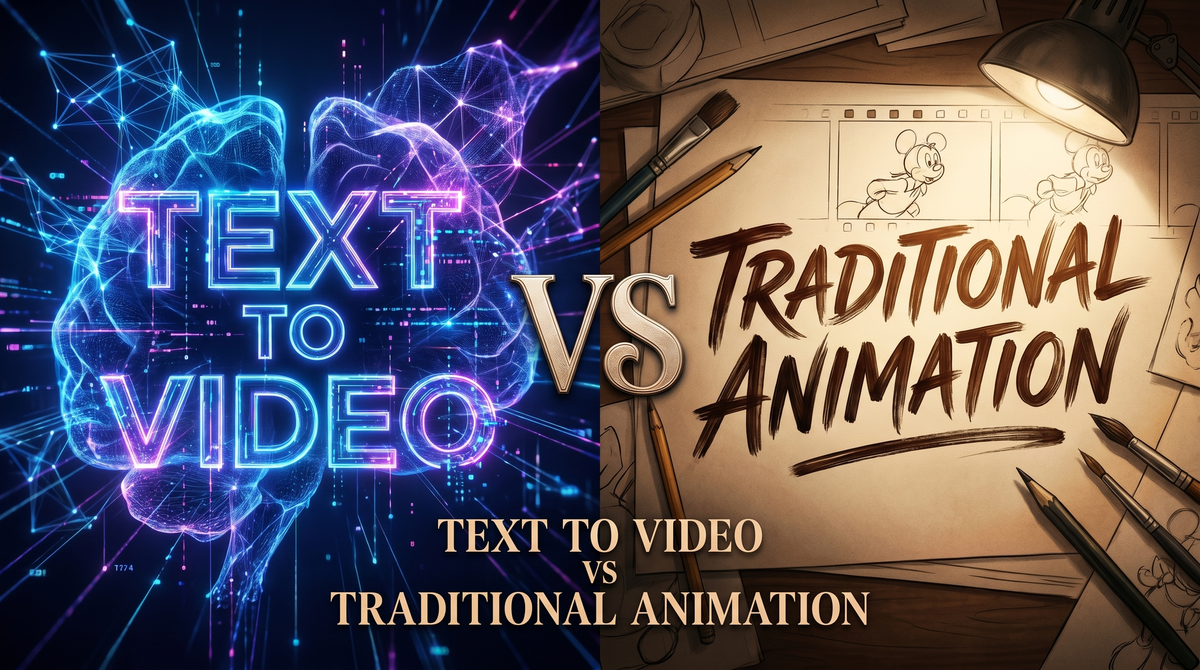
When comparing text to video vs traditional animation, the fundamental difference lies in automation versus craftsmanship: text-to-video AI generates moving images from text prompts in minutes, while traditional animation requires frame-by-frame artistry and human expertise. This 2026 guide examines the trade-offs in cost, quality, production speed, and creative control so you can decide which approach fits your project.
Text to video is an AI-driven process that converts written descriptions into animated sequences using generative models, eliminating manual frame creation. Traditional animation relies on human artists drawing, rigging, and compositing each shot. The choice depends on your budget, timeline, desired art style, and need for narrative flexibility.
- ✓ Text-to-video AI slashes production time from weeks to minutes, reducing costs by up to 90% for simple projects.
- ✓ Traditional animation offers unmatched creative control, unique art styles, and emotional depth that AI still struggles to replicate.
- ✓ The generative AI in animation market is projected to reach USD 31.37 billion by 2035, according to Precedence Research.
- ✓ Academic tools like Agent Opus (Duke Digital Media Community) and commercial releases like Gemini Omni are expanding what AI can achieve.
- ✓ Hybrid workflows—using AI for pre-visualization and traditional techniques for final polish—are becoming the industry standard in 2026.
Understanding Text to Video and Traditional Animation in 2026
Text-to-video AI refers to generative models that produce animated footage from natural language prompts. By 2026, tools have evolved far beyond early experimentations. Google’s “Dear Upstairs Neighbors” project, created by animators and AI researchers, demonstrated how AI can augment storytelling with coherent character movement and scene transitions. Meanwhile, Duke University’s Agent Opus offers 2D animation generation aimed at education and rapid prototyping.
Traditional animation—whether 2D hand-drawn, 3D CGI, or stop-motion—remains a labor-intensive art form. Studios like Ghibli and Pixar rely on teams of artists who draw, paint, rig, and composite thousands of frames. The process demands years of training and a deep understanding of timing, physics, and visual storytelling. Yet the rise of image-to-video AI generators, as reported by Techloy in June 2026, shows that static photos can now be turned into dynamic content with minimal effort, blurring the line between the two methods.
Key Differences: Cost, Speed, and Creative Control
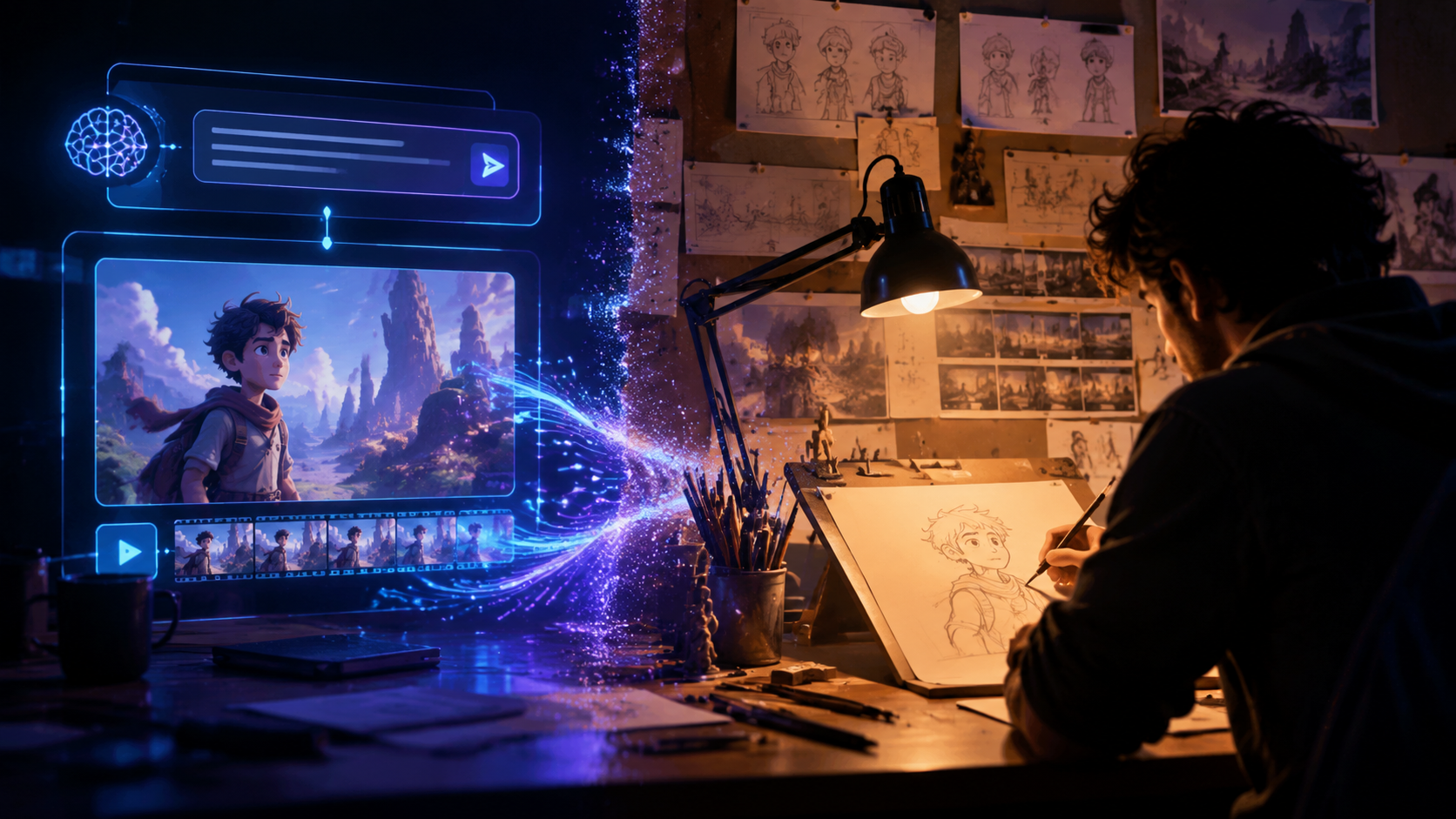
Side-by-Side Comparison
| Aspect | Text-to-Video AI | Traditional Animation |
|---|---|---|
| Production Time | Minutes to hours per scene | Days to weeks per minute of footage |
| Cost for a 60-second clip | $50–$500 (AI subscription or credits) | $5,000–$50,000 (artist labor, software, rendering) |
| Creative Flexibility | Limited by training data and prompt constraints | Unlimited – any style, any movement, any visual experiment |
| Visual Quality & Consistency | High for generic styles; occasional artifacts or style drift | Consistent, polished, can achieve cinematic quality |
| Skill Level Required | Basic prompt engineering & editing | Advanced artistry, animation principles, software mastery |
| Best For | Explainer videos, social content, rough drafts, low-budget projects | Feature films, branded storytelling, high-end commercials, art pieces |
The table reveals that while text-to-video AI democratizes access to animation—as highlighted by The Mountaineer in May 2026 in their piece “How AI Animation Generator Tools Are Making Video Creation Accessible to Everyone”—traditional animation retains an edge in originality and emotional resonance. The choice often hinges on whether your priority is speed and cost or artistic authenticity.
The Market Shift: Generative AI in Animation
Precedence Research’s March 2026 report states that the Generative AI in Animation Market size is expected to hit USD 31.37 billion by 2035, driven by increasing demand for rapid content creation across marketing, education, and entertainment. This growth is fueled by tools that reduce the barrier to entry. For example, the rise of image-to-video AI generators, covered by Techloy, allows anyone with a smartphone to turn a photo into a short animated clip, opening up new use cases for personal storytelling and social media marketing.
However, the same report also notes that traditional animation workflows are not disappearing. Instead, AI is being integrated into existing pipelines. Studios are using text-to-video for pre-visualization and background generation, then relying on human animators for character arcs and key emotional scenes. This hybrid model is already being explored by Google’s research team, as documented in the blog post about “Dear Upstairs Neighbors,” where animators collaborated with AI to produce a short film that blends machine-generated backgrounds with hand-drawn characters.
Real-World Applications and Case Studies
Accessibility for Non-Artists
According to The Mountaineer (May 2026), AI animation generator tools have made video creation accessible to non-artists, small businesses, and educators who previously lacked the budget for traditional animation. A teacher can now generate an explainer video from a script in minutes, while a startup can create product demos without hiring a studio. This democratization is a direct benefit of text-to-video technology.
Academic Innovation: Agent Opus
Duke Digital Media Community’s “Agent Opus - 2D Animation Generation” (March 2026) showcases an AI that can interpret complex prompts to produce multi-layered 2D scenes. The tool is used in classrooms to help students visualize concepts, but it also demonstrates how far AI has come in understanding narrative flow. The project’s success indicates that text-to-video AI is no longer limited to simple morphs—it can handle character interactions and scene changes.
Artist-AI Collaboration: “Dear Upstairs Neighbors”
Google’s blog (January 2026) details how animators and AI researchers co-created the short film “Dear Upstairs Neighbors.” The AI generated rough motion and background elements, while human animators refined the timing, added expression, and ensured emotional beats landed. This case study exemplifies the emerging best practice: use AI for speed and volume, then layer human artistry for quality and soul.
How to Choose Between Text to Video and Traditional Animation
Your decision should be guided by three factors: budget, timeline, and the level of creative control required. If you need a quick explainer video for social media, text-to-video AI (costing as little as $50) solves the problem. If you are producing a brand film that demands a unique visual identity and precise emotional storytelling, invest in traditional animation—or at least a hybrid approach.
Consider also the learning curve. Traditional animation requires years of training or hiring specialists. Text-to-video AI can be picked up in an afternoon, but it constrains you to the model’s style. The best strategy in 2026 is to prototype with text-to-video, then either use the output as a final product (for low-stakes content) or as a storyboard for a traditional studio.
The Future: Hybrid Workflows and Emerging Tools
Geek Vibes Nation reported in May 2026 that Gemini Omni could significantly change fan content, anime production, and geek culture. The tool’s ability to generate consistent character designs and maintain style across frames makes it a game-changer for fan animators and small studios. Similarly, Techloy’s coverage of image-to-video generators highlights how static photos are becoming dynamic content—a trend that will further blur the line between still and motion media.
As the market grows toward USD 31.37 billion, expect more hybrid solutions. Rather than a binary choice between text to video vs traditional animation, creators will increasingly combine both: using AI for speed and scalability, and human animators for the final polish that audiences recognize as art. The winners in this landscape will be those who master the blend, not those who cling to one method exclusively.
Frequently Asked Questions
Is text-to-video AI cheaper than traditional animation?
Yes, text-to-video AI is typically 10 to 100 times cheaper for short clips. A 60-second AI-generated video can cost under $500, while traditional animation often exceeds $5,000 for professional quality.
Can text-to-video AI replace human animators?
Not entirely. AI excels at generating generic animations quickly but lacks the nuanced storytelling, emotional depth, and stylistic originality that human artists bring. In 2026, the trend is collaboration rather than replacement.
What is the best use case for text-to-video in 2026?
It is ideal for rapid prototyping, social media content, educational explainers, and internal corporate videos. For high-end films or branded campaigns with a unique visual identity, traditional animation or a hybrid approach is recommended.
Which tools are leading in text-to-video animation?
Notable tools include Google’s Gemini Omni for fan content and anime, Duke’s Agent Opus for 2D academic animation, and various commercial platforms that power image-to-video conversion as highlighted by Techloy. The landscape evolves quickly, so always check the latest releases.
How long does it take to learn text-to-video AI compared to traditional animation?
Text-to-video AI can be learned in a few hours through tutorials and prompt experimentation. Traditional animation requires months to years of practice to achieve professional results, plus mastery of software like Toon Boom, Blender, or Maya.



Comments ()