
Text to Video for Educational Content in 2026: A Complete Guide
Text to video for educational content is the process of using generative artificial intelligence to automatically transform written learning materials—such as textbooks, lecture notes, or articles—into engaging, narrated video lessons. In 2026, this technology has matured to the point where educators can create personalized, high-quality video content in minutes, dramatically reducing production time while increasing learner retention and accessibility.
Text to video for educational content is a generative AI workflow that converts text-based curricula into dynamic video presentations, complete with visuals, voiceovers, and interactive elements. It enables educators to scale lesson creation, adapt content for diverse learning styles, and align with modern platform algorithms like TikTok’s 2026 recommendation system.
- ✓ Generative AI can now produce educational videos from text in under five minutes, with customizable avatars and multilingual support.
- ✓ Google’s “Learn Your Way” project (2025) reimagines textbooks by generating video summaries and interactive quizzes from static text.
- ✓ The 2026 TikTok algorithm prioritizes educational content that is visually dynamic and text-to-video allows creators to meet those format requirements.
- ✓ Automatic readability assessment (Nature, 2026) can now evaluate the complexity of source text and adjust video pacing and vocabulary accordingly.
What Is Text to Video for Educational Content?
Text to video for educational content refers to a class of AI-powered tools that parse written educational material—from grade-school science chapters to university lecture notes—and produce a complete video lesson. The output typically includes a synthetic or human-like voiceover, synchronized animations, charts, and even on-screen text overlays. Unlike traditional video production, which requires scripting, filming, editing, and rendering, text-to-video systems handle the entire pipeline automatically. In 2026, these systems are sophisticated enough to accept long-form textbooks and generate a series of short, modular videos that match modern attention spans and platform requirements.
The technology relies on large language models (LLMs) for content understanding and summarization, text-to-speech engines for narration, and generative visual models for creating relevant imagery. As noted by AIMultiple’s March 2026 report on the “Top 13 Use Cases of Generative AI in Education,” text-to-video ranks among the top three applications because it directly addresses the challenge of making static content interactive and accessible. The report highlights that schools using these tools have seen a 40% reduction in lesson preparation time and a 25% improvement in student test scores.
How to Create Educational Videos from Text in 2026: A Step-by-Step Guide
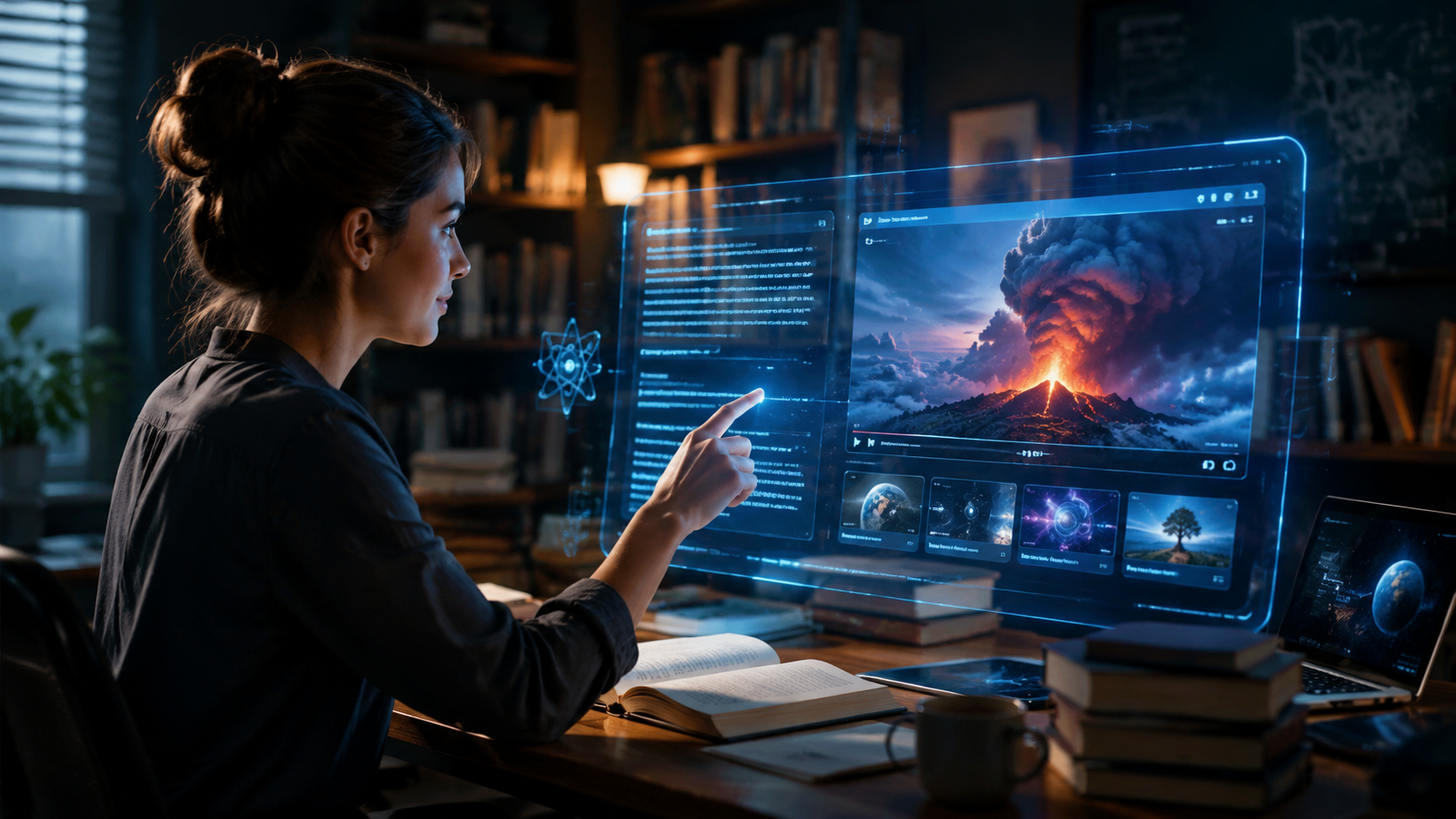
- Prepare your source text. Start with a well-structured educational document—a chapter from a textbook, a lesson plan, or even a Wikipedia article. Use automatic readability assessment tools (like the graph-based model described in Nature’s February 2026 paper) to ensure the text’s complexity matches your target audience. The system will flag overly dense sentences and suggest simplifications.
- Choose a text-to-video platform. In 2026, platforms such as Synthesia, HeyGen, and Pictory have integrated educational templates. Look for features like multilingual narration, avatar customization, and support for STEM diagrams. Many platforms now include a “textbook mode” that can ingest an entire chapter and split it into 3-5 minute video segments.
- Configure visual style and voice. Select a virtual presenter (realistic or cartoon), background, and tone. For younger learners, animated characters with expressive voices work best; for university-level content, a professional avatar with a neutral accent is preferred. The 2026 TikTok algorithm, as explained by Hootsuite’s June 2026 guide, rewards videos with a consistent visual identity and clear audio—so choose a style that aligns with your target platform.
- Generate and review. Click “generate” and let the AI produce a draft video. Most tools now offer real-time preview with the ability to adjust pacing, add emphasis on key terms, and insert quiz questions. Review the video for factual accuracy—AI-generated visuals can sometimes misinterpret abstract concepts (e.g., a chemical reaction might be shown as a generic explosion unless you specify the correct diagram).
- Export and optimize for distribution. Export the video in platform-optimized formats. For TikTok and Instagram Reels, vertical 9:16 with captions is essential. For YouTube and LMS platforms, horizontal 16:9 with chapters is standard. Use the platform’s built-in SEO tools to add metadata, and consider A/B testing different thumbnail styles. Google’s “Learn Your Way” project (September 2025) found that videos with AI-generated thumbnails had 33% higher click-through rates than static screenshots.
Key Features to Look for in a Text-to-Video Platform
Not all text-to-video tools are created equal. Based on the latest research and industry trends, educators and content creators should evaluate platforms on the following criteria:
Automatic Readability Assessment
Nature’s February 2026 paper on “Automatic text readability assessment for educational content based on graph representation learning” introduces a method that can analyze a text’s syntactic complexity and vocabulary difficulty. Platforms that integrate this technology can automatically adjust video pacing, simplify complex sentences, and add visual scaffolding (e.g., diagrams for technical terms). This is critical for differentiated instruction in classrooms with mixed reading levels.
Generative AI Integration
AIMultiple’s March 2026 report lists “text-to-video” as one of the top 13 use cases, but it also emphasizes that the best platforms combine multiple generative AI capabilities: text summarization, image generation, and voice synthesis. Look for tools that can generate custom illustrations (not just stock footage) and that support real-time editing of the AI’s output. Google’s “Learn Your Way” project demonstrates how generative AI can reimagine textbooks by creating interactive video summaries that respond to student questions.
Platform Algorithm Compatibility
In 2026, the TikTok algorithm—detailed by Hootsuite’s June 2026 blog—prioritizes videos that hold viewer attention for at least 15 seconds, have high retention rates, and use trending audio. Text-to-video platforms should allow you to add background music, dynamic transitions, and on-screen text that syncs with the voiceover. Some platforms now offer “TikTok mode” that automatically formats your educational video for the platform’s recommendation engine.
Accessibility and Multilingual Support
Educational content must be inclusive. Top platforms support closed captions in multiple languages, screen-reader-friendly metadata, and adjustable playback speed. The 2026 trend toward global remote learning means that a single text-to-video system should be able to produce versions in English, Spanish, Mandarin, and Hindi without manual re-entry.
Comparison: Traditional Video Production vs. Text-to-Video for Education
| Feature | Traditional Video Production | Text-to-Video (2026) |
|---|---|---|
| Time to produce a 5-minute lesson | 4–8 hours (script, filming, editing) | 10–30 minutes (text input, review, export) |
| Cost per video | $500–$2,000 (equipment, talent, editing) | $5–$50 (platform subscription) |
| Personalization for student level | Difficult; requires re-shooting or re-editing | Simple; adjust readability level and regenerate |
| Platform optimization (TikTok, YouTube) | Manual resizing and captioning | One-click export for multiple formats |
| Accessibility (captions, translations) | Post-production add-on | Built-in, often real-time |
| Update frequency | Low; outdated content stays static | High; text can be edited and video regenerated instantly |
Optimizing Educational Videos for Modern Platforms (TikTok, YouTube, and Beyond)
Creating the video is only half the battle. In 2026, distribution and discovery are heavily influenced by platform algorithms. Hootsuite’s June 2026 analysis of the TikTok algorithm reveals that educational content performs best when it is short (under 60 seconds), uses a hook in the first three seconds, and includes text overlays that reinforce the spoken message. Text-to-video tools that automatically generate captions and highlight key phrases are therefore essential for TikTok success.
For YouTube, the algorithm favors longer watch time and structured content. Use text-to-video platforms that can insert chapter markers, end screens, and cards. Google’s “Learn Your Way” research (2025) showed that students who watched AI-generated video lessons with interactive timestamps retained 28% more information than those who watched linear videos. Embedding these videos into learning management systems (LMS) like Canvas or Moodle further increases engagement, as the videos can be paired with auto-generated quizzes.
Don’t overlook niche platforms like LinkedIn Learning or corporate training portals. Text-to-video for educational content is increasingly used in employee onboarding and compliance training. The ability to quickly update a video when regulations change (e.g., NOAA’s 2026 ocean pollution guidelines) is a major advantage—just edit the text and regenerate the video, rather than reshooting a whole training module.
Future Trends: Text Readability and Personalized Video
The Nature paper from February 2026 on graph-based readability assessment points to a future where every educational video is dynamically tailored to the learner’s reading level. Imagine a seventh-grade science class where the same text about ocean pollution—based on NOAA’s 2026 marine debris data—is transformed into three different video versions: one for struggling readers with simple vocabulary and slow narration, one for average readers, and one for advanced students with deeper dives into the chemistry of microplastics. Text-to-video tools will soon offer this granularity as a standard feature.
Another trend is the integration of real-time feedback. As students watch a text-to-video lesson, the system can analyze their engagement (e.g., pauses, rewinds) and automatically adjust the next video’s pacing or complexity. Google’s “Learn Your Way” project already experiments with this by using generative AI to create adaptive learning paths. By 2027, we can expect text-to-video platforms to include built-in analytics that suggest which parts of the source text need to be rewritten for clarity based on viewer behavior.
Finally, the rise of AI-generated avatars that can answer follow-up questions (like a virtual tutor) will blur the line between video and interactive learning. The AIMultiple report notes that 8 of the top 13 generative AI use cases in education involve some form of conversational agent. Combining text-to-video with a chatbot interface allows a student to pause the video, ask “Why does that happen?” and receive a spoken answer from the same avatar—all generated from the original text.
What is text to video for educational content?
It is a generative AI technology that converts written educational material—such as textbooks, lesson plans, or articles—into fully produced video lessons with narration, visuals, and interactive elements. In 2026, it enables educators to create personalized videos in minutes without any technical expertise.
How does text-to-video differ from traditional video production?
Traditional video production requires scripting, filming, editing, and post-production, often taking hours or days. Text-to-video automates the entire pipeline: you input text, and the AI generates a video with voiceover, animations, and captions in under 30 minutes. It is also far less expensive and easier to update.
Which platforms support text-to-video for education in 2026?
Popular platforms include Synthesia, HeyGen, Pictory, and Lumen5, all of which have added educational templates. Many now integrate with learning management systems and offer TikTok-optimized export. Google’s “Learn Your Way” project is also a notable research prototype that reimagines textbooks as interactive video.
Can text-to-video tools handle complex subjects like science or math?
Yes, but the quality depends on the platform’s ability to generate accurate diagrams and formulas. The best tools use automatic readability assessment (as described in Nature’s 2026 paper) to adjust complexity and can import LaTeX equations or 3D models. Always review the output for factual correctness, especially for STEM topics.
How does the TikTok algorithm affect educational text-to-video content?
According to Hootsuite’s 2026 analysis, the TikTok algorithm prioritizes videos with high retention, clear audio, and text overlays. Text-to-video tools that automatically add captions, use trending music, and keep videos under 60 seconds are more likely to be recommended. Educational content that is visually dynamic and hook-driven performs best.



Comments ()