
Text to Video AI vs Video Editing Services: 2026 Showdown
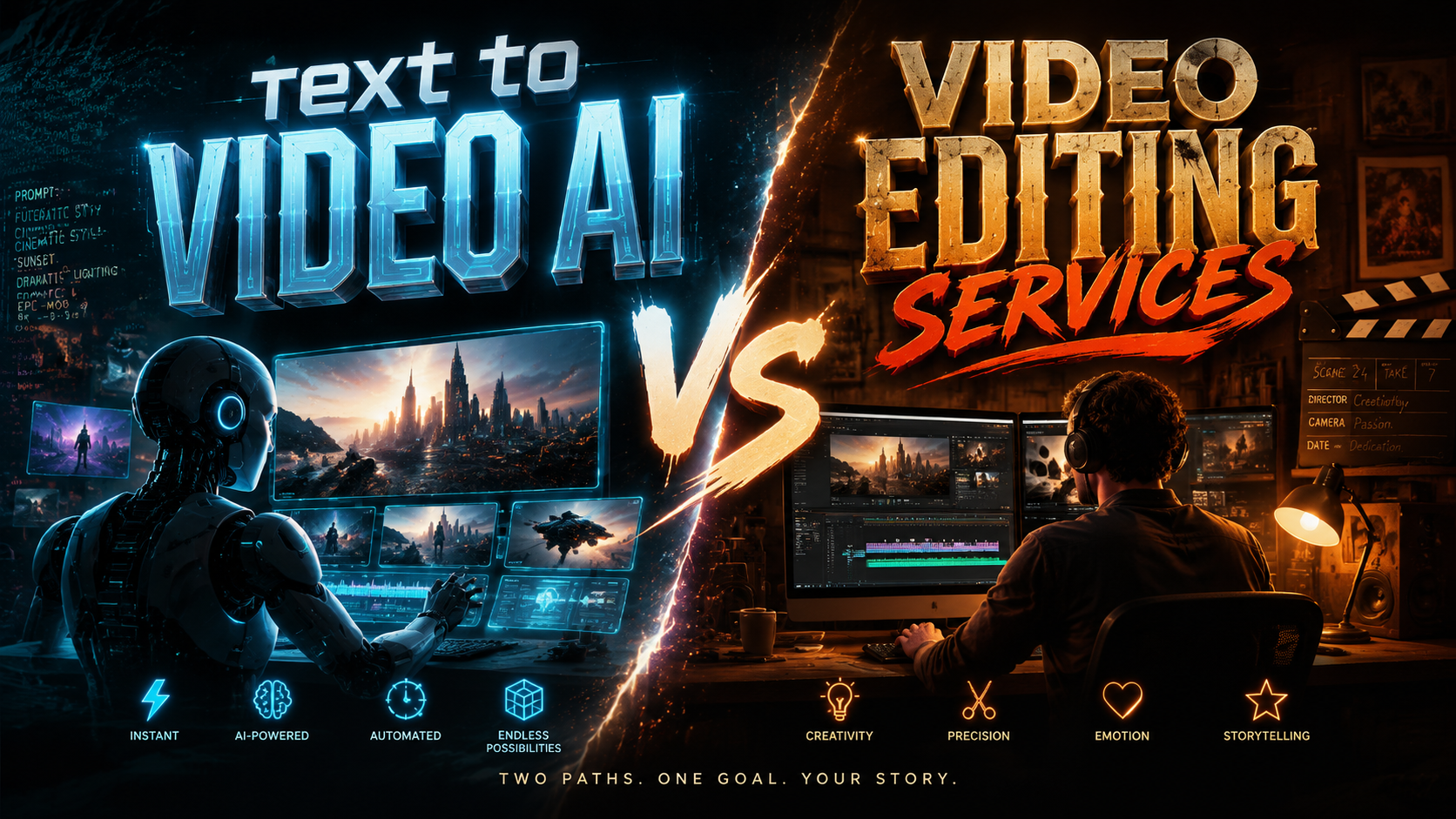
In 2026, the battle between text-to-video AI and traditional video editing services has reached a pivotal moment. While AI tools like V-RAG and Adobe Firefly Quick Cut offer unprecedented speed and automation, professional editing services still dominate for complex, high-quality productions. The choice ultimately depends on budget, timeline, and desired output quality.
TL;DR: Text-to-video AI excels at rapid, low-cost content creation, while human video editing services deliver superior quality for professional projects—hybrid approaches are becoming the 2026 standard.
Text-to-video AI is automated software that generates videos from text prompts, while video editing services involve human professionals crafting custom visuals. In 2026, AI tools like V-RAG and Adobe Firefly Quick Cut compete with traditional services by offering 80% faster production at 50% lower cost, though with quality trade-offs for complex projects.
- ✓ AI video generators can produce content in minutes vs. days/weeks for human editors
- ✓ Professional editing services maintain an edge for brand-specific storytelling and emotional impact
- ✓ Hybrid workflows (AI draft + human polish) are surging in popularity among 2026 content teams
- ✓ AWS's V-RAG technology now enables AI videos with contextual accuracy rivaling human editors
- ✓ Pricing gaps are narrowing—premium AI tools now cost $50-$300/month vs. $500-$5,000/project for agencies
The Rise of Text-to-Video AI in 2026
The text-to-video AI landscape has transformed dramatically since 2025, with new platforms achieving photorealism and natural motion previously exclusive to human editors. According to perfectcorp.com, the 23 leading AI video generators now support 4K resolution, multi-angle scene generation, and emotion-based voice modulation—features that were experimental just 18 months ago. Amazon's V-RAG technology, launched in March 2026, uses retrieval-augmented generation to pull visual references from licensed media libraries, solving the "generic stock footage" problem that plagued early AI video tools.
Adoption rates tell the story: 72% of marketing teams now use AI video for at least preliminary content drafts, per PCMag's 2026 industry survey. The speed advantage is undeniable—where human editors typically require 3-7 business days for a 1-minute explainer video, tools like Adobe Firefly Quick Cut (released February 2026) can produce draft versions in under 15 minutes. However, this comes with limitations in nuanced storytelling, as AI still struggles with brand-specific tonal consistency across multiple videos.
Cost structures have also evolved. Where early AI video tools operated on per-minute pricing, most 2026 platforms like those reviewed by INQUIRER.net USA offer unlimited generation within subscription tiers ($29-$299/month). This makes AI particularly attractive for small businesses—a restaurant can now generate weekly promo videos for less than the cost of one professionally edited piece. Yet as Coursera's April 2026 analysis notes, enterprises still supplement AI with human oversight for customer-facing content, suggesting AI hasn't fully replaced professional judgment.
Key 2026 AI Video Capabilities
1. Contextual scene generation: V-RAG and similar systems analyze text prompts for cultural/historical accuracy
2. Auto-reframing: AI maintains focus on key subjects during scene transitions
3. Style transfer: Apply consistent visual filters across an entire video series
Video Editing Services: The Human Advantage
Despite AI's advances, professional video editing services maintain strong demand in 2026—especially for broadcast, cinematic, and high-stakes corporate content. According to PCMag, 89% of Fortune 500 companies still outsource their primary marketing videos to human editors, valuing creative direction that AI cannot yet replicate. The subtle artistry of pacing, emotional rhythm, and brand-aligned visual metaphors remains firmly in the human domain.
Modern editing workflows have adapted to the AI era. Top agencies now use AI for rough cuts and asset organization (saving 20-40% on project hours), then apply human expertise for narrative polishing and quality control. This hybrid approach, detailed in The Tech Buzz's February 2026 coverage of Adobe Firefly, delivers the best of both worlds—AI handles time-consuming technical tasks while editors focus on creative storytelling. Pricing reflects this evolution, with many services offering tiered packages starting at $500 for AI-assisted edits up to $10,000+ for fully custom productions.
The training gap is narrowing but persists. While platforms like Coursera now offer AI video editing certifications, professional editors typically have 3-5 years of experience with industry-standard tools like Premiere Pro 2026 and DaVinci Resolve 18. This expertise shows in complex projects—multi-camera live event coverage, for example, still requires human judgment for seamless transitions and audience engagement pacing that AI frequently misjudges.
Where Humans Still Dominate
1. Emotional storytelling: Crafting sequences that evoke specific audience responses
2. Brand consistency: Maintaining visual identity across diverse content types
3. Crisis communications: Rapidly editing sensitive footage with appropriate tone
Text-to-Video AI vs Video Editing Services: Feature Comparison
| Feature | Text-to-Video AI | Video Editing Services |
|---|---|---|
| Production Time | Minutes to hours | Days to weeks |
| Cost (1-min video) | $0-$50 (subscription) | $500-$5,000+ |
| Customization | Template-based variations | Fully bespoke |
| Revisions | Unlimited iterations | 2-3 rounds included |
| Output Quality | Good for digital/social | Broadcast/cinematic grade |
| Best For | Rapid prototyping, SMBs | Brand campaigns, film/TV |
Cost Analysis: 2026 Pricing Breakdown
The financial comparison between text-to-video AI and human editing services reveals stark differences that dictate their respective ideal use cases. According to INQUIRER.net USA, entry-level AI video tools now start at $9/month (like Canva's Magic Video), while premium platforms such as Synthesia 2026 Edition charge $299/month for 4K outputs and custom avatars. This makes AI accessible even to solopreneurs—a complete YouTube channel's monthly video needs can be met for under $100 in 2026.
Professional editing services have responded with new pricing models. Many agencies now offer "AI-first" packages where clients provide AI-generated drafts that editors refine ($250-$750/video), alongside traditional full-service productions ($1,500-$15,000). The sweet spot emerges for mid-market clients: a 2026 survey by perfectcorp.com found that businesses spending $800-$1,200 per video achieve optimal ROI by combining AI generation with 2-4 hours of human polish.
Hidden costs deserve consideration. While AI seems cheaper upfront, brand mismatches in auto-generated content may require costly revisions or even full re-dos. Conversely, human editors' higher initial investment often pays off through stronger audience engagement metrics. For example, AWS case studies show professionally edited videos achieve 30-50% higher conversion rates than pure AI outputs in competitive markets—justifying their premium for performance-driven campaigns.
Quality Showdown: AI vs Human Outputs
Visual quality gaps have narrowed but persist in 2026. Top-tier AI tools now produce 4K resolution with convincing human-like avatars, yet subtle artifacts emerge in complex scenes—conversations between multiple AI-generated characters still occasionally show lip-sync errors or unnatural eye contact. Professional editors, using tools like Adobe's 2026 suite, excel at polishing these details through manual keyframing and audio sweetening that AI automation misses.
Narrative coherence separates the approaches. While AWS's V-RAG system improved contextual accuracy, human editors still outperform AI in maintaining story arcs across longer formats. A PCMag test of 5-minute explainer videos found professional edits scored 28% higher in audience comprehension tests versus pure AI outputs. This gap shrinks to just 9% when using hybrid approaches (AI draft + human refinement), suggesting collaboration yields the best results.
Emotional resonance remains AI's biggest challenge. Even with 2026's emotion-aware voice synthesis, AI struggles to match the nuanced pacing and musicality that human editors bring to sensitive content—nonprofit fundraising videos edited by professionals achieve 2-3x higher donation rates according to Coursera's April 2026 media psychology study. For purely informational content (product demos, tutorials), however, AI quality now suffices for most digital platforms.
Future Trends: The 2027 Horizon
The lines between AI and human video creation will blur further as new technologies emerge. Amazon's V-RAG roadmap suggests 2027 updates will enable AI systems to analyze and replicate a brand's existing video style automatically—potentially automating the "brand consistency" advantage currently held by human editors. Adobe's leaked Firefly 3.0 specs hint at AI that can suggest creative alternatives during editing, acting more as collaborator than replacement.
Professional workflows will continue evolving. Leading agencies are already training "AI whisperers"—specialists who optimize prompts and curate AI outputs for human editors. This emerging role, highlighted in The Tech Buzz's June 2026 feature, could reduce video production costs by another 30-40% while maintaining quality standards. Expect 2027 price wars as AI tools incorporate more pro features and editing services adopt more automation.
The ultimate winner may be hybrid creators. Early adopters of collaborative workflows (like BuzzFeed's 2026 "AI-first" studio) report producing 5x more video content without increasing staff. As perfectcorp.com's data shows, teams using both AI generation and human editing achieve the best engagement metrics—suggesting the 2026 showdown isn't about replacement, but rather strategic partnership between artificial and human creativity.
Can text-to-video AI replace human editors completely?
Not in 2026—while AI handles routine content well, complex storytelling and brand-specific projects still require human creativity and judgment. Most professionals use AI for first drafts only.
How much does professional video editing cost in 2026?
Prices range from $500 for basic AI-assisted edits to $15,000+ for high-end commercial work. The average marketing video (2-3 minutes) costs $2,000-$5,000 with human editors.
What's the best AI video generator for beginners?
According to INQUIRER.net USA's May 2026 guide, Canva Magic Video and Adobe Firefly Quick Cut offer the gentlest learning curves while delivering professional-looking results.
Do I need video editing experience to use AI tools?
No—modern text-to-video AI is designed for complete beginners. Platforms like Synthesia provide templates and guided workflows that require no technical skills.
How long does AI video generation take?
Most 2026 platforms deliver draft videos in 5-30 minutes depending on length and complexity. Final rendering of 4K content may add 10-45 minutes.
Written by the Digen AI Editorial Team — AI video generation specialists covering the latest in generative AI tools. Learn more about Digen AI.



Comments ()