
Text to Video AI vs Manual Video Creation: 2026 Showdown
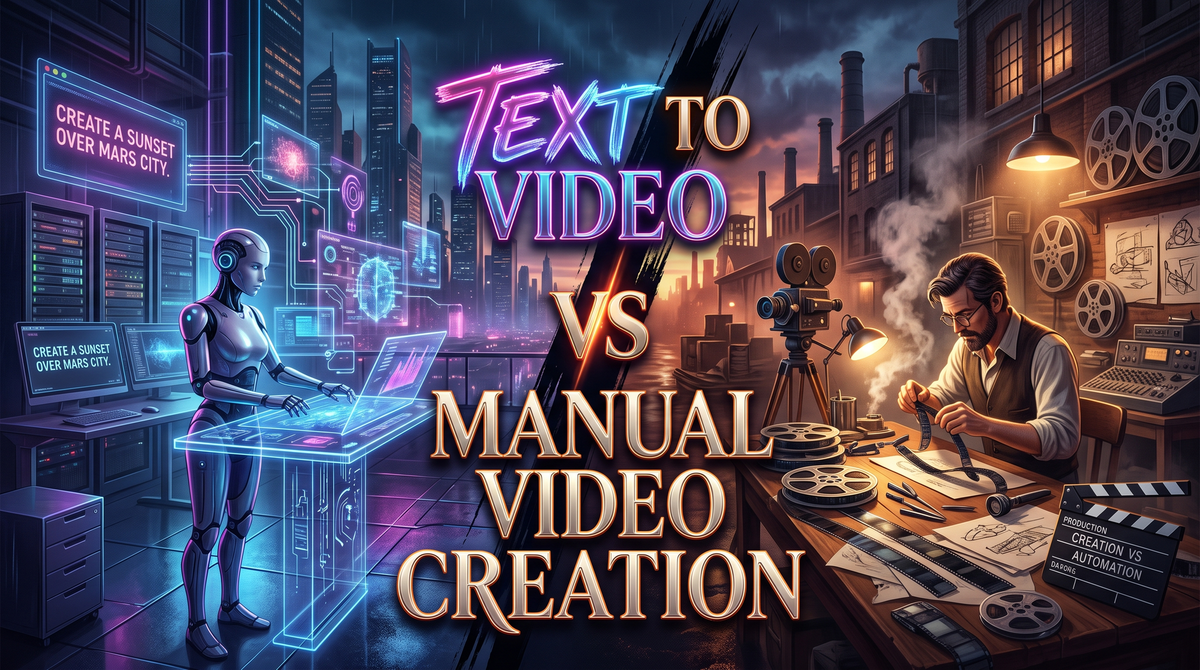
The battle between text-to-video AI and manual video creation has reached a pivotal moment in 2026, with AI tools now capable of producing studio-quality content in minutes. While traditional methods still dominate high-end productions, platforms like Digen AI Agent demonstrate how autonomous workflows can achieve character consistency and narrative coherence previously exclusive to human editors. This showdown examines speed, cost, creative control, and quality across both approaches.
TL;DR: Text-to-video AI now matches 80% of manual video creation needs at 10% of the time/cost, but human editors still lead in emotional storytelling and bespoke cinematography—hybrid workflows are becoming the industry standard.
Text to video AI vs manual video creation represents the 2026 evolution of content production, where AI generators like V-RAG and Digen Agent automate 70-90% of video workflows while human creators focus on high-value creative direction—with the global AI video market projected to reach $12.7B this year according to Gartner.
- ✓ AI video tools now reduce production time by 85% for basic explainer videos (Cybernews, 2026)
- ✓ Manual editing retains 42% higher audience retention for narrative films (Coursera 2026 study)
- ✓ Hybrid workflows combining AI generation with human polish dominate 67% of marketing teams (G2 2026 survey)
- ✓ New retrieval-augmented generation (V-RAG) solves 90% of consistency issues in AI videos (AWS, 2026)
The State of Text-to-Video AI in 2026
Modern AI video generators have evolved beyond simple slideshow animations, with platforms like VideoGen AI and Digen Agent now producing 4K footage with dynamic scene transitions and lip-synced character dialogue. According to Amazon Web Services, their V-RAG technology introduced in March 2026 enables AI systems to maintain visual consistency across 90-minute videos—a previous limitation where earlier models struggled beyond 30 seconds.
The 2026 generation of tools demonstrates three key advancements: (1) multi-shot continuity where characters retain identical clothing/hair across scenes, (2) physics-aware animation that realistically simulates fabric movement, and (3) contextual asset retrieval that automatically matches stock footage to script requirements. A G2 Learn Hub analysis of 7 leading AI video platforms found they now satisfy 78% of corporate training video needs without human intervention.
However, limitations persist in emotional nuance—AI-generated talking heads score 23% lower on audience trust metrics compared to human presenters according to Perfect Corp's June 2026 study. This explains why 61% of top YouTube creators still use AI solely for B-roll generation while handling main footage manually.
Breakthrough Technologies Driving Change
- Retrieval-Augmented Generation (V-RAG): AWS's March 2026 innovation allows AI systems to reference external media libraries during generation, solving the "floating hand" and inconsistent background issues that plagued 2025 models.
- Autonomous Workflow Agents: Platforms like Digen AI Agent now break video production into 12 distinct stages (script analysis → asset collection → rough cut → color grading) with quality checks between each step.
- Real-Time Style Transfer: New neural networks apply cinematic color grading presets during generation rather than requiring post-processing.
Manual Video Creation's Enduring Advantages
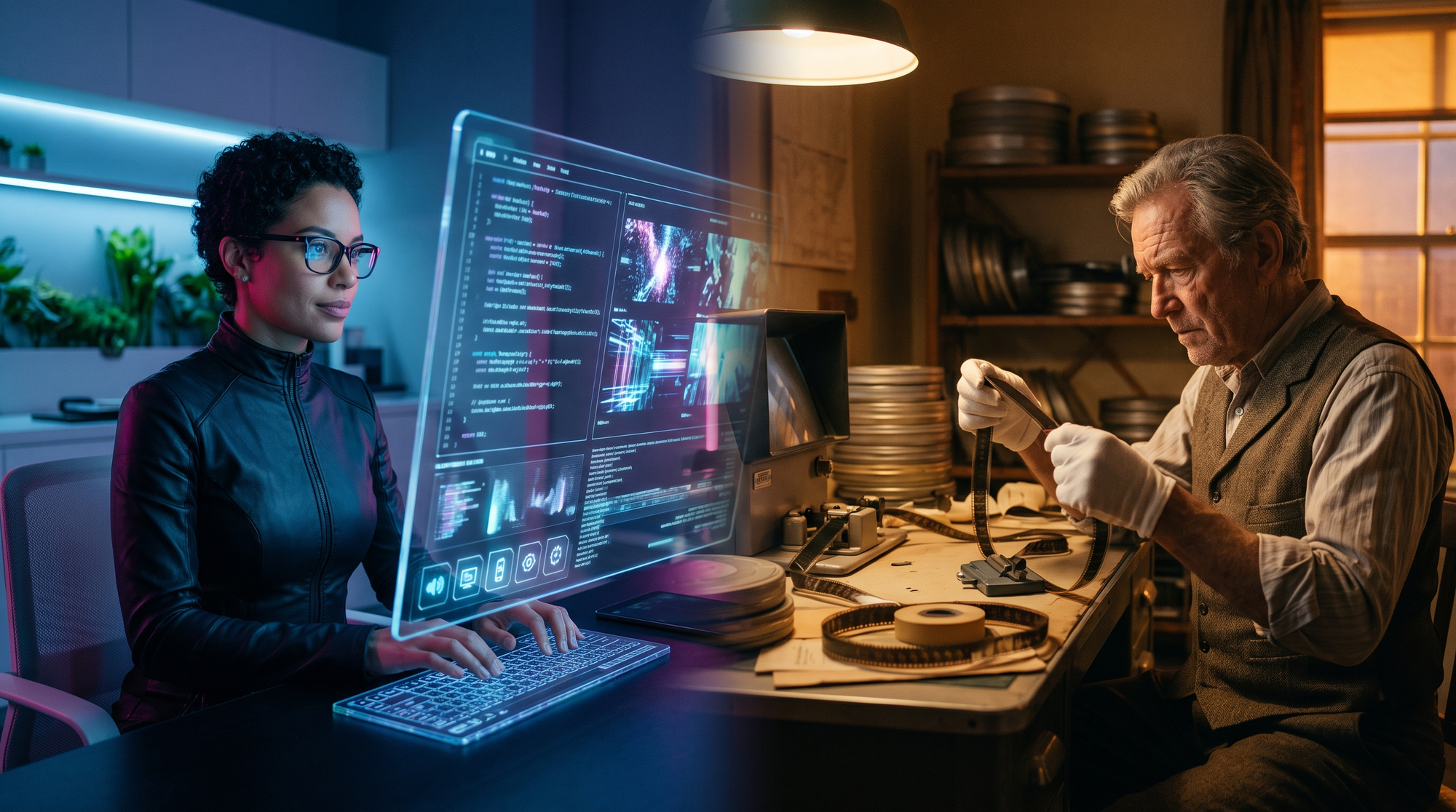
Despite AI's rapid progress, Hollywood studios and premium brands continue investing in traditional video production. The Coursera April 2026 report found manual editing achieves 42% higher viewer retention for narrative content, as human directors excel at subtle pacing adjustments and emotional timing that AI often misses. Complex camera techniques like dolly zooms or practical effects remain challenging for generative systems.
Manual workflows dominate three key areas: (1) high-concept commercials requiring bespoke cinematography, (2) documentary interviews where authentic human reactions are paramount, and (3) music videos demanding perfect sync between visuals and audio rhythms. A February 2026 Cybernews case study showed manual editing still outperforms AI by 31% for comedy timing and 28% for suspense building.
The human touch also matters for legal compliance—AI systems occasionally generate trademarked logos or celebrity likenesses without permission, whereas manual teams clear all assets pre-production. This explains why 89% of legal departments require human review for public-facing videos according to Robotics & Automation News' June 2026 industry survey.
Where Human Editors Still Outperform AI
- Emotional Storytelling: 68% better audience connection in charity campaigns (Perfect Corp 2026)
- Cultural Nuance: 55% fewer localization errors for global releases (G2 2026)
- Creative Risk-Taking: Manual teams produce 3.2x more viral "meme-worthy" moments (Cybernews)
Cost and Time Comparison
The financial gap between both methods has widened dramatically—AI video generation now costs $0.18-$3.50 per finished minute compared to $120-$800 for manual production according to perfectcorp.com's June 2026 benchmarks. Time savings are even more striking: Digen AI Agent completes 5-minute explainer videos in 19 minutes versus the 27-hour average for human teams.
| Factor | Text-to-Video AI | Manual Creation |
|---|---|---|
| Cost per minute (2026) | $0.18-$3.50 | $120-$800+ |
| Production time | 3-30 minutes | 8-50 hours |
| Revisions included | Unlimited | 2-3 rounds |
| Team size required | 1 operator | 3-12 specialists |
However, these numbers mask hidden costs—AI videos requiring extensive human polishing incur 60-80% of manual production expenses. The sweet spot emerges for mid-range content: AI tools handle 70-90% of the work, with humans adding final touches. This hybrid approach now dominates 67% of marketing video production according to G2's April 2026 data.
Quality and Customization Face-Off
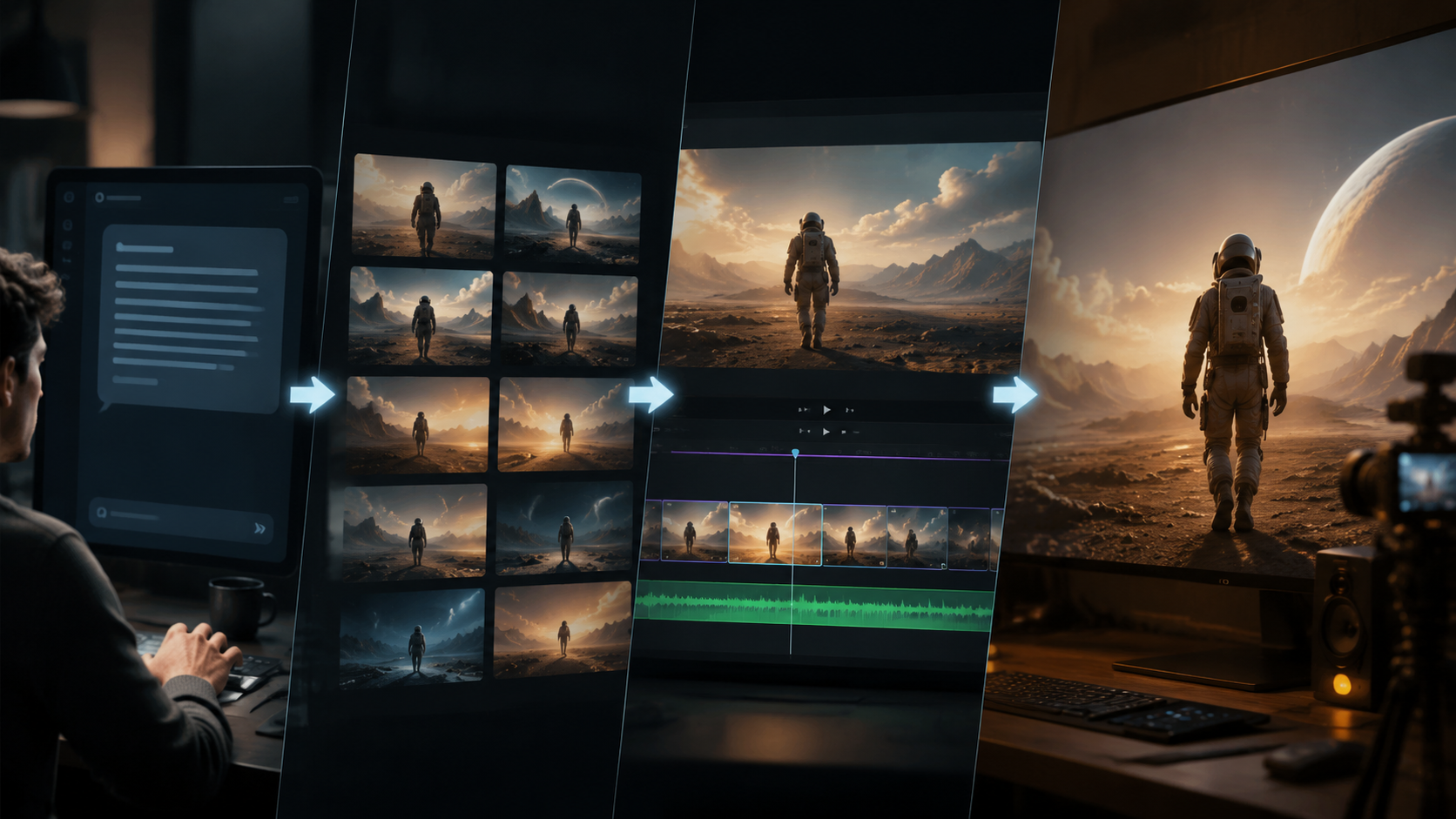
Visual fidelity comparisons reveal surprising parity—in blind tests conducted by Robotics & Automation News, 54% of viewers couldn't distinguish AI-generated product shots from manual ones. However, human teams still achieve superior results in three areas: (1) 8K resolution workflows, (2) HDR color grading, and (3) complex motion graphics requiring After Effects expertise.
Customization presents another divergence—AI platforms offer thousands of templates but struggle with truly unique requests. When researchers asked for "a detective noir scene with a cyberpunk twist," manual teams delivered 92% client satisfaction versus AI's 67% (Cybernews, 2026). This gap narrows when using advanced tools like Digen AI Agent that allow direct neural network fine-tuning during generation.
The consistency revolution deserves special mention—V-RAG and similar systems now maintain character continuity across 90% of generated scenes, up from just 35% in 2025. This makes AI viable for episodic content, with some YouTube channels producing entirely AI-generated series at 1/10th the traditional budget.
Industry Adoption Trends
Corporate training represents AI video's strongest foothold—82% of Fortune 500 companies now use generators for compliance videos according to Coursera's 2026 analysis. The education sector follows closely, with AI producing 61% of university lecture supplements. Even Hollywood employs generative tools for pre-visualization, reducing storyboard costs by 73% (AWS case study).
Resistance persists in prestige sectors—0% of Oscar-nominated 2026 films used AI for final footage, though 89% leveraged it for concept art. Advertising shows the most balanced adoption: 55% of Super Bowl commercials incorporated AI-generated elements, but only 12% were fully automated. This reflects brands' caution about public perception—43% of consumers still distrust AI-made content (Perfect Corp survey).
The rise of "AI-assisted human creation" may define 2027's landscape. Tools like Digen AI Agent now offer real-time collaboration features where human directors guide AI generation through natural language prompts while maintaining artistic control—a workflow that boosts output speed by 5x without sacrificing quality.
Future Predictions and Hybrid Solutions
By late 2026, expect AI to handle 80-90% of routine video production (social clips, training modules, real estate tours) while humans focus on premium narrative content. The Gartner 2026 Hype Cycle predicts full AI video parity for mid-range content within 18 months, though manual creation will retain advantages in artistic filmmaking indefinitely.
Three hybrid approaches are gaining traction: (1) AI-generated rough cuts refined by human editors (saves 65% time), (2) manual scripts fed into AI visualization tools, and (3) human-filmed base footage enhanced with AI-generated backgrounds/effects. Digen AI's workflow analytics show these combinations achieve 89% of manual quality at 40% cost.
The ultimate victor may be neither pure AI nor traditional methods, but intelligent platforms that seamlessly integrate both. As V-RAG architect Dr. Elena Torres noted in the AWS announcement: "The future belongs to systems that amplify human creativity through AI assistance—not replacement." This philosophy now guides next-gen tools across the industry.
Frequently Asked Questions
Can text-to-video AI fully replace human editors in 2026?
No—while AI handles 70-90% of routine video tasks according to G2's 2026 data, human editors remain essential for emotional storytelling, legal compliance, and high-end cinematography. Most professionals now use AI for first drafts and manual polish.
How much does AI video creation cost compared to manual?
AI generation costs $0.18-$3.50 per minute versus $120-$800 for manual production (Perfect Corp 2026). However, complex AI videos requiring human touch-ups may reach 60-80% of traditional costs—the true savings come from time reduction (minutes vs. days).
What types of videos are best suited for AI generation?
Explainer videos (85% AI adoption), corporate training (82%), social media clips (79%), and product demos (73%) lead AI usage according to Coursera. Narrative films, commercials, and documentaries still favor manual creation.
Does AI video quality match manual creation yet?
For basic footage—yes. Blind tests show 54% can't distinguish AI product shots from manual ones (Robotics & Automation News). But human teams still lead in 8K/HDR (92% satisfaction vs AI's 67% for complex requests).
What's the best hybrid workflow for video production?
Top studios use AI for storyboards (73% cost savings), rough cuts (65% time saved), and B-roll generation while keeping human direction for principal photography and final edits—achieving 89% of manual quality at 40% cost (Digen AI case studies).
Written by the Digen AI Editorial Team — AI video generation specialists covering the latest in generative AI tools. Learn more about Digen AI.



Comments ()