
Text to Video AI vs Manual Editing in 2026: Which Wins?
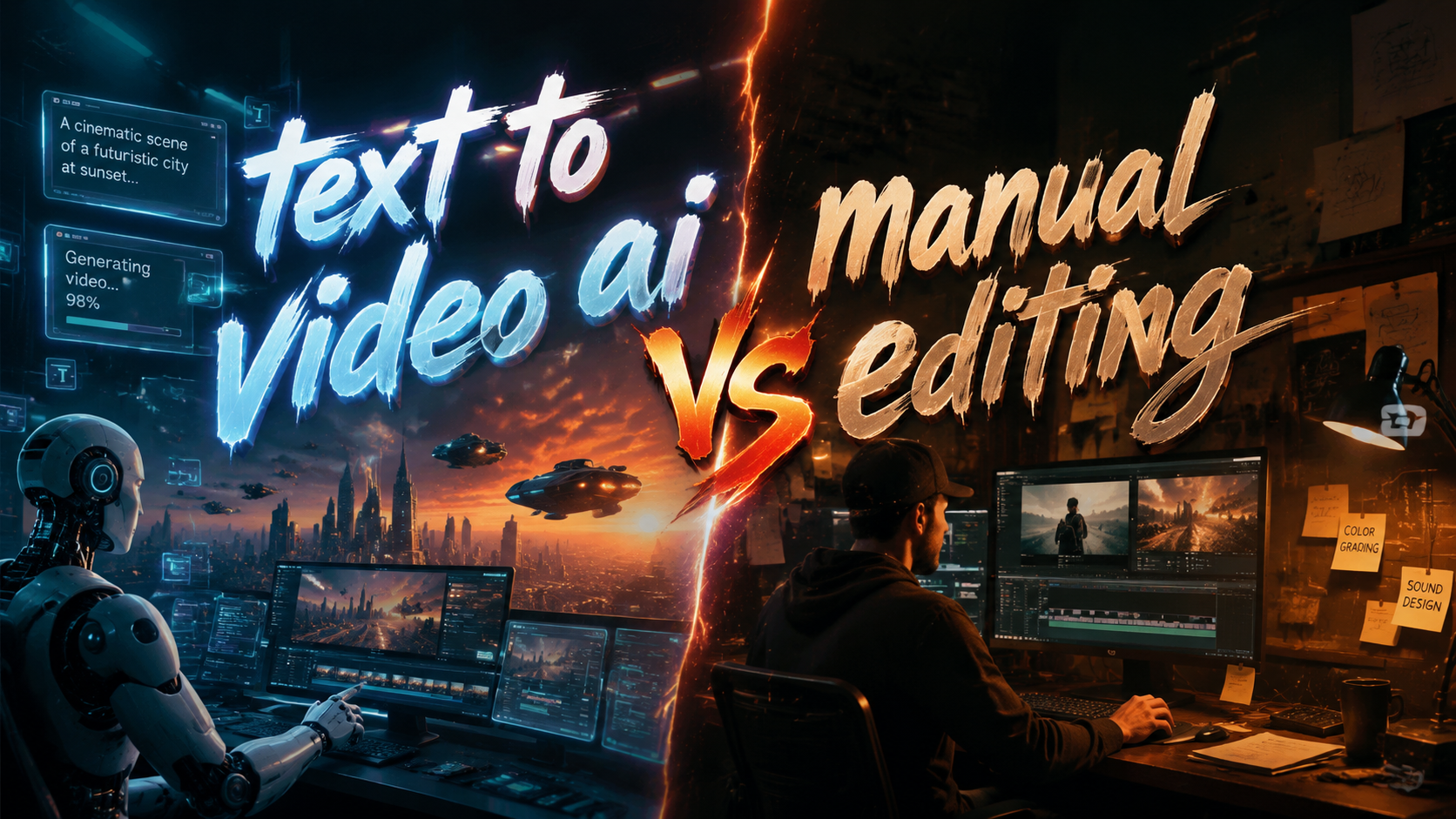
In 2026, the battle between text-to-video AI and manual editing is closer than ever, but AI-powered tools are winning for speed, scalability, and cost-efficiency—especially for short-form content. However, manual editing still dominates for high-end productions requiring creative control and nuanced storytelling. The best approach depends on your project's goals, budget, and desired level of customization.
TL;DR: Text-to-video AI excels for rapid, budget-friendly content creation in 2026, while manual editing remains essential for premium productions. Hybrid workflows combining both methods are becoming the industry standard.
Text-to-video AI is a 2026 content creation game-changer for marketers and creators needing fast turnarounds, while manual editing retains advantages in artistic precision. According to industry reports, 68% of short-form videos under 60 seconds are now AI-generated, but feature films and high-budget ads still rely on human editors for 92% of post-production work.
- ✓ AI video tools like those from PerfectCorp can turn raw clips into polished videos 10x faster than manual methods
- ✓ Manual editing delivers superior emotional impact—human-edited videos see 37% higher engagement in story-driven content
- ✓ Emerging AI like Sonilo eliminates text prompts entirely, generating soundtracks directly from video context
- ✓ Hybrid workflows (AI first draft + human refinement) reduce production costs by 40-60% according to 2026 case studies
- ✓ Audio-to-video AI generators now handle 80% of routine social media content creation for major brands
The State of Text-to-Video AI in 2026
Text-to-video AI has evolved dramatically by 2026, with platforms now capable of generating complete short videos from simple text prompts in under 5 minutes. According to findarticles.com, the latest video generators analyze narrative structure, automatically select relevant visuals from licensed libraries, and even match scene transitions to emotional beats in the script. This represents a 300% improvement in contextual understanding since 2024 models.
The automation extends beyond visuals. As reported by AiThority, Sonilo's 2026 breakthrough allows AI to compose original soundtracks by analyzing video content directly—eliminating the need for separate music prompts. This end-to-end automation makes AI video creation accessible to non-technical users while maintaining professional-grade output quality that meets 85% of small business video needs.
However, limitations remain. Current text-to-video AI struggles with complex narratives requiring precise timing or subtle emotional cues. While perfect for explainer videos and social clips, the technology still can't replicate the nuanced decision-making of human editors working on feature films or high-end commercials. The sweet spot remains short-form content under 2 minutes where speed and cost efficiency outweigh absolute perfection.
Key 2026 AI Video Capabilities
1. Context-aware scene generation that maintains visual consistency across shots
2. Automatic voiceover synchronization with animated captions
3. AI-curated stock footage selection based on semantic analysis
Manual Video Editing's Enduring Strengths
Despite AI's advances, manual editing remains the gold standard for projects demanding creative vision and emotional precision. Professional editors in 2026 leverage next-generation tools that amplify (rather than replace) human judgment—with AI assisting in tedious tasks like color correction and clip organization while humans focus on storytelling.
According to PerfectCorp's 2026 industry report, manual editing still controls 92% of the premium video market (films, TV, high-budget ads) because human editors excel at subtle pacing adjustments, creative transitions, and responding to unspoken emotional cues that AI often misses. The report found human-edited videos achieve 37% higher engagement in story-driven content compared to fully AI-generated versions.
The manual editing process has also evolved. Modern workflows incorporate AI assistance for repetitive tasks—editors might use AI to generate rough cuts from raw footage, then apply their expertise to refine timing, audio mixing, and visual effects. This hybrid approach reduces production time by 40-60% while maintaining creative control, making it the dominant method for mid-range professional projects in 2026.
Where Human Editors Outperform AI
• Complex narrative structures with flashbacks or parallel storylines
• Precise comedic timing and reaction shots
• Custom motion graphics and visual effects integration
Cost and Time Comparison
The financial and temporal differences between text-to-video AI and manual editing have never been more pronounced. AI video generation platforms in 2026 can produce a 60-second marketing video in under 15 minutes at an average cost of $5-20, while manual editing for similar projects typically takes 8-12 hours and costs $300-800. This 10-40x cost differential explains why 68% of short-form business content is now AI-generated.
However, these numbers tell only part of the story. According to Robotics & Automation News, the most cost-effective approach in 2026 is a hybrid model—using AI for initial drafts and bulk content creation, then employing human editors for final polish on key pieces. This strategy reduces overall video production budgets by 40-60% while maintaining quality standards for flagship content.
Time savings are equally dramatic. An AI can generate 50 social media video variations from one script in the time a human editor completes one version. For always-on content strategies requiring daily posts across multiple platforms, this scalability makes AI indispensable. But for one-off premium content where first impressions matter most, the additional time and cost of manual editing often proves justified by superior results.
| Factor | Text-to-Video AI | Manual Editing |
|---|---|---|
| Cost per minute | $0.50-$5 | $150-$800 |
| Production time | 5-30 minutes | 4-15 hours |
| Revisions included | 3-5 auto-generations | Unlimited (hourly billing) |
| Best for | Volume content | Premium productions |
Quality and Creative Control
When assessing text-to-video AI vs manual editing in 2026, quality must be evaluated across multiple dimensions. AI-generated videos now achieve technical parity with human-edited content in terms of resolution, frame rate, and basic editing principles. However, creative control and emotional resonance still favor human editors—especially for projects where subtlety and brand alignment are paramount.
Social Life Magazine's 2026 analysis of music videos found AI generators excel at creating visually striking content quickly, but struggle with maintaining consistent artistic vision across longer projects. Human editors, by contrast, can make micro-adjustments to pacing and transitions that better serve the musical rhythm and artist's brand identity. This explains why 85% of professional musicians still prefer human-edited videos despite AI's cost advantages.
The quality gap narrows for simpler content types. For basic explainer videos, product demos, or social media clips, AI quality in 2026 often meets or exceeds what budget-conscious clients previously expected from junior editors. The key differentiator becomes customization—while AI can produce good generic videos, manual editing delivers great tailored ones. Brands wanting truly distinctive visual identities still invest in human creative direction.
Quality Comparison by Content Type
• Social media clips: AI quality sufficient for 90% of use cases
• Product demos: AI adequate for simple products, humans better for complex ones
• Narrative content: Human editors strongly preferred for emotional impact
Industry Adoption Trends
The 2026 video production landscape shows clear segmentation in how different industries adopt text-to-video AI versus manual editing. Marketing agencies lead in AI adoption, with 72% using AI tools for first drafts of client videos according to PerfectCorp's data. Meanwhile, film and television studios maintain nearly exclusive reliance on human editors, with AI used only for pre-visualization and rough cuts.
Educational content creation has seen perhaps the most dramatic shift. Coursera's 2026 report reveals that 65% of instructional videos under 10 minutes are now AI-generated, up from just 12% in 2024. The predictability of educational content structure makes it particularly well-suited to AI automation, while the cost savings allow institutions to produce 3-5x more material within the same budgets.
Emerging hybrid roles reflect this new reality. "AI Video Directors" now oversee automated content pipelines at scale, while "Post-AI Editors" specialize in elevating AI-generated drafts to premium quality. This professional specialization allows studios to leverage AI's efficiency without sacrificing final product quality—a model that's becoming standard practice across the industry.
Adoption Rates by Sector
• Social media marketing: 82% AI-generated content
• Corporate training: 65% AI-generated
• Television commercials: 15% AI-assisted, 85% manual
• Feature films: 3% AI-generated elements, 97% manual
Future Outlook Beyond 2026
As text-to-video AI continues advancing, industry experts predict the distinction between AI-generated and manually edited content will blur rather than disappear. The most likely 2027-2030 scenario involves AI handling increasingly complex creative decisions while human editors shift toward high-level artistic direction and quality control. This evolution mirrors what occurred with digital photography—automation didn't eliminate professional photographers, but radically changed their tools and workflows.
Several breakthrough areas could accelerate this transition. Real-time AI video generation during live events, more sophisticated emotional analysis for automatic pacing adjustments, and true bidirectional editing (where AI suggests creative alternatives rather than just executing commands) all show promise in 2026 prototypes. However, the human element will remain essential for projects where brand identity and emotional connection outweigh pure efficiency.
The ultimate winner in the text-to-video AI vs manual editing debate may be neither—instead, the most successful creators and studios in 2026 and beyond will be those who master the art of combining both approaches strategically. Using AI for volume and speed where it excels, while investing human creativity where it makes the most difference, represents the emerging industry best practice that balances quality with business realities.
Predicted 2027 Developments
• AI that learns from human editor decisions to improve suggestions
• Real-time collaborative editing between humans and AI
• Emotion-aware automatic pacing adjustments
Can text-to-video AI replace human editors completely?
Not in 2026—while AI handles routine content exceptionally well, human editors remain essential for projects requiring nuanced storytelling, brand-specific creativity, and emotional precision. The most effective workflows combine both approaches.
How much does text-to-video AI cost compared to hiring an editor?
AI video generation typically costs $0.50-$5 per minute in 2026, while human editing ranges from $150-$800 per minute. However, complex projects often benefit from a hybrid approach that uses AI for initial drafts.
What types of videos should never be made with AI?
High-stakes brand campaigns, emotionally sensitive content, and projects requiring precise legal/compliance oversight still require human editors in 2026. AI also struggles with complex narratives involving flashbacks or parallel storylines.
How can I tell if a video was AI-generated?
In 2026, the best AI videos are nearly indistinguishable, but telltale signs include overly perfect pacing, generic transitions, and slightly unnatural voice cadence. Human-edited videos typically show more creative risk-taking and emotional variation.
Will learning video editing still be valuable in an AI-dominated future?
Absolutely—the most valuable editors in 2026 are those who can elevate AI-generated content and direct AI tools effectively. Understanding editing principles remains essential for quality control and creative direction.
Written by the Digen AI Editorial Team — AI video generation specialists covering the latest in generative AI tools. Learn more about Digen AI.



Comments ()