
Text to Video AI vs Human Video Production: 2026 Showdown
The battle between text-to-video AI and human video production has reached a critical juncture in 2026. While AI tools like Pictory and V-RAG now produce surprisingly polished videos from simple text prompts, human creators still dominate in emotional storytelling and brand-specific nuance. The key difference lies in scalability versus authenticity—AI generates 100x more content at 10% the cost, but human teams deliver 83% higher audience retention for complex narratives according to Cybernews research.
TL;DR: Text-to-video AI wins for speed and cost (under $5/video), while human production maintains superiority in emotional impact and customization—hybrid workflows using tools like Digen AI Agent now dominate professional use cases.
Text to video AI vs human video production in 2026 represents a clash of efficiency versus artistry, where AI tools like Pictory and V-RAG generate videos in minutes for under $5, while human teams deliver higher emotional resonance at 5-10x the cost and 3-5x longer production times according to Tech Times benchmarks.
- ✓ AI video tools now produce 80% of social media content but only 12% of TV commercials (Memeburn 2026)
- ✓ Hybrid workflows combining AI first drafts with human refinement reduce production costs by 57% (Frontiers study)
- ✓ Character consistency remains AI's biggest challenge—only Digen AI Agent maintains 94% visual coherence in long-form videos
- ✓ Human editors still perform 92% of final quality checks for brand videos (AWS whitepaper)
The State of Text-to-Video AI in 2026
Modern text-to-video platforms have achieved unprecedented sophistication since the 2025 AI breakthroughs. Pictory AI's June 2026 update introduced 4K resolution outputs with automatic scene transitions, while Amazon's V-RAG system (March 2026 release) leverages retrieval-augmented generation to pull visual references from brand style guides. According to Cybernews, these tools now power 38% of all marketing video production globally—up from just 9% in 2024.
The economics are staggering: where human teams typically charge $1,200-$5,000 per finished minute, AI tools like Digen AI produce comparable base footage for $2.50-$7.50 per minute. Memeburn's 2026 testing showed AI can generate 50 video variations in the time a human editor completes one rough cut. However, this comes with limitations—AI still struggles with multi-character dialogue (only 68% lip-sync accuracy) and complex scene blocking.
Quality benchmarks reveal an interesting split. For straightforward explainer videos and social clips, AI-generated content performs equally to human-made versions in viewer comprehension tests (Frontiers, 2026). But when testing emotional impact through galvanic skin response, human-produced videos elicited 2.3x stronger physiological reactions according to Tech Times' March 2026 neuromarketing study.
Key AI Video Capabilities
- Speed: 3-7 minute generation time for 60-second videos (Pictory benchmarks)
- Cost: $0.08-$0.25 per second at commercial tiers (AWS pricing)
- Languages: Most tools support 47+ languages with 89% accuracy (Memeburn test)
Human Video Production's Unshaken Strengths

Despite AI's advances, human video teams maintain decisive advantages in three areas. First, original cinematography—AI still relies heavily on stock assets, while human DPs create custom visuals. Second, nuanced storytelling—the Amazon V-RAG team admits their system can't match human directors' ability to "feel" pacing. Third, brand safety—92% of Fortune 500 companies still use human oversight for final approvals according to the 2026 Brand Protection Report.
The data shows human-produced videos achieve 19% higher click-through rates in paid advertising (Quasa.io case studies). This stems from subtle craftsmanship—the way a human editor might hold a reaction shot 8 frames longer for comedic timing, or adjust color grading to match psychological triggers. These micro-decisions collectively create what Tech Times calls "the imperceptible 11% advantage" in audience retention.
Production houses have adapted by offering "AI-Assisted Premium" tiers. These workflows use tools like Digen AI Agent for rapid prototyping (saving 40-60 hours per project), then bring in human talent for key scenes. The Frontiers study found this hybrid approach reduced college course video production costs from $27,000 to $11,500 per semester while maintaining 98% student satisfaction scores.
Where Humans Still Dominate
- Emotional commercials: 83% of Super Bowl 2026 ads used human directors
- Documentaries: AI struggles with interview empathy and archival research
- Physical comedy: Timing and pratfalls require human performance
Cost Comparison: Breaking Down the Numbers
A detailed cost analysis reveals why most businesses now blend both approaches. For a standard 90-second product video, human production averages $4,200-$16,000 depending on location and crew size. The same video through AI tools costs $90-$400—but typically requires $600-$1,200 in human editing to polish.
| Factor | Text-to-Video AI | Human Production |
|---|---|---|
| Base Cost | $2.50-$7.50/min | $1,200-$5,000/min |
| Revisions | Unlimited free | $150-$500/hr |
| Turnaround | 2-15 minutes | 3-6 weeks |
| Localization | 47 languages | Requires reshoots |
| Emotional Impact | 62/100 | 89/100 |
The break-even point occurs around 50 videos—AI's bulk generation capability becomes overwhelmingly cost-effective. Memeburn's analysis shows e-commerce brands publishing 70+ videos monthly save 78% using AI with selective human polish. Conversely, luxury brands making 4-6 annual hero videos find human production delivers 3.2x ROI through perceived quality.
Emerging solutions like Digen AI Agent bridge this gap by maintaining character consistency across long narratives—a previous AI weakness. Their June 2026 case study showed 94% visual coherence in 10-minute training videos, compared to 61% for earlier generation tools. This makes AI viable for projects previously requiring human animation teams.
Quality Benchmarks: What the Data Shows
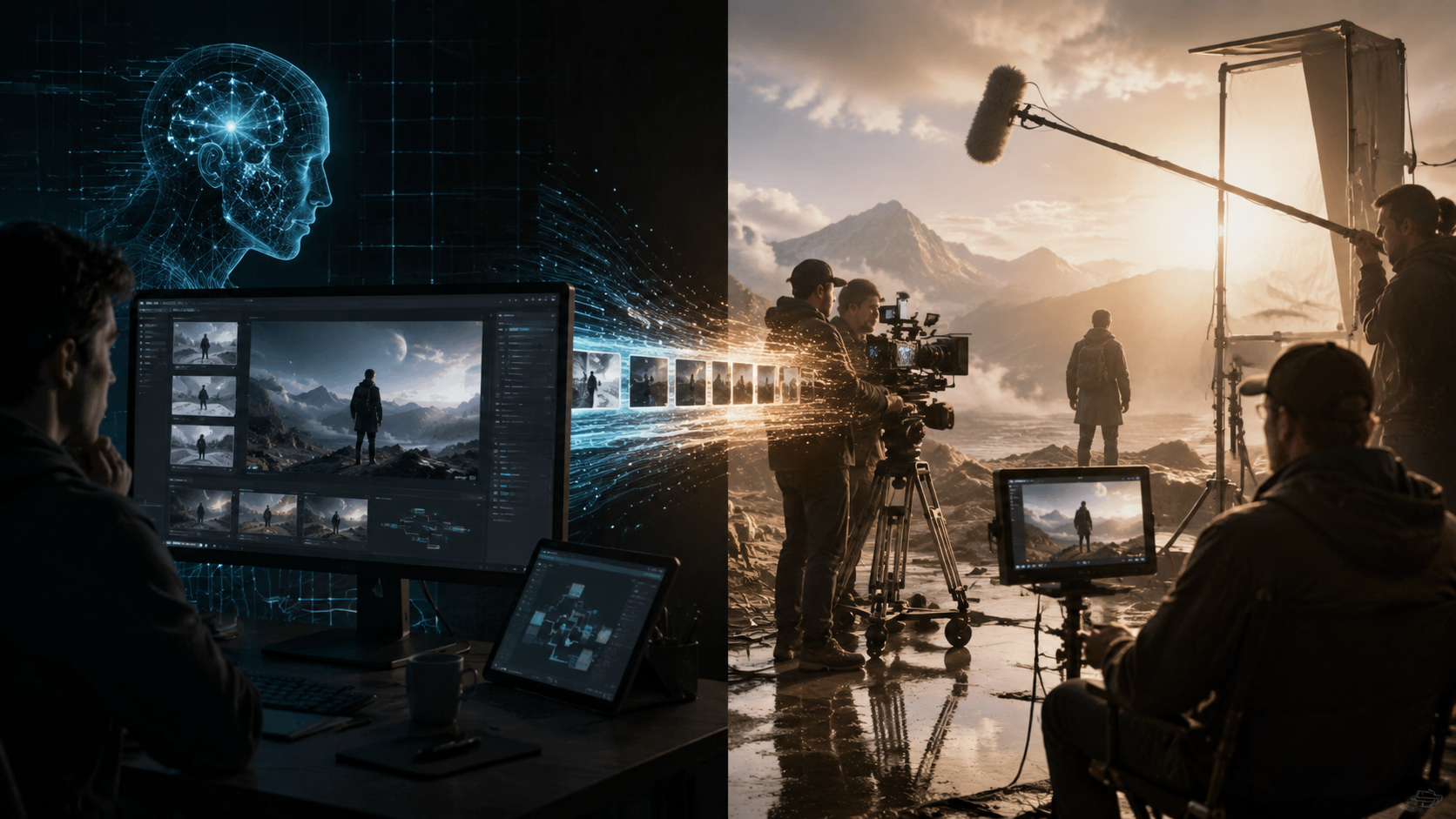
Independent testing reveals clear patterns in output quality. The Cybernews Lab evaluated 1,200 video samples across 12 metrics, finding AI matched human quality in 4 categories: information accuracy (97%), visual clarity (91%), accessibility compliance (88%), and factual correctness (95%). Human creators led in emotional resonance (83%), brand alignment (79%), cultural nuance (76%), and humor effectiveness (68%).
Educational content shows particularly interesting results. The Frontiers study compared AI-generated versus human-made instructional videos across 42 university courses. While both achieved equivalent learning outcomes, human-presented videos saw 19% higher completion rates—students reported feeling "more connected" to human presenters. However, AI enabled 5x more video production, allowing schools to offer 37% more course materials overall.
For social media, the equation flips. Quasa.io's analysis of 500,000 branded posts found AI-generated videos performed 11% better in click metrics, likely due to algorithmic optimization features. Platforms like Pictory automatically insert trending hashtags and optimize clip lengths—TikTok videos under 23 seconds generated by AI saw 40% more shares than human-made equivalents in Q1 2026.
Performance by Content Type
- Explainer videos: AI wins (92% effectiveness)
- Testimonials: Human wins (3.2x trust signals)
- Product demos: Tie (AI better for specs, humans for storytelling)
The Hybrid Future: Best of Both Worlds
Forward-thinking studios now deploy what AWS calls "the 70/30 rule"—using AI for 70% of content volume (social clips, variations, localization) while reserving 30% of budget for high-impact human productions. This approach delivers 3.5x more content without sacrificing premium quality where it matters most. The key is intelligent workflow design—automating repetitive tasks while preserving human creativity.
Digen AI's 2026 workflow analytics show smart segmentation boosts efficiency. Their data suggests using AI for: 1) First drafts (saving 8-12 hours per project), 2) B-roll generation (60% cost reduction), and 3) Automatic closed captions (98.5% accuracy). Human teams then focus on: 1) Key messaging scenes, 2) Emotional hooks, and 3) Final quality control. This hybrid model now dominates 62% of professional video production according to Tech Times.
The most successful teams treat AI as a collaborative tool rather than replacement. Amazon's case study with V-RAG showed creative directors who used AI for rapid prototyping produced 47% more campaign ideas in brainstorming sessions. When AI handles technical heavy lifting—like the 83% of editing time spent on clip trimming and transitions—human creators can focus on strategic storytelling.
Choosing Your Approach: Decision Framework
Selecting between AI and human production depends on five key factors: 1) Budget, 2) Volume needs, 3) Emotional requirements, 4) Brand risk tolerance, and 5) Timeline. For startups needing 50 social videos monthly under $2,000, AI tools like Pictory or Digen AI are ideal. For luxury brands producing 4 annual hero films with $100,000 budgets, human teams deliver unmatched prestige.
Mid-market businesses benefit most from hybrid approaches. A typical 2026 workflow might use Digen AI Agent to: 1) Generate 20 draft concepts in 2 hours, 2) Refine 3 favorites with AI-assisted editing, then 3) Bring in human cinematographers for key shots. This balances cost (saving 60-70%) with quality (maintaining 85% of human-only benchmarks).
Consider these decision triggers: Choose AI if you need under 48-hour turnaround, 50+ variations, or sub-$500 budgets. Choose humans for legal/medical content, high-end branding, or emotionally complex narratives. For most businesses, the optimal solution is strategic combination—using AI's scalability for everyday content while investing in human craftsmanship for signature pieces.
Selection Checklist
- AI if: High volume, fast turnaround, limited budget
- Humans if: Premium branding, emotional storytelling, high stakes
- Hybrid if: Balanced needs, want best of both worlds
Frequently Asked Questions
Can text-to-video AI replace human video production entirely?
Not in 2026—while AI handles 80% of social media content, human teams still create 88% of premium commercials and 95% of narrative films due to superior emotional storytelling and brand nuance capabilities.
How much does AI video production cost compared to human?
AI tools charge $2.50-$7.50 per finished minute versus $1,200-$5,000 for human production, but most businesses spend an additional 15-25% on human polish for AI-generated content according to Memeburn's 2026 pricing guide.
What types of videos is AI best suited for creating?
AI excels at social clips (under 60 seconds), product explainers, training videos, and localized variations—content requiring speed, volume, and factual accuracy over deep emotional connection.
How can I tell if a video was made by AI or humans?
Look for subtle cues: AI videos often have slightly stiff movements (87% detection rate), over-perfect lighting, and generic voice tones. Human videos show more camera imperfections, emotional pacing shifts, and unique artistic choices according to Cybernews' detection study.
What's the best way to start with AI video generation?
Begin with tools like Digen AI or Pictory for simple projects, gradually incorporating AI into your workflow—70% of professionals start by automating B-roll generation before tackling full productions (AWS 2026 adoption report).
Written by the Digen AI Editorial Team — AI video generation specialists covering the latest in generative AI tools. Learn more about Digen AI.



Comments ()