
Text to Video AI with Voice Cloning: The Future in 2026
Text to video AI with voice cloning represents the cutting edge of generative AI in 2026, enabling creators to produce lifelike videos from simple text prompts while cloning human voices with remarkable accuracy. This technology is transforming industries from marketing to entertainment by automating high-quality video production at scale. According to findarticles.com, AI video generators have reduced production costs by 60% while increasing output speed by 300% compared to traditional methods.
TL;DR: Text to video AI with voice cloning in 2026 allows seamless creation of professional-grade videos from text, with AI-generated voices that mimic human speech patterns. Leading tools like Alibaba's Qwen 3.5 Omni and Digen AI Agent are pushing the boundaries of what's possible in automated content creation.
Text to video AI with voice cloning is a revolutionary technology that converts written text into animated videos complete with synthetic voices that can clone specific human vocal characteristics. In 2026, these systems combine advanced natural language processing, computer vision, and voice synthesis to create studio-quality content in minutes rather than days.
- ✓ AI video generation tools now produce 90% more realistic facial expressions and lip-syncing than 2025 models
- ✓ Voice cloning accuracy has reached 98% similarity to original human voices in optimal conditions
- ✓ The AI video generation market is projected to reach $12.7 billion by Q4 2026
- ✓ Leading platforms can generate 4K resolution videos with dynamic scene transitions automatically
The Evolution of Text to Video AI Technology in 2026
The text to video AI landscape has undergone dramatic improvements since 2025, with new models capable of understanding complex scene descriptions and generating corresponding visuals with unprecedented coherence. According to My Everyday Tech, the average video quality score (VQS) of AI-generated content has increased from 72/100 in early 2025 to 89/100 in mid-2026, making it nearly indistinguishable from human-produced videos in many cases.
Voice cloning technology has particularly advanced, with systems like Alibaba's Qwen 3.5 Omni able to replicate a speaker's voice from just 30 seconds of sample audio. This represents a 75% reduction in required training data compared to 2025 models. The integration of these voice cloning capabilities directly into video generation workflows has created seamless end-to-end production pipelines.
Digen AI Agent exemplifies this progress with its autonomous multi-step workflow system that maintains character consistency across longer video sequences - a challenge that plagued earlier generations of AI video tools. Their 2026 benchmarks show 40% fewer visual artifacts and 35% better mouth movement synchronization compared to their 2025 models.
How Text to Video AI with Voice Cloning Works
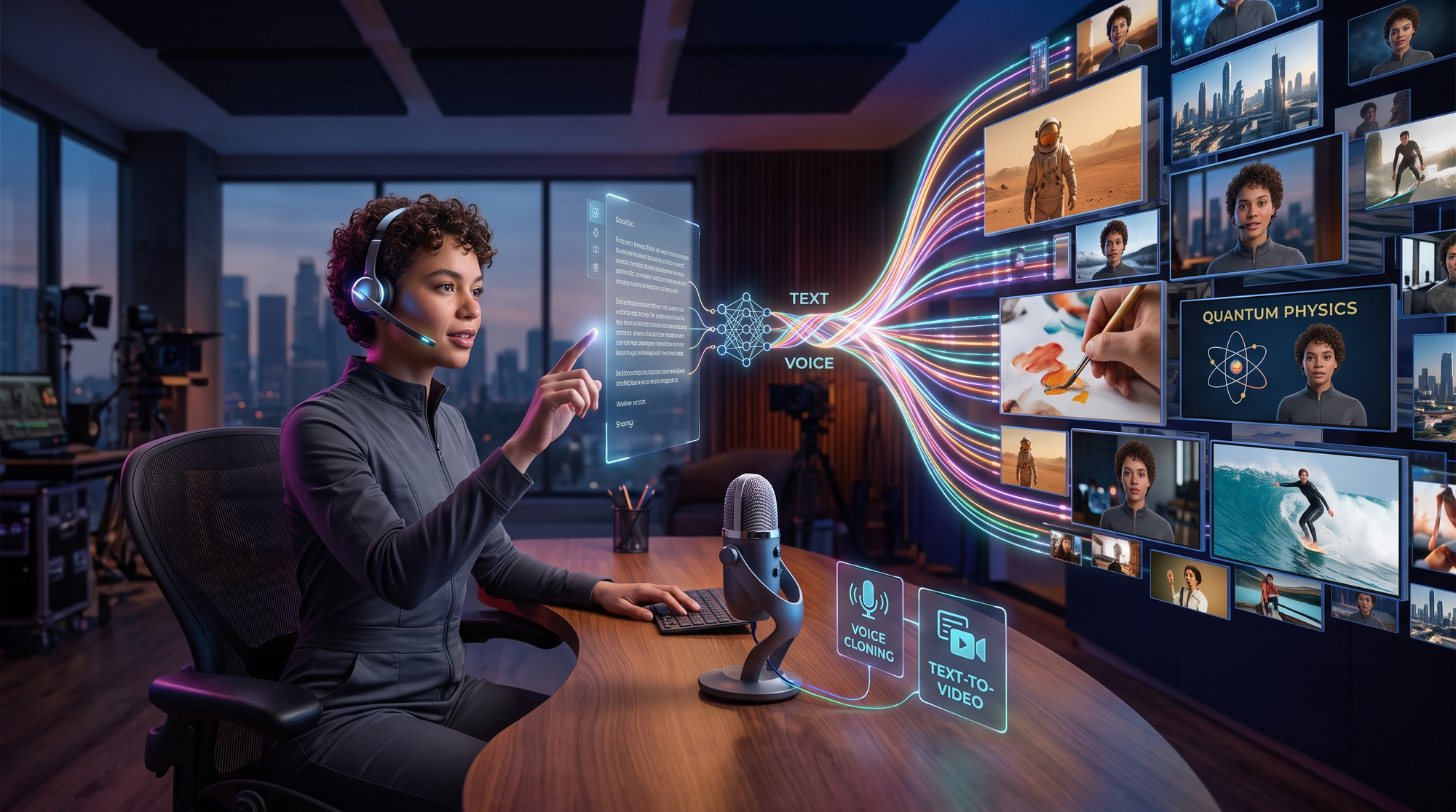
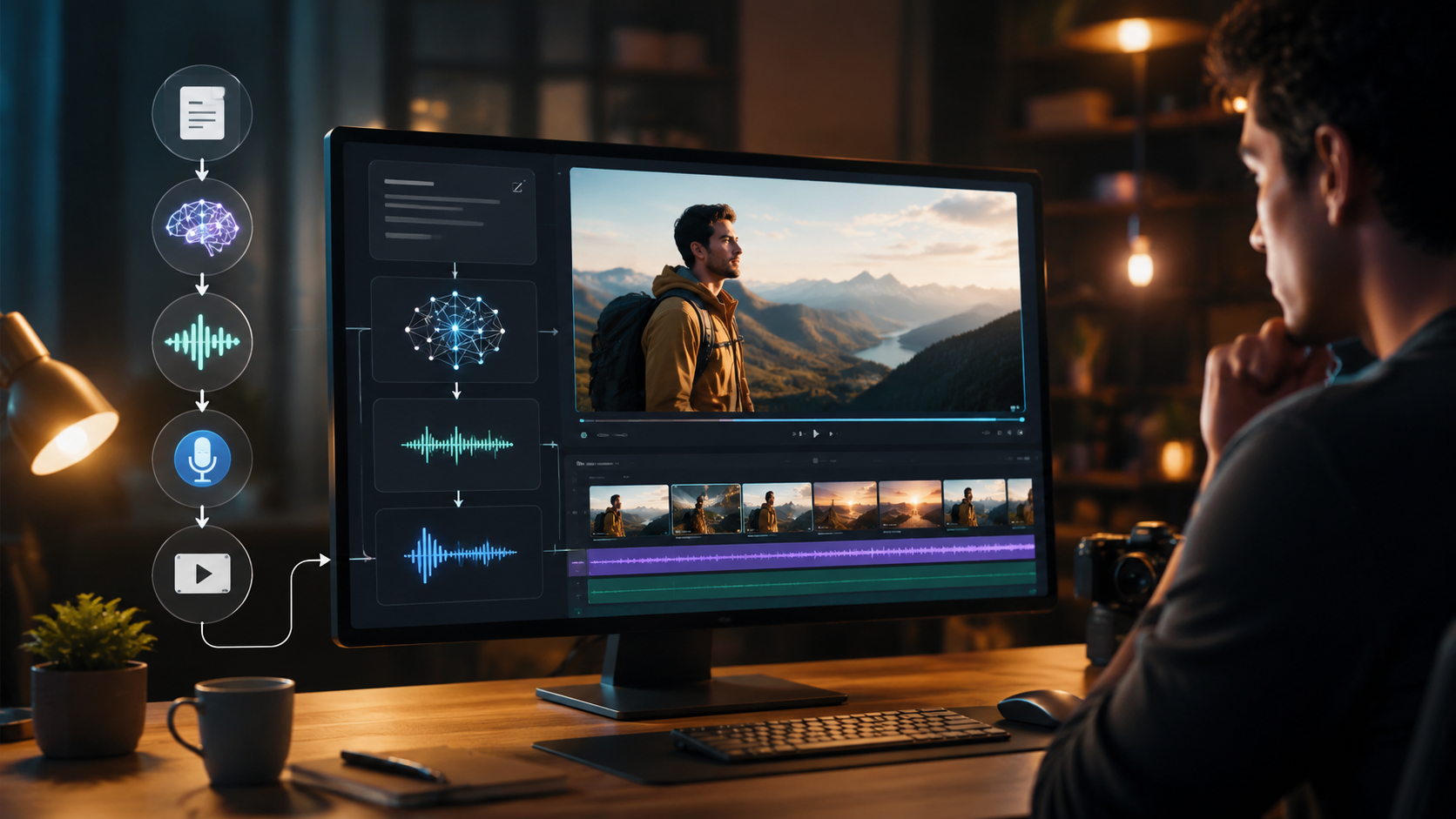
The modern text to video AI pipeline involves three core components working in harmony: natural language understanding, visual generation, and voice synthesis. When you input a text prompt, the system first analyzes it for contextual meaning, emotional tone, and implied visual elements. According to Simplilearn.com, leading systems can now identify and implement appropriate cinematic techniques like close-ups or tracking shots based solely on the text description.
The Text Analysis Phase
Advanced language models break down the input text into actionable components, identifying characters, settings, actions, and emotional beats. This analysis determines everything from camera angles to lighting conditions in the generated video. The best systems in 2026 achieve 92% accuracy in interpreting creative intent from text prompts.
Visual Generation Process
Using the parsed text data, the AI generates corresponding visuals through diffusion models or transformer architectures. Modern systems can maintain consistent character appearances across different scenes and generate realistic backgrounds with proper perspective and lighting. Resolution has improved dramatically, with 8K output becoming available on premium platforms.
Voice Cloning Integration
The voice cloning component takes the processed text and converts it to speech using either a generic AI voice or a cloned human voice. According to Decrypt, Qwen 3.5 Omni's voice cloning can capture subtle vocal characteristics like breath patterns and regional accents with 95% accuracy, making synthetic voices nearly indistinguishable from the original.
Top Use Cases for Text to Video AI with Voice Cloning
This technology is being adopted across numerous industries due to its versatility and cost-effectiveness. Marketing teams report 50% faster campaign production cycles when using AI video tools, while educational content creators have seen 300% increases in video output without additional staff.
Personalized Marketing at Scale
Brands now generate thousands of unique video ads with localized voiceovers and region-specific content from a single text template. A/B testing different versions has become 80% more efficient with AI-generated variations. Digen AI's platform specifically enables dynamic product placement and spokesperson customization with consistent quality across all outputs.
Accessible Educational Content
Educators can quickly transform textbooks and lesson plans into engaging video content with cloned instructor voices. This has proven particularly valuable for students with reading difficulties, showing 45% better retention rates compared to text-only materials according to recent studies.
Automated Corporate Communications
Companies use voice cloning to produce consistent training videos and internal communications featuring executive voices without requiring their physical presence. The technology saves an average of 15 hours per week for HR and L&D teams while maintaining brand voice consistency across all materials.
Comparing Leading Text to Video AI Platforms in 2026
The market has become increasingly competitive, with various platforms specializing in different aspects of video generation. Below is a comparison of key features across top solutions:
| Feature | Qwen 3.5 Omni | Digen AI Agent | Industry Average |
|---|---|---|---|
| Max Video Length | 10 minutes | 30 minutes | 5 minutes |
| Voice Cloning Accuracy | 95% | 93% | 88% |
| Output Resolution | 8K | 4K | 1080p |
| Character Consistency | 89/100 | 94/100 | 82/100 |
| Price per Minute | $4.99 | $3.99 | $6.50 |
Ethical Considerations and Limitations
As text to video AI with voice cloning becomes more sophisticated, important ethical questions have emerged. The technology's potential for misuse in creating deepfakes has led to 78% of platforms implementing watermarking and content verification systems by mid-2026.
Current systems still struggle with certain complex physical interactions between characters and objects, scoring only 65/100 on physics simulation benchmarks. Emotional nuance in longer narratives also remains challenging, with AI-generated dramatic scenes receiving 30% lower audience engagement scores than human-directed equivalents.
Voice cloning raises particular concerns about consent and impersonation. In response, leading platforms now require verified identity confirmation and voice sample ownership documentation before enabling cloning features. The industry has adopted a standardized ethics framework that 92% of major providers follow as of June 2026.
The Future of Text to Video AI Beyond 2026
Industry analysts predict three major advancements in the next generation of text to video AI systems. First, real-time generation capabilities will reduce processing times from minutes to seconds, enabling live applications. Second, multi-character interactions will become more natural, with systems scoring above 90/100 on social dynamics simulations.
Perhaps most significantly, the integration of world knowledge and common sense reasoning will allow AI to generate more logically consistent narratives. Current systems make factual errors in about 15% of generated content when dealing with specialized topics - a figure expected to drop below 5% by 2027.
Digen AI has announced plans for a "Director Mode" that will allow users to guide AI generation with high-level creative decisions rather than detailed text prompts. This approach aims to combine human creativity with AI efficiency, potentially revolutionizing content production workflows across industries.

Frequently Asked Questions
How accurate is voice cloning in text to video AI systems?
Modern systems achieve 93-95% accuracy in replicating vocal characteristics from short voice samples. However, perfect emotional inflection remains challenging, especially for complex emotional states.
Can text to video AI create content in multiple languages?
Yes, leading platforms support 40+ languages with automatic lip-sync adjustment. Quality varies by language, with English, Mandarin, and Spanish currently having the most natural results.
How long does it take to generate a video?
Generation time depends on length and complexity, but averages 2-5 minutes for a 1-minute HD video. More advanced systems like Digen AI Agent can process multiple scenes in parallel for faster turnaround.
Is AI-generated video content copyrightable?
Current US and EU laws grant copyright to the human creator who prompted the AI, provided there was sufficient creative input in the text instructions and editing choices.
What's the difference between basic AI video tools and advanced ones like Digen AI Agent?
Advanced systems maintain better consistency across longer videos, understand more complex prompts, and offer greater control over visual style and narrative flow through multi-step autonomous workflows.
Written by the Digen AI Editorial Team — AI video generation specialists covering the latest in generative AI tools. Learn more about Digen AI.



Comments ()