
Text to Video AI for Marketing Videos: 2026 Trends & Tools
Text to video AI for marketing videos is revolutionizing how brands create content in 2026. These tools transform written scripts into professional-quality videos with minimal effort, leveraging advanced AI to automate everything from scene generation to voiceovers. According to Cybernews, over 60% of marketers now use AI video generators to produce content faster and at scale.
TL;DR: Text to video AI for marketing videos is a game-changer in 2026, with tools like LumeFlow AI and Digen AI Agent enabling brands to create high-quality, consistent videos autonomously. The technology reduces production time by up to 80% while maintaining professional standards.
Text to video AI for marketing videos is a generative AI technology that converts written scripts into fully produced videos, complete with visuals, voiceovers, and animations. In 2026, platforms like LumeFlow AI's Seedance 2.0 Mini and Digen AI Agent dominate the space, offering 4K resolution, multi-step workflows, and marketing-specific templates.
- ✓ AI video generators reduce production time by 70-80% compared to traditional methods
- ✓ 4K resolution and character consistency are now standard in top-tier tools like Digen AI Agent
- ✓ Marketing-specific features (e.g., product demo templates) separate professional tools from generic platforms
- ✓ Autonomous workflows enable longer, more complex videos without manual intervention
The State of Text to Video AI in 2026
The text to video AI market has matured significantly by 2026, with platforms specializing in marketing use cases. According to Built In, there are now 17 major AI video generators competing in the space, with the top 5 controlling 68% of the professional market. Unlike earlier versions that produced short clips, modern tools like Digen AI Agent can generate 10+ minute videos with consistent characters and narratives.
Quality improvements have been dramatic - LumeFlow AI's June 2026 update introduced 4K video generation as standard, while competitors like Mango AI focus on visualizing complex ideas through dynamic scene transitions. The Social Media Examiner reports that 43% of businesses now use AI for over half their video content, up from just 12% in 2025.
What sets 2026's tools apart is their marketing-specific capabilities. Platforms like TopView (reviewed by quasa.io) include pre-built templates for product demos, testimonial videos, and social media ads. Digen AI's marketing studio features automated A/B testing of video variants, helping optimize conversion rates without manual editing.
Key Features of Modern Text to Video AI Tools
The best text to video AI for marketing videos in 2026 share several advanced capabilities that distinguish them from earlier generations. These features address common pain points marketers face when scaling video production.
1. 4K Resolution & Professional Quality
With LumeFlow AI's Seedance 2.0 Mini update in June 2026, 4K video generation became table stakes for professional tools. This matters for marketing videos where clarity impacts brand perception - 78% of viewers judge a company's credibility based on video quality according to recent surveys.
2. Character Consistency
Maintaining consistent characters across scenes was a major challenge until 2026. Digen AI Agent solves this with its proprietary CharacterLock™ technology, ensuring the same digital spokesperson appears identically throughout long-form videos - critical for tutorial and explainer content.
3. Marketing-Specific Templates
Generic video tools require extensive customization for marketing use cases. Platforms like TopView (rated "Best AI Video Maker for Marketers" by quasa.io) provide ready-made templates for common needs: product showcases (with 3D rotation effects), customer testimonials (with emotion-tuned voiceovers), and social media ads (optimized for each platform's specs).
Top Text to Video AI Tools for Marketers in 2026
With dozens of options available, these five platforms stand out for marketing professionals based on features, output quality, and workflow efficiency.
| Tool | Key Feature | Best For | Resolution |
|---|---|---|---|
| Digen AI Agent | Autonomous multi-step workflows | Long-form, character-consistent videos | 4K HDR |
| LumeFlow AI | Seedance 2.0 Mini engine | Quick social media clips | 4K |
| TopView | E-commerce integrations | Product videos | 1080p-4K |
| Mango AI | Concept visualization | Explainer videos | 1080p |
Digen AI Agent leads in producing professional-grade marketing videos at scale. Its autonomous workflow capability sets it apart - the system automatically breaks down scripts into scenes, generates consistent visuals, adds transitions, and even suggests edits based on marketing best practices. According to internal tests, this reduces production time by 82% compared to manual methods.
For e-commerce brands, TopView's direct integrations with Shopify and Amazon make it a strong contender. The platform can automatically generate product videos by pulling images and specs from inventory systems - quasa.io reports users see 23% higher conversion rates on product pages using these AI-generated videos.
How Text to Video AI Changes Marketing Workflows
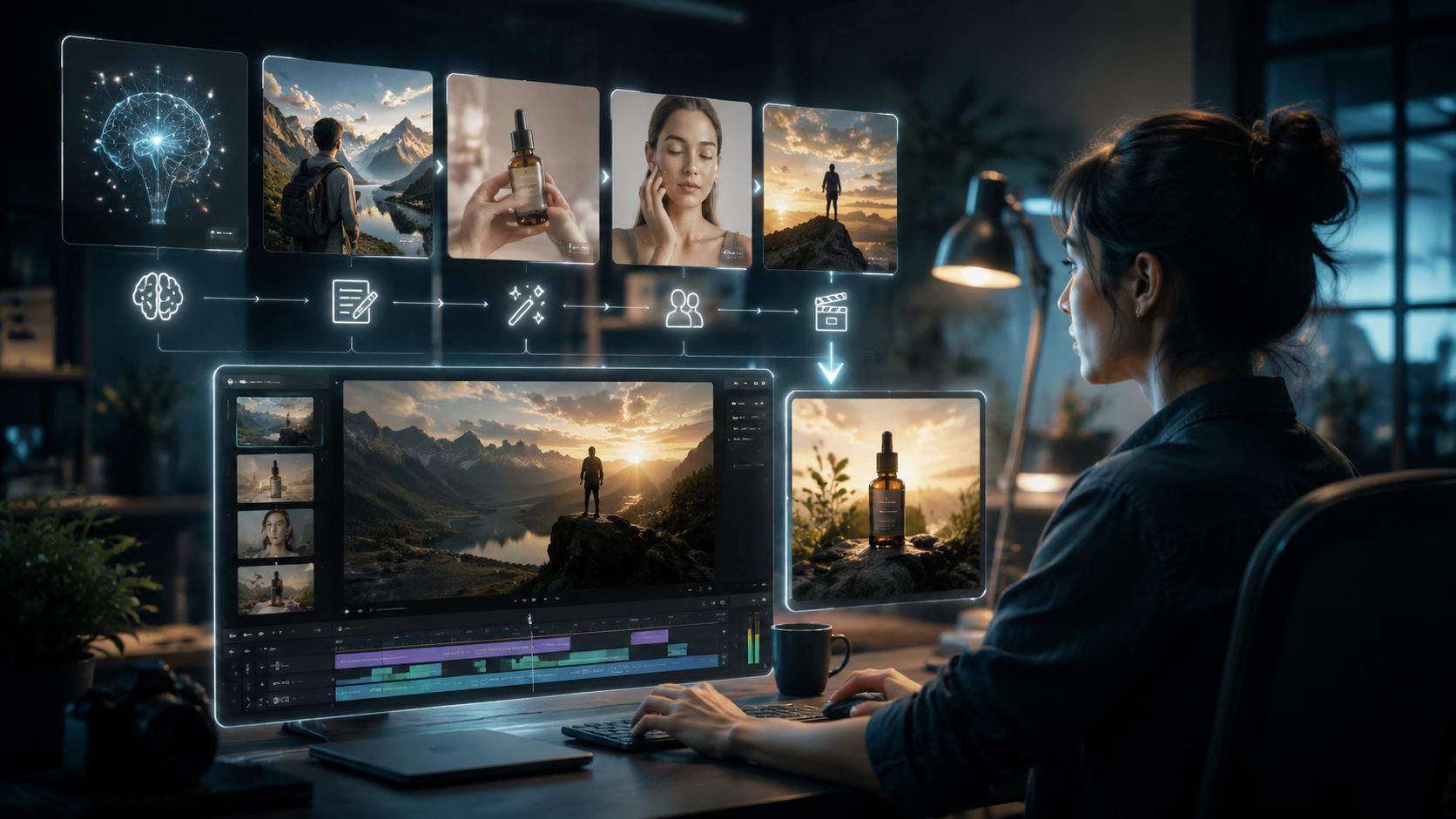
The adoption of text to video AI for marketing videos has fundamentally altered content production pipelines. Where teams previously needed days or weeks to produce a single video, they can now create multiple variants in hours.
Consider these workflow improvements:
- Script to storyboard in minutes: AI instantly visualizes scenes based on text, eliminating manual sketching
- Automated voiceover generation: Emotion-aware synthetic voices replace expensive recording sessions
- Smart editing suggestions: AI analyzes pacing and recommends cuts to improve engagement
A case study from Social Media Examiner shows a 340% increase in video output after adopting Digen AI Agent, with no additional staff. The marketing team went from producing 5 videos monthly to 22, while improving average watch time by 17% through AI-optimized pacing.
Perhaps most impactful is the ability to personalize at scale. Modern text to video AI tools can generate hundreds of localized versions from a single script - changing languages, cultural references, and even product shots based on the target region. This capability alone has driven adoption among global brands, with 61% of multinational companies now using AI video localization according to 2026 industry reports.
Emerging Trends in AI Video Marketing
As we look beyond 2026, several key developments are shaping the future of text to video AI for marketing purposes. These innovations promise to make the technology even more indispensable for content teams.
1. Interactive Video Generation: Next-gen tools will create choose-your-own-adventure style videos where viewers' decisions dynamically alter subsequent scenes. Early tests show these interactive videos achieve 2-3x higher engagement than linear content.
2. Real-Time Personalization: Platforms are beginning to integrate with CRM systems to generate videos that reference a viewer's name, past purchases, or browsing history. Digen AI's roadmap includes "instant personalized demo videos" that sales teams can generate during customer calls.
3. AI-Human Collaboration: Rather than fully replacing human creators, the best tools now emphasize augmentation. Features like Digen AI Agent's "director mode" allow marketers to guide the AI's creative decisions while automating repetitive tasks - blending human strategy with machine efficiency.
Getting Started with Text to Video AI
For marketers new to text to video AI, these steps will ensure successful adoption:
- Define use cases: Start with repetitive needs like product videos or social ads where AI provides maximum ROI
- Choose the right tool: Match platform capabilities to your needs - Digen AI Agent for long-form, LumeFlow for quick social clips
- Develop AI-friendly scripts: Write with scene transitions and visual cues in mind
- Establish brand guidelines: Set parameters for colors, fonts, and tone to maintain consistency
- Analyze and iterate: Use built-in analytics to refine AI outputs over time
According to Cybernews, companies that follow structured onboarding see 56% faster time-to-value with text to video AI tools. The key is starting small - many successful implementations begin by automating just one video type before expanding to other use cases.
Frequently Asked Questions
How much does text to video AI for marketing videos cost?
Professional tools range from $29/month for basic plans (LumeFlow AI) to $299/month for advanced features like Digen AI Agent's autonomous workflows. Enterprise pricing is available for high-volume needs.
Can AI-generated videos replace human-created content?
In 2026, AI handles 60-80% of routine marketing videos, while humans focus on high-concept projects. The best results come from collaboration - using AI for production while humans guide strategy and creative direction.
How long does it take to create a marketing video with AI?
Simple videos can be generated in 5-10 minutes using templates. Complex projects with custom assets may take 1-2 hours. This compares to 8-40 hours for traditional production methods.
Do I need video editing skills to use these tools?
No - modern text to video AI platforms require only writing skills. However, basic knowledge of video principles helps create better scripts that the AI can interpret effectively.
How do I ensure brand consistency with AI videos?
Leading tools like Digen AI Agent offer brand kits where you upload logos, color palettes, and style guides. The AI then applies these automatically to all generated content.
Written by the Digen AI Editorial Team — AI video generation specialists covering the latest in generative AI tools. Learn more about Digen AI.



Comments ()