
Text to Video AI for Filmmakers: 2026 Cinematic Revolution
Text to video AI for filmmakers is a suite of generative artificial intelligence tools that transform written descriptive prompts into high-fidelity, cinematic motion picture sequences. In 2026, this technology has evolved from a novelty experimental tool into a foundational pillar of the modern production pipeline, allowing creators to generate complex visual effects, background plates, and full-scale narrative scenes directly from a script. By leveraging deep learning models trained on vast libraries of cinematic data, filmmakers can now achieve Hollywood-level production value with unprecedented speed and cost-efficiency.
Text to video AI for filmmakers is the process of using generative models like Runway Gen-4 and Google Flow to synthesize photorealistic video from text descriptions. In 2026, this technology serves as a "cinematic engine," enabling directors to bypass traditional physical constraints by generating high-resolution, temporal-consistent footage that integrates seamlessly with live-action or fully digital productions.
- ✓ AI video generators have shifted from standalone tools to integrated "behind-the-scenes" workflows in major studios.
- ✓ Real-time collaboration and multimodal prompting (text, image, and motion control) are now standard in 2026.
- ✓ The demise of early prototypes like Sora has paved the way for more filmmaker-centric platforms like Runway and Google Flow.
- ✓ Cost reductions in pre-visualization and VFX are estimated at over 60% compared to 2024 methods.
The Evolution of Text to Video AI for Filmmakers in 2026
The cinematic landscape of 2026 is defined by the "Generative Revolution," a period where the boundaries between imagination and execution have effectively vanished. For years, the industry anticipated the arrival of high-fidelity video generation, but it wasn't until the mid-2020s that the technology achieved the temporal stability required for professional filmmaking. Today, text to video AI for filmmakers is no longer about generating grainy, five-second clips; it is about orchestrating entire sequences with precise control over lighting, camera movement, and character consistency.
According to The AI Journal (March 2024), the revolution in 2026 is characterized by "Hyper-Realism," where AI-generated frames are indistinguishable from 35mm film. This shift has forced a re-evaluation of the traditional production funnel. While early concerns focused on the displacement of human artists, the reality in 2026 shows a different trend: AI is acting as a force multiplier. Directors are using these tools to iterate on visual concepts in minutes rather than weeks, allowing for a more democratic and experimental approach to storytelling that was previously reserved for high-budget studio projects.
The competitive landscape has also shifted dramatically. While the industry mourned the end of OpenAI’s Sora project and its high-profile Disney partnership in early 2026, the vacuum was quickly filled by specialized platforms. As reported by IndieWire, the "AI video battle is just beginning," with new players focusing on professional-grade tools that respect the nuances of cinematography, color science, and editorial pacing rather than just general video generation.
How to Implement AI Video into Your Production Workflow
If you are looking to integrate text to video AI for filmmakers into your next project, follow these industry-standard steps for 2026:
- Conceptualization and Prompt Engineering: Draft highly detailed prompts that specify lens type (e.g., 35mm anamorphic), lighting conditions (e.g., golden hour, high-key), and specific camera movements (e.g., slow dolly-in).
- Pre-Visualization (Pre-Viz): Use AI to generate rapid storyboards and "moving mood boards" to align the creative team before expensive physical production begins.
- Asset Generation: Create background plates, crowd simulations, or environmental textures using generative models to replace costly on-location shoots or manual CGI.
- Integration and In-Painting: Use tools like Google Flow to modify existing footage, adding or removing elements through text-based commands to refine the final frame.
- Final Rendering and Upscaling: Export the generated sequences into 8K resolution with HDR metadata, ensuring compatibility with professional color grading suites like DaVinci Resolve.
The Major Players: Runway vs. Google Flow in 2026
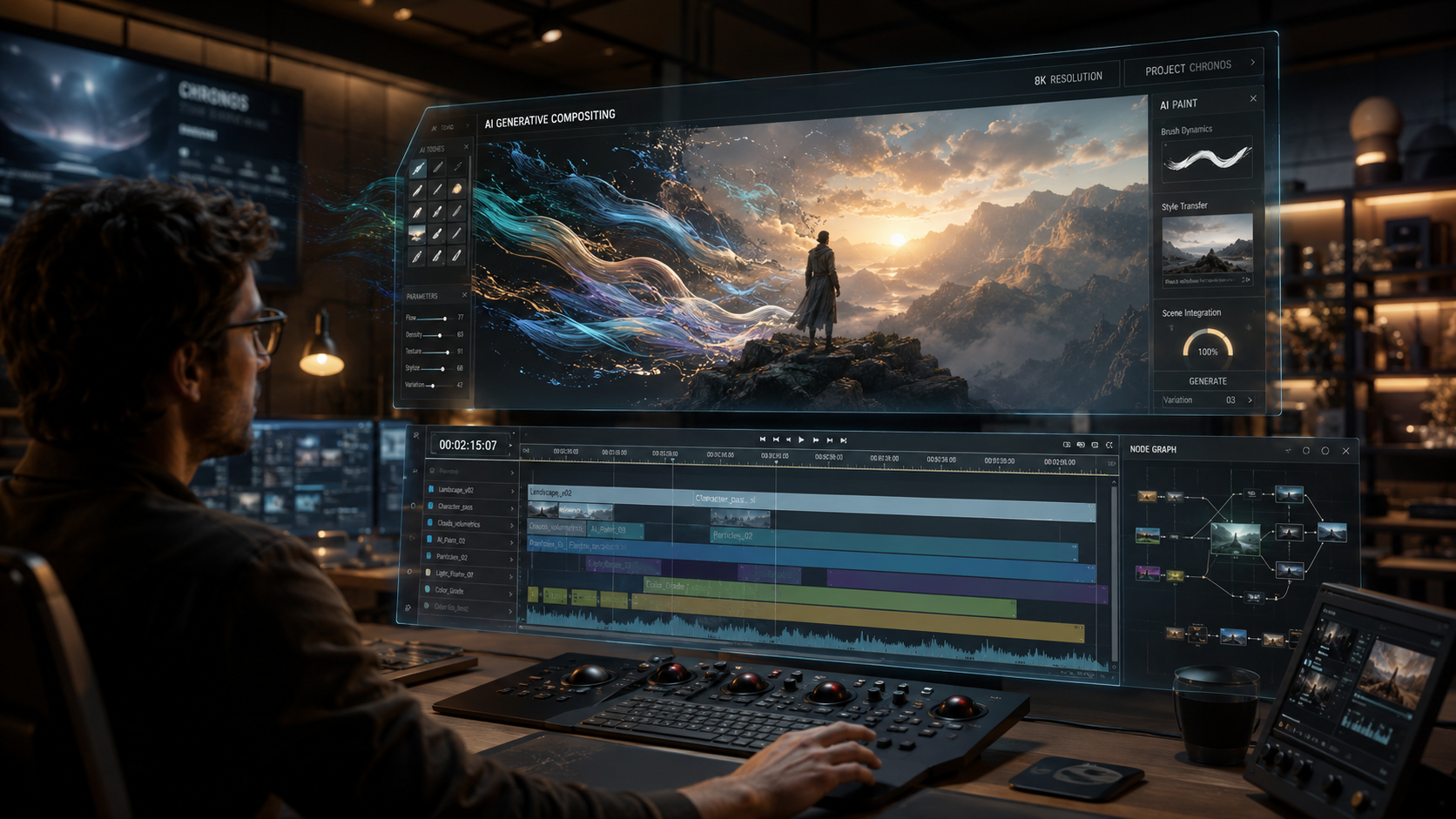
As of mid-2026, two primary ecosystems dominate the professional market. Runway, which began as a niche tool for experimental artists, has pivoted aggressively toward the professional film sector. TechCrunch notes that Runway’s current strategy is to "beat Google at AI" by offering a suite of tools designed specifically for the filmmaker’s psyche—focusing on granular control rather than just automated output. Their 2026 updates include advanced "Director Mode" features that allow for spatial manipulation of subjects within a generated 3D volume.
On the other hand, Google Flow has leveraged its massive infrastructure to provide a seamless, cloud-based experience. Since the major feature updates in late 2025, Google Flow has become the go-to for collaborative production. BGR reports that Flow’s new AI features allow multiple editors to work on the same generative timeline simultaneously, with "Neural Rendering" speeds that allow for near-instant previews of complex text-to-video prompts. This has made it an essential tool for tight-turnaround commercial work and episodic television.
| Feature | Runway (2026 Edition) | Google Flow | Industry Standard |
|---|---|---|---|
| Core Strength | Cinematic Control & Texture | Real-time Collaboration | Photorealism |
| Max Resolution | 8K Raw Export | 4K Neural Stream | 4K+ |
| Control Mechanism | Multi-modal (Text + Motion) | Integrated Workspace / UI | Text-to-Video |
| Best For | Independent Features & VFX | Commercials & Social Media | General Content |
The "Behind the Scenes" Revolution: More Than Just Pixels
While the visual output of text to video AI for filmmakers gets the most attention, the real transformation is occurring in the technical infrastructure. No Film School highlights that the "Real AI Revolution" is happening behind the scenes, specifically in metadata management and automated asset tagging. In 2026, AI models are used to organize terabytes of footage, automatically syncing dialogue to generated lip-movements and suggesting edits based on the emotional cadence of a scene.
This "invisible AI" extends to the lighting and physics engines of these generators. Modern AI models no longer just "guess" what a scene looks like; they simulate the way light bounces off surfaces and the way gravity affects liquid. This physical accuracy is why 2026 is considered the turning point for cinematic AI. Filmmakers can prompt a "rainy street in London with neon reflections" and receive a clip where every raindrop reacts correctly to the light sources, a feat that would have required a massive VFX team just two years ago.
The Impact on Independent Filmmaking
For independent creators, the 2026 cinematic revolution has leveled the playing field. The cost of entry for high-concept sci-fi or period dramas has plummeted. According to data cited by Autodesk News, the average cost of pre-visualization for indie films has dropped by nearly 70% since 2025. This allows directors to "fail fast" in the digital space, refining their vision through text to video AI before a single physical camera is ever rented. This shift is fostering a new wave of "AI-native" filmmakers who view generative tools as essential as the lens or the microphone.
Addressing the Ethical and Creative Questions of 2025-2026
The journey to 2026 has not been without its hurdles. Autodesk News recently revisited the "Five questions that dominated the AI and filmmaking conversation in 2025," which included concerns over copyright, actor likeness, and the "soul" of AI-generated art. While the legal frameworks have caught up—with most platforms now offering "cleared" models trained on licensed content—the creative debate continues. Filmmakers are now tasked with finding the balance between the efficiency of AI and the unique human intuition that defines great cinema.
The industry has largely moved toward a "hybrid" model. In this setup, text to video AI for filmmakers handles the "heavy lifting" of environment building and complex visual effects, while human actors and directors focus on the emotional core of the performance. This synergy is what has prevented the predicted "death of cinema" and instead birthed a new era of storytelling. The 2026 revolution is less about replacing the filmmaker and more about expanding the vocabulary of what can be filmed.
Technical Milestones in 2026 AI Video
Several key technical breakthroughs have defined this year's progress in text to video AI for filmmakers:
- Temporal Consistency: The "flicker" effect that plagued 2024-era AI video has been solved through advanced latent space smoothing.
- Long-form Generation: Models can now maintain character and setting consistency across sequences lasting up to 10 minutes, rather than just short clips.
- Directable Motion: Filmmakers can now draw "motion paths" on their screens to tell the AI exactly where an object or camera should move within the generated scene.
The Future of the Cinematic AI Battle
As we look toward the latter half of 2026 and into 2027, the focus is shifting from "can we do this?" to "how well can we control it?" The collapse of the OpenAI-Disney deal earlier this year proved that even the biggest players aren't immune to the complexities of the film industry. However, as IndieWire noted, this has only intensified the competition. We are seeing a surge in "Boutique AI" houses that offer customized models for specific genres, such as "Noir-AI" or "Horror-Synth," tailored to the aesthetic needs of specific directors.
Text to video AI for filmmakers is also beginning to integrate with real-time game engines like Unreal Engine 6. This convergence allows for a "Generative Sandbox" where filmmakers can use text prompts to alter a 3D environment in real-time during a virtual production shoot. The 2026 Cinematic Revolution is, therefore, not a single event, but a continuous expansion of the boundaries of visual media, driven by the relentless pace of AI innovation and the enduring human desire to tell stories.
What is the best text to video AI for filmmakers in 2026?
Currently, Runway and Google Flow are the industry leaders. Runway is preferred for its granular "Director Mode" and cinematic textures, while Google Flow is favored for its real-time collaboration features and integration with other production tools.
Did OpenAI cancel its AI video project?
Yes, according to reports from March 2026, OpenAI's Sora project is no longer in active development for the public, and its partnership with Disney has ended. This has allowed other competitors like Runway to lead the professional filmmaking market.
Can AI video be used for professional color grading?
Yes, in 2026, most top-tier AI video generators export in high-bitrate formats (like ProRes or RAW) with full HDR metadata, allowing them to be graded in professional suites like DaVinci Resolve just like traditional footage.
How has AI reduced the cost of filmmaking?
Studies cited by Autodesk News indicate that AI has reduced pre-visualization and VFX costs by over 60%. By using text to video AI for filmmakers, productions can generate complex sequences and storyboards without the need for large physical crews or expensive manual rendering.
Is AI-generated video legal for commercial film use?
In 2026, most professional platforms use "Ethically Sourced" or "Licensed Only" training sets. This ensures that the generated content is legally cleared for commercial distribution, addressing the copyright concerns that were prevalent in 2024 and 2025.



Comments ()