
Text to Video AI for Ecommerce Products: 2026 Guide
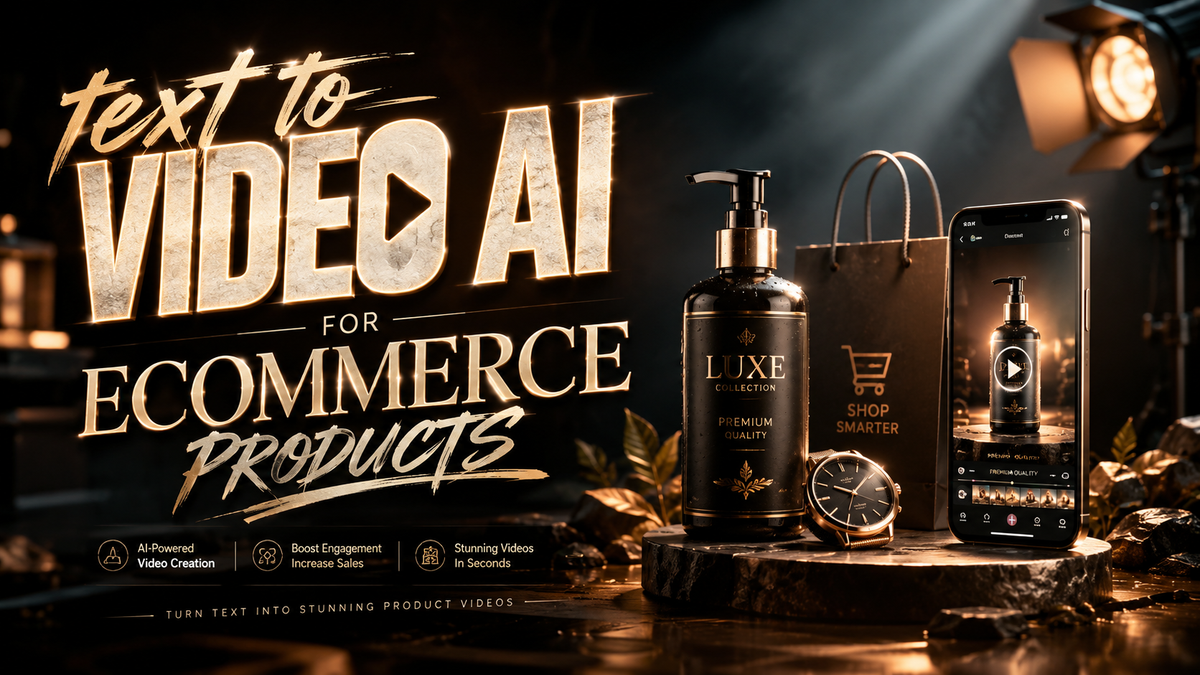
Text to video AI for ecommerce products is an advanced technology that converts written product descriptions, specifications, and marketing copy into professional, engaging video content without the need for a studio or filming crew, enabling online retailers to scale their visual merchandising at unprecedented speed in 2026.
Text to video AI for ecommerce products is a generative engine that takes product text, images, and sometimes audio prompts and automatically produces high-quality video demos, ads, and social media clips. It eliminates manual editing, reduces production costs, and allows brands to create hundreds of unique product videos in minutes.
- ✓ Text to video AI for ecommerce products cuts video production time by up to 80% compared to traditional methods.
- ✓ Leading tools now offer multimodal retrieval, combining text, image, and video data for richer product demos.
- ✓ By 2026, over 60% of ecommerce brands are expected to use AI-generated video for at least half of their product catalog.
- ✓ The technology supports multiple languages and formats, making global expansion easier than ever.
- ✓ Early adopters report a 30–50% increase in conversion rates when using AI-generated product videos over static images.
What Is Text to Video AI for Ecommerce Products?
In simple terms, text to video AI for ecommerce products refers to a set of machine learning models that take textual input—such as a product title, bullet points, or a full description—and generate a video that showcases the item in action. The output can include voiceovers, background music, text overlays, and dynamic transitions. According to a 2026 report by Cybernews, "The Rise of AI Video Generators: How Text-to-Video Technology Is Changing Content Creation in 2026" highlights that these tools are now sophisticated enough to produce studio-quality results from a single paragraph of text.
Unlike traditional video creation, which requires cameras, actors, lighting, and editing software, text to video AI for ecommerce products relies on pre-trained neural networks. Many platforms allow users to upload a product image alongside the text, which the AI then animates or incorporates into a scene. For instance, perfectcorp.com launched an AI Product Video Generator in early 2026 that "create[s] product videos without a studio," enabling even small businesses to produce high-end content on a tight budget.
The technology has matured to the point where multimodal retrieval—combining text, images, and even existing video clips—is becoming standard. Amazon Web Services introduced multimodal retrieval for Amazon Bedrock Knowledge Bases in January 2026, allowing AI models to pull from diverse data sources to generate more contextual video content. This development is a game-changer for ecommerce, where product information often exists in multiple formats across a brand’s catalog.
Why Ecommerce Businesses Are Adopting AI Video Generators in 2026

The product demo dilemma has long plagued online retailers: creating a video for every item in a large catalog is prohibitively expensive and time-consuming. As Intelligent Living reported in April 2026, "The Product Demo Dilemma: How AI is Scaling E-Commerce Video Production" details how AI is solving this bottleneck. Brands are now producing hundreds of short-form videos per week, each tailored to different platforms—from TikTok and Instagram Reels to Amazon product pages and Google Shopping ads.
Beyond cost savings, text to video AI for ecommerce products improves customer engagement. Videos give shoppers a better sense of scale, texture, and functionality than static images. According to Shopify (September 2025), AI image generators have already boosted conversion rates, and the natural next step is video. In 2026, platforms like Shopify are integrating directly with AI video generators, allowing merchants to generate product videos with one click during listing creation.
Another driver is personalization. Multimodal AI can now analyze a customer’s browsing history and generate a custom video that highlights the features most relevant to that user. For example, a skincare brand might create a video that emphasizes hydration for a customer who previously searched for moisturizers. This level of personalization was unthinkable just two years ago but is now a core feature of the top tools.
Key Benefits at a Glance
- Speed: Generate a 30-second product video in under 5 minutes.
- Scale: Create videos for an entire catalog without manual labor.
- Consistency: Maintain brand voice and visual style across all videos.
- Cost: Reduce production expenses by 70–90% compared to traditional studios.
Key Features of Top Text-to-Video AI Tools for Ecommerce
Based on the 2026 review from G2 Learn Hub (“7 Best AI Video Generators I’ve Tried (and Loved!) for 2026”), the best tools for ecommerce share several critical features. First, they offer intuitive interfaces that require no video editing experience. Second, they support multimodal inputs—text, images, and sometimes audio—to create richer outputs. Third, they provide templates optimized for different sales channels, such as product demos, unboxing videos, and social media ads.
Multimodal Capabilities
The most advanced systems, like those built on AWS Bedrock, can retrieve relevant images, diagrams, or even competitor video snippets from a knowledge base. This means a text prompt like “show the unboxing experience of our wireless earbuds” might pull in existing product shots, user reviews, and 3D models to create a seamless narrative. As Amazon Web Services demonstrated in early 2026, multimodal retrieval drastically improves the relevance and accuracy of AI-generated content.
Customization and Branding
Leading tools allow users to upload brand fonts, color palettes, logos, and even specific voice actors for narration. Some platforms integrate with AI voice cloning, so a brand can use the same narrator voice across all videos. G2’s review noted that the top-rated generators in 2026 all offer style transfer, enabling a video to mimic the look and feel of a brand’s existing marketing materials.
E-Commerce Integrations
Many text-to-video AI solutions now plug directly into ecommerce platforms like Shopify, WooCommerce, and BigCommerce. This allows automatic video generation whenever a new product is added to the catalog. Shopify listed AI image generators as a top tool in 2025, and by 2026 the ecosystem has expanded to include full video generation as a standard feature.
How to Create Product Videos Using Text-to-Video AI (Step-by-Step)
If you’re new to text to video AI for ecommerce products, follow these steps to create your first professional product video in under 10 minutes:
- Choose a tool: Select a reputable AI video generator that specializes in ecommerce. Look for one that offers multimodal retrieval and channel-specific templates.
- Prepare your product information: Write a clear, detailed product description. Include key features, benefits, dimensions, materials, and your unique selling proposition. Have at least one high-resolution product image ready.
- Set brand parameters: Upload your logo, choose brand colors from the palette, select a voiceover style (or record your own), and pick background music that fits your brand tone.
- Input text and image: Paste your product description into the AI tool. Attach your product image. Some tools also let you input a target audience or desired video length (e.g., 15 seconds for Instagram Stories, 60 seconds for YouTube).
- Select a template: Choose from available video formats such as product demo, unboxing, before/after, or educational explainer. The AI will use the template to structure shots, transitions, and text overlays.
- Generate and review: Click “Generate” and wait for the AI to produce the video. Most tools preview the result in under a minute. Watch the video and check for accuracy, pacing, and visual appeal.
- Edit and export: If needed, adjust text, swap out background music, or change the voiceover. Once satisfied, export the video in the required resolution (1080p, 4K) and format (MP4, MOV). Download and upload to your ecommerce store or social channels.
Comparison of Leading AI Video Generators for Ecommerce
While many tools exist, the following comparison highlights three categories of solutions referenced in the 2026 research. Note that specific pricing and feature sets vary; always check the latest version from each provider.
| Tool / Category | Multimodal Input | Studio Required? | Integration with Ecommerce Platforms | Best For |
|---|---|---|---|---|
| Perfect Corp AI Product Video Generator | Text + Image | No | Shopify, Magento | Beauty and fashion brands needing lifelike product try-ons |
| Amazon Bedrock Knowledge Bases | Text + Image + Video (retrieval) | No | Custom API integration | Large retailers with existing product databases |
| Top-rated generators from G2’s 2026 list | Text + Image (some support audio) | No | Shopify, WooCommerce, BigCommerce | Small to mid-size businesses seeking all-in-one solutions |
Note: The G2 review (April 2026) emphasized that the best generators offer a free trial or tiered pricing, making them accessible even for startups.
Best Practices for Using AI-Generated Product Videos
To maximize the impact of text to video AI for ecommerce products, follow these best practices:
- Keep videos short: Aim for 15–30 seconds for social media and up to 60 seconds for product pages. Viewers’ attention spans are short, and AI tools excel at condensing information.
- Test multiple variations: Generate A/B versions with different voiceovers, music, or text placement to see which drives more conversions. The speed of AI makes this easy.
- Add captions: Many viewers watch videos without sound. Ensure the AI tool automatically adds text overlays or allows you to include captions for accessibility.
- Optimize for mobile: Over 70% of ecommerce traffic comes from mobile devices. Choose vertical or square formats that fill the screen.
- Combine with real footage: For credibility, consider mixing AI-generated scenes with short clips of the actual product. Some tools let you upload a video snippet and integrate it seamlessly.
Frequently Asked Questions
What exactly is text to video AI for ecommerce products?
It is a technology that automatically creates product videos from written descriptions and optional images. Instead of filming, you simply provide text, and the AI generates a complete video with voiceover, music, and visual effects.
How accurate are AI-generated product videos in 2026?
Modern multimodal models, such as those powered by AWS Bedrock, achieve high accuracy in depicting product details. However, always review the output for factual errors, especially when showing dimensions or colors. User ratings from G2 in 2026 indicate satisfaction rates above 85% for professional-grade outputs.
Can I use text to video AI for a large catalog with thousands of products?
Yes. Most enterprise-level tools support bulk generation via CSV upload or API integration. Shopify and other platforms now offer direct plugins that automatically generate videos for new listings, as highlighted in Shopify’s 2025 guide to AI tools.
Is text to video AI expensive for small ecommerce businesses?
No. According to the Intelligent Living article, many providers offer pay-per-video or subscription plans starting as low as $20–$50 per month. The cost is far lower than hiring a videographer and editor, and the ROI from increased conversions often offsets the investment quickly.
Do I need special hardware or software to run these tools?
No. All major text to video AI generators are cloud-based and run in your browser. You only need a computer or tablet with internet access. The heavy computing is done on the provider’s servers.
How does multimodal retrieval improve ecommerce video generation?
Multimodal retrieval, as introduced by Amazon Bedrock in January 2026, allows the AI to pull in relevant images, diagrams, and even clips from your existing product library. This results in videos that are more contextually accurate and visually richer than those based on text alone.
As we move deeper into 2026, text to video AI for ecommerce products is no longer a futuristic concept—it is a practical, scalable solution that every online retailer should consider. Whether you are a solo seller or a multinational brand, the tools reviewed by Cybernews, Intelligent Living, perfectcorp.com, G2, and Shopify demonstrate that the barrier to high-quality video content has never been lower. Start with a single product, measure the impact on engagement and sales, and then scale across your entire catalog. The future of ecommerce video is written in text, and the AI is ready to turn those words into views.



Comments ()