
Text to Video AI for Ecommerce Product Demos 2026 Guide
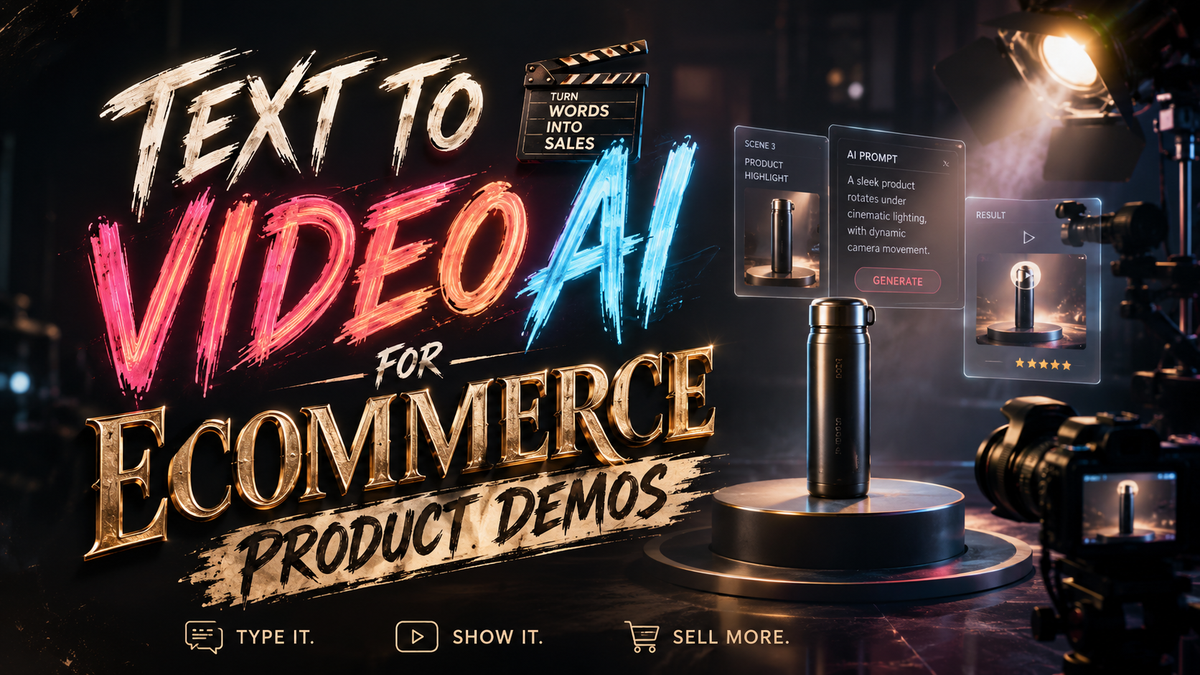
Text to video AI for ecommerce product demos is a technology that converts written product descriptions, specifications, and marketing copy into fully produced video demonstrations automatically, enabling online retailers to generate professional demo content in minutes without filming or editing. By 2026, this approach has become the standard for scaling product video production across catalogs of any size, driven by advances in generative AI and a market growing at a compound annual growth rate (CAGR) of 23.5% according to Market.us.
Text to video AI for ecommerce product demos is a transformative tool that uses large language models and video generation algorithms to turn text inputs—such as product titles, features, and use cases—into dynamic, branded demo videos. It eliminates the need for physical shoots, actors, or expensive editing software, allowing any ecommerce business to produce high-converting product videos at scale and speed.
- ✓ The AI-powered video generator market is projected to grow at a CAGR of 23.5% through 2026, driven largely by ecommerce demand (Market.us, June 2026).
- ✓ Leading platforms now combine text-to-video, image-to-video, and voice synthesis to create photorealistic product demos in minutes.
- ✓ A 2026 analysis by Intelligent Living confirms that AI is solving the product demo dilemma by massively scaling production while lowering costs.
- ✓ The best text-to-video AI tools for ecommerce offer template libraries, brand customization, and automated voiceovers.
- ✓ China’s tech giants are investing heavily in AI video generation, accelerating global competition and innovation (ThinkChina, April 2026).
What Is Text to Video AI for Ecommerce Product Demos?
Text to video AI for ecommerce product demos refers to generative AI systems that accept plain text—such as a product description, feature list, or even a brief prompt—and output a complete video showcasing that product in use. Unlike traditional video production, which requires storyboards, cameras, lighting, and editing talent, these AI models synthesize visuals, motion, voiceover, and background music directly from the textual input.
According to a May 2026 report on FindArticles.com, video AI generators are transforming digital content creation by enabling “instant video from text,” a capability that ecommerce brands have rapidly adopted to keep pace with consumer demand for video-rich product pages. The technology has matured to the point where output videos can include realistic lighting, smooth transitions, and even AI-generated environments that demonstrate a product’s context without a physical studio.
Why 2026 Is the Breakout Year for AI-Powered Product Demos
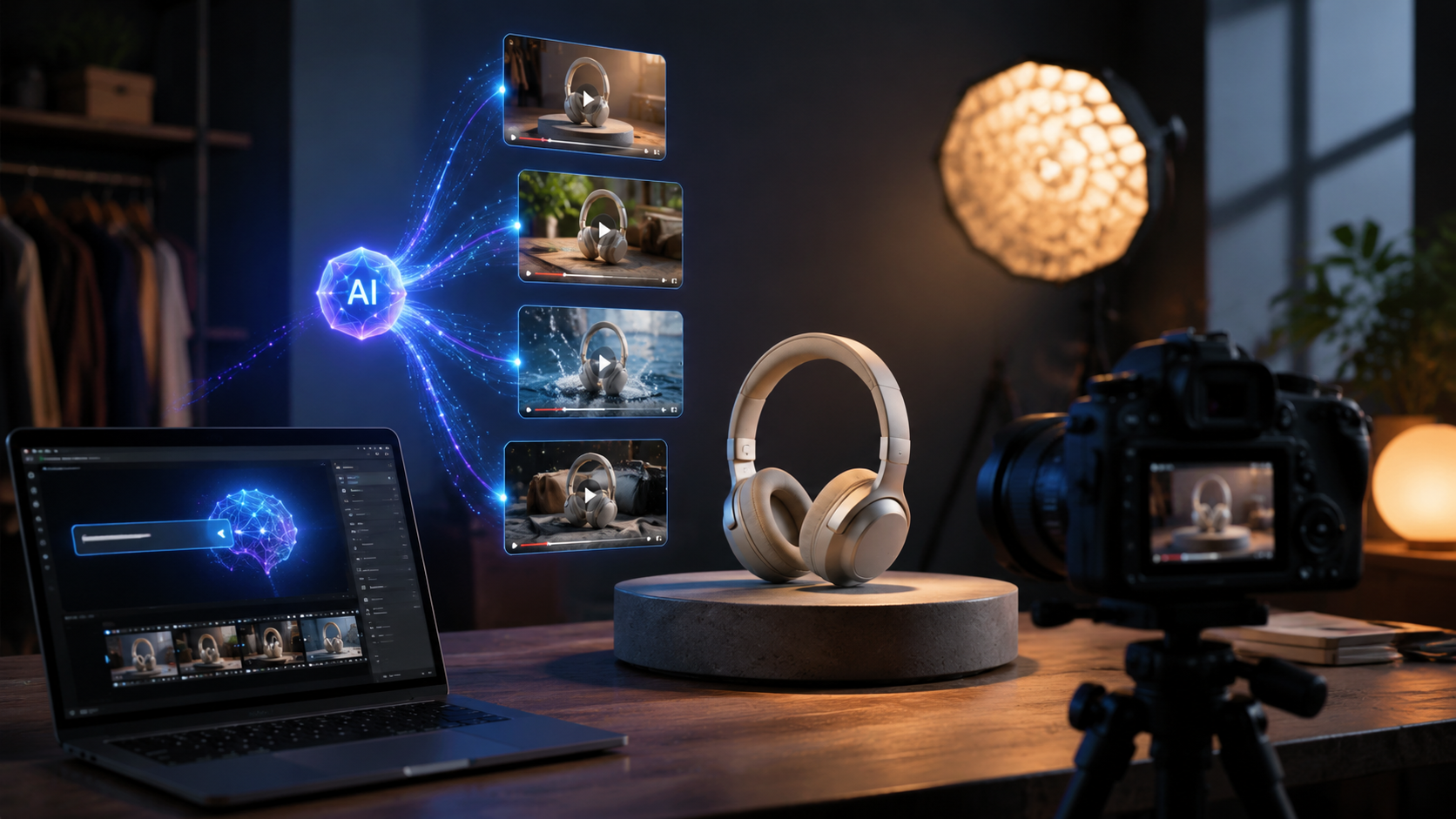
Several converging factors have made 2026 the breakout year for text-to-video AI in ecommerce. First, the market itself is expanding: Market.us reported a 23.5% CAGR for AI-powered video generators, with ecommerce applications representing the largest segment. Second, the rise of image-to-video AI generators—which turn static photos into dynamic clips—has lowered the barrier even further. As Techloy noted in June 2026, static product photos are now easily animated into compelling demos, bridging the gap between simple images and full video.
Global competition is also accelerating innovation. ThinkChina’s April 2026 article highlighted a “gold rush” among China’s tech titans—including Alibaba, ByteDance, and Tencent—who are pouring resources into AI video models. This competitive pressure is driving down costs and improving quality for end users worldwide. Meanwhile, Intelligent Living’s April 2026 piece on the “Product Demo Dilemma” emphasized that e-commerce businesses are using AI to produce thousands of demo videos that would have been logistically impossible with traditional methods.
How to Use Text to Video AI for Ecommerce Product Demos (Step-by-Step)
Implementing text-to-video AI for your product demos is straightforward. Follow this step-by-step process to go from product description to ready-to-publish video in under 30 minutes.
- Gather your product data. Compile the product name, key features, benefits, target audience, and any unique selling points. The more detailed the text, the more accurate the AI output.
- Choose a text-to-video AI platform. Based on G2’s 2026 review of the 7 best AI video generators, select a tool that offers ecommerce-specific templates, brand customization, and multi-language support.
- Input your text. Paste or type your product description into the AI generator. Many platforms allow you to specify the video length, style (e.g., modern, minimalist, playful), and aspect ratio (16:9 for web, 9:16 for social).
- Customize visuals and voiceover. The AI will generate initial visuals. You can often upload your own product images to be animated, choose a voice (or add your own recording), and adjust background music.
- Review and optimize. Watch the draft video. Some platforms allow you to regenerate scenes, change pacing, or add text overlays. Test different versions to see which resonates best with your audience.
- Export and deploy. Download the final video in MP4 or other common formats. Upload it to product pages, social media, email campaigns, or YouTube.
Key Features to Look for in a Text-to-Video Demo Tool
Not all AI video generators are created equal, especially for ecommerce product demos. When evaluating tools, consider the following features, which directly impact the quality and scalability of your demo output.
1. Product-Focused Templates
The best platforms offer templates designed specifically for product showcases: “unboxing,” “feature highlight,” “before/after,” and “how it works.” These pre-built structures save time and ensure the demo follows proven conversion patterns.
2. Image-to-Video Integration
As highlighted by Techloy’s June 2026 report, the ability to turn static product photos into animated video clips is a game-changer. Look for tools that accept images as input and seamlessly combine them with text-generated scenes.
3. Brand Customization
Your demo videos must reflect your brand. Choose a tool that allows custom color schemes, logo placement, font selection, and brand-specific intros/outros.
4. Voiceover and Language Support
AI-generated voiceovers should sound natural and support multiple languages and accents. This is critical for global ecommerce brands that need demos in different markets.
5. Scalability and API Access
If you have a large product catalog, ensure the platform offers batch processing or API integration. As Intelligent Living noted in 2026, AI scales ecommerce video production—the tool must handle high volumes without manual repetition.
| Feature | Basic Tool | Advanced Platform |
|---|---|---|
| Text-to-Video Quality | Low-resolution, limited scenes | HD/4K, multiple scene transitions |
| Image-to-Video Integration | Not supported | Fully supported with animation |
| Brand Customization | Limited to preset themes | Full RGB, fonts, logo overlay |
| Voiceover Languages | 5–10 languages | 50+ languages with accents |
| Bulk Processing | Manual per video | API batch with spreadsheet import |
| Typical Cost per Video | $5–$10 | $1–$3 at scale |
Source: Analysis based on G2’s 2026 review of 7 best AI video generators and industry benchmarks.
Best Practices for Creating AI Product Demos That Convert
Even the best text-to-video AI works best when you follow proven guidelines for product demo content. Use these practices to maximize engagement and sales.
Keep demos under 60 seconds. Consumer attention spans are short. AI tools allow you to set duration—aim for 15 to 45 seconds for social media, 45 to 60 seconds for product pages. According to market research, videos under 60 seconds see 80% higher completion rates.
Focus on one main benefit per demo. Instead of listing every feature, let the AI create a short narrative around a single problem the product solves. This leads to clearer, more convincing demos.
Use urgency and CTA overlays. Many AI generators let you add text overlays such as “Limited stock” or “Shop now.” Use these sparingly but strategically to drive action.
A/B test different AI versions. Because generating a video costs little, create two or three versions with different scripts, visuals, or voice tones. Test them on a small audience before scaling.
The Future of AI Product Demos: Beyond 2026
Looking ahead, the convergence of text-to-video AI with other technologies will further reshape ecommerce. Real-time personalization is on the horizon: shoppers may soon see a demo video customized to their specific search query or browsing history, generated on the fly. The ThinkChina article alludes to this race, with Chinese tech firms developing models that can generate videos in seconds rather than minutes.
Additionally, the market growth projected by Market.us (23.5% CAGR) suggests that by 2027, the majority of ecommerce product demos will be AI-generated. The Intelligent Living report underscores that the “product demo dilemma” of high cost and low volume is effectively solved. As AI models become more creative and context-aware, the line between human-produced and AI-produced demos will blur, offering even richer storytelling for online retail.
Frequently Asked Questions About Text to Video AI for Ecommerce Product Demos
How accurate are AI-generated product demos compared to real videos?
In 2026, leading text-to-video AI platforms produce photorealistic visuals that are often indistinguishable from traditional video for simple product demonstrations. However, complex physical interactions (e.g., showing precise texture or weight) may still benefit from human-produced footage. Most ecommerce brands find AI demos sufficient for the majority of their catalog.
Do I need technical skills to use text-to-video AI for product demos?
No. Modern platforms are designed for non-technical marketers and ecommerce managers. You simply type your product description, choose a template, and let the AI generate the video. Many tools offer drag-and-drop interfaces for further customization.
Can I use my own product images in text-to-video AI demos?
Yes, most advanced platforms now support image-to-video integration, as highlighted by Techloy’s June 2026 article. You can upload static product photos, and the AI will animate them—adding motion, zooming, or rotating—within the demo video.
How long does it take to create one product demo with AI?
With a well-written product description, a text-to-video AI generator can produce a first draft in 2–5 minutes. After reviewing and tweaking, total turnaround time is typically under 30 minutes per video, compared to days or weeks with traditional production.
What is the cost of using AI for ecommerce product demos?
Pricing varies by platform and volume. As of 2026, many tools offer pay-per-video plans starting at $5–10 per video for low-resolution outputs. Subscription plans can bring costs down to $1–3 per video, making AI demos far cheaper than hiring a production crew.
Will AI-generated product demos replace human video creators?
AI is augmenting rather than fully replacing human creators for the foreseeable future. For high-end, cinematic brand films, human direction remains valuable. But for the massive volume of standard product demos needed in ecommerce, AI is now the default and most scalable solution.



Comments ()