
Best Text to Video AI for Education Training in 2026

Text to video AI for education training refers to advanced generative software that converts written scripts, curricula, or instructional prompts into high-quality digital video content featuring lifelike avatars, voiceovers, and visual aids. In 2026, these tools have become essential for scaling personalized learning and reducing the high costs associated with traditional video production in academic and corporate environments.
The best text to video AI for education training in 2026 is a platform that integrates Retrieval Augmented Generation (V-RAG) for factual accuracy, supports hyper-realistic pedagogical avatars, and offers cost-efficient rendering. Leading solutions include OpenAI’s Sora for cinematic simulations and AWS-backed V-RAG systems that ensure instructional content remains grounded in verified educational data.
- ✓ AI-enhanced videos significantly reduce costs and improve learning outcomes in specialized fields like surgery.
- ✓ Retrieval Augmented Generation (V-RAG) is the new gold standard for ensuring factual accuracy in educational AI video.
- ✓ Modern text-to-video tools allow for rapid localization, translating training modules into dozens of languages instantly.
- ✓ Integration with university-led research, such as UCF’s latest editing technology, is bridging the gap between generative AI and precise instructional design.
The Evolution of Text to Video AI for Education Training in 2026
As we navigate through 2026, the landscape of instructional design has been fundamentally altered by generative artificial intelligence. The primary challenge of the previous years—maintaining factual integrity in AI-generated content—has been largely solved through architectural breakthroughs. Educational institutions are no longer just experimenting with AI; they are deploying it at scale to create dynamic, interactive training modules that respond to the specific needs of diverse student populations.
According to the World Bank Group, the artificial intelligence revolution in education is providing unprecedented access to high-quality instruction in regions where traditional resources are scarce. This global shift is powered by the ability to turn a simple text-based lesson plan into a multi-sensory video experience. For education training, this means that a single subject matter expert can produce a library of hundreds of specialized videos in the time it previously took to film one studio-based session.
The integration of text to video AI for education training has also seen a significant boost from academic institutions. For instance, the University of Central Florida (UCF) recently announced a breakthrough in AI video editing technology that allows educators to modify specific elements of a generated video using natural language commands. This ensures that pedagogical content can be updated in real-time as new data emerges, without the need to re-generate the entire video file from scratch.
How to Implement AI Video in Your Training Curriculum
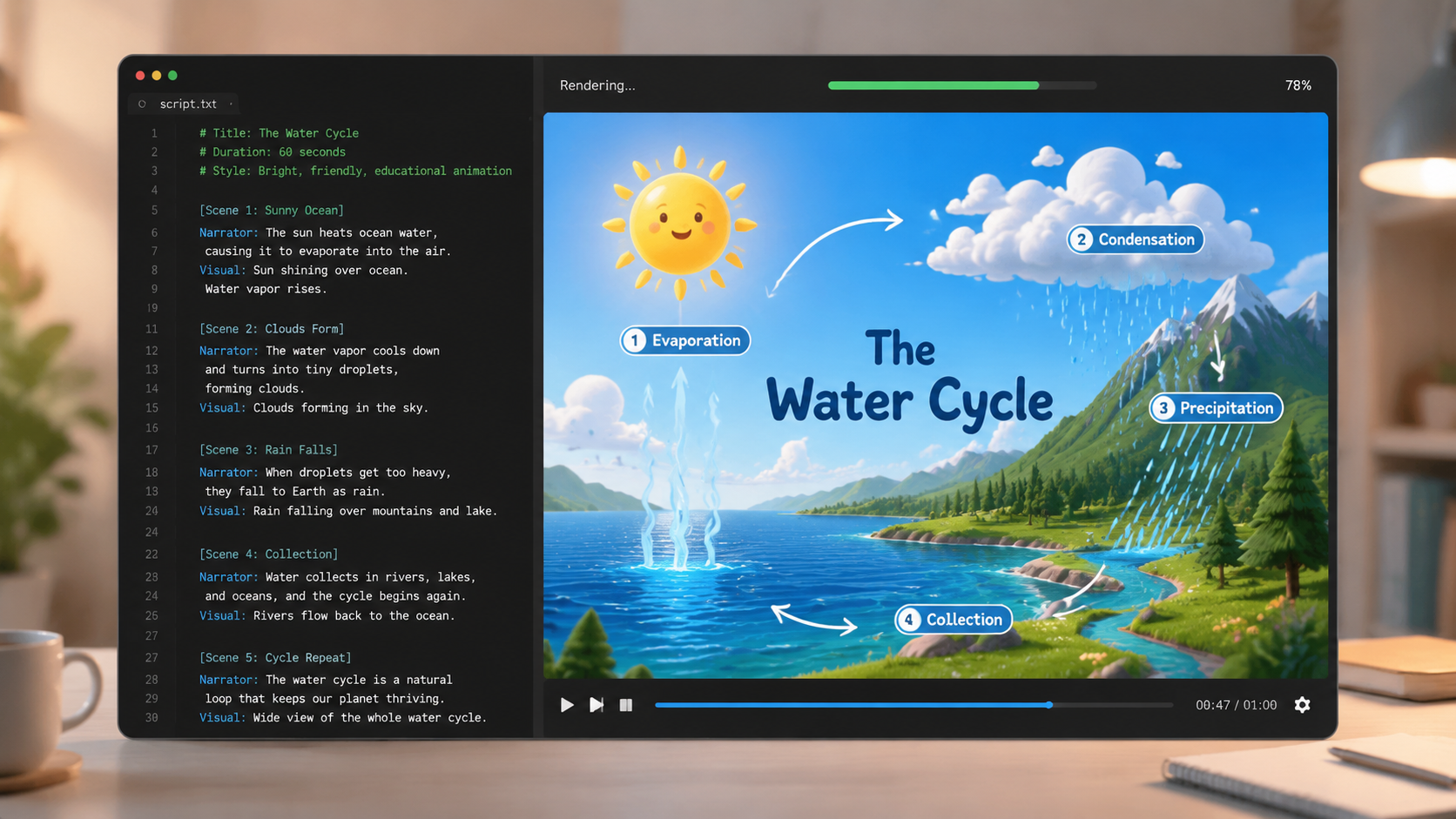
Adopting text to video AI for education training requires a structured approach to ensure that the technology enhances rather than distracts from the learning objectives. Follow these steps to integrate AI video generation into your workflow:
- Define the Learning Objective: Identify the specific skill or knowledge gap the video aims to address. Use your existing curriculum text as the foundation.
- Script Optimization: Input your training text into the AI platform. Ensure the script includes clear headings and "visual cues" that the AI can interpret for on-screen graphics.
- Select an Instructional Avatar: Choose a digital presenter that aligns with your audience demographics. In 2026, these avatars feature micro-expressions that increase learner engagement.
- Apply V-RAG for Accuracy: Utilize Retrieval Augmented Generation features to link the video generation process to your institution's verified database or textbooks.
- Review and Edit: Use natural language editing tools (like those developed by UCF) to fine-tune the visual metaphors and technical terminology.
- Deploy and Analyze: Distribute the video through your Learning Management System (LMS) and track retention rates compared to traditional text-based materials.
Top AI Video Platforms for Educators in 2026
The current market offers a variety of specialized tools, each catering to different aspects of the educational journey. From high-fidelity simulations to data-driven instructional videos, the choice of platform depends heavily on the complexity of the subject matter. In 2026, the focus has shifted from "cool visuals" to "pedagogical efficacy."
OpenAI Sora: Cinematic Educational Simulations
Since its wide release, OpenAI’s Sora has set the benchmark for creating complex, physics-compliant video from text. For education training, Sora is particularly powerful in science and history. It can generate realistic simulations of chemical reactions or historical reenactments that were previously too expensive to film. By providing a text prompt describing a 17th-century laboratory, an educator can generate a 60-second high-definition clip that serves as a perfect visual aid for a lecture.
AWS V-RAG: The Authority in Factual Training
One of the most significant releases of 2026 is Amazon Web Services' V-RAG (Video Retrieval Augmented Generation). This technology addresses the "hallucination" problem common in earlier generative models. V-RAG allows educational organizations to "ground" the AI in their own proprietary data. When a user inputs a script for medical training, the AI cross-references the visual output with verified medical journals and internal documents to ensure that every anatomical detail is 100% accurate. This is a game-changer for high-stakes training environments.
Specialized Medical and Technical AI Video
The impact of these tools is already being measured in rigorous scientific environments. A quasi-experimental study published in Nature in March 2026 highlighted the educational impact and cost efficiency of AI-enhanced videos in pediatric surgery training. The study found that surgeons trained with AI-customized video modules showed a marked improvement in procedural accuracy compared to those using standard video libraries. The ability to generate specific surgical scenarios via text allows for a level of personalization that traditional media cannot match.
| Feature | OpenAI Sora | AWS V-RAG | UCF AI Editor |
|---|---|---|---|
| Primary Strength | Cinematic Realism | Factual Accuracy (RAG) | Granular Editing |
| Best For | History & Science Simulations | Medical & Corporate Compliance | Iterative Curriculum Updates |
| Data Source | Generative Pre-trained | User-defined Knowledge Base | Existing Video Assets |
| Ease of Use | High (Prompt-based) | Medium (Requires Data Link) | High (Natural Language) |
The Role of V-RAG in text to video AI for education training
The introduction of V-RAG (Video Retrieval Augmented Generation) by AWS in March 2026 has revolutionized how we think about "truth" in AI-generated media. In an educational context, a video that looks professional but contains factual errors is worse than no video at all. V-RAG solves this by ensuring the AI "retrieves" information from a trusted source before "generating" the pixels. This is particularly vital for text to video AI for education training in fields like law, medicine, and engineering.
For example, when a professor uses a V-RAG-enabled tool to create a video on structural engineering, the system doesn't just "guess" what a bridge stress test looks like. It pulls data from the professor’s uploaded research papers and uses that data to inform the visual representation of the stress points. This ensures that the text to video AI for education training remains a reliable source of academic truth, fostering trust between the student and the digital medium.
Furthermore, the cost efficiency of these systems is driving a "long-tail" revolution in education. Smaller vocational schools that could never afford a professional film crew are now producing high-end training content. By leveraging V-RAG, these institutions can ensure their content meets industry standards without the overhead of traditional production, effectively leveling the playing field in global education.
Future Trends: Real-time Interactive AI Training
Looking toward the latter half of 2026 and into 2027, the trend is moving toward "interactive" text-to-video. This involves videos that don't just play from start to finish but change based on student input. If a student asks a question during a pause in the video, the AI can generate a supplemental visual explanation on the fly. This "just-in-time" content generation is the next frontier for text to video AI for education training.
Researchers at the University of Central Florida are already laying the groundwork for this with AI video editing technology that operates at the speed of thought. By reducing the latency between a text command and a video update, we are moving toward a reality where the "text" in "text-to-video" is a live dialogue between a learner and an AI tutor. This creates a personalized feedback loop that mimics one-on-one human instruction but at a fraction of the cost.
The financial sector is also taking note. A May 2026 report from FinancialContent identified the top 5 AI video makers for professional visual creation, noting that the fastest-growing segment is "Instructional Design and Corporate Training." Companies are realizing that video-based training leads to 40% higher retention rates than text-based manuals, and with AI, the barrier to entry for creating that video has virtually disappeared.
Frequently Asked Questions
What is the best text to video AI for education training in 2026?
The "best" tool depends on your needs, but AWS V-RAG is currently the leader for factual accuracy, while OpenAI's Sora is preferred for high-fidelity visual simulations. For those needing to edit existing content, the technology coming out of UCF is the most advanced for granular control.
Is AI-generated video accurate enough for medical training?
Yes, provided the system uses Retrieval Augmented Generation (V-RAG). A 2026 study in Nature demonstrated that AI-enhanced videos are highly effective and cost-efficient for specialized training, such as pediatric surgery, when properly grounded in factual data.
How does V-RAG improve educational videos?
V-RAG (Video Retrieval Augmented Generation) allows the AI to pull information from a specific, trusted database before generating the video. This prevents the AI from creating "hallucinations" or factual errors, which is critical for instructional and compliance-based training.
Can I update an AI video without regenerating the whole file?
Thanks to new AI video editing technology from institutions like UCF, educators can now use natural language prompts to edit specific parts of a video. This makes it easy to update a single slide or a specific spoken sentence without starting the project over.
Is text-to-video AI expensive for small schools?
In 2026, the cost of AI video production has dropped significantly. Most platforms offer subscription models that are far more affordable than hiring a video production team, making high-quality visual education accessible to smaller institutions and non-profits.



Comments ()