
Text to Video AI Editor 2026: Revolutionize Content Creation
A text to video AI editor is a generative tool that converts written prompts into fully produced video content. In 2026, these editors have evolved beyond short clips to create coherent, long-form films from a single text prompt, revolutionizing how creators, marketers, and filmmakers approach content production.
A text to video AI editor is a software platform that uses large language models and diffusion-based video generators to transform text descriptions into realistic or stylized video footage. In 2026, leading tools like Google Gemini Omni and Adobe Firefly enable users to generate minutes-long, narrative-driven videos with consistent characters and scenes.
- ✓ 2026 text to video AI editors can produce long-form films (over several minutes) from a single text prompt, as demonstrated by Mshale's coverage of the "Forget SORA 2" trend.
- ✓ Google's Gemini Omni, introduced in May 2026, integrates a world model that maintains spatial and temporal coherence across generated scenes.
- ✓ Adobe Firefly (December 2025) now offers unlimited generations and new editing tools, making professional-grade AI video accessible to all.
- ✓ UCF researchers have pioneered AI video editing technology that allows frame-level adjustments via natural language commands.
- ✓ The technology is reshaping content creation for marketing, education, entertainment, and social media, according to a Cybernews analysis from June 2026.
What Is a Text to Video AI Editor?
A text to video AI editor is a generative AI system that accepts a written description—ranging from a few words to a detailed script—and outputs a video sequence. Unlike earlier tools that produced only short, abstract clips, the 2026 generation leverages advanced world models and temporal attention mechanisms to create videos that follow logical narrative arcs, maintain consistent character appearances, and respect physical laws.
According to the University of Central Florida's research published in October 2025, these editors now support frame-level editing through text commands, enabling users to refine specific segments without regenerating the entire video. This marks a shift from purely generative tools to true editing platforms.
How It Works
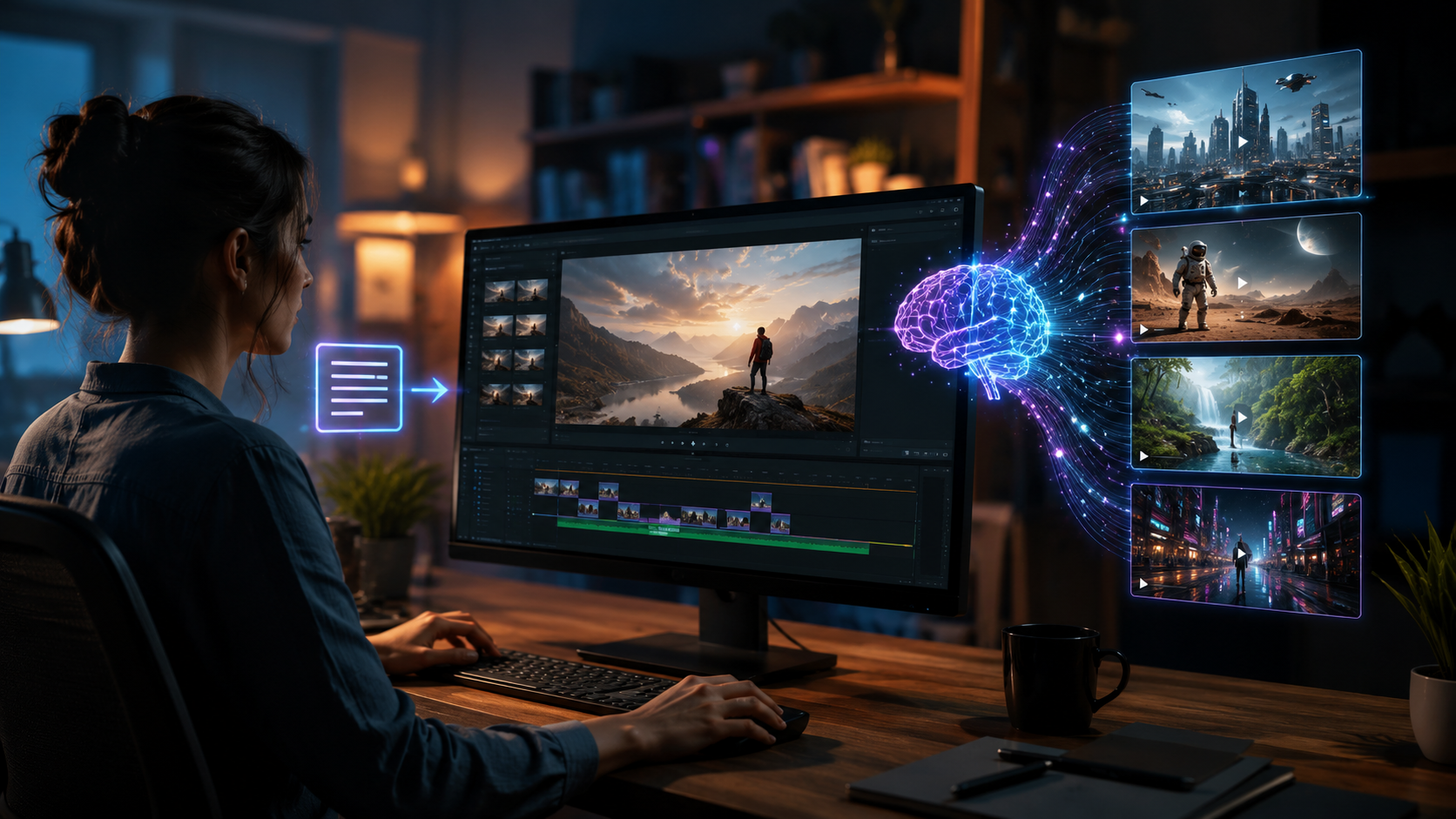
Modern text to video AI editors combine three core components: a large language model (LLM) that interprets the prompt, a video diffusion model that generates frames, and a world model that ensures consistency across time and space. Google's Gemini Omni, unveiled at Google I/O on May 19, 2026, exemplifies this architecture by using a unified model that processes text, images, and video simultaneously.
The user simply types a prompt like "a detective walks through a rainy city at night, discovers a clue, and enters a dimly lit office." The editor analyzes the narrative, generates keyframes, interpolates motion, and applies stylistic filters—all within minutes. Adobe Firefly, updated in December 2025, added unlimited generation capacity and new tools for adjusting lighting, camera angles, and pacing.
The 2026 Landscape: Major Players and Breakthroughs
Several key developments in 2025 and 2026 have defined the current state of text to video AI editing. Below is a comparison of the most notable platforms and technologies based on recent news.
| Platform / Technology | Key Feature | Release / Update Date | Unique Capability |
|---|---|---|---|
| Google Gemini Omni | World model for coherent long-form video | May 29, 2026 (blog.google) | Generates multi-scene narratives from a single prompt with consistent physics and character identity |
| Adobe Firefly (2025 update) | Unlimited generations, new editing tools | December 16, 2025 (Adobe) | Professional-grade editing controls, unlimited video creation, integration with Creative Cloud |
| UCF AI Video Editing Technology | Frame-level text-based editing | October 27, 2025 (UCF) | Allows users to modify individual frames or objects using natural language commands |
| "Forget SORA 2" trend (Mshale, June 2026) | Longest AI video generator capable of creating films | June 4, 2026 (Mshale) | Demonstrates ability to produce extended narratives (e.g., a car accident lawyer scenario) from a single text prompt |
As noted by Cybernews on June 3, 2026, the rise of these tools is fundamentally changing content creation. Marketers can now produce explainer videos in minutes, educators can generate custom lesson visuals, and independent filmmakers can prototype scenes without expensive equipment.
How to Use a Text to Video AI Editor: A Step-by-Step Guide
Getting started with a text to video AI editor in 2026 is straightforward. Follow these steps to create your first AI-generated video:
- Choose a platform. Select a tool like Google Gemini Omni, Adobe Firefly, or an open-source alternative. Consider your needs: long-form narrative (Gemini Omni) vs. short clips with editing controls (Firefly).
- Write a detailed prompt. Include characters, setting, actions, mood, and desired style. For example: "A futuristic cityscape at dusk, a drone flies over neon-lit skyscrapers, then zooms into a rooftop garden."
- Configure parameters. Set video length (seconds to minutes), resolution (up to 4K), frame rate, and optional style presets (cinematic, anime, documentary).
- Generate the video. Click generate and wait for the AI to process. Depending on length and complexity, this may take 30 seconds to several minutes.
- Edit and refine. Use text-based editing commands to adjust specific frames, change lighting, or reorder scenes. Adobe Firefly's new tools allow unlimited iterations.
- Export and share. Download the video in common formats (MP4, MOV) or directly upload to social media platforms.
For advanced users, platforms like the one covered by Mshale (June 4, 2026) allow creating entire short films by chaining multiple prompts into a single coherent narrative. The key is to maintain consistent character descriptions across prompts.
Key Features That Make 2026 Editors Revolutionary
Several features distinguish the 2026 generation of text to video AI editors from earlier versions.
Long-Form Video Generation
Perhaps the most significant breakthrough is the ability to produce videos lasting several minutes—not just 5–15 second clips. The "Forget SORA 2" trend highlighted by Mshale on June 4, 2026, showcases a system that generates an entire film from a single prompt, including consistent characters and plot progression. This is made possible by world models that remember earlier scenes and maintain spatial relationships.
World Models and Coherence
Google's Gemini Omni, introduced on May 29, 2026, incorporates a world model that understands physics, object permanence, and cause-effect relationships. According to Mashable's coverage of Google I/O (May 19, 2026), this allows the AI to generate videos where a cup placed on a table remains in the same position across cuts, or a character walking out of frame reappears from the correct direction. This level of coherence was previously impossible.
Unlimited Generations and Professional Editing
Adobe Firefly's December 2025 update removed generation limits and added tools for precise control over lighting, color grading, and camera movement. This makes the technology viable for professional video production, not just experimentation. UCF's research further enables frame-level text editing, allowing creators to fix a single object's appearance without regenerating the entire scene.
Real-World Applications and Future Trends
The implications for content creation are vast. Marketing teams can produce personalized video ads at scale. Educators can generate historical reenactments or scientific visualizations. Filmmakers can storyboard entire movies before shooting a single frame. As noted by Cybernews on June 3, 2026, small businesses and independent creators now have access to video production capabilities that were once reserved for large studios.
Looking ahead, we can expect even tighter integration with other AI tools. For instance, combining text to video editors with voice cloning and AI music generation will allow fully automated video production from a script. The trend toward longer, more coherent narratives suggests that by late 2026, we may see AI-generated feature films competing at festivals.
Frequently Asked Questions
What is a text to video AI editor?
A text to video AI editor is a generative tool that converts written text prompts into video content. In 2026, these editors can produce long-form, coherent videos with consistent characters and scenes.
How long does it take to generate a video with a text to video AI editor?
Generation time varies by length and complexity. A 30-second clip typically takes 30–60 seconds, while a 5-minute film may require 5–10 minutes. Platforms like Adobe Firefly offer unlimited generations with no wait times for processing.
Can I edit specific parts of an AI-generated video?
Yes. UCF researchers (October 2025) developed frame-level text-based editing. Adobe Firefly and other tools now allow you to modify individual frames, change lighting, or adjust camera angles using natural language commands.
What are the best text to video AI editors in 2026?
Leading options include Google Gemini Omni (best for long-form narrative coherence), Adobe Firefly (best for professional editing and unlimited generation), and emerging platforms highlighted in the "Forget SORA 2" trend (best for single-prompt film creation).
Is text to video AI editing free?
Most platforms offer free tiers with limited capabilities. Adobe Firefly provides unlimited generations as part of its subscription. Google Gemini Omni is available through Google Cloud's AI services with pay-as-you-go pricing.
Will AI video editors replace human filmmakers?
No. These tools are designed to augment human creativity, not replace it. They handle repetitive tasks and enable rapid prototyping, but storytelling, artistic vision, and emotional nuance still require human input.
The text to video AI editor has matured from a novelty into a practical content creation tool in 2026. With breakthroughs from Google, Adobe, UCF, and independent developers, anyone can now turn a single text prompt into a compelling video—revolutionizing how we tell stories, educate, and market. As the technology continues to evolve, the only limit is your imagination.



Comments ()