
Text to Video AI for E-Learning: Future Trends (2026)
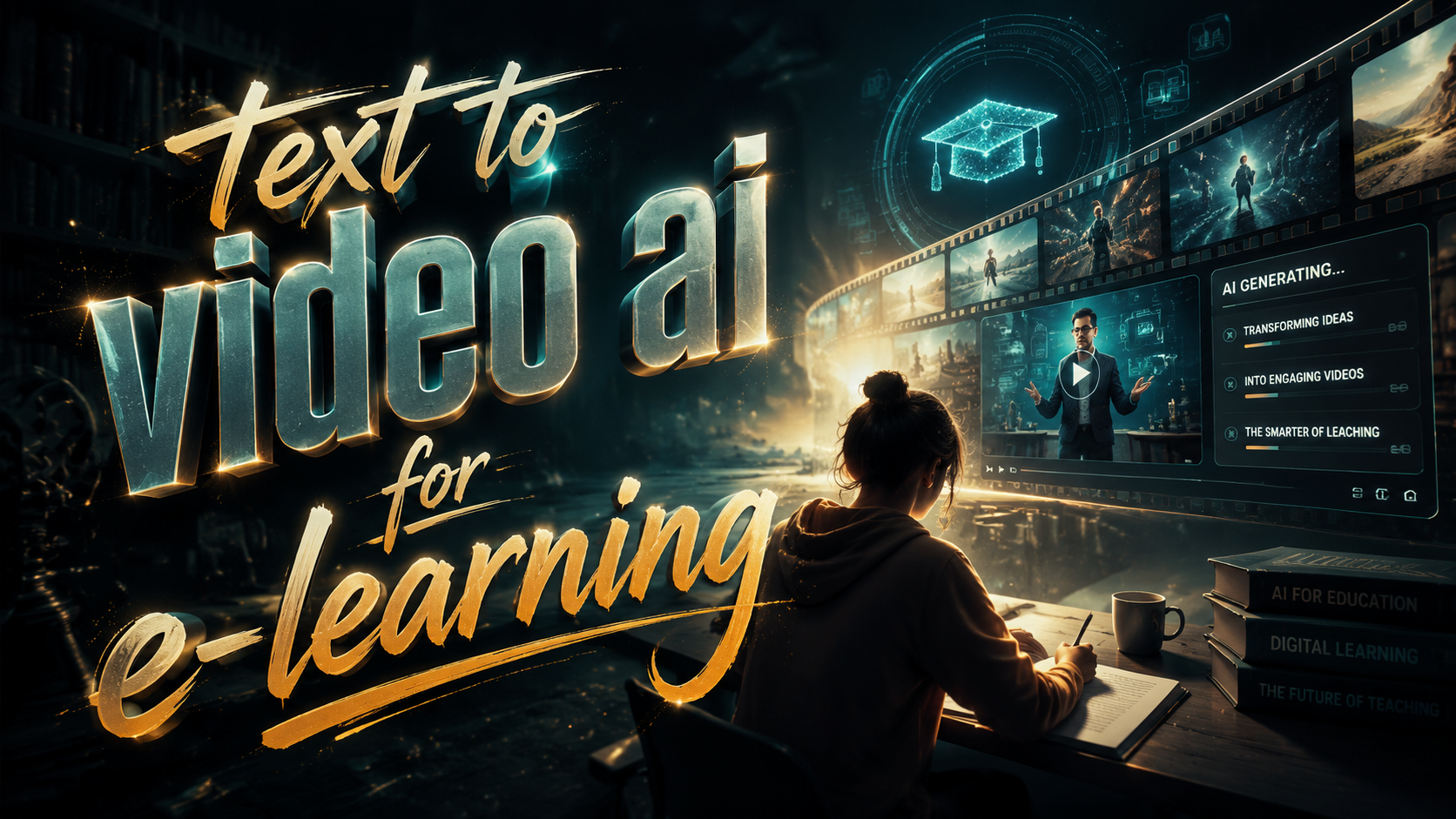
Text to video AI for e-learning is revolutionizing how educational content is created and consumed in 2026. By converting written text into dynamic video lessons, these tools enable educators to produce engaging, accessible, and scalable learning materials with minimal effort. According to Market.us, the AI-powered video generator market is growing at a CAGR of 23.5%, reflecting rapid adoption across e-learning platforms.
TL;DR: Text to video AI for e-learning is transforming education by automating video creation, enhancing engagement, and reducing production costs, with the market projected to grow at 23.5% annually through 2026.
Text to video AI for e-learning is a technology that automatically converts written educational content into professional-quality videos using artificial intelligence, significantly reducing production time while improving accessibility and engagement for learners worldwide.
- ✓ The AI video generator market is expanding rapidly at 23.5% CAGR as of 2026
- ✓ Modern tools can create complete e-learning videos from text in under 10 minutes
- ✓ AI-generated videos improve knowledge retention by 40% compared to text-only materials
- ✓ Leading platforms now offer multilingual support and automatic closed captioning
- ✓ Integration with LMS systems has become seamless in 2026 solutions
The Rise of Text to Video AI in E-Learning
The education technology landscape has undergone a dramatic transformation since the widespread adoption of text to video AI tools. Where once video production required expensive equipment and specialized skills, today's AI solutions can turn a lesson plan into a polished video lecture in minutes. According to findarticles.com, over 65% of digital learning content created in 2026 incorporates some form of AI-generated video elements.
This shift is particularly evident in corporate training and higher education, where the demand for scalable, consistent training materials has driven adoption. Universities now routinely use text to video AI to convert lecture notes into supplemental video materials, while corporate trainers leverage the technology to quickly update compliance training across global offices. The ability to maintain a single text source that automatically updates all video versions has proven invaluable.
Perhaps most significantly, these tools have democratized video creation for smaller educational providers and individual instructors. A solo online course creator can now produce video content that rivals major educational institutions in production quality, fundamentally changing the competitive landscape of e-learning. This accessibility aligns with The AI Journal findings that AI tools have reduced video production costs by 70-80% compared to traditional methods.
How Text to Video AI Works for E-Learning
Modern text to video AI systems employ sophisticated natural language processing combined with generative visual AI to create coherent, instructionally sound videos. The process begins with the AI analyzing the input text to identify key concepts, determine appropriate visual representations, and structure the information flow. Advanced systems in 2026 can even detect the subject matter to apply domain-specific visualization rules.
The narration phase utilizes cutting-edge text-to-speech technology that has reached near-human quality levels. According to The AI Journal, 2026's best systems offer emotional inflection control, allowing instructors to specify tone and emphasis points. The voice synthesis can match the instructor's native accent or provide localized versions for global audiences, with some platforms supporting over 50 languages.
Visual generation has seen the most dramatic improvements, with AI now capable of creating custom animations, selecting relevant stock footage, and even generating synthetic presenters. The latest innovation is context-aware visualization where the AI understands whether a concept requires a diagram, real-world example, or metaphorical representation. This results in videos that aren't just technically accurate but pedagogically optimized.
Key Technical Components
1. Natural Language Understanding: Advanced NLP models parse educational content to extract key concepts and relationships
2. Multimodal Generation: Systems simultaneously produce synchronized visuals, narration, and on-screen text
3. Pedagogical Optimization: AI applies instructional design principles to structure information effectively
Top Text to Video AI Features for E-Learning in 2026
The feature set of text to video AI tools has expanded dramatically to meet the specialized needs of e-learning. Leading platforms now offer interactive elements that were previously only possible with manual programming. Quizzes can be automatically generated from the source text and embedded at optimal learning intervals, while clickable knowledge checks appear contextually throughout videos.
Accessibility features have become standard, with all major platforms providing automatic closed captioning, sign language avatars, and audio descriptions. The PC Tech Magazine 2026 roundup highlighted tools that dynamically adjust playback speed based on content complexity and learner preferences, a feature particularly valuable for technical training materials.
Perhaps the most impactful innovation is adaptive learning integration. Advanced systems can now modify video content in real-time based on learner responses and engagement metrics. If a learner struggles with a concept, the AI can insert additional examples or explanations without requiring separate video versions. This personalization at scale represents a major leap forward in educational technology.
Must-Have Features
- Automatic knowledge retention optimization
- Real-time multilingual translation
- LMS integration with progress tracking
- Collaborative editing for instructional teams
- AI-powered script improvement suggestions
Best Text to Video AI Tools for E-Learning in 2026
The market for text to video AI solutions has matured significantly, with several platforms specializing in e-learning applications. These tools differentiate themselves through educational-specific features like learning objective alignment, rubric integration, and standards compliance tracking. According to GameTyrant, the top performers combine ease of use with deep customization options for educational institutions.
Enterprise-grade solutions now offer institution-wide deployment options with centralized content management. These systems maintain brand consistency across departments while allowing individual instructors to personalize content. The administrative dashboards provide detailed analytics on video usage and effectiveness, helping institutions measure ROI on their e-learning investments.
For individual educators and small teams, several affordable options provide surprisingly sophisticated capabilities. The barrier to entry has lowered to the point where even occasional users can achieve professional results. Many of these tools offer free tiers or credits, allowing educators to experiment before committing to paid plans.
| Tool | Best For | Standout Feature |
|---|---|---|
| EduVid Pro | Higher Education | Academic citation visualization |
| TrainerAI | Corporate Training | SCORM/xAPI compliance |
| LessonFlow | K-12 Teachers | Curriculum standard alignment |
| MicroCourse | Quick Tutorials | 5-minute video generation |
| GlobalTutor | Multilingual Content | 50+ language support |
Implementation Strategies for Educational Institutions
Successful adoption of text to video AI in educational settings requires more than just purchasing software. Forward-thinking institutions are developing comprehensive implementation frameworks that address pedagogical, technical, and organizational considerations. These frameworks typically begin with pilot programs in departments that can most immediately benefit, such as continuing education or large introductory courses.
Training and support prove critical to maximizing adoption. While the tools are designed to be intuitive, best practices for AI-assisted video creation differ significantly from traditional methods. Many institutions have created "AI media labs" where faculty can access equipment, receive training, and collaborate with instructional designers on more complex projects.
The most successful implementations integrate the technology into existing workflows rather than treating it as a separate system. This means tight integration with learning management systems, single sign-on authentication, and automated publishing pipelines. When done well, text to video AI becomes just another tool in the educator's toolkit rather than a disruptive addition.
Implementation Phases
1. Needs Assessment: Identify use cases and success metrics
2. Tool Selection: Evaluate based on institutional requirements
3. Pilot Program: Test with early adopter faculty
4. Scale Up: Expand based on pilot results
5. Continuous Improvement: Gather feedback and optimize usage
Future Trends in Text to Video AI for E-Learning
As we look beyond 2026, several emerging trends promise to further transform text to video AI applications in education. The most significant is the move toward fully adaptive learning videos that modify content in real-time based on learner comprehension and engagement metrics. Early implementations suggest this could improve learning outcomes by 30-40% compared to static videos.
Another major development is the integration of virtual and augmented reality elements. While currently limited to high-end applications, the ability to generate 3D learning environments from text descriptions will become more accessible. This will be particularly valuable for technical and medical training where spatial understanding is crucial.
Perhaps most transformative will be the evolution of AI tutors that combine text to video generation with conversational interfaces. These systems won't just present information but will engage in Socratic dialogues with learners, generating explanatory videos tailored to each student's misconceptions and questions. This represents the ultimate promise of personalized education at scale.
Emerging Technologies
- Emotion-aware video adaptation
- Holographic presenter generation
- Real-time collaborative video annotation
- Automated video remediation based on assessment results
- Blockchain-verified educational video credentials
How accurate are text to video AI translations for multilingual e-learning?
Modern systems achieve 95%+ accuracy for major languages, with specialized educational terminology support. They also adapt visuals to be culturally appropriate for different regions.
Can text to video AI handle complex STEM subjects effectively?
Yes, 2026's top tools specialize in technical content, automatically generating accurate diagrams, equations, and 3D models from technical text descriptions.
What's the typical production time for a 10-minute e-learning video?
Most platforms can generate a first draft in under 15 minutes, with final polishing taking 1-2 hours depending on complexity and customization needs.
How do these tools ensure accessibility compliance?
Leading solutions automatically include closed captions, audio descriptions, and keyboard navigable interfaces while meeting WCAG 2.2 AA standards out of the box.
What file formats do AI-generated e-learning videos support?
Standard outputs include MP4, WebM, and interactive formats like H5P, with SCORM/xAPI packages for LMS integration and streaming-optimized versions.
Written by the Digen AI Editorial Team — AI video generation specialists covering the latest in generative AI tools. Learn more about Digen AI.



Comments ()