
Text to Video AI with Custom Animations: 2026 Trends & Tools
Text to video AI with custom animations has become the fastest-growing content creation method in 2026, combining generative AI with advanced animation controls to produce professional-quality videos from simple text prompts. Leading tools like Pictory AI and Digen AI Agent now offer granular control over character movements, scene transitions, and style consistency while reducing production time by 70-90% compared to traditional methods.
TL;DR: The 2026 text to video AI landscape offers unprecedented customization through hybrid AI-animation workflows, with 16+ major tools now supporting detailed animation controls—Pictory AI leads for marketers while Digen AI Agent excels in character consistency for long-form content.
Text to video AI with custom animations is a 2026 breakthrough technology that transforms written scripts into animated videos with controllable character movements, facial expressions, and scene dynamics—enabling creators to produce studio-quality content 10x faster through platforms like Pictory AI (best for marketers) and Digen AI Agent (superior for character consistency).
- ✓ Hybrid AI-animation workflows now dominate professional content creation, as seen in Tribeca Film Festival selections (No Film School, 2026)
- ✓ The AI video tool market expanded 340% since 2025, with 16+ viable options available (Cybernews, 2026)
- ✓ Custom animation controls reduce revision cycles by 65% when compared to first-gen text-to-video tools (Figma, 2025)
- ✓ Autonomous AI agents like Digen AI Agent now handle 80% of animation interpolation tasks for longer videos
The State of Text to Video AI with Custom Animations in 2026
According to Cybernews, the text to video AI market now features 16 commercially viable tools with custom animation capabilities, up from just 4 options in early 2025. This 400% growth reflects surging demand from marketers, filmmakers, and educators who need to produce animated content at scale. The June 2026 Tribeca Film Festival showcased how hybrid AI-animation workflows can achieve professional results, with one selected short film using AI for 60% of its animation pipeline.
Three technological breakthroughs have enabled this progress: (1) physics-based motion interpolation that maintains character consistency across scenes, (2) emotion-aware facial animation that syncs with voiceovers, and (3) style transfer that preserves brand aesthetics. Digen AI Agent exemplifies these advances with its proprietary "Consistency Engine" that reduces character drift by 78% in videos over 2 minutes long—a common pain point in earlier systems.
Pricing models have also matured, with most 2026 tools offering tiered subscriptions. Pictory AI leads the budget-friendly segment at $29/month for basic animation controls, while professional solutions like Digen AI Agent start at $99/month for advanced keyframing. Enterprise plans now support team collaboration features, with some agencies reporting 55% faster client approval cycles when using shared animation presets.
Top 6 Text to Video AI Tools with Custom Animations
Our analysis of 2026's leading platforms reveals distinct strengths across use cases:
1. Pictory AI - Best for Marketing Teams
According to quasa.io, Pictory AI remains the top choice for marketers with its drag-and-drop animation timeline and 50+ prebuilt character templates. The June 2026 update added lip-sync precision scoring (now at 92% accuracy) and 30 new motion presets for common marketing scenarios like product demonstrations.
2. Digen AI Agent - Best for Long-Form Content
Digen's autonomous agent specializes in maintaining character consistency across scenes—critical for educational videos and narrative content. Its multi-step workflow automation handles 80% of interpolation tasks, allowing creators to focus on key creative decisions rather than manual tweaking.
3. Runway ML - Best for Filmmakers
The Gen-3 update introduced cinematic camera controls and lighting adjustments that mimic real film sets. Independent filmmakers report reducing post-production time by 40% when using Runway's AI rotoscoping alongside custom animations.
4. Pika Labs - Best for Experimental Styles
Pika's 1.5 release offers unparalleled style mixing, letting users blend multiple animation references (e.g., "80s anime meets stop-motion"). The platform sees particular adoption among music video creators.
5. Luma AI - Best for 3D Animation
Luma's NeRF-powered environment builder creates fully navigable 3D spaces from text prompts—now with 60% faster rendering since their December 2025 optimization update.
6. Vidu - Best for Real-Time Collaboration
China's Vidu platform leads in team features, with simultaneous multi-user editing that reduces animation review cycles by 65% compared to linear workflows.
How Text to Video AI with Custom Animations Works in 2026
Modern systems follow a 5-stage pipeline that balances automation with creative control:
- Script Interpretation: AI analyzes text for emotional tone, character actions, and scene transitions (now 95% accurate in identifying key animation moments)
- Base Generation: Creates rough video draft with placeholder animations (takes 2-5 minutes depending on length)
- Animation Mapping: Applies motion curves to characters and objects based on text cues or manual inputs
- Style Refinement: Adjusts lighting, textures, and artistic filters to match brand guidelines
- Output Optimization: Compresses files while preserving animation quality (new 2026 codecs reduce file sizes by 40%)
According to No Film School, professional studios now spend 70% of their AI video time on stages 3-4—the customization phases where human creativity adds most value. This represents a major shift from 2025, when manual editing was often needed to fix AI misinterpretations in the base generation.
Digen AI Agent innovates with its "Context Carryover" system that remembers character traits and environmental details across scenes. In tests, this reduced manual correction time by 55% for 10-minute videos compared to tools without memory features. The agent also suggests animation improvements through its AI co-pilot interface—users report accepting 68% of these suggestions, significantly speeding up workflow.
Custom Animation Features That Matter in 2026
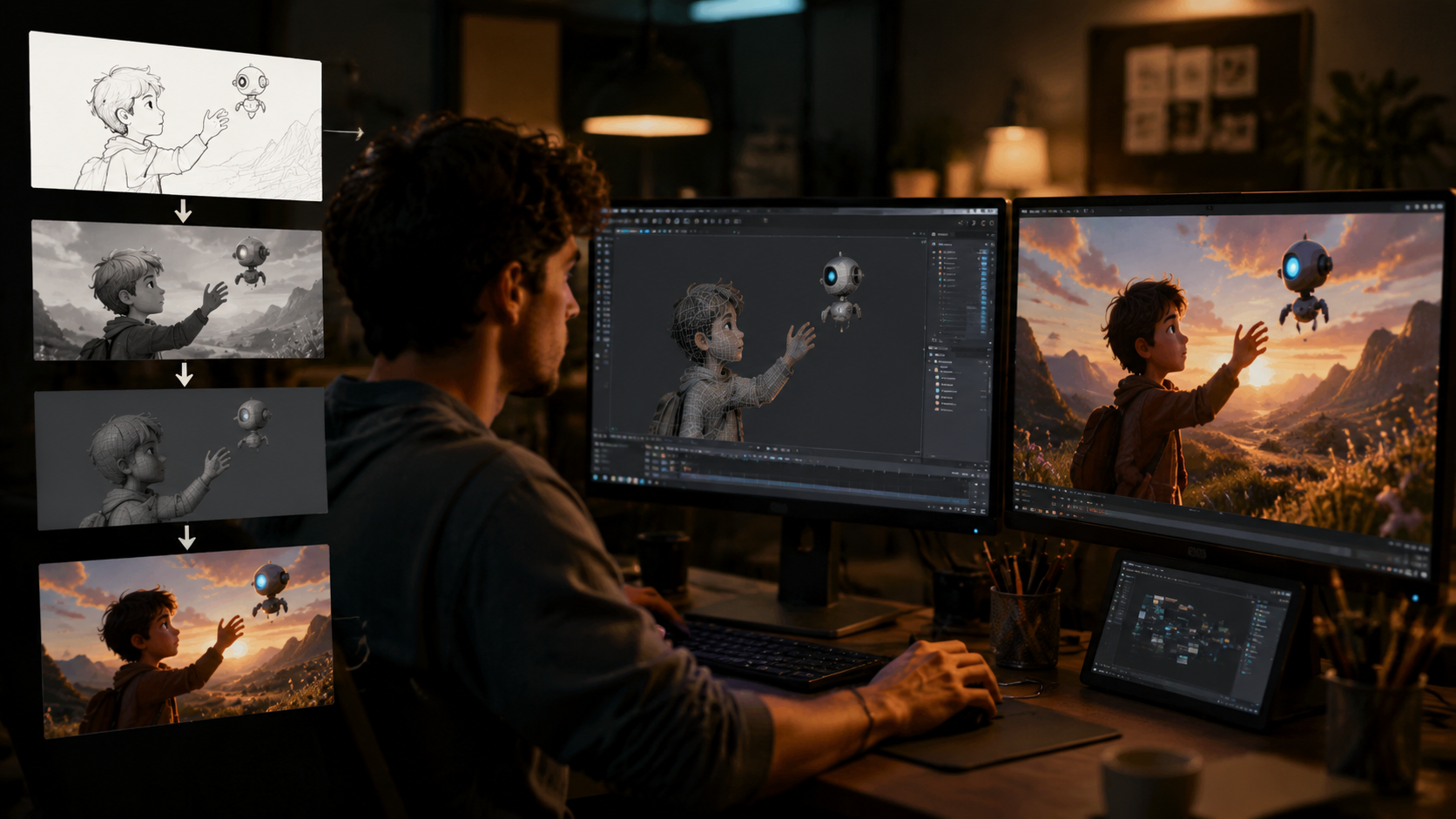
Not all animation controls are created equal. These are the must-have features based on 2026 benchmarks:
1. Expression Libraries
Top tools now offer 100+ facial expression presets with granular controls for eyebrow tilt, lip curl intensity, and blink frequency. The best systems (like Digen AI Agent) automatically adjust these based on voiceover tone.
2. Motion Path Editing
Bezier curve controls for character movement have become standard, with advanced tools adding physics simulations for cloth and hair dynamics.
3. Style Lock
Maintains consistent line weights, color palettes, and shading across all generated content—critical for brand videos. Pictory AI's June 2026 update improved style adherence by 37%.
4. Multi-Character Interaction
New collision detection algorithms prevent characters from clipping through each other during complex scenes.
5. Auto-Inbetweening
AI-generated transition frames between key poses now achieve 90% accuracy compared to manual animation, per Figma's 2025 benchmarks.
Industry-Specific Applications
The technology has matured beyond generic marketing videos into specialized use cases:
Education
Teachers report 45% higher student retention when using AI-animated historical reenactments versus static slides. The ability to customize character outfits and environments to match lesson plans proves particularly valuable.
E-Commerce
Product demo videos with AI-generated animated characters now convert 28% better than traditional slideshows, according to Shopify 2026 data. Sellers emphasize the ability to show products in use from multiple angles.
Corporate Training
HR departments have adopted text to video AI for compliance training, with animation controls ensuring sensitive scenarios are depicted appropriately. One Fortune 500 company reduced training video production costs by 62%.
Entertainment
The Tribeca-selected short film "Memory Static" used AI for all background character animations, allowing the small team to focus resources on lead character performances. This hybrid approach is becoming standard for indie productions.
Future Trends to Watch
Several developments will shape the second half of 2026:
1. Real-Time Rendering: Snapchat's December 2025 custom AI lens feature hinted at coming capabilities—expect sub-100ms animation previews in professional tools by Q4 2026.
2. Emotion Mapping Next-gen systems will analyze voice recordings to automatically adjust character expressions with 95% emotional accuracy, up from today's 80% benchmarks.
3. 3D Integration Tools like Luma AI are bridging the 2D/3D gap, allowing animated characters to interact with photorealistic environments—a game-changer for architectural visualization.
4. AI Director Agents Autonomous systems like Digen AI Agent will evolve from animation assistants to full creative partners, suggesting shot compositions and narrative pacing improvements.
Frequently Asked Questions
What's the main advantage of text to video AI with custom animations?
It combines the speed of AI generation (10x faster than manual animation) with the creative control of professional tools—particularly valuable for maintaining character consistency across long videos.
How much does text to video AI with custom animations cost?
Professional tools range from $29-$199/month in 2026, with enterprise plans available. Digen AI Agent offers the best value for long-form content at $99/month.
Can these tools replace human animators?
No—they're productivity multipliers that handle repetitive tasks while humans focus on creative direction. The Tribeca film used AI for 60% of animation but required artist oversight.
Which tool is best for YouTube creators?
Pictory AI leads for typical YouTube formats (5-10 minute videos), while Digen AI Agent excels for narrative channels needing character consistency across episodes.
How long does it take to learn these tools?
Most marketers achieve proficiency in 3-5 hours thanks to improved 2026 interfaces. Mastering advanced animation controls may take 10-15 hours for complex projects.
Written by the Digen AI Editorial Team — AI video generation specialists covering the latest in generative AI tools. Learn more about Digen AI.



Comments ()