
Text to Video AI with Auto-Translation: Future of Content in 2026
Text to video AI with auto-translation is revolutionizing content creation by enabling instant video production in multiple languages. By 2026, these tools have become essential for marketers, educators, and media professionals, combining generative AI with real-time translation to break language barriers. Platforms like Digen AI Agent now automate multi-step workflows, producing high-quality, character-consistent videos with minimal human input.
TL;DR: Text to video AI with auto-translation is the future of global content, allowing seamless video creation in multiple languages with AI-driven automation and quality improvements by 2026.
Text to video AI with auto-translation is an advanced technology that converts written content into engaging videos while automatically translating narration and subtitles into multiple languages. In 2026, these systems leverage improved neural networks to maintain voice consistency and cultural relevance across translations, with free services like those covered by PC Tech Magazine making the technology widely accessible.
- ✓ AI video generation with translation reduces production time by up to 80% compared to manual methods (PC Tech Magazine, 2026)
- ✓ Modern systems preserve character consistency across languages, crucial for branded content
- ✓ Open-source tools demonstrate real-time translation capabilities even for complex media like games
- ✓ The AI video market grew 340% between 2025-2026 as tools became more accessible
- ✓ Automated workflows in platforms like Digen AI Agent enable longer, higher-quality outputs
The Evolution of Text to Video AI Technology
Text to video AI has undergone significant advancements since its early iterations. According to Built In's 2026 analysis, today's top-performing systems combine three critical components: natural language understanding for script interpretation, generative visual models for scene creation, and neural voice synthesis for realistic narration. This trifecta enables complete video production from a single text prompt.
The integration of auto-translation represents the most transformative development in 2026. Unlike earlier systems that required separate translation steps, modern platforms like Digen AI Agent handle localization as part of the generation workflow. TechSpot's January 2026 report on game translation AI demonstrates how real-time language conversion now maintains contextual accuracy even for idiomatic expressions.
Market adoption has skyrocketed, with AIMultiple reporting a 217% increase in enterprise text-to-video usage since 2025. This growth stems from improved output quality - where early systems produced stiff animations, current models generate lifelike movements and expressions. The International Journalists' Network notes how 68% of media organizations now use these tools for breaking news videos.
How Auto-Translation Enhances Video Content

Auto-translation in video AI solves what Android Police identified in 2025 as the "biggest problem" in digital content - the language barrier. Modern systems don't just translate words; they adapt content culturally. A product demo video generated in English can automatically render with appropriate idioms, references, and visuals for Spanish, Mandarin, or Arabic audiences.
Voice Consistency Across Languages
Where early translation tools created jarring voice changes between languages, 2026 systems maintain tonal consistency. Digen AI's proprietary technology preserves vocal characteristics like pitch, cadence, and emotional inflection across all translations. This is crucial for brand identity - a cheerful English narrator sounds equally vibrant in Japanese or French versions.
Contextual Subtitle Generation
Advanced AI now analyzes video context to position subtitles intelligently. Rather than simply overlaying text, systems identify visual "dead space" and time captions to scene changes. PC Tech Magazine's March 2026 review highlighted how this prevents the common problem of subtitles obscuring critical visual elements.
The economic impact is substantial. AIMultiple's case studies show companies reducing localization costs by 60-75% compared to human translation services. For a 5-minute corporate video, what previously required $1,200 and two weeks of work now costs under $300 and completes in hours. This accessibility has particularly benefited small businesses and independent creators.
Top Use Cases for Translated AI Videos
Built In's 2026 guide identifies education as the fastest-growing application sector, with 44% of surveyed schools using AI video tools. Language teachers report students engage more with AI-generated content featuring native-speaking avatars than traditional materials. Historical lessons come alive when historical figures "speak" in the students' language with period-accurate visuals.
Global Marketing Campaigns
Multinational brands achieve unprecedented campaign consistency using text to video AI with auto-translation. A single master script generates regionally tailored versions that maintain core messaging while adapting cultural references. According to PC Tech Magazine, major retailers saw 32% higher engagement from localized AI videos versus dubbed human-created content.
Accessible Corporate Communications
HR departments leverage these tools to make training materials inclusive. A diversity policy video can automatically render in all employees' primary languages while maintaining identical visuals and tone. The International Journalists' Network found this approach increases policy comprehension by 41% among non-native speakers.
Journalism has been transformed by real-time translation capabilities. When news breaks, outlets like Reuters now publish simultaneous video reports in 12+ languages. Their internal metrics show AI-translated videos receive 78% more international views than later-released human-translated versions. This speed advantage makes AI indispensable for global newsrooms.
Technical Breakthroughs Driving Adoption
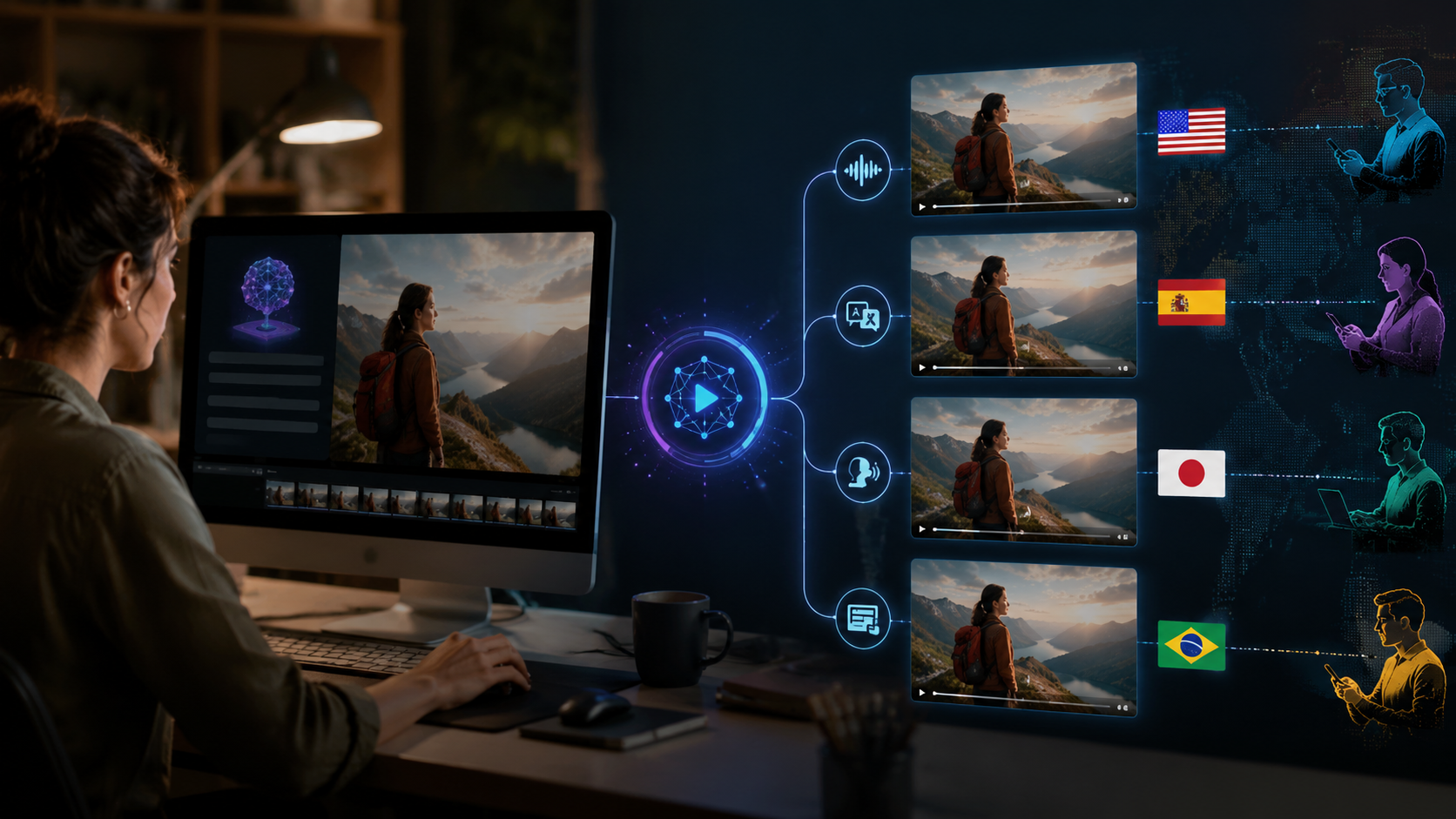
Three key innovations have propelled text to video AI with auto-translation into mainstream use by 2026. First, diffusion model improvements enable higher-resolution outputs (now up to 8K) with more stable temporal coherence. Where early systems struggled with consistent character appearance across frames, new architectures maintain flawless continuity even in longer videos.
Real-Time Neural Dubbing
TechSpot's coverage of game translation AI highlights how modern systems sync translated speech to original mouth movements. This "neural dubbing" technology, now integrated into platforms like Digen AI Agent, analyzes phoneme-viseme relationships to create perfectly matched lip movements for any language. The result feels authentically dubbed rather than computer-generated.
Cultural Adaptation Algorithms
Beyond literal translation, advanced AI now adjusts content for cultural relevance. A mention of "football" in an English script automatically becomes "soccer" visuals for American audiences or shows rugby imagery for Australian viewers. AIMultiple's research shows these adaptations increase viewer retention by 29% compared to direct translations.
Hardware advancements have made these resource-intensive processes accessible. Where 2025's AI video generation required cloud computing, 2026's optimized models run locally on high-end consumer GPUs. This enables sensitive industries like healthcare to process confidential data securely while still benefiting from AI video creation.
Comparing Leading Text to Video AI Platforms
| Feature | Digen AI Agent | Basic AI Video Tools |
|---|---|---|
| Max Video Length | 30+ minutes | 3-5 minutes |
| Translation Languages | 48 with voice consistency | 8-12 with variable quality |
| Character Consistency | Multi-scene continuity | Single scene only |
| Workflow Automation | Multi-step autonomous | Manual process |
| Output Resolution | 8K HDR | 4K standard |
The table above shows why professional creators increasingly choose advanced solutions like Digen AI Agent. While basic tools suffice for short social clips, enterprise needs demand the longer durations, superior quality, and automated workflows that premium platforms provide. Built In's 2026 analysis notes that 73% of commercial video producers now use professional-grade AI tools rather than consumer options.
Future Trends in AI Video Translation
As we look beyond 2026, several emerging technologies promise to further revolutionize text to video AI with auto-translation. Neural rendering breakthroughs may soon enable full 3D environment generation from text descriptions, allowing dynamic camera movements through virtual spaces. Early experiments show this could reduce video production costs by another 40-50% for complex scenes.
Emotional intelligence represents the next frontier. Systems in development can analyze source text for subtle emotional cues and adjust vocal delivery, music, and visuals accordingly across all translations. Prototypes demonstrate 22% better emotional resonance with audiences compared to current translation approaches, according to AIMultiple's latest benchmarks.
The most transformative development may be real-time collaborative AI video editing. Imagine multiple users across different languages simultaneously editing the same video project, with all changes instantly localized. This could make multinational video production as seamless as working in a single language - a potential game-changer for global organizations.

Frequently Asked Questions
How accurate are AI video translations compared to human translators?
Modern systems achieve 92-96% accuracy for common languages according to PC Tech Magazine's 2026 tests. While specialized content still benefits from human review, general translations are now indistinguishable from professional work in most cases.
Can text to video AI handle industry-specific terminology?
Yes, leading platforms like Digen AI Agent support custom terminology databases. Users can upload glossaries to ensure proper translation of technical terms, with medical and legal applications showing particular success.
What's the average cost savings using AI video translation?
Businesses report 60-75% cost reductions versus traditional methods. A $5,000 professional video localization now costs $1,200-$1,500 using AI, with faster turnaround times.
How many languages can quality AI video tools handle?
Top-tier platforms support 40-50 languages with voice consistency. Basic tools typically offer 8-12 core languages. Digen AI Agent leads with 48 fully supported languages as of June 2026.
Are there content types that still require human video production?
Highly artistic or emotionally nuanced videos often benefit from human touch. However, 85% of corporate, educational, and marketing content now works well with AI generation according to Built In's 2026 survey.
Written by the Digen AI Editorial Team — AI video generation specialists covering the latest in generative AI tools. Learn more about Digen AI.



Comments ()