
Runway Gen 3 vs Pika 1.5: The 2026 AI Video Face-Off
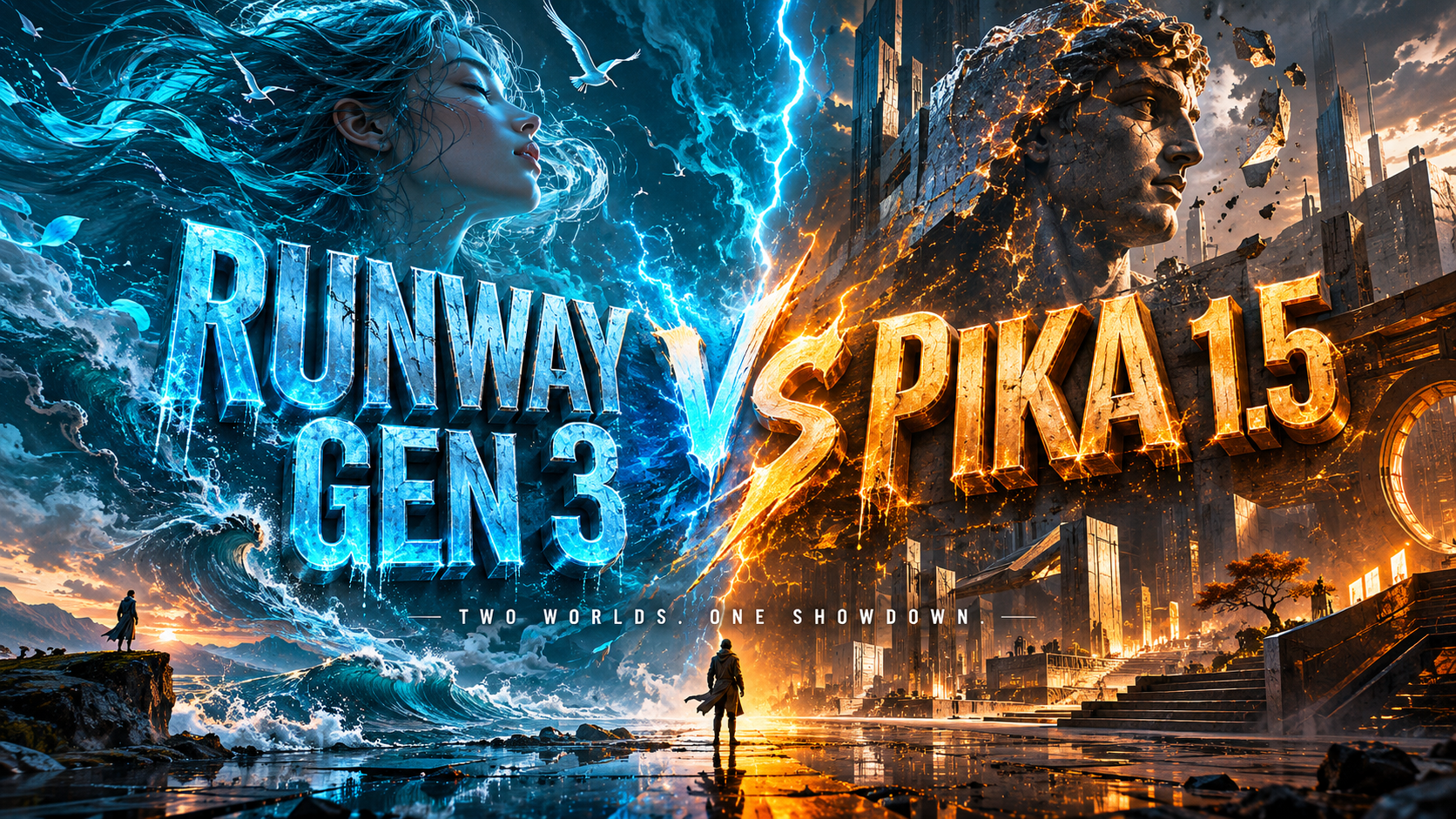
When comparing runway gen 3 vs pika 1.5 in 2026, the choice depends on whether you prioritize cinematic realism or creative, physics-defying special effects. Runway Gen-3 Alpha remains the industry leader for high-fidelity, photorealistic video generation with complex temporal consistency, while Pika 1.5 has carved out a niche with its "Pika Effects" that allow for surreal, physics-based transformations like melting, crushing, and inflating objects. Both platforms have evolved significantly by early 2026, offering professional-grade tools for filmmakers and content creators alike.
Runway Gen-3 is a high-end AI video model designed for hyper-realistic textures and cinematic lighting, ideal for professional film production. Pika 1.5 is a versatile animation tool famous for its "physics-defying" effects and user-friendly interface, making it the preferred choice for viral social media content and imaginative, stylized animations in 2026.
- ✓ Runway Gen-3 Alpha excels in temporal consistency and high-resolution photorealism.
- ✓ Pika 1.5 offers unique "Pika Effects" for surreal object manipulation and physics-based animations.
- ✓ Both tools now support advanced Lip Sync and Sound Effects (SFX) integration as of 2026.
- ✓ Runway is generally preferred for commercial production, while Pika leads in creative flexibility.
Understanding the Evolution: Runway Gen 3 vs Pika 1.5
The landscape of AI video generation has shifted dramatically by 2026. While early models struggled with "hallucinations" and warping, the current iteration of runway gen 3 vs pika 1.5 showcases near-perfect human anatomy and environmental physics. Runway has doubled down on its "General World Models" theory, aiming to simulate the physical laws of the real world to ensure that every camera movement and character gesture feels authentic. This has made it a staple in Hollywood pre-visualization and indie film production.
Pika 1.5, on the other hand, has embraced the "unreal." Following its landmark launch that introduced physics-defying AI special effects, Pika has focused on giving users granular control over how objects interact. According to VentureBeat, the release of Pika 1.5 marked a turning point where AI stopped just "generating" video and started "simulating" complex interactions like squishing, melting, and exploding. In 2026, these features have been refined to work with any uploaded image or text prompt, providing a playground for digital artists.
How to Choose Between Runway and Pika
- Define your project goal: Choose Runway for realism or Pika for stylized creativity.
- Assess your technical needs: Use Runway’s Director Mode for precise camera control (pan, tilt, zoom).
- Experiment with physics: Utilize Pika’s "Effect" presets if you need to manipulate specific objects in a scene.
- Review output quality: Export in 4K using Runway’s upscale tools for professional monitoring.
- Integrate audio: Use both platforms' built-in SFX generators to match the visual rhythm of your AI video.
Technical Specifications and Performance Comparison
When we look at the raw power of runway gen 3 vs pika 1.5, the differences in their underlying architecture become clear. Runway Gen-3 Alpha was built on a new infrastructure designed for large-scale multi-modal training. This allows for much faster generation times—often producing 10-second clips in under a minute. As reported by Runway Research, the model's ability to handle complex transitions and high-speed motion is a direct result of this next-generation training approach.
Pika 1.5 focuses on the "fun" factor without sacrificing quality. While it may not always match the sheer resolution of Runway’s top-tier settings, it wins on accessibility. The Pika interface is designed for rapid iteration. In 2026, Pika’s "Motion Control" features allow users to specify the intensity of movement, which prevents the "floaty" look often associated with AI-generated content. This makes it a formidable competitor to other 2026 leaders like Kling 2.6 and Google Veo 3.1.
| Motion Control | Advanced Director Mode | Physics-Based Presets |
| Feature | Runway Gen-3 Alpha | Pika 1.5 |
|---|---|---|
| Primary Strength | Cinematic Realism & Photorealism | Physics Effects & Creativity |
| Max Resolution | 4K Upscaled | 2K / 4K (Beta) |
| Video Duration | 5s, 10s, and Extendable | 3s to 10s Segments |
| Unique Feature | Multi-Motion Brush | Crush/Melt/Inflate Effects |
| Best For | Commercials & Film | Social Media & Animation |
Key Features of Runway Gen-3 Alpha in 2026
Runway Gen-3 Alpha has introduced several features that set it apart in the runway gen 3 vs pika 1.5 debate. One of the most significant is the "Custom Camera Control," which allows users to act as a virtual cinematographer. You can dictate precise coordinates for camera paths, ensuring that the AI doesn't just generate a random shot, but follows a specific storyboard. This level of control is why Cybernews ranked Runway as a top contender in their "Best AI Animation Generators 2026" review.
Advanced Character Consistency
One of the biggest hurdles in AI video has always been keeping a character looking the same across different shots. Runway's 2026 updates include a "Character Reference" tool that is remarkably stable. By uploading a single image of a person, the model can place that character in any environment or lighting condition without losing their identity. This is a game-changer for long-form storytelling where visual continuity is non-negotiable.
The Power of Multi-Motion Brush
While Pika has physics effects, Runway has the Motion Brush. In Gen-3, this tool has evolved into "Multi-Motion Brush," allowing users to paint up to six different areas of a still image and give them independent movement directions. For example, you can make clouds drift left, a river flow right, and a character wave their hand—all within a single generation. This level of granular environmental control is currently unmatched by most competitors.
Key Features of Pika 1.5 in 2026
Pika 1.5 has remained relevant by being the most "reactive" AI video tool on the market. Their "Pika Effects" are not just filters; they are deep integrations of physics engines with generative AI. According to VentureBeat, these effects allow users to perform actions like "Cake-ify" (turning an object into a cake being sliced) or "Squish," which were previously impossible without complex 3D modeling. This has made runway gen 3 vs pika 1.5 a choice between "Reality" and "Imagination."
Physics-Defying Special Effects
The standout feature of Pika 1.5 is undoubtedly its ability to manipulate the physical state of objects. In the 2026 version, these effects have expanded to include "Vaporize," "Liquidize," and "Teleport." These presets allow creators to produce eye-catching content for platforms like TikTok and Instagram in seconds. While Runway focuses on making things look real, Pika focuses on making things look impossible yet tactile.
Seamless Lip Sync and Audio Integration
Pika was one of the first to master integrated lip-syncing. In 2026, this has been upgraded to "Emotional Lip Sync," where the character's facial expressions change based on the tone of the audio uploaded. If the audio is an angry shout, the AI automatically adjusts the brow and eye tension of the character. This makes Pika an excellent tool for creating animated talking heads or character-driven memes without needing a full production suite.
The Competitive Landscape: 2026 Context
It is important to view the runway gen 3 vs pika 1.5 rivalry within the broader context of 2026. As noted by Geeky Gadgets, the market is now crowded with high-performance models like Kling 2.6 and Google's Veo 3.1. These competitors have pushed both Runway and Pika to innovate faster. While Google Veo 3 offers deep integration with the YouTube ecosystem, Runway and Pika have remained the preferred choices for independent creators due to their flexible web-based interfaces and robust community sharing features.
Furthermore, Techpoint Africa highlights that the rise of "Pixverse AI alternatives" has made the market more accessible. In 2026, users no longer need expensive GPUs to generate high-quality video; cloud-based processing on Runway and Pika has become so efficient that 1080p previews are virtually instantaneous. This democratization of video production has shifted the focus from "who has the best tech" to "who has the best creative tools."
Pricing and Accessibility in 2026
Both platforms have adopted tiered subscription models. Runway tends to be slightly more expensive, targeting professional studios with its "Enterprise" and "Unlimited" tiers. Pika 1.5 maintains a more aggressive pricing strategy for individuals, often offering "Free-to-Play" daily credits that allow hobbyists to experiment with its physics effects. Gadgets 360 recently listed Pika as one of the "Best Free AI Video Generators in 2025/2026" for those just starting their AI journey.
Is Runway Gen-3 better than Pika 1.5 for professional films?
Yes, Runway Gen-3 is generally considered superior for professional filmmaking due to its higher photorealism, better temporal consistency, and advanced camera controls. It is designed to mimic real-world cinematography more accurately than Pika 1.5.
What are "Pika Effects" in Pika 1.5?
Pika Effects are a suite of physics-based animation tools that allow users to melt, crush, inflate, or explode objects within a video. These effects use AI to simulate how materials would react to physical forces, creating surreal and engaging visuals.
Can I use my own images in both Runway and Pika?
Absolutely. Both platforms offer robust "Image-to-Video" capabilities. In 2026, these tools have improved to the point where they can maintain the exact style, lighting, and character details of your original upload while adding realistic motion.
Does Runway Gen-3 support sound effects?
Yes, Runway Gen-3 includes an integrated "Acted Audio" and SFX generator. This allows the AI to automatically generate synchronized sounds—like footsteps, wind, or engine noises—based on the visual content of the video it has created.
Which tool is easier for beginners to use?
Pika 1.5 is often cited as being more beginner-friendly. Its interface is streamlined, and the "Effects" buttons provide instant results without requiring complex prompting or knowledge of camera settings, making it ideal for casual creators.
Final Verdict: Choosing Your AI Video Powerhouse
The battle of runway gen 3 vs pika 1.5 does not have a single winner, as both tools serve different creative masters. If your goal is to produce a high-end commercial, a cinematic short film, or a realistic documentary, Runway Gen-3 Alpha is the gold standard. Its ability to render light, shadow, and human skin with such precision makes it an essential tool for the modern digital creator. The "Director Mode" alone provides a level of professional oversight that few other platforms can match.
However, if you are looking to push the boundaries of social media content, create whimsical animations, or experiment with physics in ways that reality doesn't allow, Pika 1.5 is your best bet. Its physics-defying effects are not just a gimmick; they represent a new way of thinking about digital video as a malleable, interactive medium. As we move further into 2026, the gap between professional tools and creative toys continues to shrink, leaving the power of high-end video production in the hands of anyone with a prompt and an idea.



Comments ()