
Best Realistic Text to Video AI Models: 2026 Rankings
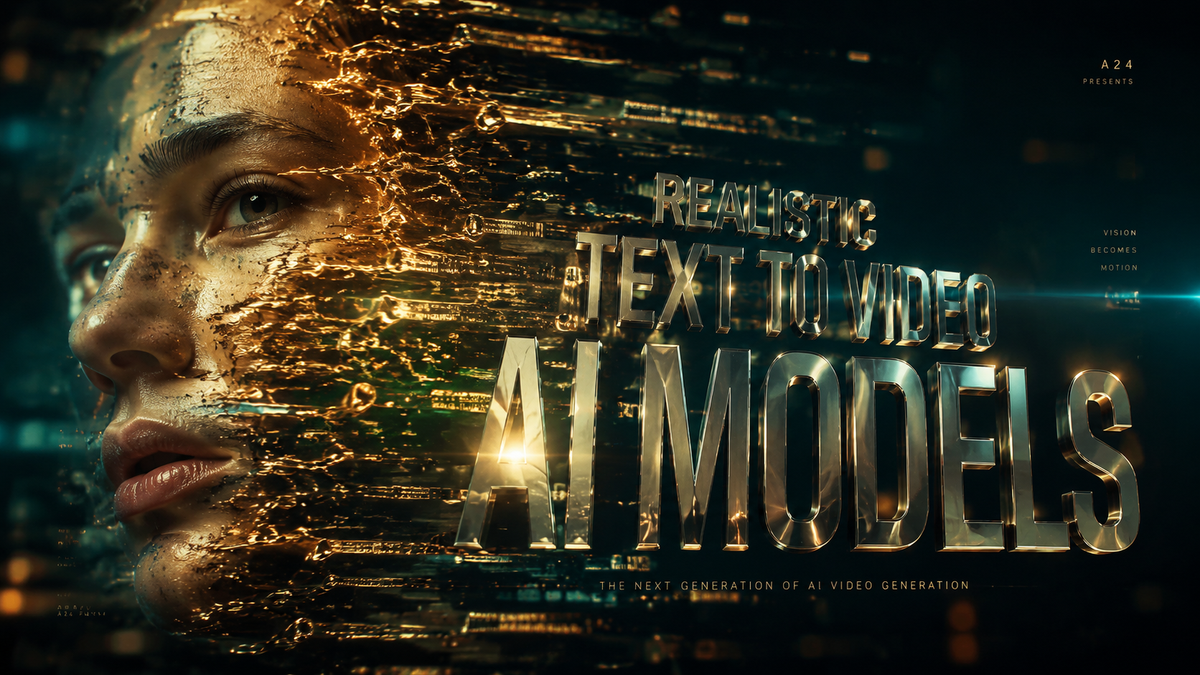
The best realistic text to video ai models in 2026 are characterized by hyper-realistic physics, temporal consistency, and the ability to render complex human emotions with near-perfect accuracy. Leading the market are Gemini Omni, Kling 2.0, and the latest iterations from Runway and Luma AI, which have surpassed early pioneers by offering cinematic 4K resolution and extended clip durations. These models transform simple text prompts into professional-grade video sequences, effectively bridging the gap between artificial intelligence and traditional cinematography.
Realistic text to video AI models are advanced generative neural networks that convert natural language descriptions into high-fidelity video content. In 2026, the industry standard is defined by "Omni-modal" architectures like Google's Gemini Omni, which process video, audio, and text simultaneously to create photorealistic scenes that are indistinguishable from real-world footage.
- ✓ Gemini Omni and Kling 2.0 currently lead the 2026 rankings for cinematic realism and temporal stability.
- ✓ Chinese AI developers have significantly narrowed the gap, with models like Vidu and Kling often outperforming US-based rivals in motion fluidness.
- ✓ Modern workflows now prioritize "Audio-to-Video" integration, allowing for perfectly synced soundscapes alongside visual generation.
- ✓ Accessibility has increased, with most top-tier models now supporting real-time previewing and granular camera control.
The Evolution of Realistic Text to Video AI Models in 2026
As we move through the midpoint of 2026, the landscape of generative video has shifted from experimental novelty to a foundational tool for global media production. According to a recent report by Incrypted, the top 15 neural networks for video generation in 2025-2026 have introduced features that were once considered impossible, such as consistent character persistence across multiple scenes and complex fluid dynamics. The "uncanny valley" that plagued earlier models has largely been bridged by the implementation of transformer-based diffusion architectures that understand the laws of physics.
The competitive pressure has reached an all-time high. As noted by the Financial Times in May 2026, Chinese AI groups have pulled ahead of many US rivals in the video generation race, particularly in the realm of commercial-grade realism. This geopolitical competition has accelerated the release cycles of major players, leading to rapid-fire updates that improve frame rates and reduce the visual "hallucinations" that used to occur during fast-motion sequences. Today's users expect nothing less than 60fps 4K output from a single sentence of text.
How to Use Realistic Text to Video AI Models
- Draft a Detailed Prompt: Describe the subject, lighting, camera movement (e.g., "dolly zoom"), and specific environmental textures.
- Select Your Model: Choose a model based on your needs—Gemini Omni for multimodal integration or Kling for high-action realism.
- Configure Parameters: Adjust the aspect ratio (16:9 for film, 9:16 for social) and the "motion scale" to determine how much movement occurs in the frame.
- Generate and Refine: Use seed numbers to maintain consistency and apply "negative prompts" to exclude unwanted elements like motion blur.
- Upscale and Export: Utilize built-in AI upscalers to reach 4K or 8K resolution before final rendering.
Top-Ranked AI Video Generators: Detailed Comparison

The current market is dominated by a few key players who have redefined what "realistic" means. Google’s Gemini Omni, introduced in May 2026, has become a benchmark for the industry. Unlike previous models that generated video as a secondary function, Gemini Omni is natively multimodal. This allows it to understand the nuance of a script and generate video that aligns perfectly with the intended emotional tone. PCMag recently noted in their "So Long, Sora" review that newer models have largely surpassed the original pioneers in terms of prompt adherence and complex object interaction.
Another major contender is the suite of tools coming from the East. Models like Kling and Vidu have gained massive traction among professional creators for their ability to handle long-duration clips—up to 2 minutes in a single generation—without losing the identity of the characters. This level of stability is crucial for filmmakers who require realistic text to video ai models to handle narrative storytelling rather than just short, 5-second loops. The following table highlights the key differences between the top-tier models available today.
| Model Name | Max Resolution | Key Strength | Best For |
|---|---|---|---|
| Gemini Omni | 4K (Native) | Multimodal Reasoning | Feature Films & Commercials |
| Kling 2.0 | 4K | Physical Accuracy | Action Scenes & Physics |
| Runway Gen-4 | 4K | Creative Control | Artistic Direction |
| Luma Dream Machine Pro | 2K / 4K Upscaled | Speed of Generation | Social Media & Prototyping |
| Vidu 1.5 | 4K | Character Consistency | Long-form Storytelling |
Deep Dive: Gemini Omni and the Multimodal Revolution
Gemini Omni represents a paradigm shift in how we interact with AI. According to blog.google, this model was designed to be "omni-capable," meaning it doesn't just translate text to pixels; it understands the physics of the scene it is creating. If you prompt for a glass of water shattering on a marble floor, Gemini Omni calculates the trajectory of the shards and the reflection of the light in real-time. This level of detail has made it the preferred choice for high-end visual effects houses looking to augment their pipelines.
Furthermore, the integration of audio has become a standard feature. As reported by Robotics & Automation News in June 2026, the best workflows now involve audio-to-video generators that can take a voiceover track and generate a talking head with perfect lip-sync and micro-expressions. Gemini Omni excels here, providing a holistic creation environment where the video, sound, and dialogue are synthesized in a single pass, ensuring that the visual "acting" matches the vocal delivery perfectly.
The Rise of Chinese Video AI: Kling and Vidu
The 2026 rankings cannot be discussed without acknowledging the dominance of Chinese models. Kling 2.0 has become a viral sensation for its ability to simulate complex human movements, such as eating or intricate hand gestures, which were notorious "AI giveaways" in previous years. The Financial Times highlights that these models are often trained on more diverse datasets, allowing them to capture a wider range of cultural nuances and environmental settings than their Western counterparts.
Key Features to Look for in Realistic Text to Video AI Models
When evaluating realistic text to video ai models, resolution is no longer the only metric that matters. In 2026, "Temporal Consistency" is the gold standard. This refers to the AI's ability to keep the background, lighting, and character features identical from the first frame to the last. If a character walks behind a tree, they should emerge on the other side looking exactly the same, without their clothes changing color or their face morphing. Models like Runway Gen-4 have introduced "Director Mode," giving users granular control over these specific elements.
Additionally, camera control has become a vital feature. Modern users require the ability to specify focal lengths, aperture, and specific cinematic movements. Whether it is a "handheld" shake for a documentary feel or a smooth "technocrane" sweep for a luxury car commercial, the best AI models now interpret these cinematographic terms with precision. CNET's 2026 review of AI tools emphasizes that the most successful models are those that speak the language of filmmakers, not just programmers.
The Role of Audio-Video Synchronization
A major trend identified by Robotics & Automation News is the shift toward unified content workflows. Realistic video is only half the battle; without realistic spatial audio, the illusion is broken. The top-ranked models in 2026 now feature "Environmental Audio Generation," where the AI analyzes the visual scene—such as a rainy street at night—and automatically generates the corresponding sound of tires on wet asphalt and distant thunder. This 360-degree approach to realism is what separates the top 5 models from the rest of the pack.
Future Outlook: Beyond 2026
Looking toward the end of the decade, the trajectory of realistic text to video ai models suggests a move toward full-length feature film generation from a single prompt. While we are not quite there yet, the jump in quality between 2025 and 2026 has been the largest in the history of the medium. The barrier to entry for high-quality video production has been permanently lowered, allowing independent creators to produce visuals that rival major Hollywood studios.
However, this power comes with its own set of challenges. The industry is currently grappling with the ethics of photorealism, leading to the implementation of mandatory C2PA watermarking on all outputs from major models like Gemini and Runway. As these models become more realistic, the focus is shifting from "can we make it look real?" to "how can we ensure it is used responsibly?" The rankings for 2026 reflect not just technical prowess, but also the safety and transparency features integrated into these powerful neural networks.
What is the most realistic AI video generator in 2026?
Currently, Gemini Omni and Kling 2.0 are tied for the top spot. Gemini Omni is preferred for its multimodal integration and lighting accuracy, while Kling 2.0 is renowned for its superior handling of complex human motion and physical interactions.
Can AI generate 4K video from text?
Yes, by 2026, most flagship models like Runway Gen-4 and Gemini Omni support native 4K output. These models use advanced diffusion techniques to ensure that the high resolution does not result in visual artifacts or loss of detail.
How long are the videos generated by these AI models?
While early models were limited to a few seconds, 2026 rankings show that models like Vidu 1.5 can generate up to 2 minutes of consistent video in a single pass. Extensions and "looping" features allow for even longer content creation.
Do these models include sound?
Most top-tier realistic text to video ai models now include integrated audio generation. This allows the AI to create synchronized sound effects and background music that match the visual context of the generated video.
Are Chinese AI video models better than US models?
According to the Financial Times, Chinese AI groups have taken a lead in specific areas of video generation, such as motion fluidity and character persistence. However, US models like Gemini Omni remain superior in multimodal reasoning and integration with other creative tools.



Comments ()