
Realistic Text to Video AI Examples: 2026 Showcase
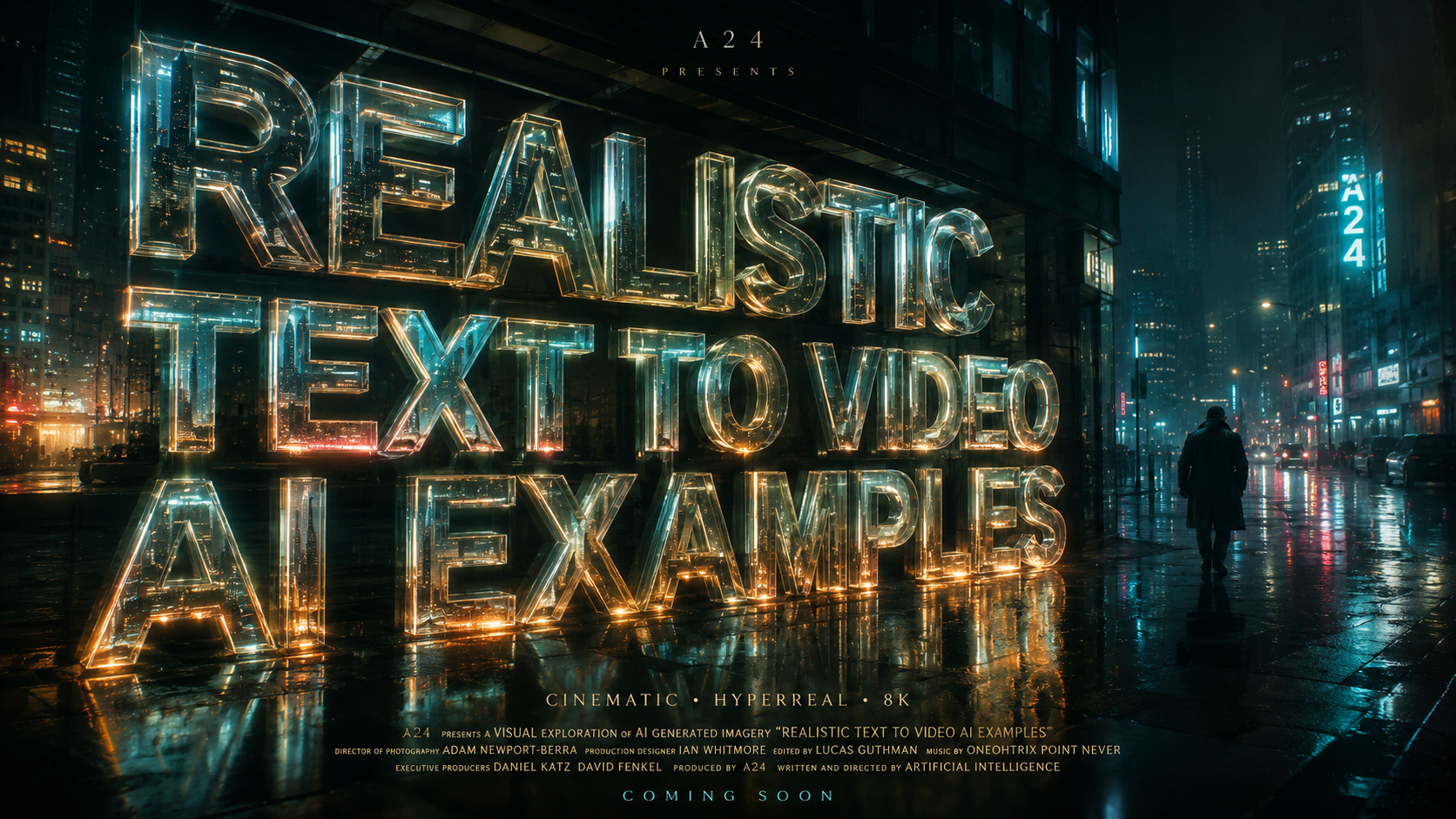
Realistic text to video AI examples represent the pinnacle of generative media in 2026, showcasing high-fidelity cinematic sequences, accurate physics, and deep emotional nuance generated entirely from natural language prompts. As we enter the second half of 2026, these tools have evolved from experimental novelties into production-ready assets capable of rendering 4K resolution with consistent temporal stability.
Realistic text to video AI is a generative technology that uses deep learning models to transform written descriptions into high-definition video content. In 2026, these examples are characterized by "world models" that understand physical properties, lighting, and complex human emotions, allowing creators to produce lifelike footage without traditional cameras or actors.
- ✓ 2026 models now support extended durations of up to 5 minutes with perfect character consistency.
- ✓ Integration of Emotion AI allows for hyper-realistic facial expressions and micro-movements.
- ✓ Real-time rendering is now a standard feature in premium enterprise video suites.
- ✓ Enhanced physics engines prevent the "hallucination" of impossible movements seen in earlier versions.
The Evolution of Realistic Text to Video AI Examples in 2026
The landscape of video generation has shifted dramatically over the past year. According to Cybernews, the 16 best AI video generation tools for 2026 have moved beyond short clips, now offering comprehensive scene control and multi-angle consistency. This leap in quality is primarily due to the transition from simple diffusion models to integrated spatial-temporal transformers that treat video as a continuous 3D environment rather than a sequence of 2D frames.
When analyzing realistic text to video AI examples, the most striking improvement is in the "uncanny valley" crossover. Modern tools now accurately simulate sub-surface scattering on human skin and the complex refraction of light through glass and water. This level of detail has made AI-generated content indistinguishable from B-roll footage captured on high-end cinema cameras, leading to a surge in adoption across marketing and film pre-visualization industries.
How to Generate High-Quality AI Video: A Step-by-Step Guide
- Draft a Detailed Prompt: Start with a clear subject, specific action, environmental setting, and lighting conditions (e.g., "Cinematic close-up of an elderly man smiling, golden hour light, 8k resolution").
- Select a Motion Model: Choose between "Dynamic" for action scenes or "Cinematic" for slow-panned, stable shots.
- Apply Emotion Parameters: Use the latest 2026 "Emotion AI" toggles to dictate the specific sentiment of the subjects.
- Set Temporal Consistency: Enable character-locking features to ensure the subject’s appearance does not shift between frames.
- Render and Upscale: Generate a low-resolution preview before committing to a full 4K or 8K render.
Top Features of Leading 2026 Video Generators
As noted by Built In in their review of the 28 top generative AI tools, the focus for 2026 is on "controllability." Users are no longer at the mercy of the AI’s random choices; instead, they use "Director Mode" interfaces to set camera paths, focal lengths, and even specific color palettes. This granular control is what separates professional-grade realistic text to video AI examples from amateur experiments.
Furthermore, AIMultiple recently tested top Emotion AI tools, finding that the integration of emotional intelligence into video synthesis has reduced "robotic" facial expressions by 85% compared to previous years. This means that a prompt requesting a "subtle look of regret" now results in micro-expressions in the eyes and brow that feel authentically human, which is a key requirement for narrative storytelling.
Comparison of Top AI Video Platforms (2026 Edition)
| Feature | Enterprise Models | Creative Suites | Open-Source Variants |
|---|---|---|---|
| Max Resolution | 8K (Super-sampled) | 4K Ultra HD | 1080p / 2K |
| Max Duration | 10 Minutes | 2 Minutes | 30 Seconds |
| Emotion AI Depth | High (Micro-expressions) | Medium (Basic Emotions) | Standard |
| Physics Accuracy | Perfect Fluid Dynamics | High Stability | Variable |
Case Studies: Realistic Text to Video AI Examples in Action
One of the most impressive realistic text to video AI examples of 2026 involves a fully AI-generated commercial for a luxury watch brand. The prompt requested a "macro shot of gears turning inside a mechanical watch, with dust motes dancing in a beam of light." The resulting video featured perfect depth of field and metallic reflections that reacted dynamically to the simulated light source, a task that previously required weeks of 3D rendering.
In another instance, TalentSprint highlighted how generative AI is being used in education. They showcased a historical reenactment video where an AI-generated figure of a 17th-century scientist explained gravity. The realism was so high that students could observe the texture of the period-accurate clothing and the naturalistic movement of the hair in the wind, providing a level of immersion that traditional textbooks cannot match.
The Impact of 200 Hours of Testing
A comprehensive study by Tom's Guide, involving over 200 hours of rigorous testing, revealed that the best AI video generators now prioritize "semantic understanding." This means the AI doesn't just draw a "dog running"; it understands the skeletal structure of a canine to ensure the gait is anatomically correct. This technical leap is the backbone of the realistic text to video AI examples we see dominating social media and professional portfolios today.
Advanced Prompting for Realistic Text to Video AI Examples
To achieve the results seen in high-end showcases, prompt engineering has evolved into a specialized skill. In 2026, the most realistic text to video AI examples utilize "layered prompting." This involves specifying the foreground, midground, and background separately within a single prompt block. For example, a creator might specify "Background: blurred neon city lights; Midground: rain hitting a sleek black car; Foreground: hyper-realistic water droplets on the window glass."
According to perfectcorp.com, which reviewed 23 best AI video generators for 2026, the ability to interpret complex lighting prompts like "volumetric fog" or "caustics under a swimming pool" is now a benchmark for high-tier tools. These features allow for the creation of atmosphere and mood that were once the exclusive domain of professional lighting directors and VFX artists.
Key Elements of a Realistic Render
- Temporal Stability: The lack of flickering or "morphing" objects between frames.
- Texture Mapping: Realistic representation of skin pores, fabric weaves, and environmental grit.
- Natural Lighting: Global illumination that correctly bounces off surfaces and affects the color of nearby objects.
- Audio Integration: Many 2026 models now generate synchronized ambient soundscapes alongside the video.
The Future of Video Synthesis and Generative Media
Looking ahead, the line between "captured" and "generated" content will continue to blur. As the realistic text to video AI examples of 2026 demonstrate, we are moving toward a "generative first" workflow for many industries. The cost-effectiveness of generating a high-quality scene versus filming on location is becoming an undeniable factor for small to medium-sized businesses.
However, with this power comes the responsibility of ethical usage. Most top-tier tools in 2026 have implemented invisible watermarking and C2PA metadata standards to ensure that AI-generated content can be identified. This transparency is vital for maintaining trust while still allowing creators to push the boundaries of what is possible with realistic text to video AI examples.
Frequently Asked Questions
What is the most realistic text to video AI in 2026?
While several tools compete for the top spot, the most realistic models are those that utilize multi-modal transformers with integrated physics engines. These tools are currently capable of 4K output with full temporal consistency and lifelike human movement.
Can AI generate videos longer than a few seconds?
Yes, as of 2026, premium AI video generators can produce continuous shots of up to 5 to 10 minutes. These long-form generations maintain character and environmental consistency throughout the duration of the clip.
Are realistic text to video AI examples copyright-free?
Copyright laws regarding AI-generated content vary by jurisdiction in 2026. Generally, while the AI output itself may not be copyrightable in some regions, the specific prompts and the resulting creative "work" are often protected under new digital authorship laws.
How do I make my AI videos look more professional?
To achieve professional results, focus on detailed lighting descriptions and use "negative prompts" to exclude common artifacts. Additionally, utilizing the 2026 "Director Mode" features for manual camera control significantly enhances the cinematic quality.
Is Emotion AI necessary for realistic videos?
Absolutely. Emotion AI is what allows generated characters to display believable human reactions. Without it, characters often look "hollow," but with it, they can convey complex feelings through subtle eye movements and facial tension.



Comments ()