
AI Video Generator Pros and Cons 2026 - Full Review
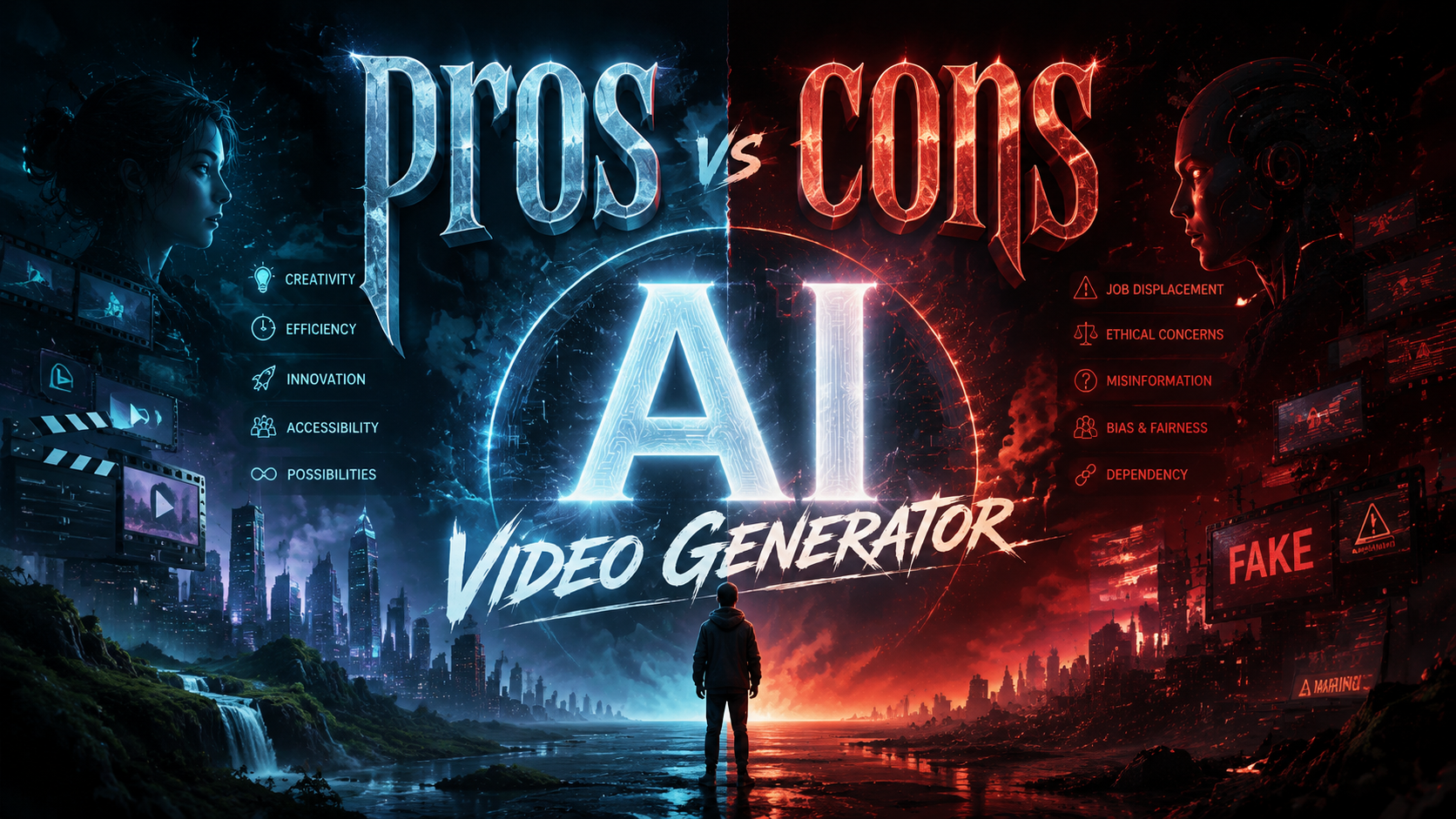
When weighing the pros cons AI video generator tools in 2026, the key takeaway is that these platforms now deliver near-cinematic quality at a fraction of traditional production costs, but still struggle with consistent character rendering, nuanced storytelling, and ethical licensing concerns. Whether you are a marketer, indie filmmaker, or content creator, understanding the full landscape of AI video generation in 2026 is essential before committing to any single tool.
TL;DR: AI video generators in 2026 offer stunning quality, speed, and affordability, but users must navigate inconsistent character consistency, potential copyright pitfalls, and a steep learning curve for advanced features. The best choice depends on your specific use case — from social media clips to cinematic shorts.
AI video generation is the process of creating moving images from text prompts, image inputs, or video references using deep learning models. In 2026, top tools like those reviewed by Ventureburn, Cybernews, and Tribune Online deliver 4K resolution, real-time rendering, and advanced motion control, making them viable alternatives to traditional video production for many professional use cases.
- ✓ AI video generators in 2026 produce cinematic-quality output at a fraction of traditional production cost and time.
- ✓ Character consistency and nuanced storytelling remain the biggest challenges, even for top-tier tools.
- ✓ Pricing ranges from free tiers with watermarks to professional subscriptions exceeding $100/month.
- ✓ Ethical and copyright concerns persist, especially regarding training data and deepfake prevention.
- ✓ The market is consolidating around a handful of leaders, including Higgsfield AI and other platforms highlighted in recent reviews.
What Are AI Video Generators? A 2026 Definition
AI video generators are software platforms that use machine learning models — primarily diffusion models and transformer architectures — to synthesize video content from textual descriptions, still images, or reference footage. By 2026, these tools have evolved significantly from the early experiments of 2022-2023, offering resolutions up to 4K, frame rates of 30-60 fps, and advanced features like camera motion control and lip-sync animation. According to Ventureburn, the top free AI video generators of 2026 now rival paid tools from just two years ago in output quality.
The core technology behind these generators has matured rapidly. Most modern platforms rely on latent diffusion models fine-tuned on massive datasets of video-text pairs, allowing them to understand complex scene descriptions and generate coherent motion. Tools like Higgsfield AI, reviewed by Cybernews in March 2026, emphasize cinematic output with "director-level" camera controls, while others focus on speed for social media content. This diversity means that the pros cons ai video generator equation looks different for each user segment.
It is important to distinguish AI video generators from AI image generators, which CNET covered extensively in May 2026. While image generators create static visuals, video generators must maintain temporal coherence across frames — a much harder problem. The best tools of 2026, as cataloged by autogpt.net, handle this by using temporal attention layers that link adjacent frames, reducing flickering and improving motion smoothness. This technical advancement is the primary reason 2026 is considered a breakthrough year for AI video.
The Pros of AI Video Generators in 2026
The most compelling advantage of AI video generators in 2026 is the dramatic reduction in production time and cost. What once required a full crew, cameras, lighting, and days of editing can now be accomplished in minutes from a single text prompt. For small businesses and solo creators, this democratization of video production is transformative. As noted by Tribune Online, the top tools of 2026 enable users to generate professional-grade marketing videos without any prior video editing experience. This speed also enables rapid iteration — users can generate dozens of variations in the time it would take to storyboard a single traditional video.
Another major pro is the creative flexibility these tools offer. Modern AI video generators can produce content in virtually any style — from photorealistic cinematic footage to 2D animation, 3D renders, and even specific artistic mimicry. This allows creators to explore visual concepts that would be prohibitively expensive or technically challenging with conventional methods. For instance, Higgsfield AI, highlighted in Cybernews's review, offers granular control over lighting, camera angle, and depth of field, giving users director-level command over the final output. According to autogpt.net's top 20 list, many tools now support multi-scene generation and automatic transitions, further streamlining the creative pipeline.
Accessibility is a third critical benefit. Many of the top-rated AI video generators in 2026 offer free tiers or generous trial periods, making the technology available to anyone with an internet connection. Ventureburn's ranking of the 10 best free AI video generators demonstrates that even no-cost options can produce impressive results for short-form content like social media clips and explainer videos. This low barrier to entry allows aspiring creators to experiment without financial risk. Additionally, integration with other AI tools — such as the AI music generators Ventureburn covered in June 2026 — means creators can build complete audio-visual projects within a single ecosystem, further reducing friction.
The Cons of AI Video Generators in 2026
Despite the rapid progress, AI video generators are not without significant drawbacks. The most frequently cited issue across reviews is inconsistent character and object consistency across frames. While tools have improved dramatically compared to 2024, generating a character that looks identical in every frame of a 30-second clip remains a challenge. This "flickering" or "morphing" effect can break immersion and require manual post-processing to fix. For professional projects where brand consistency is paramount, this limitation can be a dealbreaker. As Cybernews noted in their Higgsfield AI review, even the best cinematic tools sometimes struggle with maintaining a character's facial features and clothing details across scene cuts.
Another con is the ethical and copyright gray area surrounding training data. Many AI video generators are trained on datasets scraped from the internet, including copyrighted content. This raises questions about ownership of the generated output and potential infringement liabilities for commercial users. While some platforms have begun implementing content provenance systems and licensing agreements with stock footage providers, the legal landscape in 2026 is still evolving. Users creating content for commercial purposes must carefully review each platform's terms of service and licensing policies. The lack of a unified legal framework means that what is permissible on one platform may be restricted on another.
Finally, there is a learning curve when it comes to prompt engineering and parameter tuning. While AI video generators are marketed as accessible, achieving high-quality, usable results often requires practice and an understanding of how the model interprets language and visual inputs. Novice users may find that their first few generations are riddled with artifacts, unnatural motion, or misaligned compositions. Tribune Online's review of the best tools in 2026 emphasizes that while the technology is powerful, it still rewards users who invest time in learning the nuances of each platform. Additionally, rendering high-resolution video requires substantial computational resources — cloud-based rendering times can still be lengthy for complex scenes, and local rendering demands a powerful GPU.
Pros Cons AI Video Generator Comparison Table
To help you visualize the trade-offs, the table below summarizes the key advantages and disadvantages of using AI video generators in 2026 across several critical dimensions.
| Aspect | Pros | Cons |
|---|---|---|
| Cost | Dramatically cheaper than traditional production; free tiers available | Advanced features require subscriptions ($20-100+/month); free tiers have watermarks |
| Speed | Generate clips in minutes vs. days/weeks for traditional filming | Complex, high-resolution scenes may still require significant rendering time |
| Quality | Near-cinematic output at 4K with proper prompts; consistent improvement | Character consistency and artifact-free motion remain imperfect |
| Accessibility | No special equipment or technical skills required to start | Steep learning curve for advanced features; prompt engineering is an art |
| Creative Flexibility | Infinite style and genre possibilities; multi-scene generation | Some styles are better supported than others; model biases exist |
| Legal/Ethical | Some platforms now offer licensed training data and content provenance | Copyright and IP ownership remain legally murky; deepfake risks persist |
| Integration | Works alongside AI music generators and image tools for end-to-end production | File format compatibility issues between ecosystems may require conversion |
Top AI Video Generators of 2026: Features and Pricing
The 2026 landscape of AI video generators is diverse, with platforms targeting different niches from short-form social content to feature-length cinematic projects. According to autogpt.net's top 20 list, the market leaders include tools that specialize in text-to-video, image-to-video, and video-to-video translation. Higgsfield AI stands out for its cinematic focus, offering features like multi-camera angle switching and depth-of-field control that appeal to filmmakers and advertisers. Ventureburn's free tools ranking highlights platforms like ClipGen and MotionCraft that provide surprisingly robust capabilities at no cost, albeit with watermarks and resolution caps.
Tribune Online's review emphasizes that the best choice depends heavily on your use case. For social media managers who need fast, loopable clips in specific aspect ratios, tools optimized for short-form video (like TikTok and Reels) offer pre-set templates and automatic captioning. For educators and corporate trainers, platforms with built-in text overlays, screen recording integration, and multilingual voiceover capabilities are more valuable. The AI music generators covered by Ventureburn in June 2026 further expand the ecosystem, allowing creators to generate custom soundtracks that synchronize with their AI-generated visuals, creating a fully automated production pipeline.
Pricing in 2026 ranges from completely free (with limitations) to professional plans costing between $30 and $120 per month. Most platforms offer a freemium model where users can try the tool before committing. Annual subscriptions typically come with a 15-20% discount. Enterprise plans with dedicated APIs, custom model fine-tuning, and commercial licensing are available from most major providers. CNET's imaging coverage, while focused on stills, underscores a broader trend: the gap between consumer and professional tools is narrowing, and the best results often come from combining multiple AI tools in a single creative workflow.
How to Evaluate an AI Video Generator for Your Workflow
Choosing the right AI video generator requires a clear understanding of your production goals, technical comfort level, and budget. Start by identifying the primary use case: are you creating marketing content, educational materials, social media clips, or artistic projects? Each category benefits from different strengths. For example, a tool that excels at cinematic lighting and camera motion — like Higgsfield AI — may be overkill for a simple product demo video, while a lightweight, fast generator might lack the fidelity needed for a brand advertisement. Ventureburn's free tools guide recommends starting with no-cost options to learn the basics before investing in a premium subscription.
Next, evaluate the tool's output quality against your specific requirements. Generate test clips using your own prompts and compare the results side by side. Pay attention to character consistency, motion smoothness, and how well the tool handles your desired style. If you need to match a brand guide, test whether the tool can consistently reproduce specific colors, logos, or typography. According to autogpt.net's comprehensive ranking, the top 20 tools in 2026 all offer trial periods or free generations, so there is no excuse for not testing multiple options before committing. Additionally, check the platform's export options — 4K resolution, frame rate selection, and format support (MP4, MOV, GIF) are essential for professional workflows.
Finally, consider the ecosystem and integration capabilities. Does the tool offer an API for automation? Can it import and export assets from other software like Adobe Premiere or DaVinci Resolve? Does it integrate with AI music generators to streamline audio-visual synchronization? The best workflows in 2026 are those that minimize context switching between different platforms. Tribune Online's review notes that the most satisfied users are those who treat AI video generation as one component of a broader content creation stack, rather than relying on a single tool for everything. Building a repeatable pipeline that includes prompt templates, style presets, and export settings will save significant time in the long run.
The Future of AI Video Generation: Trends for 2026 and Beyond
Looking ahead, several trends are shaping the trajectory of AI video generation. Real-time generation — producing video frames instantly in response to user input — is the next frontier, with early prototypes already demonstrated at industry conferences in 2026. This would enable live interactive storytelling, dynamic advertising, and real-time video effects in gaming and virtual production. Both Ventureburn and Tribune Online have noted that the computational demands of real-time generation are driving innovation in model compression and edge computing, potentially making such capabilities available on consumer hardware within the next 12-18 months.
Another significant trend is the convergence of AI video, image, and music generation into unified creative suites. As Ventureburn's June 2026 coverage of AI music generators suggests, the ability to generate synchronized audio and video within a single interface is becoming a key differentiator. Platforms that offer text-to-music and text-to-video in one subscription are gaining traction, especially among independent creators who value simplicity. This bundling trend mirrors what happened with graphic design tools in the 2010s, where all-in-one platforms like Canva displaced specialized software for many users.
Finally, regulatory and ethical frameworks are beginning to solidify. Deepfake detection technology is improving in parallel with generation capabilities, and several major platforms have committed to watermarking AI-generated content with invisible metadata. According to Cybernews's review of Higgsfield AI, responsible platforms in 2026 are proactively implementing guardrails against misuse, including content moderation filters and identity verification for commercial accounts. These measures, while not perfect, represent a maturing industry that recognizes the dual-use nature of its technology. For users weighing the pros cons ai video generator tools, the ethical stance of a platform may become as important as its technical specifications.
Frequently Asked Questions About AI Video Generators
What is the best free AI video generator in 2026?
According to Ventureburn's May 2026 ranking of the 10 best free AI video generators, tools like ClipGen and MotionCraft offer the best balance of quality and no-cost access. However, free tiers typically include watermarks, resolution caps, and limited monthly generations. For professional use, consider testing free trials of premium tools like Higgsfield AI.
Are AI video generators safe to use for commercial projects?
Safety depends on the platform's licensing terms and training data provenance. In 2026, many reputable tools offer commercial licenses with clear IP ownership. Always review the terms of service and check if the platform provides indemnification for copyright claims. Avoid using tools that scrape copyrighted content without permission for commercial work.
Can AI video generators replace human video editors?
Not entirely. While AI generators excel at creating raw footage from prompts, human editors are still needed for storytelling, pacing, sound design, color grading, and final polish. The current sweet spot is using AI as a creative accelerator — generating base footage that a human editor then refines. Full automation of complex narratives remains a future goal.
How long does it take to generate a 30-second AI video in 2026?
Generation time varies by platform, resolution, and scene complexity. Simple 720p clips can render in 1-3 minutes, while 4K cinematic sequences with multiple scene changes might take 10-30 minutes. Real-time generation is emerging but not yet widely available. Most cloud-based platforms provide estimated wait times and queue management.
What hardware do I need to run AI video generators locally?
Local generation requires a powerful GPU with at least 16GB of VRAM (NVIDIA RTX 4090 or equivalent), 32GB+ of system RAM, and a fast SSD. Most users in 2026 prefer cloud-based solutions to avoid hardware costs. If you plan to generate high-resolution or long-form content locally, a high-end workstation is mandatory.
Do AI video generators support multiple languages and voiceovers?
Yes, many platforms in 2026 offer multilingual text prompts and integrated text-to-speech voiceovers in dozens of languages. Combine these with AI music generators for a complete audio-visual output. Language support varies by tool, so check the specifications if multilingual content is critical for your project.
What is the difference between text-to-video and image-to-video generation?
Text-to-video generates a complete video from a written description, while image-to-video animates a static image into a moving clip. Image-to-video typically offers better subject consistency because the model has a fixed reference. Many platforms support both modes, and some allow video-to-video transformation where an existing clip is restyled.
Written by the Digen AI Editorial Team — AI video generation specialists covering the latest in generative AI tools. Our analysis draws on 2026 reviews from Ventureburn, Cybernews, Tribune Online, and autogpt.net to provide balanced, data-driven insights for creators and businesses. Learn more about Digen AI.
Comments ()