
Pika Labs vs Runway ML Comparison: Best AI Video in 2026
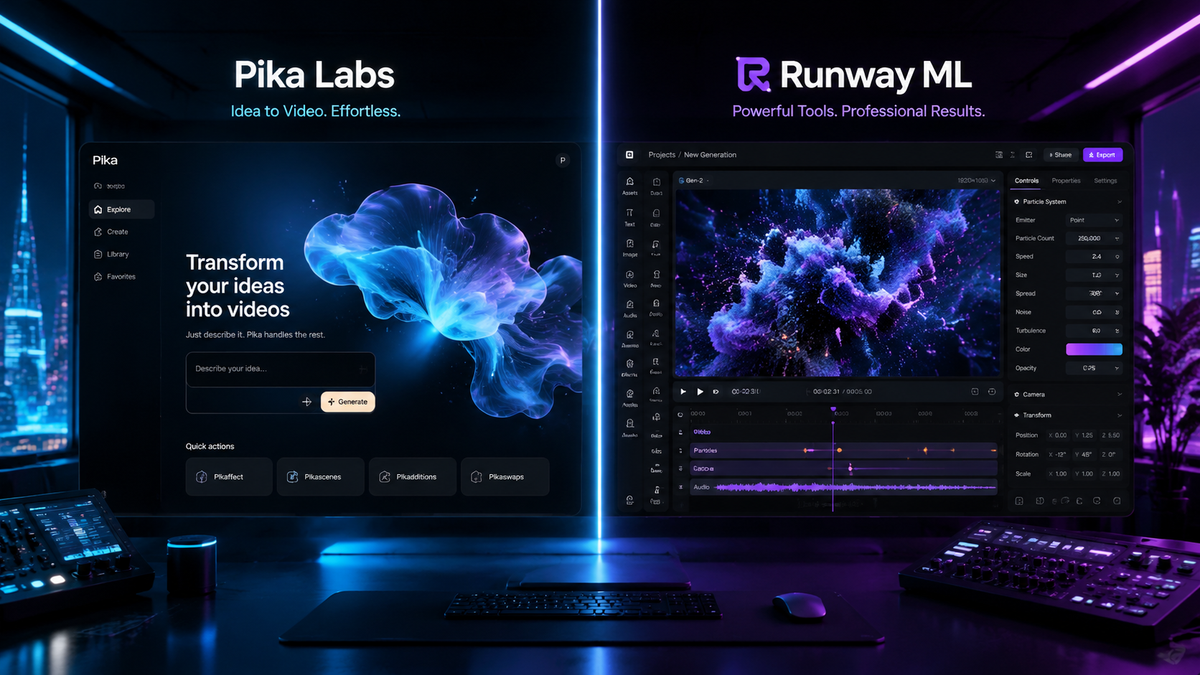
The pika labs vs runway ml comparison for 2026 reveals a landscape where cinematic quality and creative control have reached unprecedented heights. While Runway ML continues to lead in professional-grade enterprise tools and structural consistency, Pika Labs has carved out a dominant niche in stylized animation and intuitive physics-based motion. Choosing the best AI video generator in 2026 depends entirely on whether you prioritize granular editing control or artistic, fluid visual storytelling.
Runway ML is a comprehensive creative suite offering Gen-3 Alpha Turbo and advanced "Act-One" facial mapping for professional studios, whereas Pika Labs is the premier choice for stylized animation, featuring unique sound effect generation and localized motion control. In 2026, Runway leads in realism, while Pika excels in creative flexibility and ease of use.
- ✓ Runway ML offers superior structural consistency for long-form professional video production.
- ✓ Pika Labs provides better integrated audio-visual synchronization and stylized "Lip Sync" features.
- ✓ Both platforms now support 4K upscaling and 10+ second continuous generation clips.
- ✓ According to recent testing by Tom's Guide, Runway remains the top pick for photorealism in 2026.
Understanding the 2026 AI Video Landscape
As we navigate through 2026, the evolution of generative video has moved past the "uncanny valley" phase into a realm of true utility. The pika labs vs runway ml comparison is no longer just about who can make a 3-second clip of a cat dancing; it is about which platform can sustain a 24-frame-per-second narrative without visual artifacts. Modern creators are looking for temporal consistency—the ability for a character to look the same in the first second as they do in the tenth.
According to a 2026 review by Cybernews, the industry has shifted toward "Multimodal Control," where users interact with AI using text, images, and even skeletal motion maps. Runway ML has leaned heavily into the "World Engine" concept, treating video generation as a physics simulation. Conversely, Pika Labs has focused on the "Director's Experience," ensuring that even a novice can produce high-quality animation with minimal prompting effort. This divergence has created two distinct ecosystems for digital artists.
Furthermore, the integration of sound has become a major battleground. While earlier versions of these tools were silent, 2026 marks the year where "Video-to-Audio" (V2A) technology is standard. Pika Labs has gained significant traction by allowing users to generate sound effects that perfectly match the on-screen action, such as the crunch of gravel or the hum of a lightsaber, directly within the generation interface.
How to Choose Between Pika Labs and Runway ML
- Identify your output goal: Use Runway ML if you need photorealistic humans for a commercial; use Pika Labs if you are creating an animated short or a stylized music video.
- Evaluate your hardware: Both are cloud-based, but Runway's desktop interface is more resource-intensive, whereas Pika Labs remains highly optimized for mobile and web-based workflows.
- Test the motion controls: Utilize Runway’s "Motion Brush" for specific directional movement or Pika’s "Area Control" to animate only specific segments of an image.
- Check for audio needs: If your project requires synchronized lip-syncing, Pika’s 2026 toolset currently offers a more streamlined workflow for matching character mouth movements to uploaded audio.
- Analyze the budget: Compare the credit-based systems, as Runway typically targets enterprise users with higher-tier subscriptions, while Pika offers competitive "Pro" tiers for independent creators.
Core Feature Comparison: Pika Labs vs Runway ML
To better understand the strengths of each platform, we must look at the technical specifications and user interface capabilities available in 2026. The following table breaks down the essential metrics that professional editors use to decide between these two powerhouses.
| Feature | Runway ML (Gen-3/Act-One) | Pika Labs (Pika 2.5) |
|---|---|---|
| Primary Strength | Photorealism & Physics | Stylization & Animation |
| Max Resolution | 4K Upscaled | 4K Upscaled |
| Motion Control | Advanced Motion Brush / Camera Control | Physics-based "Modify" Tools |
| Character Consistency | High (via Act-One mapping) | Moderate (via Seed Control) |
| Audio Integration | External/Integrated Gen | Native Sound Effects & Lip Sync |
| Platform Access | Web, iOS, Professional API | Web, Discord, iOS/Android |
Runway ML: The Professional’s Choice for Realism
Runway ML has maintained its lead in the 2026 market by focusing on what they call "High-Fidelity Human Simulation." Their Act-One feature allows creators to record themselves on a simple webcam and transpose that exact facial performance onto an AI-generated character. This has revolutionized the way independent filmmakers approach character acting, reducing the need for expensive motion-capture suits. According to Techloy's 2026 hands-on review, Runway's ability to maintain skin texture and lighting consistency is currently unmatched by competitors.
The Runway ecosystem is also highly collaborative. In 2026, their "Shared Workspace" allows multiple editors to work on the same generative timeline. This enterprise-level focus makes it the preferred tool for ad agencies and VFX houses. If your pika labs vs runway ml comparison is based on which tool fits better into a Hollywood-style pipeline, Runway ML is the definitive winner due to its robust API and integration with traditional editing software like Adobe Premiere and DaVinci Resolve.
Pika Labs: The King of Creative Animation
Pika Labs has taken a different route, prioritizing the "fun" and "expressive" elements of video creation. Their 2026 updates introduced advanced physics modifiers that allow users to melt, crush, or inflate objects within a video clip using simple text commands. This level of granular object manipulation is what sets Pika apart. While Runway focuses on the scene as a whole, Pika gives the user the power to be a "digital puppeteer," controlling specific elements of the frame with high precision.
Moreover, Pika Labs has become the go-to for the burgeoning AI music video community. As noted by Techloy in early 2026, Pika’s ability to sync visual pulses to the beat of a soundtrack has made it a favorite for social media creators. The platform’s "Lip Sync" tool has also seen massive improvements, now supporting over 30 languages with accurate phoneme mapping, making it an essential tool for localized content creation and global marketing campaigns.
Performance and Technical Reliability in 2026
A critical factor in the pika labs vs runway ml comparison is the speed of generation. In 2026, Runway ML introduced "Turbo Mode," which can generate a 5-second, high-definition preview in under 15 seconds. This rapid iteration is vital for professional environments where time is money. Runway’s servers are optimized for high-throughput, though this often comes at a higher subscription cost. For many, the premium price is justified by the lack of "hallucinations" in the video frames.
Pika Labs, while slightly slower in its "High Quality" render mode, offers a more flexible credit system that appeals to hobbyists and semi-pro creators. Studies by Bayelsa Watch on AI usage in 2026 indicate that Pika Labs has a higher retention rate among individual "prosumers" because of its lower barrier to entry and more intuitive prompting language. Pika’s AI understands natural language better than ever, meaning you don't need to be a "prompt engineer" to get a stunning result; you just need to describe what you see in your mind.
Consistency across frames remains a challenge for the entire industry, but both companies have made strides. Runway uses a "Global Consistency" algorithm that checks the first and last frames of a sequence to ensure the background doesn't shift. Pika uses a "Local Motion" approach, which ensures that while the background stays still, the subject's movement remains fluid and organic. This difference in technical philosophy results in Runway videos feeling more like "cinema" and Pika videos feeling more like "life."
Advanced Use Cases and Workflow Integration
In 2026, the pika labs vs runway ml comparison extends into how these tools fit into a broader creative workflow. Runway ML has successfully positioned itself as an "AI Lab," offering tools for image editing, audio cleaning, and 3D texture generation alongside its video capabilities. For a creator who wants an all-in-one solution, Runway is difficult to beat. You can generate a background, remove a person from a shot, and add a cinematic LUT all within the same browser tab.
Pika Labs, however, has leaned into the "Social and Viral" aspect of video. Their integration with platforms like Discord (which remains a core part of their identity in 2026) allows for a community-driven creation process. Pika’s "Remix" feature allows users to take a trending video style and apply their own prompt to it instantly. This has made Pika the primary engine behind most AI-generated viral content on platforms like TikTok and Instagram Reels in 2026.
According to No Film School, the "Image-to-Video" (I2V) capabilities of both platforms have reached a point where they are indistinguishable from real footage in short bursts. However, Runway ML holds the edge for "Video-to-Video" (V2V) transformations, where you upload a real video and change its style (e.g., turning a live-action shot into a claymation scene). Pika’s V2V is excellent for character swaps but sometimes struggles with complex background transformations compared to Runway’s Gen-3 engine.
The Verdict: Which is Best for You?
Ultimately, the pika labs vs runway ml comparison doesn't result in a single winner, but rather a choice between two different creative philosophies. If you are a filmmaker, creative director, or working on a high-budget commercial project, Runway ML’s suite of tools provides the control and realism required for professional output. Its Act-One and Gen-3 Alpha Turbo models are the current gold standard for photorealistic AI video in 2026.
On the other hand, if you are an animator, a social media influencer, or a creative experimenter, Pika Labs offers a more versatile and "imaginative" toolkit. Its physics-based animations, superior sound effect integration, and user-friendly interface make it the best choice for projects that require a unique artistic flair or a touch of whimsy. Pika Labs remains the most "accessible" high-end video AI on the market today.
As we look toward the latter half of 2026, both platforms are expected to integrate even more deeply with real-time 3D engines. For now, the best approach for any serious creator is to maintain a subscription to both—using Runway for the heavy lifting of realism and Pika for the creative sparks that make a video truly stand out.
Is Pika Labs or Runway ML better for beginners?
Pika Labs is generally considered more beginner-friendly due to its intuitive natural language processing and simple "modify" tools. Runway ML has a steeper learning curve but offers more professional-grade controls for those with a background in video editing.
Can I use Runway ML and Pika Labs for free in 2026?
Both platforms offer limited free tiers or trial credits. However, for high-definition 4K exports and watermark-free video, a paid subscription is required on both Runway ML and Pika Labs.
Which AI is better for making music videos?
Pika Labs is currently the preferred choice for music videos because of its native sound-syncing capabilities and stylized animation filters, which are highly effective for visualizers and rhythmic content.
Does Runway ML support 4K video generation?
Yes, in 2026, Runway ML supports 4K upscaling for its Gen-3 models, providing crisp, professional-quality output suitable for commercial broadcasting and film.
What is the maximum video length for these AI tools?
Both Pika Labs and Runway ML can generate initial clips of 5-10 seconds, which can then be extended using "Extend Video" features to create much longer sequences, often reaching several minutes through iterative stitching.



Comments ()