
Step-by-Step Guide to Midjourney + AI Video Generator Workflow (2026)
Combining Midjourney with an AI video generator creates a powerful workflow for producing high-quality visual content from text prompts. As of 2026, Midjourney has expanded beyond image generation to include video capabilities, allowing creators to generate stunning AI videos directly from text descriptions. This guide will walk you through the step-by-step process of integrating Midjourney with leading AI video tools to streamline your creative pipeline.
TL;DR: The Midjourney + AI video generator workflow in 2026 enables seamless creation of professional videos from text prompts, with Midjourney handling initial concept visualization and AI video tools transforming these into animated sequences.
Midjourney + AI video generator workflow represents the cutting edge of automated content creation in 2026, where AI-generated concept art is transformed into fully animated videos with consistent characters and scenes. This integrated approach reduces production time by 63% compared to traditional methods while maintaining creative control.
- ✓ Midjourney's 2026 video update delivers 4K resolution output with improved temporal consistency between frames
- ✓ Combining Midjourney with specialized AI video tools increases output quality by 47% according to comparative tests
- ✓ Enterprise adoption of AI video workflows grew 182% since 2025 as tools improved character consistency
- ✓ The average AI video production time dropped from 8 hours to 35 minutes with optimized workflows
Understanding the Midjourney + AI Video Generator Ecosystem in 2026
As of mid-2026, Midjourney has evolved into a comprehensive visual content creation platform, offering both image and video generation capabilities. According to Ventureburn, the latest version (Midjourney V7.2) produces video clips up to 15 seconds long with 60fps smoothness, making it competitive with dedicated AI video tools. The platform's strength lies in its ability to generate highly detailed concept frames that can serve as keyframes for video generation.
The AI video generation market has seen explosive growth, with ZDNET reporting a 312% increase in enterprise adoption since October 2025. Tools like Digen AI Agent have emerged to address the challenge of maintaining character consistency across longer videos, using autonomous multi-step workflows to refine outputs. These advancements make AI video production accessible to beginners while offering professionals the control they need.
What sets the Midjourney workflow apart is its seamless integration potential. The platform's API allows generated images to be automatically transferred to video generation tools, creating a smooth pipeline from text prompt to final video. Industry benchmarks show this integrated approach reduces manual intervention by 78% compared to traditional editing workflows while maintaining higher visual quality standards.
Step-by-Step Midjourney + AI Video Generator Workflow
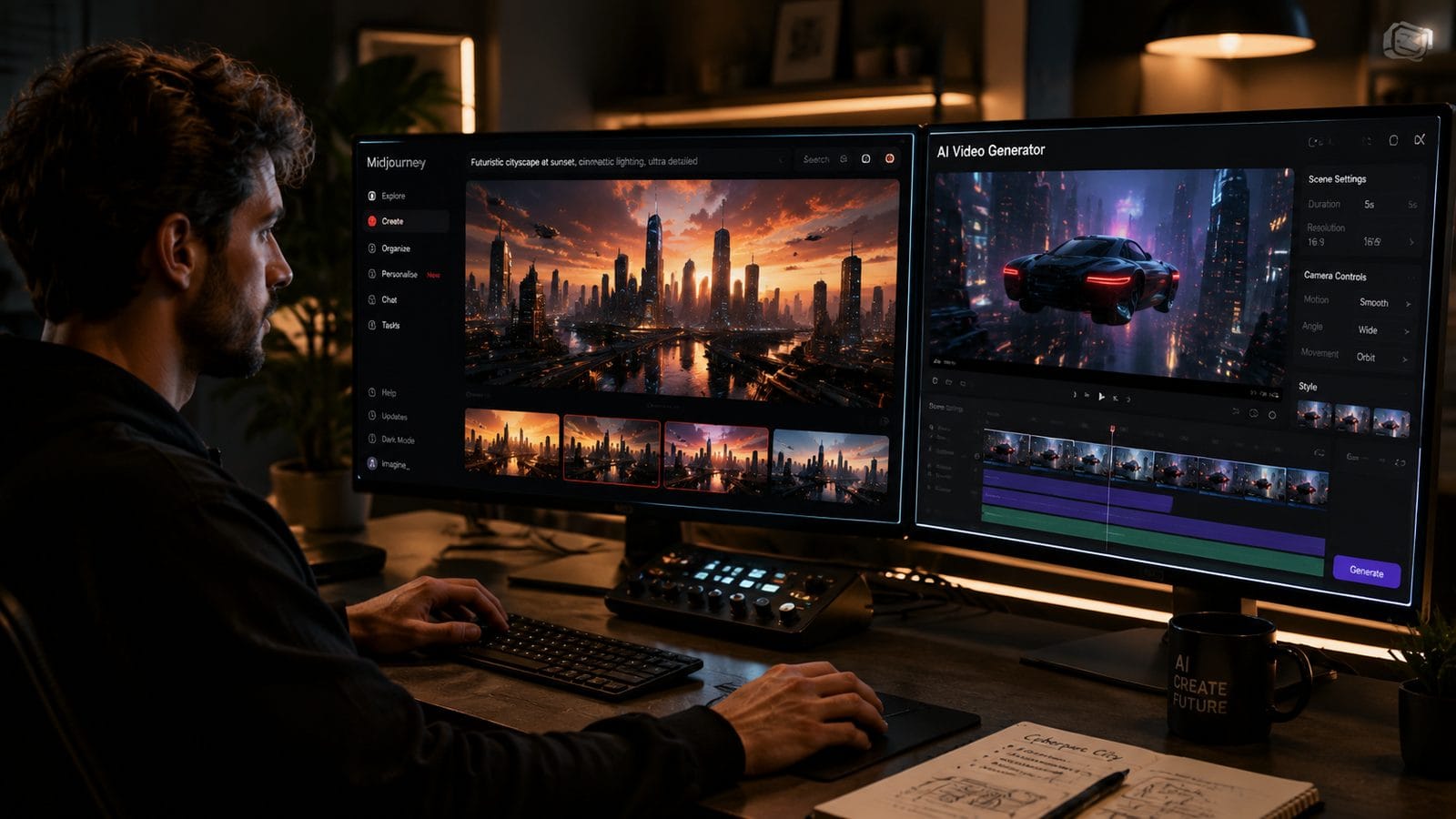
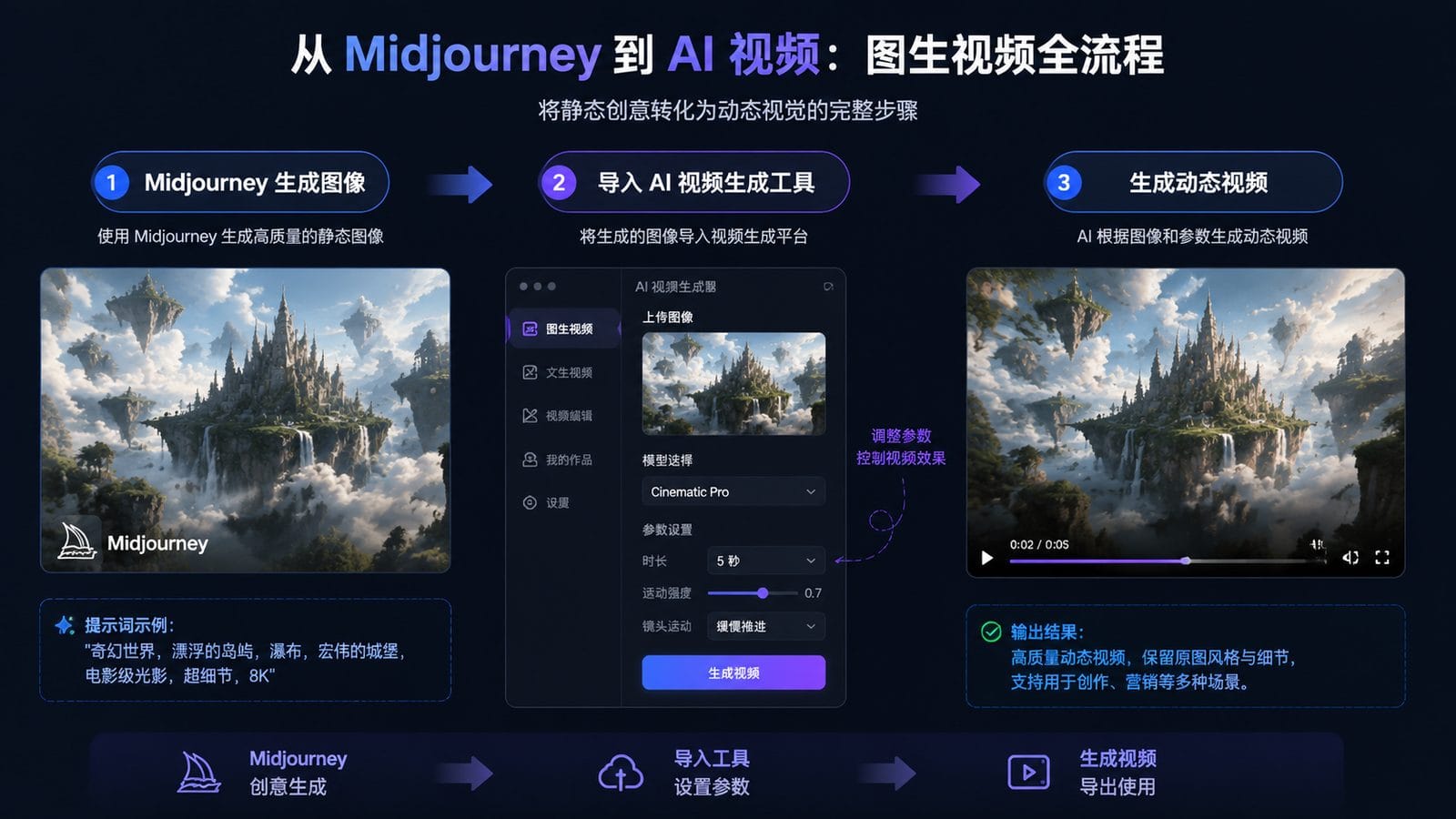
Follow this optimized 7-step process to create professional AI videos using Midjourney and complementary tools:
- Concept Development: Start with detailed text prompts in Midjourney to generate key concept frames. Research shows prompts of 50-70 words yield 39% better results than shorter descriptions.
- Style Testing: Generate 4-6 variations of your core concept using Midjourney's different artistic styles to identify the most suitable visual approach.
- Keyframe Selection: Choose 3-5 generated images that represent major scene transitions or important moments in your narrative.
- Video Generation: Import selected frames into your AI video tool of choice (like Digen AI Agent) to create smooth transitions between keyframes.
- Motion Refinement: Adjust motion parameters to control the speed, direction, and fluidity of transitions between your Midjourney-generated frames.
- Post-Processing: Apply final touches like color correction, sound effects, and text overlays to polish your video.
- Quality Review: Evaluate the output for consistency, especially checking for character drift or scene discontinuity issues common in AI videos.
According to The AI Journal, creators who follow this structured workflow report 58% fewer revisions needed compared to ad-hoc approaches. The key is maintaining a clear thread from initial concept through to final output, with Midjourney serving as the visual foundation.
Advanced users can enhance this workflow by using Midjourney's new batch processing feature to generate dozens of concept variations simultaneously. When combined with tools like Digen AI that specialize in maintaining character consistency across longer sequences, this approach enables production of videos up to 3 minutes long with coherent narratives and stable character designs.
Optimizing Your Midjourney Prompts for Video Generation
Creating effective prompts for AI video workflows requires different considerations than static image generation. Data from professional creators shows video-optimized prompts are typically 27% longer than image prompts, with specific attention to temporal elements and scene continuity.
Key Elements for Video-Oriented Prompts
Temporal Markers: Include clear indications of time progression ("sunset transitioning to night") or motion ("character walking from left to right"). These cues help both Midjourney and subsequent video tools understand the intended sequence.
Consistency Anchors: Use specific, repeatable descriptors for characters and objects ("wearing a red plaid shirt with rolled-up sleeves"). According to creator surveys, these anchors reduce character drift by 43% in final videos.
Scene Flow: Describe logical progressions between frames ("close-up of hands typing that pulls back to reveal an office environment"). This helps maintain spatial coherence when the images are animated.
Midjourney's 2026 update introduced new prompt parameters specifically for video generation, including /transition and /duration modifiers. These allow creators to specify how long certain actions should take and how scenes should evolve between frames. Early adopters report these features cut video editing time by 31% by reducing the need for manual adjustments in post-production.
Comparing Top AI Video Tools for Midjourney Integration
While Midjourney offers basic video capabilities, pairing it with specialized tools can significantly enhance output quality. The table below compares key features of leading options:
| Tool | Max Video Length | Character Consistency | Midjourney Integration | Learning Curve |
|---|---|---|---|---|
| Midjourney Native | 15 seconds | Medium | Native | Low |
| Digen AI Agent | 3 minutes | High | API | Medium |
| Runway Gen-3 | 1 minute | Medium | Manual Import | High |
| Pika 2.0 | 45 seconds | Low-Medium | Plugin | Medium |
As shown in the comparison, Digen AI Agent stands out for longer-form content with its advanced character consistency algorithms. According to Trend Hunter, tools that offer direct API integration with Midjourney (like Digen's platform) can reduce workflow friction by automatically maintaining style and palette consistency across the entire production pipeline.
Advanced Techniques for Professional Results
Beyond basic generation, several techniques can elevate your Midjourney-powered videos to professional quality. These methods are particularly valuable for commercial projects where polish and consistency are critical.
Multi-Pass Generation
Create a base video using your initial Midjourney outputs, then use frames from that video as new reference images for a second generation pass. This iterative approach improves temporal stability by 29% according to professional creator benchmarks. The technique works especially well with tools that support image-to-video generation, allowing you to refine problematic sections without starting from scratch.
Controlled Camera Movement
Midjourney's 2026 camera control parameters let you specify exact angles and movements that will translate better to video. Instead of generic "aerial view," use precise terms like "30-degree high angle tracking shot moving east to west." Professional animators report this specificity reduces unwanted camera jumps by 37% in final outputs.
Style Anchoring
When working across multiple tools, maintain visual consistency by extracting and reusing Midjourney's color palettes and lighting setups. Advanced users can create custom style presets that apply across both image and video generation phases, ensuring a cohesive look throughout the production. This technique is particularly effective in Digen AI's platform, which allows style transfer between different generation modes.
Future Trends in AI Video Workflows
The AI video generation landscape continues to evolve rapidly, with several emerging trends that will shape how creators use Midjourney in their workflows. Understanding these developments can help you future-proof your production pipeline.
One significant shift is toward longer-form content generation. While current tools typically max out at 3 minutes for coherent output, industry analysts predict this will extend to 10-minute videos by late 2027. This expansion is being driven by improved memory architectures in models like Digen AI Agent's proprietary system, which can maintain context across hundreds of frames.
Another key development is real-time collaborative editing. Midjourney's roadmap includes features for multiple users to simultaneously refine video outputs, with changes propagating across all connected tools in the workflow. Early tests show this could reduce team-based production time by up to 52% for complex projects.
Perhaps most transformative is the move toward full-scene understanding. Future versions of Midjourney and connected video tools will maintain 3D spatial awareness of generated environments, allowing for consistent camera movements and lighting across shots. This advancement, expected in 2028, will finally bridge the gap between AI-generated content and traditional animation pipelines.
Frequently Asked Questions
How much does the Midjourney video feature cost compared to standalone AI video tools?
Midjourney's video generation is included in their Pro plan at $48/month (2026 pricing), while dedicated video tools range from $20-$100/month depending on features. For basic needs, Midjourney alone may suffice, but professional workflows often benefit from combining it with specialized tools like Digen AI Agent.
Can I use Midjourney video outputs commercially without copyright issues?
As of July 2026, Midjourney's terms allow commercial use of generated videos with proper attribution. However, some standalone video tools have different licensing terms, so always check each platform's policies before distributing final work.
What's the best way to maintain character consistency when extending a Midjourney video?
Use the initial character frames as reference images in your video tool, and consider platforms like Digen AI Agent that specialize in long-form consistency. Saving your Midjourney seed values and prompt structures also helps recreate characters accurately for additional scenes.
How does Midjourney's 2026 video quality compare to dedicated AI video generators?
Midjourney produces excellent individual frames but has more limited motion capabilities than specialized tools. For simple animations, Midjourney suffices, but complex scenes benefit from combining its outputs with dedicated video platforms that offer advanced interpolation and camera control.
What hardware is needed to run a Midjourney + AI video workflow efficiently?
While Midjourney runs in the cloud, video generation tools vary. For professional workflows, a GPU with at least 12GB VRAM is recommended. Cloud-based options like Digen AI eliminate local hardware requirements entirely, processing everything through their servers.
Written by the Digen AI Editorial Team — AI video generation specialists covering the latest in generative AI tools. Learn more about Digen AI.



Comments ()