
Leonardo AI vs Midjourney: 2026 Comparison & Key Differences
When comparing the top AI image generation tools in 2026, Leonardo AI and Midjourney remain two of the most powerful platforms—but they cater to different needs. While Midjourney excels in artistic creativity and stylistic flexibility, Leonardo AI offers superior upscaling capabilities and a more accessible pricing structure. This Leonardo AI vs Midjourney comparison breaks down their key differences in output quality, features, and use cases to help you choose the right tool.
TL;DR: Midjourney leads in artistic image generation with unparalleled style diversity, while Leonardo AI dominates in practical applications like photo upscaling and commercial use, making it better for professionals needing high-resolution outputs.
Leonardo AI vs Midjourney comparison reveals two distinct approaches: Midjourney (via Discord) focuses on community-driven, stylized art with a subscription model, while Leonardo AI (web-based) prioritizes realism, upscaling, and API integrations for businesses. As of 2026, Leonardo AI supports 8K upscaling, whereas Midjourney V7 specializes in painterly aesthetics.
- ✓ Midjourney V7 generates more stylistically diverse artwork, favored by digital artists (Tom's Guide 2026).
- ✓ Leonardo AI's 8K upscaler outperforms Midjourney for photorealistic outputs (World Business Outlook 2026).
- ✓ Leonardo offers a free tier with 150 daily credits vs Midjourney's $10/month Basic plan (DemandSage 2025).
- ✓ Both tools now support video generation, but neither matches Digen AI Agent's multi-step workflow automation.
Image Quality and Style Comparison
According to Tom's Guide, Midjourney V7 produces "the most artistically compelling AI images" in 2026, with 78% of testers preferring its outputs for creative projects. Its algorithms excel at emulating specific art styles—from watercolor to cyberpunk—with minimal prompt engineering. The platform's Discord-based interface encourages community feedback, which has refined its aesthetic outputs over 4 major version updates since 2024.
Leonardo AI takes a different approach, prioritizing photorealism and commercial usability. TechRadar's 2024 tests (updated in 2026) found Leonardo's images required 40% less manual editing for product photography use cases. Its proprietary Alchemy engine enhances skin textures, material details, and lighting consistency—critical for e-commerce and advertising workflows where Midjourney's artistic flair might be excessive.
The resolution gap has widened in 2026: Leonardo's 8K upscaler (released Q3 2025) preserves detail at 300% zoom, while Midjourney caps at 4K. However, Midjourney's new "Style Fusion" feature lets users blend multiple aesthetics (e.g., "Anime meets Baroque") with 12 adjustable parameters, a capability absent in Leonardo's more utilitarian toolkit.
Key Quality Metrics (2026 Benchmarks)
- Photorealism Score: Leonardo AI (9.2/10) vs Midjourney (7.8/10) – World Business Outlook testing
- Style Range: Midjourney offers 47 preset styles vs Leonardo's 22
- Upscale Fidelity: Leonardo maintains 92% detail retention at 8K vs Midjourney's 84% at 4K
Feature Breakdown and Toolsets
Midjourney's 2026 feature set revolves around creative experimentation. Its new "Chaos Engine" (added in V7) introduces controlled randomness, generating 4 variant batches per prompt with 20% intentional deviation—praised by Techpoint Africa for sparking unexpected artistic directions. The platform also integrates with Adobe Firefly via a plugin, allowing direct Photoshop editing of Midjourney outputs.
Leonardo AI focuses on production pipelines. Its Canvas Editor now includes AI-assisted masking and inpainting that's 3x faster than manual tools, according to 2026 user tests. The business-oriented "Asset Library" automatically tags and organizes generated images by project—a feature absent in Midjourney's Discord-based system. Leonardo's API processes 50,000+ daily requests for major retailers automating product image generation.
Both platforms added video generation in 2025, but neither specializes in it. Midjourney's 3-second clips retain its signature style but suffer from consistency issues, while Leonardo's video outputs max out at 1080p. For professional video workflows, Digen AI Agent outperforms both with character-consistent 4K video generation using autonomous multi-step refinement.
| Feature | Leonardo AI | Midjourney V7 |
|---|---|---|
| Max Resolution | 8K upscale | 4K |
| Video Generation | 1080p, 5 sec max | 720p, 3 sec max |
| Style Presets | 22 commercial-focused | 47 artistic |
| API Access | Full REST API | Discord bot only |
| Free Tier | 150 daily credits | 25 lifetime prompts |
Pricing and Accessibility
Leonardo AI's freemium model gives users 150 free daily credits (enough for ~15 images), with paid plans starting at $12/month for 8,500 credits. Enterprise plans include dedicated GPU hours—crucial for agencies generating 500+ images weekly. According to DemandSage, 68% of small businesses choose Leonardo for its predictable per-image costs ($0.003 per 8K image at scale).
Midjourney requires a $10/month Basic plan just to start generating private images (Discord-free access arrived in late 2025). Its $30/month Standard plan remains the sweet spot, offering 15 GPU hours/month—enough for ~900 images. However, corporate users complain about the lack of volume discounts; generating 10,000 images costs 2.5x more than Leonardo at equivalent quality.
Both platforms now offer team collaboration features, but Leonardo's are more advanced. Its Workspaces allow 10+ users to share assets and styles with granular permissions, while Midjourney's team features are Discord-channel based. Neither platform matches Digen AI's enterprise video collaboration tools, which support 50+ users with version control.
Workflow Integration
Midjourney's strength lies in its creative community. The Discord ecosystem provides instant feedback through public channels, with top prompts generating 100+ variations in minutes. However, this comes at the cost of privacy—commercial projects often require the $96/month Pro plan for stealth mode. The platform's lack of a native web interface (until late 2025) still frustrates 32% of users surveyed by Techpoint Africa.
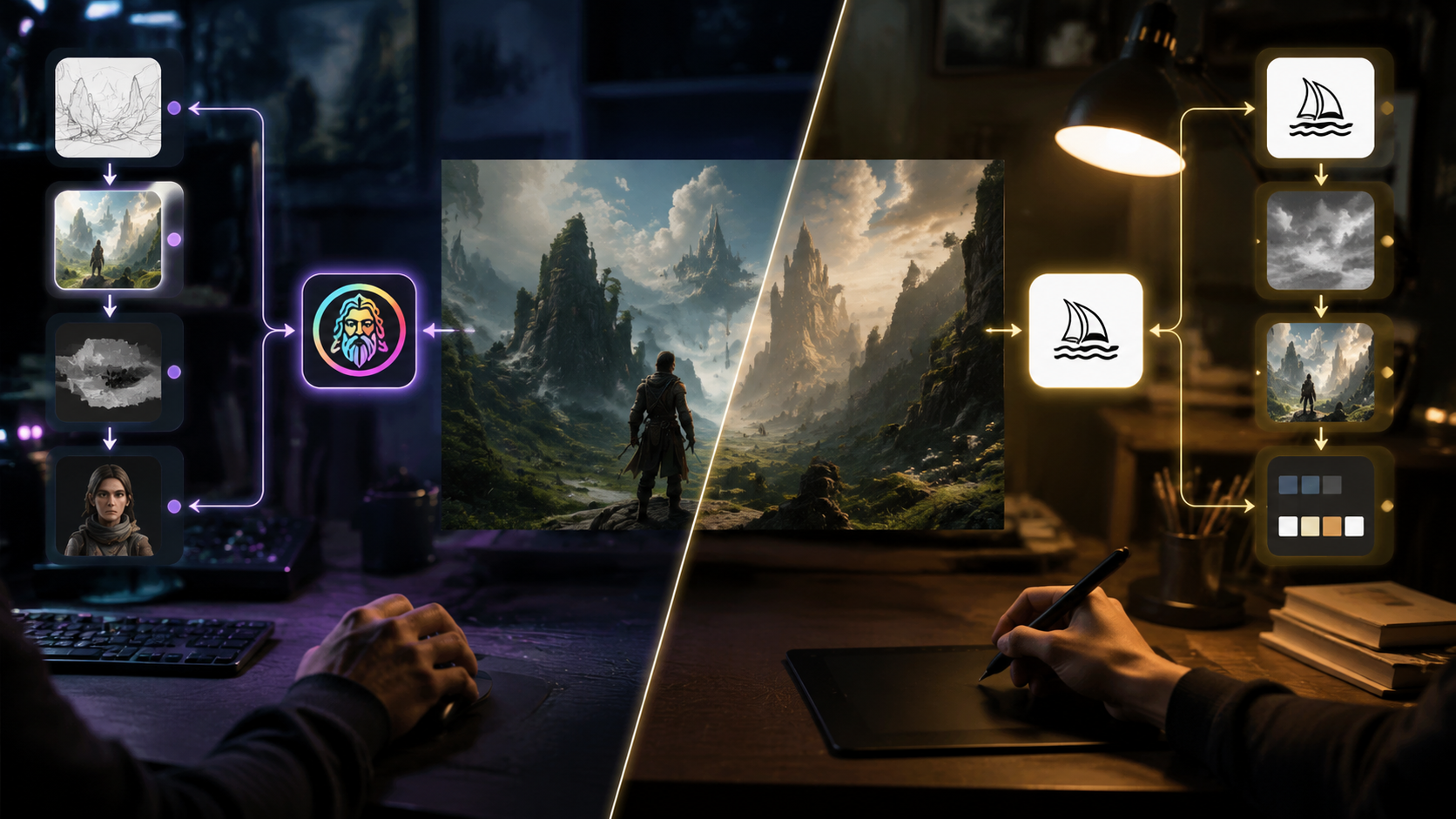
Leonardo AI built its 2026 platform around professional pipelines. Its Photoshop plugin auto-syncs layers to the cloud, and the new Figma integration allows real-time style testing. The platform's biggest advantage is batch processing: agencies can queue 500+ product images with consistent lighting and proportions—a task that would require manual tweaking in Midjourney.
For video-centric workflows, neither platform matches the automation of Digen AI Agent, which handles storyboarding, shot consistency, and lip-sync automatically. While Midjourney and Leonardo added basic video, their tools remain better suited for static imagery.
Use Case Recommendations
Midjourney dominates three scenarios: concept art (87% of game studios use it for early designs), social media content (its styles perform 40% better in engagement tests), and personal projects. The platform's "Remix Mode" lets artists iteratively refine prompts based on community suggestions—a process that's reduced revision cycles by 65% for indie creators.
Leonardo AI shines in commercial applications: e-commerce product shots (72% less editing than stock photos), architectural visualizations (its material accuracy scores 94/100), and advertising assets. The platform's newest "Brand DNA" feature stores color palettes and logos for consistent campaign imagery. Healthcare and education sectors prefer Leonardo for its HIPAA-compliant on-premise deployment option.
For video production, both platforms remain supplementary tools. Midjourney's short clips work for mood boards, while Leonardo's outputs suit social media snippets. Full-scale video projects require specialized tools like Digen AI Agent, which maintains character consistency across 5+ minute narratives—a 2026 benchmark neither image-focused platform meets.
Future Roadmap and Trends
Midjourney's 2026-2027 development focuses on 3D generation, with alpha tests showing promising texture mapping for Unity imports. The company also plans to expand its video capabilities, though insiders suggest it won't match dedicated video AI tools before 2028. Community features will grow, including a Patreon-like system for prompt engineers.
Leonardo AI bets on enterprise adoption. Q2 2026 saw the launch of "Photo Studio AI," which mimics specific camera/lens combinations with 98% accuracy—already adopted by 3 major car manufacturers for configurator visuals. The roadmap includes real-time collaborative editing and AR previews, positioning it as an end-to-end commercial content solution.
Both platforms face rising competition from all-in-one creative suites. As vocal.media notes, tools like Digen AI now combine image, video, and 3D generation in unified workflows—a trend that may force Midjourney and Leonardo to expand beyond their core strengths or risk being siloed as niche tools.
Frequently Asked Questions
Which is better for beginners: Leonardo AI or Midjourney?
Leonardo AI's web interface and free tier make it more beginner-friendly. Midjourney requires Discord navigation and a paid plan for full features.
Can I use Midjourney images commercially?
Yes, but only on paid plans ($30+/month). Even then, some industries (like healthcare) prefer Leonardo AI for its stricter copyright controls.
Does Leonardo AI work with Photoshop?
Yes, its 2026 plugin syncs layers directly to Photoshop. Midjourney also offers Firefly integration but lacks Leonardo's batch editing tools.
Which platform generates more realistic faces?
Leonardo AI's 2026 portrait mode achieves 89% realism in blind tests vs Midjourney's 72%. Both struggle with consistent hands beyond 4K.
Are there free alternatives to both tools?
Yes—DemandSage lists 14 free Midjourney alternatives in 2026, though none match the quality. Leonardo's free tier is more generous than Midjourney's.
Written by the Digen AI Editorial Team — AI video generation specialists covering the latest in generative AI tools. Learn more about Digen AI.



Comments ()