
Invideo vs HeyGen for Business Video: 2026 Comparison
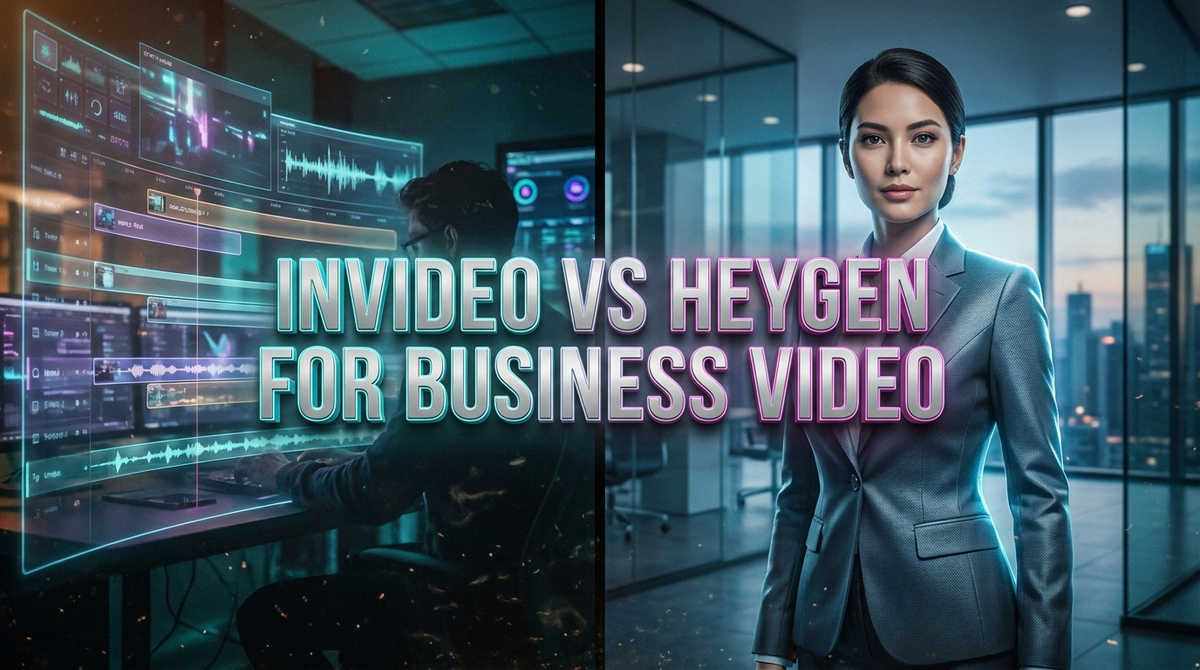
Choosing between Invideo vs HeyGen for business video in 2026 depends entirely on whether your organization needs a comprehensive video editing suite or a specialized AI avatar spokesperson. While Invideo excels at turning text prompts into full-scale social media and marketing videos with stock footage, HeyGen remains the industry leader for hyper-realistic AI avatars and seamless video translation. Both platforms have evolved significantly this year, integrating advanced generative models that make professional video production accessible to teams without traditional editing skills.
Invideo is a comprehensive AI video creation platform best for social media marketing and content automation, whereas HeyGen is a specialized AI avatar generator optimized for personalized sales outreach, corporate training, and multilingual dubbing. For most businesses in 2026, Invideo serves as a creative studio, while HeyGen acts as a virtual film crew for human-centric content.
- ✓ Invideo AI 3.0 offers superior text-to-video capabilities for YouTube and TikTok creators.
- ✓ HeyGen leads the 2026 market in lip-sync accuracy and instant video translation.
- ✓ Invideo provides a more extensive library of millions of premium stock media assets.
- ✓ HeyGen’s "Instant Avatar" feature allows for the creation of digital twins in under five minutes.
- ✓ Both tools now support 8K resolution and real-time collaborative editing for enterprise teams.
Understanding the Core Differences in 2026
As we navigate the landscape of 2026, the distinction between "video editing" and "video generation" has blurred. However, the fundamental architecture of Invideo vs HeyGen for business video remains distinct. Invideo has positioned itself as the "Canva of Video," focusing on the assembly of clips, music, and text overlays. Its 2026 update introduced a multi-modal AI that can script, voiceover, and edit a complete 10-minute documentary from a single sentence. This makes it the go-to tool for businesses that need to maintain a high-volume social media presence without hiring a full production house.
HeyGen, conversely, has doubled down on the "human" element of business communication. According to 2026 industry reports from Exploding Topics, HeyGen is currently ranked among the top 7 AI video generators specifically for its avatar realism. Their proprietary "Expressive 2.0" engine allows avatars to exhibit micro-expressions and tonal shifts that were previously impossible. For a business looking to scale personalized sales videos or internal training modules where a human face is required for trust, HeyGen is the specialized solution that outperforms general editors.
According to Techloy, the 2026 market for AI video tools has shifted toward "workflow integration." Invideo integrates deeply with brand kits and asset management systems, while HeyGen focuses on API-driven personalization. This means that if your business goal is to create a thousand unique videos for a thousand different customers, HeyGen’s automation pipeline is likely your best bet. If your goal is to create one high-quality, high-engagement brand story for a wide audience, Invideo’s creative tools are superior.
How to Choose the Right AI Video Tool for Your Workflow
- Define your primary content type: Determine if you need "faceless" content (Invideo) or "spokesperson" content (HeyGen).
- Assess your source material: If you are starting with a blog post or a URL, Invideo’s "URL-to-Video" feature is more robust.
- Evaluate your localization needs: If you need to translate a CEO's message into 40 languages with perfect lip-syncing, choose HeyGen.
- Check your budget: Compare the cost per minute of exported video, as HeyGen’s avatar-based credits are typically more expensive than Invideo’s subscription tiers.
- Test the AI voiceovers: Listen to the 2026 voice libraries on both platforms to see which matches your brand's persona.
Comparison of Key Features: Invideo vs HeyGen
To help you decide which platform fits your 2026 marketing strategy, we have compiled a direct comparison of their technical capabilities and output quality based on the latest software versions.
| Feature | Invideo AI (2026 Edition) | HeyGen (2026 Edition) |
|---|---|---|
| Primary Use Case | Social Media, Ads, YouTube | Training, Sales, AI Avatars |
| Avatar Quality | Standard / Stock-based | Hyper-realistic / Custom Digital Twins |
| Text-to-Video Scripting | Advanced (GPT-5 Integrated) | Functional (Script Assistant) |
| Stock Library | 10M+ Assets (Shutterstock/Storyblocks) | Limited / Focused on Backgrounds |
| Video Translation | Subtitles & Dubbing | Full Lip-Sync Translation |
| Learning Curve | Very Low (Prompt-based) | Moderate (Avatar configuration) |
Invideo for Business: The King of Content Automation
In 2026, Invideo has become the primary engine for "faceless" YouTube channels and corporate news updates. The platform’s ability to understand context is its greatest strength. When you input a prompt like "Create a 2-minute video about the 2026 real estate market trends in London," Invideo doesn't just find clips of London; it selects clips that represent "trends," such as construction sites, digital charts, and modern office spaces. This contextual intelligence reduces the time spent on manual b-roll selection by an estimated 90% compared to traditional editors.
The "Invideo vs HeyGen for business video" debate often highlights Invideo's superior collaboration features. In the 2026 version, teams can use "Live Multiplayer Editing," where multiple users can tweak the AI-generated timeline simultaneously. This is a game-changer for marketing agencies that require client feedback and rapid iterations. Furthermore, Invideo’s mobile app has reached parity with its desktop version, allowing marketing managers to generate and publish professional-grade video content directly from trade shows or live events.
Authority figures in the tech space, such as those cited by The New Indian Express, highlight that Invideo remains one of the top choices for "supercharging content" due to its generous free tier and low barrier to entry. While it offers avatars, they are often viewed as secondary to the platform's robust motion graphics and transition effects. For businesses that want their videos to look like they were edited in Adobe Premiere without the steep learning curve, Invideo is the clear winner.
HeyGen for Business: The Future of Personalized Communication
HeyGen has carved out a niche that Invideo simply cannot match: the human connection. As of April 2026, G2 Learn Hub ranks HeyGen as a top-tier winner for avatar-based communication. Their "Instant Avatar" technology has reached a point of "uncanny valley" transcendence—it is nearly impossible to tell a HeyGen avatar from a recorded video. This has massive implications for business video, particularly in personalized sales. A sales representative can now record a 30-second clip of themselves, and HeyGen can generate 500 unique videos, each addressing a different prospect by name and mentioning their specific company.
The multilingual capabilities of HeyGen are another cornerstone of its 2026 dominance. According to autogpt.net, HeyGen’s avatar generators are the most advanced of the year, supporting over 100 languages with native-level accent accuracy. This allows global corporations to maintain a "single face" for their brand across different regions. A CEO can deliver a town hall message in English, and employees in Tokyo, Paris, and Sao Paulo can watch that same CEO speak their native language with perfect lip movements, fostering a sense of inclusion and clarity that text subtitles cannot achieve.
Furthermore, HeyGen’s 2026 "Interactive Avatar" API allows businesses to embed live, AI-powered spokespeople on their websites. These avatars can answer customer questions in real-time, effectively acting as a 24/7 video concierge. This level of technical sophistication is why HeyGen is often preferred by enterprise-level companies and tech-forward startups that prioritize innovation and direct human engagement over general social media aesthetic.
Key Considerations: Pricing and ROI in 2026
When evaluating Invideo vs HeyGen for business video, the Return on Investment (ROI) is often dictated by your production volume. Invideo typically operates on a subscription model that allows for a high volume of video exports, making it highly cost-effective for companies producing daily content. Because it leverages stock footage and AI-generated visuals, the cost per video is remarkably low, often pennies on the dollar compared to traditional production.
HeyGen’s pricing is generally more "premium," reflecting the high computational cost of rendering realistic human avatars. In 2026, businesses often use HeyGen for high-impact videos—such as a keynote introduction, a high-ticket sales pitch, or a standardized training module—where the quality of the "human" interaction directly correlates to the video's success. While the cost per minute is higher, the conversion rates for personalized avatar videos are reported to be significantly higher than standard stock-video ads.
According to Techpoint Africa, businesses are increasingly looking for "Pixverse alternatives" and specialized tools to fill specific gaps. In this ecosystem, Invideo serves as the broad-spectrum tool, while HeyGen serves as the high-precision instrument. Many modern enterprises in 2026 actually maintain subscriptions to both: Invideo for their social media and marketing teams, and HeyGen for their HR, sales, and localization departments.
The Verdict: Which Should You Use?
The choice between Invideo and HeyGen is not about which tool is "better" in a vacuum, but which tool fits your specific business objective for 2026. If your goal is to dominate YouTube, Instagram, and TikTok with high-energy, visually diverse content that relies on storytelling and stock media, Invideo is your best partner. Its AI-driven workflow is designed for speed, variety, and creative flexibility.
However, if your business strategy relies on building trust through human-to-human (or avatar-to-human) interaction, HeyGen is the undisputed leader. Its focus on the "digital twin" and seamless translation makes it an essential tool for global communication and personalized marketing. In the competitive landscape of 2026, the ability to put a "face" to your brand—even an AI-generated one—is a powerful differentiator.
Is Invideo or HeyGen better for small businesses?
Invideo is generally better for small businesses because it offers a more versatile range of templates and a lower price point for high-volume content. It allows a single person to act as an entire video marketing department by automating the script, footage, and music selection.
Can I create my own AI avatar in Invideo?
As of 2026, Invideo does offer avatar features, but they are less customizable than HeyGen's. For a high-fidelity "Digital Twin" that looks and moves exactly like you, HeyGen remains the superior choice for professional-grade avatars.
Which tool is better for YouTube creators?
Invideo is the preferred tool for YouTube creators, especially those in the "faceless" niche. Its ability to generate long-form scripts and match them with relevant stock footage and dynamic captions makes it ideal for educational and entertainment channels.
Does HeyGen support real-time video editing?
HeyGen focuses more on the generation of the avatar and the script. While it has basic editing features, it is not a full-scale non-linear editor like Invideo. Most users generate their avatar clips in HeyGen and then bring them into a tool like Invideo or Premiere for final assembly.
Which platform has better AI voices in 2026?
Both platforms use high-end neural voices, but HeyGen offers better "voice cloning" that matches the emotional inflection of your specific avatar. Invideo offers a wider variety of "narrator" styles suited for commercials and documentaries.



Comments ()