
Invideo vs Fliki for Content Creators: 2026 Comparison
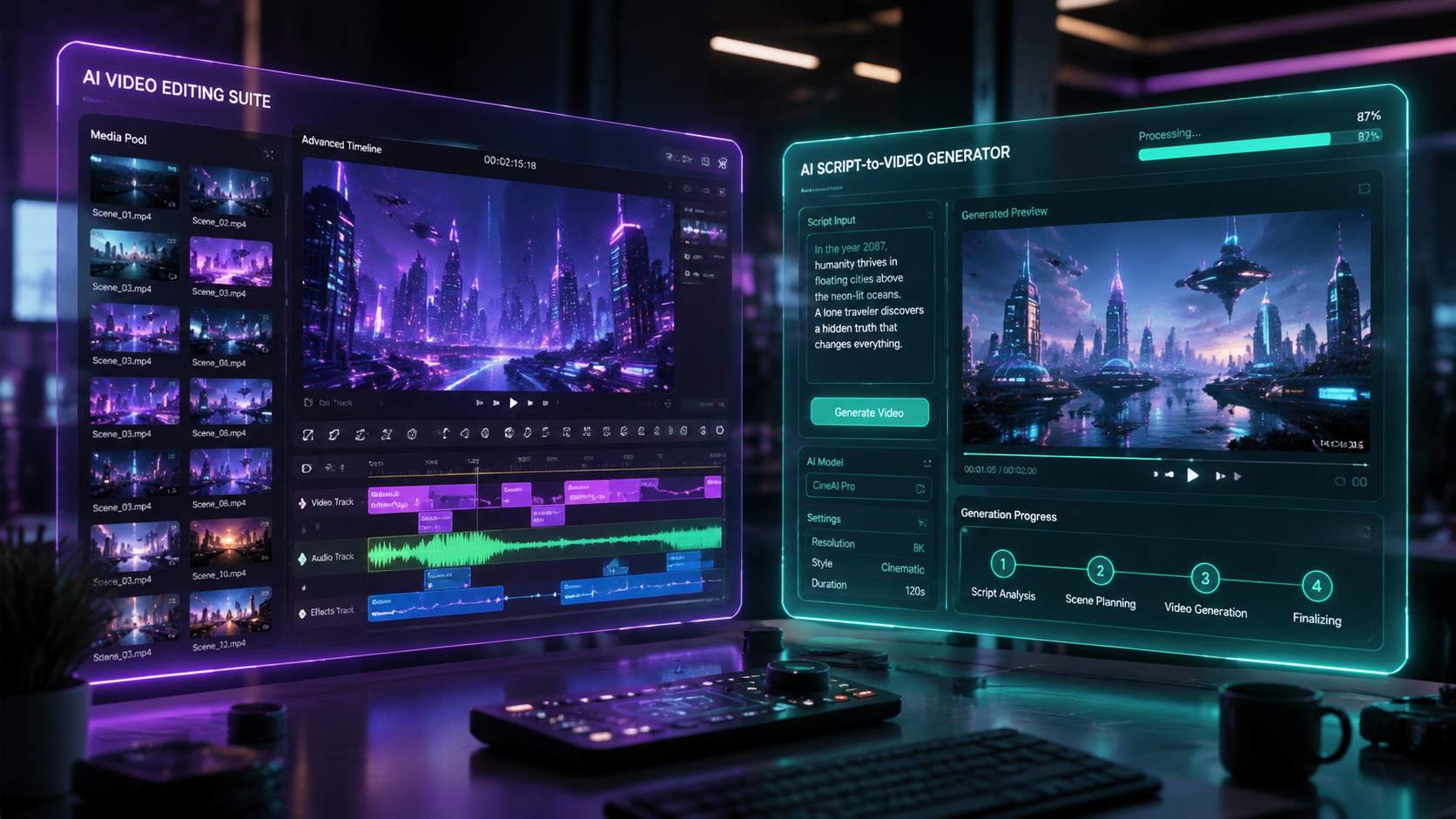
Choosing between Invideo vs Fliki for content creators in 2026 depends on whether you prioritize cinematic editing control or lightning-fast social media automation. Invideo AI remains the powerhouse for high-fidelity video production with granular timeline editing, while Fliki excels at transforming text scripts into viral-ready shorts using lifelike voiceovers and an extensive media library. Both platforms have integrated deep-learning generative features that allow creators to produce professional-grade content in minutes rather than hours.
Invideo is a comprehensive AI video editor designed for creators who need custom control over visuals and pacing, whereas Fliki is a specialized text-to-video tool optimized for speed and voice-centric content. For 2026, Invideo is best for YouTube and brand marketing, while Fliki is the superior choice for high-volume social media storytelling and podcast-to-video workflows.
- ✓ Invideo AI 3.0 offers advanced prompt-to-video capabilities with full timeline editing.
- ✓ Fliki provides industry-leading AI voice cloning and seamless blog-to-video conversion.
- ✓ Both platforms now support 8K upscaling and real-time collaborative editing.
- ✓ Invideo is preferred for long-form content; Fliki dominates the vertical video niche.
The Evolution of AI Video: Invideo vs Fliki for Content Creators
As we navigate the creative landscape of 2026, the distinction between manual editing and AI generation has blurred. Content creators are no longer looking for simple templates; they require intelligent assistants that understand context, tone, and brand identity. The competition between Invideo vs Fliki for content creators has shifted from "who has more stock footage" to "who has the better generative engine." According to recent industry analysis by Unite.AI in their May 2026 report, these two platforms represent the pinnacle of accessible AI video technology, though they serve distinct creative philosophies.
Invideo has evolved into a multimodal studio. It doesn't just generate a video; it provides a canvas where AI handles the heavy lifting of sourcing and cutting, while the creator retains the final say through a traditional non-linear editor (NLE) interface. This makes it a favorite for professional YouTubers and marketing agencies who cannot afford the "uncanny valley" look of fully automated videos. The platform's ability to interpret complex prompts—such as "create a 10-minute documentary on the history of renewable energy in the style of National Geographic"—is currently unmatched in the consumer space.
Conversely, Fliki has doubled down on the "speed-to-market" model. For a creator managing five different TikTok and Instagram accounts, Fliki is the ultimate efficiency tool. Its interface is built around a script-first workflow. You don't "edit" video in the traditional sense; you edit text, and the video adjusts accordingly. In 2026, Fliki's voice synthesis engine has reached a point of near-perfect human parity, allowing creators to clone their own voices with such accuracy that it is often indistinguishable from a studio recording. This focus on "vocal-first" content makes it the go-to for educational and narrative-driven creators.
How to Start Your AI Video Workflow
- Select your primary content source (a blog URL, a detailed prompt, or a pre-written script).
- Input your source into the chosen platform's AI generator.
- Review the generated storyboard and adjust the media clips or AI-generated b-roll.
- Choose an AI voiceover or upload a voice clone to maintain brand consistency.
- Export in the desired aspect ratio (9:16 for Shorts/Reels or 16:9 for YouTube).
Core Feature Comparison: Technology and Performance
When comparing Invideo vs Fliki for content creators, the technical specifications of their generative engines are paramount. Invideo utilizes a proprietary video-centric LLM that prioritizes visual flow and cinematic transitions. According to data from the "10 Best AI Apps (May 2026)" report by Unite.AI, Invideo's latest update allows for "Smart Swapping," where the AI suggests alternative clips based on the emotional resonance of the background music. This level of aesthetic intelligence is a significant leap forward for creators who want their videos to feel "hand-crafted."
Fliki, on the other hand, excels in linguistic processing. Its integration with advanced language models allows it to summarize long-form articles into punchy, high-engagement scripts automatically. The platform's 2026 feature set includes "Dynamic Captions," which sync perfectly with the AI's vocal inflections, a feature that has become a staple for viral social media content. While Invideo focuses on the "look," Fliki focuses on the "message" and the ease with which that message can be consumed across different platforms.
| Feature | Invideo AI (2026) | Fliki (2026) |
|---|---|---|
| Primary Workflow | Prompt-to-Video & Timeline Editor | Script-to-Video & Voice-Centric |
| AI Voice Quality | High (100+ Voices) | Ultra-Realistic (2000+ Voices) |
| Max Resolution | 8K UHD | 4K UHD |
| Best For | YouTube, Documentaries, Ads | TikTok, Reels, Explainer Videos |
| Editing Control | Advanced (Granular) | Simplified (Text-based) |
Invideo vs Fliki for Content Creators: Visual and Audio Assets
The quality of stock libraries and generative assets is a major deciding factor. Invideo has maintained its partnership with major stock providers while adding an "AI Image Generator" that can create bespoke b-roll when a suitable clip doesn't exist in the library. This ensures that creators never run into the problem of using the same overused stock footage as their competitors. In 2026, Invideo's library spans over 20 million premium assets, all searchable via natural language queries.
Fliki's strength lies in its "Media Search AI," which doesn't just look for keywords but understands the context of the sentence. If your script mentions "the bittersweet feeling of a departing legend," Fliki's AI might pull a clip of a sunset or a stadium farewell, rather than a literal "sad person." This contextual awareness is similar to the emotional intelligence praised in other sectors of media this year. For instance, in May 2026 news, figures like Hansi Flick have been noted for their emotional intelligence in handling team transitions; Fliki attempts to mirror this human-centric understanding in its automated media selection.
The Power of Voice Cloning in 2026
Voice cloning has become the standard for creators who want to scale their personal brand without spending hours in a recording booth. Fliki leads this category with its "Instant Voice Clone" technology, which requires only 30 seconds of audio to create a perfect digital twin. This twin can then be used to narrate hundreds of videos in multiple languages. Invideo also offers voice cloning, but its implementation is geared more toward "brand voices" rather than individual creator personas, making it slightly more suited for corporate environments.
Pricing and Scalability for Modern Creators
In the current economic climate of 2026, ROI is essential. Invideo offers a tiered subscription model that caters to everyone from hobbyists to large-scale production houses. Their "Unlimited" plan is particularly popular among full-time creators because it removes the friction of per-video costs, allowing for unlimited experimentation. Studies show that creators who use AI-integrated tools like Invideo reduce their production costs by up to 60% compared to traditional editing suites.
Fliki utilizes a "Credits" system, which some creators find more transparent for high-volume, short-form output. Because Fliki videos are often shorter (under 60 seconds), the credit system allows creators to pay only for exactly what they produce. For a creator pushing out 3-5 videos a day across multiple platforms, Fliki’s specialized social media plan offers the best value. It includes automated resizing and one-click distribution to YouTube, Instagram, and TikTok, which saves hours of manual uploading time.
Collaboration and Team Workflows
Both platforms have introduced robust collaboration features in 2026. Invideo’s "Multiplayer Mode" allows two editors to work on the same timeline simultaneously, a feature previously reserved for high-end desktop software. Fliki’s team workspace is more focused on approval workflows, where a manager can review scripts and AI-generated drafts before they are finalized for social media posting. This makes Fliki an excellent choice for distributed marketing teams.
Verdict: Which Should You Choose?
The choice between Invideo vs Fliki for content creators ultimately comes down to your output goals. If you are building a YouTube channel that requires cinematic quality, complex storytelling, and precise visual timing, Invideo is the superior tool. Its transition into a full-fledged AI-powered NLE makes it a versatile asset for any professional creator's toolkit. It bridges the gap between AI automation and professional artistry.
However, if your goal is to dominate the "attention economy" through high-frequency social media posting, Fliki is the clear winner. Its ability to turn a blog post or a simple idea into a polished, voiced-over video in under two minutes is unparalleled. In 2026, speed is a competitive advantage, and Fliki is built entirely for speed. Regardless of your choice, both tools represent the cutting edge of the creator economy, proving that AI is no longer just a trend, but the foundation of modern digital storytelling.
Is Invideo or Fliki better for YouTube Shorts?
Fliki is generally better for YouTube Shorts due to its text-to-video efficiency and optimized vertical templates. It allows creators to produce high volumes of short-form content with minimal manual effort.
Can I use my own voice on these platforms?
Yes, both Invideo and Fliki support high-fidelity AI voice cloning in 2026. You can record a short sample, and the AI will generate a digital version of your voice to narrate any script you provide.
Which platform has better stock footage?
Invideo currently holds a slight edge in stock footage variety, offering over 20 million premium clips from sources like Getty and Shutterstock, integrated directly into its AI search engine.
Do I need editing experience to use Invideo?
While Invideo offers advanced tools, its AI-prompting system is designed for beginners. You can create a full video using only text commands, though having some editing knowledge helps you refine the final product.
Are these AI videos monetizable on YouTube?
Yes, as of 2026, YouTube allows monetization of AI-generated content as long as it provides unique value and adheres to their transparency guidelines regarding "altered or synthetic" content.



Comments ()