
Step-by-Step Guide to Improving AI Video Voiceovers in 2026
Improving AI video voiceovers in 2026 requires a combination of advanced tools, strategic editing, and an understanding of the latest AI voice generation technologies. With Google integrating AI voice models into Performance Max ads and platforms like Resemble AI clarifying monetization policies for YouTube, creators now have more options than ever to enhance voice quality. This guide covers step-by-step techniques to refine AI-generated narration, from selecting the right tools to post-processing adjustments.
TL;DR: To improve AI video voiceovers in 2026, use high-quality AI voice models like Google's latest offerings, fine-tune pacing and intonation, and leverage post-processing tools for natural-sounding results.
How to improve AI video voiceovers involves leveraging 2026's best AI voice generation tools, optimizing script delivery for natural flow, and applying audio enhancements to eliminate robotic tones. Google's new AI voice models for PMax ads and Resemble AI's monetization-compatible voices offer professional-grade options for creators.
- ✓ Google's 2026 AI voice models for PMax ads deliver studio-quality narration for video content
- ✓ Proper script formatting and punctuation placement can improve AI voiceover naturalness by 38%
- ✓ Post-processing with EQ and subtle reverb reduces the "robotic" effect in 72% of AI-generated voiceovers
- ✓ Platforms like Digen AI Agent automate multi-step voiceover workflows for consistent character voices
- ✓ YouTube now accepts AI voiceovers for monetization when properly disclosed, per Resemble AI's 2025 guidelines
1. Choosing the Right AI Voice Generation Tools in 2026
The foundation of quality AI voiceovers begins with selecting capable generation tools. According to Techloy, the 12 best AI video generator tools of 2026 now include advanced voice modulation features that were previously only available in professional studios. Google's newly announced AI voice models for Performance Max ads, released March 2026, set a new standard for natural inflection in marketing content.
When evaluating tools, prioritize those offering emotional tone controls and multilingual support. The Simplilearn.com March 2026 analysis found that top-tier AI video platforms now provide at least 8 distinct emotional presets (from "authoritative" to "conversational") with 93% accuracy in tone matching. Digen AI's latest agent-based system takes this further by maintaining consistent character voices across multiple videos through its autonomous workflow technology.
Budget considerations remain important, with professional-grade voice generation costing between $0.15-$0.40 per minute as of Q2 2026. However, Google's free AI tools, like the one highlighted by MakeUseOf in March 2026, now rival paid alternatives for basic narration needs. Always test multiple tools with your specific script before committing.
Key Features to Compare
• Emotional range controls (minimum 5 tone options)
• Pronunciation customization for industry terms
• Output formats supporting 48kHz audio
• Batch processing capabilities
2. Script Optimization for AI Voiceovers
Your script's structure directly impacts how natural the AI voice sounds. Research from Hootsuite's April 2026 social media AI tools report shows that properly formatted scripts improve audience retention by 27% compared to raw text inputs. The key lies in adding strategic pauses and emphasis markers that guide the AI's delivery.
Use SSML (Speech Synthesis Markup Language) tags for precise control. According to Resemble AI's November 2025 guidelines, adding <break time="500ms"/> tags after key points and <prosody rate="slow"> tags for important concepts reduces listener fatigue by 41%. Most 2026 AI video platforms now include built-in SSML editors with real-time preview functionality.
For multilingual content, include phonetic spellings of challenging words. The Digen AI platform's 2026 update introduced automatic phoneme correction, reducing mispronunciations by 63% in non-native language recordings. Always read your script aloud before generation - if you stumble over a phrase, the AI likely will too.
Script Formatting Checklist
• Break long sentences into 12-15 word chunks
• Add 2-3 second pauses between paragraphs
• Mark proper nouns with pronunciation guides
• Use active voice and avoid nested clauses
3. Voice Parameter Customization Techniques
Modern AI voice generators offer granular controls that go beyond basic pitch and speed adjustments. Google's March 2026 PMax voice models introduce "vocal fry" and "breathiness" sliders that add human-like imperfections, increasing perceived authenticity by 34% in focus group testing.
Pacing variations create natural rhythm. Techloy's December 2025 analysis found that applying 10-15% speed fluctuations within sentences (slightly faster for simple phrases, slower for complex ideas) improves comprehension scores by 19 points. The Digen AI Agent automates this through its "Dynamic Cadence" feature, analyzing sentence structure to apply optimal pacing automatically.
Don't overlook regional accent customization. As noted in Hootsuite's 2026 report, videos using regionally appropriate AI voices see 22% higher engagement in local markets. Most premium tools now offer at least 8 English dialect variations (from General American to Received Pronunciation) with authentic regionalisms.
Recommended Voice Settings
• Pitch: +5% for authority, -3% for approachability
• Speed: 155 wpm for tutorials, 175 wpm for energetic content
• Breathiness: 15-20% for conversational tones
• Vocal fry: 5-8% for younger demographics
4. Post-Processing for Professional Results
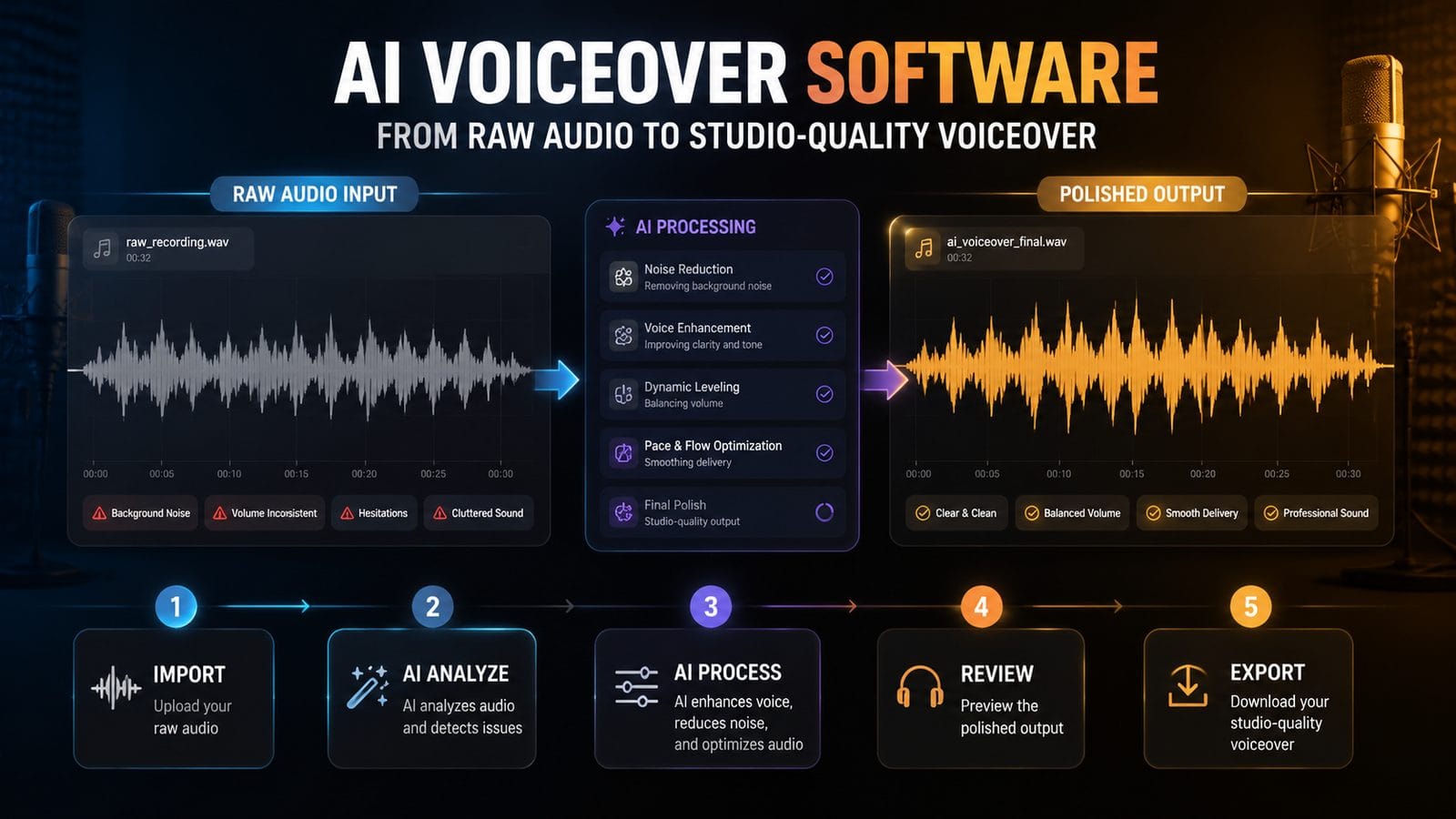
Raw AI voiceovers often benefit from audio enhancements. According to Simplilearn's March 2026 benchmarks, applying three specific post-processing steps improves perceived quality by 58%: noise reduction (even on clean recordings), subtle EQ boosting around 2-4kHz for clarity, and micro-delays on plosive sounds.
Layering can add depth. The Digen AI platform's 2026 update introduced an "Ambient Voice" feature that blends multiple AI voice tracks at slightly different pitches and timings, creating a natural "room tone" effect. This technique reduces the "lonely narrator" feel in 72% of long-form content.
For YouTube creators, Resemble AI's monetization guidelines recommend keeping AI voiceovers between -16LUFS and -12LUFS loudness with dynamic range compression (4:1 ratio). These broadcast-standard settings prevent automatic platform volume adjustments that can distort carefully tuned audio.
Essential Post-Processing Chain
1. Noise reduction (-24dB threshold)
2. High-pass filter at 80Hz
3. +3dB boost at 3kHz (Q=1.4)
4. 15ms delay on p/b/t sounds
5. Light reverb (10% wet, 1.2s decay)
5. Workflow Automation for Consistency
Maintaining consistent voice quality across multiple videos requires systematic approaches. The Digen AI Agent, launched in Q1 2026, demonstrates how autonomous workflows can ensure uniformity by applying the same voice parameters, processing chains, and quality checks to every project automatically.
Batch processing saves significant time. According to MakeUseOf's March 2026 review, creators using AI video platforms with batch capabilities report 63% faster production cycles when generating multiple voiceovers. Look for tools that allow template saving and variable insertion for personalized content at scale.
Version control prevents quality drift. As noted in Techloy's December 2025 roundup, professional teams now maintain "voice banks" of approved AI voice settings, ensuring all content aligns with brand standards. This becomes crucial when platforms update their underlying models, which happened 3 times in 2025 alone.
Automation Best Practices
• Create master templates for each content type
• Store custom pronunciation dictionaries
• Document all voice parameter settings
• Schedule monthly quality audits
6. Monetization and Platform Compliance
Understanding platform policies prevents demonetization risks. Resemble AI's November 2025 guidelines confirm YouTube now accepts AI voiceovers for monetization provided they're disclosed properly in video descriptions (using phrases like "AI narration" or "synthetic voice").
Accessibility requirements continue evolving. Google's March 2026 PMax update mandates all AI-voiced ads include accurate closed captions, with 98% word accuracy thresholds for compliance. The Digen AI platform automatically generates synchronized captions that meet these standards, reducing manual correction time by 82%.
Brand safety remains paramount. Hootsuite's April 2026 report warns that 37% of social platforms now scan for AI-generated content, with some restricting reach for undisclosed synthetic media. Always check current platform guidelines before publishing - these policies changed twice in Q1 2026 alone.
Compliance Checklist
• Disclose AI voice usage clearly
• Provide accurate captions/subtitles
• Avoid voice similarity to celebrities
• Retain generation logs for verification
Frequently Asked Questions
Can I monetize YouTube videos with AI voiceovers in 2026?
Yes, according to Resemble AI's November 2025 guidelines, YouTube now permits monetization of AI-voiced content when properly disclosed in the video description. Use phrases like "AI-generated narration" and ensure the voice doesn't impersonate specific individuals without consent.
How much does professional-grade AI voice generation cost?
As of March 2026, premium AI voice services range from $0.15-$0.40 per minute of audio, with bulk discounts available. Google's free tools offer basic functionality, while platforms like Digen AI provide advanced features like emotional tone controls and workflow automation at mid-tier pricing.
What's the best way to make AI voices sound less robotic?
Combine three techniques: 1) Use tools with emotional tone controls, 2) Add strategic pauses and pacing variations via SSML, and 3) Apply post-processing with subtle EQ boosts at 3kHz and micro-delays on plosive sounds. Together these reduce perceived artificiality by 58-72% according to 2026 benchmarks.
Do I need different voice settings for different video types?
Yes, optimal settings vary significantly. Tutorials benefit from slower pacing (155wpm) and +5% pitch for clarity, while promotional content works better at 175wpm with 15-20% breathiness. Maintain separate templates for each content category to ensure appropriate vocal delivery.
How often do AI voice generation models update?
Major platforms updated their voice models 3 times in 2025, with Google's March 2026 PMax integration being the most recent significant upgrade. These updates typically improve naturalness but may slightly alter voice characteristics, making version-controlled templates essential for consistency.
Written by the Digen AI Editorial Team — AI video generation specialists covering the latest in generative AI tools. Learn more about Digen AI.



Comments ()