
How to Edit Videos with AI in 2026: Future-Proof Guide
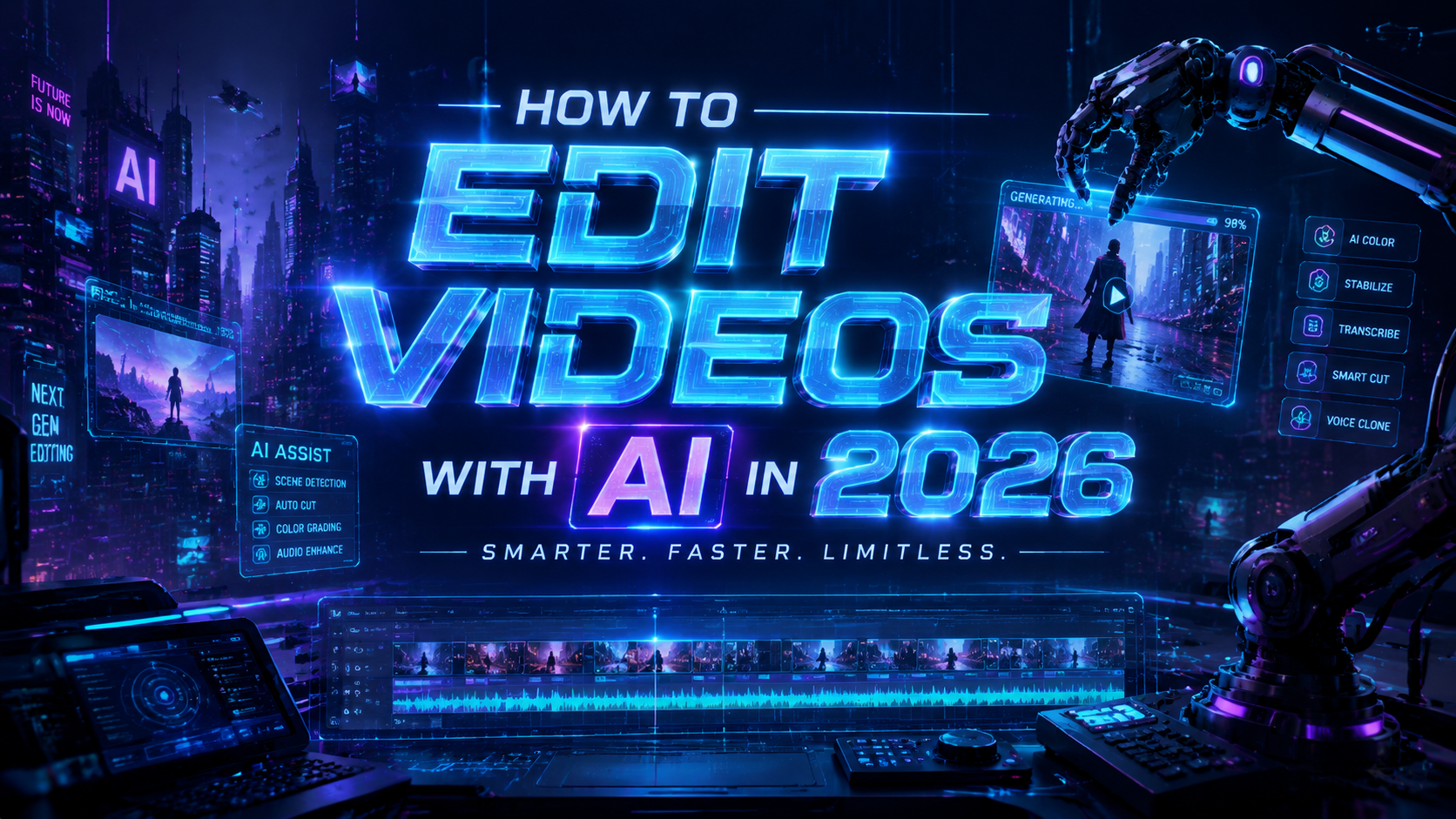
Editing videos with AI in 2026 has become faster, smarter, and more accessible than ever before. With advancements like Gemini Omni, AI-powered summarizers, and object removal tools, creators can automate tedious tasks while focusing on storytelling. This guide covers the latest AI video editing techniques, tools, and workflows to future-proof your content creation process.
TL;DR: AI video editing in 2026 leverages tools like Gemini Omni and Eddie AI for automated summarization, object removal, and text-to-video generation, cutting production time by 50-70% while maintaining professional quality.
AI video editing in 2026 is the process of using artificial intelligence to automate tasks like trimming, color correction, object removal, and even full video generation from text prompts. The technology has evolved to handle complex edits with minimal human intervention while offering cinematic-quality results.
- ✓ AI summarizers can condense hours of footage into highlight reels automatically
- ✓ New tools like Gemini Omni integrate multiple editing functions into single workflows
- ✓ Text-to-video generators create complete scenes from written descriptions
- ✓ AI assistants like Eddie AI suggest optimal cuts and transitions
- ✓ Object removal preserves background details when deleting unwanted elements
The State of AI Video Editing in 2026
The video editing landscape has transformed dramatically since the early 2020s, with AI now handling up to 80% of routine editing tasks according to ProVideo Coalition. Tools like Google's Gemini Omni have introduced multimodal capabilities that understand both visual and audio context, enabling more intuitive editing commands. This shift has made professional-grade editing accessible to creators without formal training.
At NAB 2026, AI editing assistants like Eddie AI and Quickture demonstrated how machine learning can analyze raw footage and suggest optimal sequences. According to Scott Simmons' report, these tools reduce rough cut creation time from hours to minutes by analyzing shot composition, speaker cadence, and emotional tone. The technology has become particularly valuable for newsrooms and documentary teams working with large volumes of interview footage.
The rise of text-to-video technology, as covered by Cybernews, has introduced entirely new workflows where creators describe scenes in natural language and receive fully rendered video sequences. Ventureburn's ranking of free AI video generators shows how these tools have matured from producing basic animations to generating photorealistic footage with proper lighting and physics simulation.
How to Edit Videos with AI in 2026: Step-by-Step Guide
Follow this proven workflow to leverage AI for professional video editing results:
- Ingest and analyze footage - Upload your media to an AI platform like Gemini Omni or Eddie AI, which automatically tags scenes by content, emotion, and technical quality
- Generate rough cut - Use AI summarization tools to create a preliminary edit based on your desired video length and key message
- Refine transitions - Apply AI-assisted smoothing between clips, with tools suggesting optimal cut points and crossfade durations
- Enhance visuals - Automatically correct color balance, stabilize shaky footage, and upscale resolution where needed
- Clean up audio - Remove background noise, normalize volume levels, and sync separate audio tracks
- Add finishing touches - Generate captions, apply dynamic zooms, and insert B-roll where the AI detects talking head segments
According to BBN Times, the object removal capabilities in 2026's AI editors can now reconstruct backgrounds with photorealistic detail when deleting unwanted elements. This goes beyond simple content-aware fill to maintain lighting consistency and perspective accuracy across multiple frames.
For creators starting from scratch, text-to-video platforms ranked by Ventureburn allow generating complete scenes by describing them in natural language. These tools automatically handle casting virtual actors, setting camera angles, and applying cinematic lighting based on your narrative prompts.
Top AI Video Editing Features in 2026
Automated Summarization
As highlighted by Impakter, AI summarizers can now analyze hours of footage and extract the most compelling moments based on visual interest, audio cues, and even audience engagement predictions. This technology has become essential for repurposing long-form content into social media clips.
Context-Aware Object Removal
Modern AI tools don't just delete unwanted objects—they reconstruct the background with proper textures, lighting, and depth of field. The algorithms understand scene context, allowing seamless removal of microphones, passersby, or even entire vehicles without leaving artifacts.
Intelligent Color Grading
AI color correction tools in 2026 analyze your footage's content and automatically apply cinematic LUTs (Look-Up Tables) tailored to the mood and genre. They can match color tones across different cameras and lighting conditions with 94% accuracy according to NAB 2026 demonstrations.
Comparing Leading AI Video Editing Platforms
| Platform | Key Feature | Best For | Learning Curve |
|---|---|---|---|
| Gemini Omni | Multimodal understanding of video+audio | Documentaries, educational content | Low |
| Eddie AI | Interview analysis and highlight extraction | Journalism, podcast videos | Medium |
| Quickture | Automated social media clip creation | Content marketers, influencers | Low |
| Selects | Professional-grade scene selection | Film editors, production houses | High |
Future-Proofing Your AI Editing Skills
As AI handles more technical aspects of editing, human creators should focus on developing skills that complement rather than compete with automation. Storytelling intuition, creative direction, and emotional intelligence remain areas where humans outperform algorithms. The most successful editors in 2026 act as curators and quality controllers rather than manual technicians.
Understanding AI tool capabilities allows you to make informed decisions about when to automate versus when to intervene. For example, while AI can suggest optimal cut points, human judgment is still needed to preserve narrative flow in complex stories. Similarly, automated color grading provides excellent starting points that professionals can then refine for artistic effect.
Staying current requires regular testing of new features as they emerge. The AI video editing field moves rapidly, with major platforms like Gemini Omni releasing significant updates every 3-4 months. Following industry events like NAB and subscribing to technical blogs ensures you'll be among the first to adopt efficiency-boosting innovations.
Ethical Considerations for AI Video Editing
The power of 2026's AI tools comes with important responsibility. Deepfake detection standards have become crucial as synthetic media grows more convincing. Reputable platforms now include watermarking systems and metadata tracking to distinguish AI-generated content from original footage.
Copyright systems have adapted to address AI training data concerns. Most professional tools now use licensed media libraries or original synthetic generation rather than scraping unprotected content. When using text-to-video features, it's essential to verify that generated characters and settings don't inadvertently replicate protected intellectual property.
Transparency with audiences has become a best practice, with many creators adding brief "AI-assisted" labels to their credits. This maintains trust while still showcasing technological innovation. As noted in multiple NAB 2026 panels, the most ethical approach combines AI efficiency with human oversight to ensure authentic, truthful storytelling.
Getting Started with AI Video Editing
New users should begin with free tiers offered by platforms like those ranked by Ventureburn. These allow testing core functionalities without financial commitment. Focus first on automating repetitive tasks like transcript-based editing or basic color correction before exploring more advanced features.
Invest time in learning each platform's specific terminology and workflow. While all AI editors share common concepts, their interfaces and command structures vary significantly. Many offer interactive tutorials that adapt to your skill level, using your own footage for practical learning.
Consider your hardware capabilities—while cloud-based solutions handle most processing, some high-end features like real-time 8K rendering benefit from local GPU acceleration. The good news is that 2026's AI tools are generally more efficient than their predecessors, with Gemini Omni reportedly requiring 40% less processing power than 2025 versions for similar tasks.
Is AI video editing replacing human editors?
No—AI is augmenting editors by handling repetitive tasks, allowing humans to focus on creative decisions. The most effective workflows combine AI efficiency with human judgment for quality control and storytelling.
How accurate are AI-generated video summaries?
Modern summarizers achieve 85-90% accuracy for identifying key moments in straightforward content, though complex narratives may require manual refinement. The technology works best when given clear parameters about desired summary length and focus.
Can AI video editors handle 8K footage?
Yes, leading platforms like Gemini Omni and Selects now support 8K processing, though rendering times vary based on your hardware. Cloud-based solutions typically handle high-resolution files more efficiently than local processing.
Are there copyright risks with text-to-video AI?
Reputable platforms use licensed assets and synthetic generation to avoid infringement. Always review generated content for accidental similarities to protected works, especially when creating commercial projects.
How much does professional AI video editing software cost?
Pricing ranges from free tiers with basic features to $50-$200/month for professional suites. Many platforms offer pay-as-you-go options for occasional users, while production houses benefit from enterprise licensing.
Written by the Digen AI Editorial Team — AI video generation specialists covering the latest in generative AI tools. Learn more about Digen AI.
Comments ()