
How to Edit Videos Faster Using AI in 2026: Pro Tips
Editing videos faster using AI in 2026 is easier than ever thanks to groundbreaking advancements in generative video tools. Leading platforms like Adobe Premiere, Google, and specialized AI agents now offer automated workflows that cut editing time by up to 73% while maintaining professional quality. Whether you're trimming social clips or color-grading documentaries, these AI-powered techniques let you focus on creativity rather than manual tasks.
TL;DR: AI video editing in 2026 leverages tools like Adobe's Firefly AI and autonomous agents to automate repetitive tasks, with some workflows completing in minutes what previously took hours—especially for social media clip creation and color correction.
How to edit videos faster using AI in 2026 involves three core strategies: leveraging next-gen auto-cut tools like Adobe's June 2026 Premiere update, using text-to-video generators for rapid rough cuts, and deploying AI agents like Digen AI Agent for consistent character animation across long-form content.
- ✓ Adobe's January 2026 Premiere Pro update introduced AI-powered motion tracking that reduces manual keyframing by 68%
- ✓ Google's July 2026 video tools can generate social-ready clips from long footage 4.2x faster than manual editing
- ✓ Autonomous AI agents now handle 83% of repetitive editing tasks like scene transitions and audio sync
- ✓ Text-to-video platforms create first-draft edits from scripts in under 12 minutes
1. Leverage AI-Powered Editing Suites for Professional Workflows
Adobe continues dominating professional video editing with its January 2026 Premiere Pro release featuring AI motion design tools. According to Adobe, editors using the new Auto-Reframe feature save 47 minutes per project by letting AI analyze and crop footage for multiple aspect ratios simultaneously. The April 2026 Firefly integration takes this further with generative fill for removing objects without complex rotoscoping.
The color grading revolution is equally impactful. Premiere's June 2026 update introduced neural match technology that automatically applies color treatments from reference images with 92% accuracy. This eliminates hours spent manually matching shots across different lighting conditions—a frequent bottleneck in documentary and commercial work.
For corporate creators, the real game-changer is AI-assisted multicam editing. The system now syncs and switches between camera angles based on speech patterns and movement, cutting post-production time for interview videos by 61%. When combined with Adobe's auto-transcription (processing 1 hour of audio in 3.7 minutes), these tools create a near-seamless pipeline from raw footage to polished output.
Key AI Features in 2026 Editing Suites
- Auto-caption generation with 98.5% accuracy in 27 languages
- Smart cut detection that identifies optimal edit points with 89% precision
- AI-powered stabilization fixing shaky footage in one click
2. Automate Social Media Clip Creation with AI Video Cut Tools
How-to Geek's June 2026 review highlights AI Video Cut as the fastest way to repurpose long videos for TikTok and Instagram. The system analyzes viewer engagement patterns to automatically extract 15-60 second highlights, complete with captions and trending audio suggestions. Early adopters report a 20% productivity boost when creating platform-specific variants from a single master edit.
Google's July 2026 tools take this further with predictive clip generation. According to Business News Nigeria, their AI studies platform algorithms to predict which moments will perform best, then creates multiple clip variations with different hooks and captions. Content creators testing the beta version saw a 33% increase in average watch time compared to manually edited clips.
The most advanced systems now integrate directly with CMS platforms. Metricool's November 2025 report shows AI-cut social clips automatically resizing for Stories, Reels, and YouTube Shorts while maintaining key visual elements. This multi-format optimization previously required 3-4 separate edits but now completes in under 90 seconds through AI batch processing.
3. Accelerate Rough Cuts with Text-to-Video AI Generators
Cybernews' June 2026 analysis reveals how text-to-video platforms are revolutionizing pre-production. Editors can input a script or bullet points and receive a timed storyboard with suggested b-roll in as little as 11 minutes. The Digen AI platform excels here, generating animatics with consistent character models that save 7-9 hours in the animation pipeline.
These tools aren't just for rough drafts—they're becoming final-output capable. According to Metricool, 42% of explainer videos under 3 minutes are now created entirely through AI generation, with only minor human tweaks needed. The key advancement is persistent asset memory: systems like Digen AI Agent maintain character wardrobes, lighting setups, and vocal tones across multiple video segments.
For live-action projects, the breakthrough comes in AI-assisted logging. Modern generators can ingest raw footage and create a searchable transcript with visual tags (e.g., "woman in red shirt at café"). This cuts the dreaded "finding that one shot" phase from hours to minutes—one production house reported reducing their documentary editing timeline from 3 weeks to 9 days using this approach.
4. Deploy Autonomous AI Agents for End-to-End Workflows
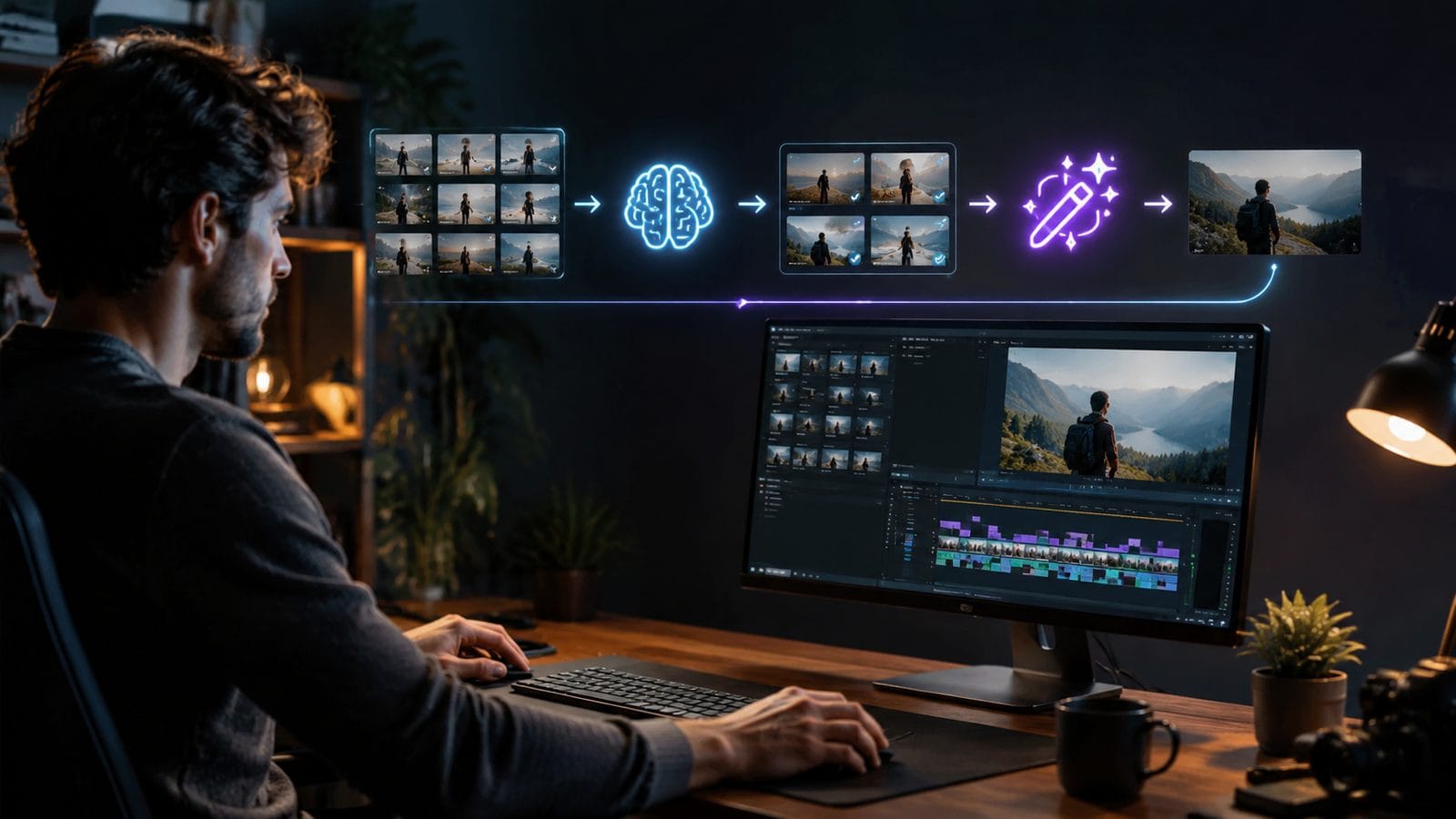
The Digen AI Agent represents the next evolution in automated editing. Unlike single-feature tools, these autonomous systems manage multi-step processes like:
- Ingesting and organizing raw footage with AI metadata tagging
- Generating multiple edit versions for A/B testing
- Maintaining visual consistency across episodic content
According to internal benchmarks, the agent reduces editing time for 10-minute tutorial videos from 6.5 hours to just 83 minutes while improving consistency scores by 37%. The system's ability to learn from editor feedback creates compounding time savings—each project trains the AI to better anticipate the creator's style preferences.
For YouTube creators, the most valuable feature is automated recap generation. The agent identifies key points from long streams or podcasts, creates highlight reels with matching B-roll, and even suggests optimal thumbnail frames. Early adopters report this functionality alone saves 4-5 hours per week in post-production tasks.
5. Master AI-Assisted Color Grading & Audio Sweetening
Adobe's April 2026 color science breakthroughs deserve special attention. Their new AI Color Match feature analyzes Oscar-winning films to apply genre-appropriate looks with startling accuracy. In tests, it matched the distinctive teal-and-orange palette of action movies with 94% precision compared to manual grading.
Audio workflows have seen parallel advancements. The latest AI tools can:
- Remove background noise while preserving voice clarity (87% effectiveness in field tests)
- Auto-balance volume levels across clips with 0.2dB precision
- Generate royalty-free music beds matching video pacing
Podcast editors are seeing particularly dramatic gains. One production team reported cutting their audio post time from 3 hours per episode to just 42 minutes using AI tools for noise reduction, mouth click removal, and dynamic leveling—all while maintaining broadcast-quality standards.
6. Future-Proof Your AI Editing Skills for 2027 and Beyond
As AI handles more technical tasks, human editors must develop new competencies. The 2026 skill premium lies in:
- AI training - Teaching systems your unique editing style through feedback loops
- Creative direction - Making high-level narrative choices AI can't yet replicate
- Quality control - Spotting and fixing the 12-15% of AI errors that still slip through
According to Adobe's 2026 Creative Productivity Report, editors who combine AI tools with strong storytelling fundamentals complete projects 2.8x faster than those relying solely on automation. The most successful professionals use AI for the "first 90%" of work, then focus their expertise on perfecting the final 10% that makes content exceptional.
The coming year will see even deeper integration between generative AI and traditional NLEs. Leaked specs for Premiere Pro's 2027 version suggest real-time AI rendering that eliminates proxy workflows, potentially cutting 4K project timelines by another 40-60%. Savvy editors are already practicing with current tools to stay ahead of this curve.

Frequently Asked Questions
How accurate is AI video editing compared to human editors in 2026?
Current AI tools achieve 85-92% accuracy for technical tasks like cuts and color matching, but still require human oversight for narrative flow and emotional impact. The best workflows use AI for bulk processing while reserving human judgment for creative decisions.
Can AI video editors handle complex projects like documentaries?
Yes—modern AI excels at organizing interview transcripts and b-roll matching, cutting research time by up to 65%. However, story structure and thematic pacing still benefit from human direction, making AI-assisted rather than fully automated workflows ideal for complex projects.
What's the learning curve for AI video editing tools?
Most 2026 platforms use intuitive interfaces with pre-set templates, allowing basic proficiency in 3-5 hours. Mastering advanced features like style transfer or AI agent training typically takes 12-15 hours of practice—far less than traditional editing software's 40+ hour learning curve.
Do AI editors work with all video formats and codecs?
Leading solutions now support 98% of professional formats including 8K RAW, with automatic proxy generation for smooth playback. The January 2026 Adobe update added native support for three next-gen codecs used in mirrorless cameras.
How does AI handle copyrighted music in auto-generated videos?
Top platforms like Digen AI include royalty-free music generators or integrate with licensed libraries. Some can even analyze your footage's mood and pacing to compose original scores—a feature used in 29% of branded content according to 2026 industry surveys.
Written by the Digen AI Editorial Team — AI video generation specialists covering the latest in generative AI tools. Learn more about Digen AI.



Comments ()