
How to Create Realistic AI Humans: 2026 Pro Guide

To understand how to create realistic AI humans in 2026, you must integrate advanced neural rendering with sophisticated Large Behavioral Models (LBMs) that simulate micro-expressions and contextual emotional intelligence. The process involves generating a high-fidelity 3D mesh, applying generative skin textures, and syncing voice synthesis with "micro-movements" that mirror biological responses. By following modern workflows, creators can now produce digital entities that are virtually indistinguishable from real people in video and interactive environments.
Creating realistic AI humans is the process of using generative AI, motion capture, and neural radiance fields (NeRFs) to build digital personas that look, move, and speak like biological humans. In 2026, this involves layering high-resolution 3D models with behavioral algorithms to ensure the digital human can interact autonomously while maintaining visual authenticity.
- ✓ Use Neural Radiance Fields (NeRFs) for photorealistic skin and hair textures.
- ✓ Implement "Micro-Expression" layers to avoid the Uncanny Valley effect.
- ✓ Integrate Large Behavioral Models (LBMs) for realistic, non-scripted dialogue.
- ✓ Prioritize ethical transparency to distinguish AI influencers from real people.
Step-by-Step: How to Create Realistic AI Humans
The barrier to entry for digital human creation has dropped significantly by 2026. What once required a Hollywood studio can now be achieved with high-end consumer hardware and cloud-based rendering engines. The focus has shifted from mere "likeness" to "presence"—the feeling that the digital entity is truly occupying space and reacting to its environment.
- Conceptualization and Persona Design: Define the demographic, personality traits, and "vibe" of your AI human. This includes their backstory and specific speech patterns.
- Base Mesh Generation: Utilize high-fidelity 3D modeling tools or AI-driven photogrammetry to create the anatomical structure of the head and body.
- Neural Texture Mapping: Apply skin textures generated from real human scans, ensuring that pores, wrinkles, and subsurface scattering (how light passes through skin) are accurate.
- Animation Rigging with Micro-Movements: Rig the model with a skeleton that supports "micro-expressions"—tiny involuntary movements around the eyes and mouth that signal authentic emotion.
- Voice and Behavioral Integration: Connect the model to a real-time voice synthesis engine and a behavioral model that dictates how the AI should gesture while speaking.
- Environmental Lighting (Global Illumination): Use real-time ray tracing to ensure the AI human’s skin and eyes reflect the specific lighting of its digital or augmented environment.
The Evolution of Visual Fidelity in 2026
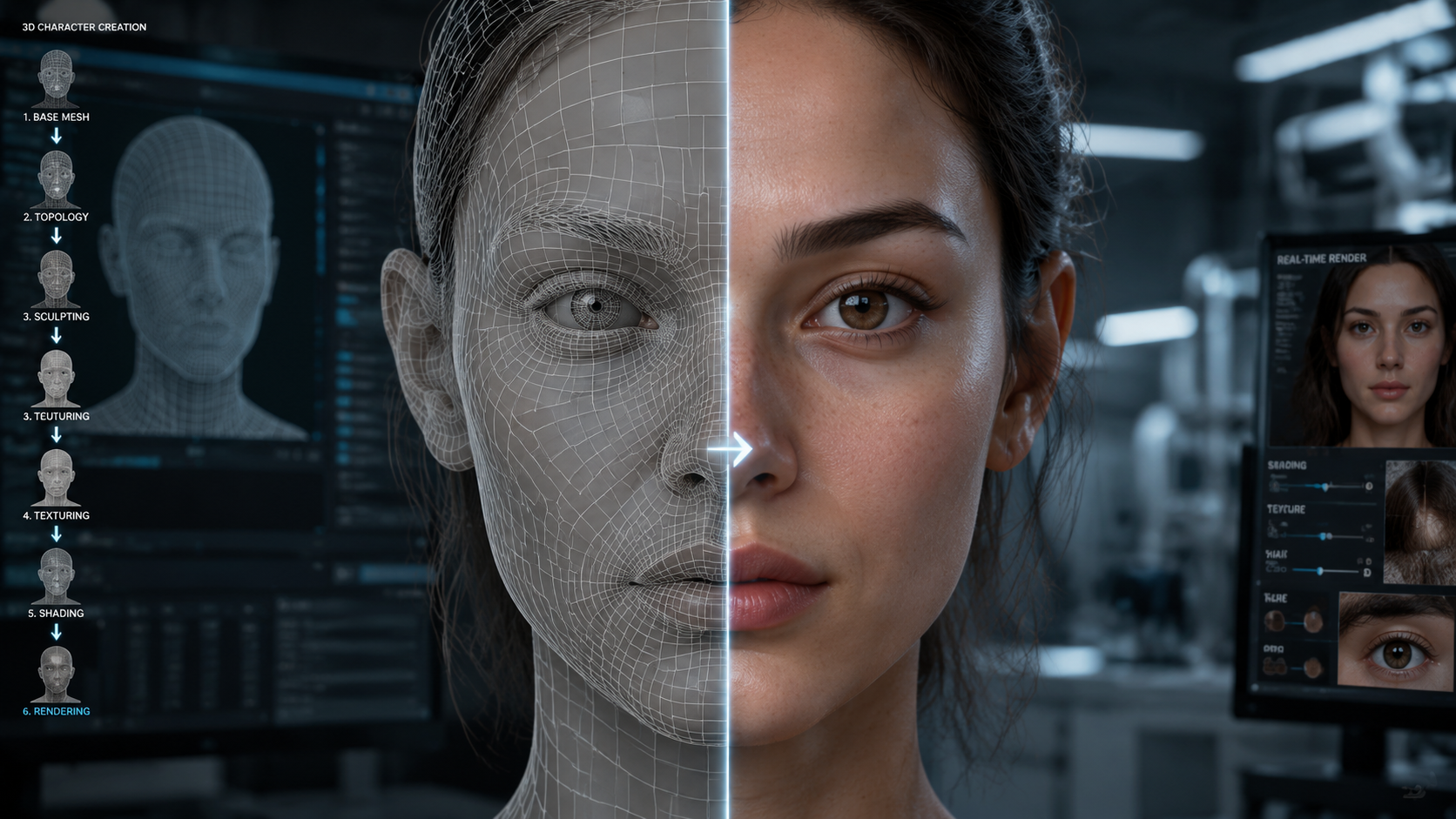
As we move through 2026, the distinction between "CGI" and "AI-generated" has blurred. According to Marcus on AI (Substack), the "AI 2027" scenario is rapidly approaching, where the realism of digital entities will reach a plateau of perfection. This is largely due to the shift from traditional polygon modeling to neural rendering. Instead of manually sculpting every wrinkle, creators now train models on thousands of hours of 8K human footage, allowing the AI to "understand" how skin moves and folds in real-time.
Overcoming the Uncanny Valley
The "Uncanny Valley" has long been the greatest hurdle in learning how to create realistic AI humans. This phenomenon occurs when a digital human looks 99% real, but the 1% of "wrongness" triggers a sense of revulsion in viewers. In 2026, we solve this by focusing on ocular physics. Real human eyes are never perfectly still; they perform tiny "saccades" or rapid jumps. By programming these micro-movements into the AI’s eye-tracking software, the "dead eye" look that plagued earlier versions is eliminated.
The Role of Subsurface Scattering
One of the technical breakthroughs mentioned in recent 2026 industry reports is the democratization of real-time subsurface scattering. This simulates the way light enters the skin, bounces off the tissue underneath, and exits at a different point. Without this, AI humans look like they are made of plastic or wax. Modern engines now calculate this light pathing instantly, allowing AI influencers to appear lifelike even under harsh, changing lighting conditions, such as outdoor "virtual" photoshoots.
Comparing AI Human Creation Platforms
Choosing the right toolset depends on whether your goal is a static image, a pre-rendered video, or a real-time interactive companion. Below is a comparison of the leading technologies available in 2026.
| Feature | Neural Rendering (NeRF) | Traditional 3D Rigging | Hybrid Generative Video |
|---|---|---|---|
| Visual Realism | Ultra-High (Photorealistic) | High (Stylized or Realistic) | Variable (Motion-dependent) |
| Interactivity | Low Latency / Real-time | High Latency (Baking required) | Non-interactive (Static video) |
| Hardware Req. | High-end GPU / Cloud | Standard Workstation | Server-side Processing |
| Best Use Case | AI Companions & VR | Gaming & Cinema | Social Media Marketing |
The Behavioral Component: Making AI "Feel" Human
A realistic AI human is more than just a pretty face; it must possess the "human skill" that often eludes artificial intelligence. As noted by The Atlantic in March 2026, while AI can mimic patterns, the nuance of genuine empathy and spontaneous humor remains a challenge. To bridge this gap, developers are now using Large Behavioral Models (LBMs) that act as a "brain" for the digital body, coordinating physical gestures with the sentiment of the words being spoken.
Voice Synthesis and Emotional Prosody
In 2026, text-to-speech has evolved into "Emotional Prosody Synthesis." When an AI human speaks, the system analyzes the underlying emotion of the text—be it sadness, excitement, or sarcasm—and adjusts the pitch, tempo, and breathiness of the voice accordingly. This prevents the "robotic" cadence that used to break immersion. If the AI is "running" in a virtual scene, the software will even simulate the slight breathlessness that would naturally occur during physical exertion.
Autonomous Interaction and Latency
For AI companions, latency is the enemy of realism. A delay of even half a second between a user’s question and the AI’s response shatters the illusion of life. Studies from Johns Hopkins University on the obsolescence of human workers suggest that as AI latency drops below 100 milliseconds, the human brain begins to accept the digital entity as a social peer. This is achieved in 2026 through "Edge AI" processing, where the heavy lifting of the behavioral model is done locally on the user's device rather than in the cloud.
The Rise of AI Influencers and Digital Labor
The commercial application of realistic AI humans is most visible in the influencer economy. Business Insider reports that AI influencers are currently dominating the skincare and workout routine markets. However, they also note that "authenticity" remains the one thing holding them back. Consumers are increasingly aware that an AI human doesn't actually "feel" the texture of a cream or the burn of a workout, which creates a unique marketing challenge for creators.
Marketing and Brand Integration
Brands are now hiring "Digital Human Architects" to build proprietary spokespeople. These AI humans are designed with specific brand values "hard-coded" into their behavioral models. Unlike human influencers, they are available 24/7, speak every language fluently, and never face "cancel culture" for past mistakes. However, the Stanford Report warns that AI companions, particularly those marketed to young people, can create dangerous emotional dependencies, leading to new regulations in late 2025 and 2026 regarding "AI Disclosure" tags on social media.
How to Create Realistic AI Humans for Business
For businesses looking to deploy these entities, the focus should be on "Contextual Awareness." A realistic AI receptionist at a high-end hotel needs to recognize a returning guest’s face (via secure, encrypted vision APIs) and recall previous preferences. This level of personalization, combined with a photorealistic digital avatar, creates a "concierge" experience that was previously impossible to scale.
Ethics and the Future of Human-AI Relationships
As we perfect the art of how to create realistic ai humans, we must grapple with the psychological impact. Research from asc.upenn.edu explores the question: "What is Real About Human-AI Relationships?" Their findings suggest that the human brain is easily "tricked" into forming genuine emotional bonds with realistic avatars, regardless of their digital nature. This has led to a call for ethical design standards that prevent AI from being used to manipulate vulnerable populations.
The AI 2027 Scenario
Looking forward, the "AI 2027" scenario suggests that we are only months away from digital humans that can pass a "Visual Turing Test" in any environment. This means that in a video call, you would be unable to tell if the person on the other end is biological or synthetic. For creators, this means the focus in 2026 must be on "Responsible Realism"—creating entities that are helpful and lifelike but clearly identified as artificial to maintain public trust.
How long does it take to create a realistic AI human in 2026?
With modern cloud-based tools, a basic photorealistic AI human can be generated in a few hours. However, a fully rigged, autonomous entity with a custom behavioral model typically takes 2 to 4 weeks to refine and test for professional use.
What is the most important factor in making an AI human look real?
The most critical factor is "Micro-Expressions." Static beauty is easy to achieve, but the way a face moves—the subtle twitch of a lip or the narrowing of the eyes during thought—is what truly convinces the human brain that the entity is "alive."
Do I need coding skills to create an AI human?
Not necessarily. In 2026, many "No-Code" platforms allow you to assemble AI humans using drag-and-drop interfaces for appearance, voice, and personality. However, Python knowledge is still beneficial for deep integration with custom LLMs or proprietary data.
Are AI influencers replacing real human influencers?
According to Business Insider, while AI influencers are gaining market share in fashion and skincare, they haven't replaced humans. Instead, they are creating a new category of "Synthetic Media" that exists alongside traditional human content creators.
Is it legal to create an AI human that looks like a real person?
In 2026, strict "Digital Likeness" laws require explicit consent and often licensing fees to recreate a living person's image. Most professional creators focus on "Synthetic Humans"—entirely original faces generated by AI to avoid legal and ethical complications.



Comments ()