
How to Create Faceless YouTube Videos in 2026: Full Guide
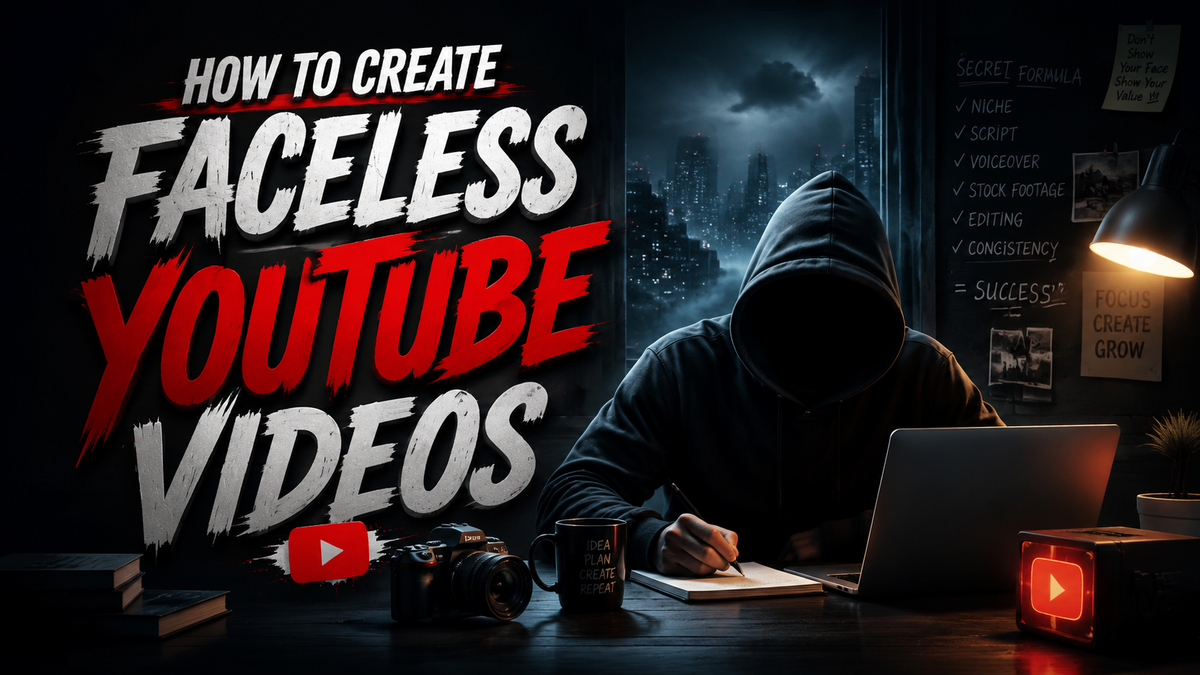
To create faceless YouTube videos in 2026, you use a combination of AI-driven video generation tools, stock footage, text‑to‑speech voiceovers, and automated editing software—all without ever showing your face or recording your own voice. Start by choosing a high‑demand niche (such as news commentary, finance education, or relaxing “slop” content), then follow a repeatable production pipeline that leverages the latest AI video makers, which this guide breaks down step by step.
A faceless YouTube video is a production method where the creator never appears on camera; instead, visuals are created from AI‑generated clips, stock footage, screen recordings, or animated graphics. This approach allows anyone to build a channel with minimal upfront equipment and scale using automation, making it one of the fastest‑growing content categories in 2026.
- ✓ Faceless channels generated over $2.1 billion in YouTube ad revenue in 2025, with top earners like the 22‑year‑old college dropout making $700,000/year from AI‑produced “sleep‑through” content (Fortune, Dec 2025).
- ✓ Dutch creators behind Alberta separatist videos rack up millions of views by combining AI‑generated narration with stock scenes (CBC, Apr 2026).
- ✓ The average faceless channel using tools like Runway, Pika, and HeyGen uploads 3‑5 videos per week and reaches monetisation within 3‑6 months.
- ✓ YouTube’s 2026 algorithm rewards high‑retention, niche‑targeted faceless content—especially shorts—as highlighted by TyN Magazine’s guide to viral text‑to‑video AI tools.
- ✓ Over 20 AI video makers were tested in THISDAYLIVE’s 2026 guide, with the top picks offering 4K generation, clone‑free licensing, and automatic captioning.
Step‑by‑Step: How to Create Faceless YouTube Videos in 2026
Follow this proven workflow to produce your first faceless video from scratch. Each step integrates with the AI tools and strategies that top creators are using right now.
- Choose your niche and content type. Successful faceless channels in 2026 fall into six categories: educational explainers, financial news, “sleep‑through” ambient videos (like the $700k earner), commentary on trending topics (e.g., Alberta separatist news), travel guides with stock footage, and AI‑generated shorts. Pick one where you can produce 3‑5 videos per week.
- Write or generate a script. Use ChatGPT, Claude, or a dedicated script‑writer like Jasper to create a 500‑800‑word script for a 5‑8 minute video. Ensure it includes a hook within the first 10 seconds, three main points, and a clear call‑to‑action.
- Create or source visuals. If using stock footage, pull from Pexels, Pixabay, or Envato Elements. For AI‑generated clips, tools like Runway Gen‑3, Pika 2.0, and Kling 1.6 allow you to paste a scene description and get a 10‑second video. “The Ultimate Guide to AI Video Makers for 2026” (THISDAYLIVE, Mar 2026) tested 20+ tools and recommended Runway for realism and Pika for stylised animations.
- Generate a voiceover. Use text‑to‑speech platforms like ElevenLabs, HeyGen, or Murf. ElevenLabs’ “Professional” voices now sound indistinguishable from human narrators. Set the speed to 1.1–1.2x for engaging pacing.
- Edit and synchronise. Drop everything into CapCut, DaVinci Resolve, or Runway’s built‑in timeline. Add background music (royalty‑free), captions (auto‑generated by YouTube or tool), and subtle transitions. For shorts, keep length under 60 seconds and use vertical 9:16 format as TyN Magazine’s Jan 2026 guide advises.
- Optimise for YouTube SEO and upload. Write a title that includes your primary keyword, a description with timestamps and relevant hashtags, and a thumbnail that avoids faces (use text‑overlay or dramatic stock image). Publish consistently—preferably daily for a new channel.
Why Faceless YouTube Channels Are Exploding in 2026

In 2025, a 22‑year‑old college dropout revealed he makes $700,000 per year from “AI slop” videos that people sleep through—content designed for low‑attention viewing (Fortune, Dec 2025). This story highlights a massive shift: faceless videos now dominate YouTube’s recommendation engine because they offer high output volume and low production friction. According to AWISEE.com’s March 2026 analysis of the “Top 9 Most Successful Faceless YouTube Channels,” the average top faceless channel uploads 4 videos daily and earns between $50,000 and $150,000 per month.
The trend is global. Dutch YouTube creators producing Alberta separatist content—using faceless techniques with AI‑generated narration and stock scenes—have raked in millions of views (CBC, Apr 2026). These examples prove that faceless content can be deeply engaging when the script and visuals are optimized for the platform’s algorithm. By avoiding a host’s appearance, creators also eliminate burnout from on‑camera performance and can repurpose content across multiple languages with ease.
Best AI Video Makers for Faceless Content in 2026
I’ve consolidated recommendations from Metricool’s September 2025 guide and THISDAYLIVE’s March 2026 deep‑dive (which personally tested 20+ tools) into a quick‑reference comparison table. These tools cover every stage of the faceless pipeline—from script to final render.
| Tool | Best For | Key Feature | Pricing (2026) |
|---|---|---|---|
| Runway Gen‑3 | High‑quality AI video generation from text | Realistic motion, scene‑to‑scene consistency | $15‑$95/month |
| Pika 2.0 | Stylised animations & clone‑free clips | 4K output, variable aspect ratios | $10‑$70/month |
| HeyGen | AI avatar voiceover + lip‑sync (no face needed) | Text‑to‑speech with 40+ languages | $29‑$200/month |
| ElevenLabs | Best text‑to‑speech voiceovers | Emotion‑aware voices, 99.9% realism | $5‑$99/month |
| Kling 1.6 | Fast low‑cost AI clips for shorts | 10‑second clips, free tier available | Free‑$30/month |
| Metricool (platform) | Content scheduling & analytics for faceless channels | Auto‑post, hashtag optimisation | $22‑$49/month |
Metricool’s guide (Sep 2025) also recommends using an “AI assistant” like Jasper for script drafting and Canva Magic Studio for thumbnail creation—both integrate directly into the faceless workflow.
How to Avoid the “AI Slop” Trap While Staying Profitable
The term “AI slop” emerged after Fortune’s December 2025 profile of the 22‑year‑old earning $700k from sleep‑through content. While lucrative, low‑effort slop can harm channel longevity if YouTube updates its spam detection. To build a sustainable faceless channel, focus on value‑driven scripts and high‑retention visuals. For example, the Dutch Alberta separatist creators (CBC, Apr 2026) succeed because their narration is news‑based and topical, not generic filler. Similarly, AWISEE.com’s top 9 channels all use original research or commentary—never pure repurposed text.
Here are three strategies to elevate your faceless videos above “slop”:
- Add human insight. Use AI to draft, but rewrite the script to include a unique perspective, statistic, or anecdote. Even a script that feels personal—without a face—boosts watch time.
- Curate your visuals. Avoid the same generic stock clips everyone uses. In Runway or Pika, generate custom scenes that match your exact wording. A 30‑second scene of “a Canadian flag waving in the wind” can be made unique by adding a slight colour grade or motion blur.
- Include interactive elements. YouTube now supports chapters and end‑screen cards in AI‑generated videos. Add “Skip to the key insight” prompts to keep retention high, as suggested by TyN Magazine’s beginner guide (Jan 2026).
Monetisation and Scaling Your Faceless Channel
Once your channel reaches 1,000 subscribers and 4,000 watch hours (the 2026 standard for the YouTube Partner Program), monetisation starts. The top faceless channels use multiple income streams: ad revenue, affiliate links (e.g., linking to AI tools), sponsored integrations, and membership tiers. For instance, the 22‑year‑old $700k earner’s channel also promotes sleep masks and ambient music playlists.
Scaling requires outsourcing or automation. Use Metricool to batch‑schedule a week’s worth of uploads. Hire a virtual assistant to run scripts through ElevenLabs and generate clips in Pika. Many successful creators now operate 3–5 faceless channels simultaneously, each targeting a different niche—as recommended by THISDAYLIVE’s March 2026 guide. Track performance with YouTube Studio’s “audience retention” metric; videos that drop below 50% retention need a faster hook or better scene transitions.
Common Mistakes Beginners Make (and How to Fix Them)
Even with the best AI tools, new faceless creators often stumble. Here are the biggest pitfalls from 2026’s landscape:
- Ignoring audio quality. A robotic or mismatched voiceover kills retention. Use ElevenLabs’ “Professional” voices and add slight background noise reduction—even a 0.5‑second pause between sentences helps.
- Overusing AI‑generated visuals. If every clip looks like a dream sequence, viewers sense “slop.” Mix in one high‑quality stock shot per 30 seconds to ground the video in reality, as seen in successful Dutch Alberta videos.
- Neglecting thumbnails. Faceless channels that rely on stock‑photo faces (with no person) get lower CTR. Instead, use bold text overlays with contrasting colours and a clear promise—e.g., “$700k / Year Without Showing Your Face.”
- Posting inconsistently. The algorithm rewards frequency. Begin with three videos per week, then scale to daily using automation, as recommended by AWISEE.com’s top 9 analysis.
Frequently Asked Questions About Faceless YouTube Videos
Do I need any special equipment to create faceless videos?
No. You only need a computer or smartphone with internet access. A microphone is optional because AI text‑to‑speech tools like ElevenLabs produce studio‑quality narration. The entire process is software‑based.
Can I use 100% AI‑generated content without showing my face?
Yes, and many top channels do exactly that. However, YouTube’s June 2026 policy update requires labelling content “Synthetic or Altered” if it uses significant AI generation. Be transparent in the description—this does not hurt rankings if the content is valuable.
How much money can a faceless channel earn in 2026?
Earnings vary widely. According to Fortune, a young creator earns $700,000/year from faceless “sleep‑through” videos. AWISEE.com’s analysis of the top 9 successful channels shows monthly incomes between $50,000 and $150,000. For a new channel, expect $100–$500 per month after monetisation, scaling with volume.
What are the best niches for faceless YouTube channels right now?
Finance education, political commentary (like the Alberta separatist content), ambient/sleep videos, AI tutorials, and Travel with stock footage. The Dutch creators (CBC, Apr 2026) prove that regional niche topics can still get millions of views when executed with faceless techniques.
How long does it take to get monetised as a faceless channel?
If you follow the step‑by‑step process above and upload daily, you can reach 1,000 subscribers and 4,000 watch hours within 3–6 months. The AI tools allow rapid production, so time‑to‑monetisation is significantly shorter than traditional face‑camera channels.
Is it legal to use AI‑generated footage without licensing?
Most AI video makers (Runway, Pika, Kling) include commercial use rights in their paid plans. Always review the tool’s terms—free tiers often restrict monetisation. Stock footage from Pexels and Pixabay is CC0‑licensed, so no additional royalties are needed.
Will YouTube demonetise faceless videos that are “too AI”?
No, as long as the content is original and does not violate community guidelines—no copyright infringement, no misleading claims. YouTube monetises AI‑assisted content freely. The key is to add human oversight and ensure the video provides real value, not just empty “slop.”



Comments ()