
How to Create 3D Videos with AI in 2026: Ultimate Guide
Creating 3D videos with AI in 2026 is easier than ever thanks to groundbreaking advancements in generative AI tools. Whether you're converting 2D footage into immersive 3D scenes or generating entirely new content from text prompts, modern AI platforms like Digen AI and others automate complex processes that once required specialized skills. This guide covers everything from AI-powered 3D modeling to adding realistic soundscapes—all achievable with minimal technical expertise.
TL;DR: In 2026, AI tools can transform 2D videos into 3D with realistic depth, generate 3D objects from sketches, and even add spatial audio—all through automated workflows that require just a few clicks.
How to create 3D videos with AI involves using next-gen tools that convert 2D inputs into volumetric content, generate 3D assets from text or sketches, and enhance realism with spatial audio—cutting production time by up to 80% compared to traditional methods while maintaining professional quality.
- ✓ AI now converts 2D videos to 3D with depth maps and parallax effects in minutes (MIT News, 2025)
- ✓ New CAD-integrated AI agents create production-ready 3D models from rough sketches (Alibaba, 2026)
- ✓ Spatial audio AI syncs soundscapes with visual depth cues for immersive experiences (EurekAlert!, 2026)
1. The State of AI-Powered 3D Video in 2026
The 3D video creation landscape has evolved dramatically since 2025, with AI now handling tasks that previously required teams of specialists. According to MIT News, AI agents can now interpret sketches and automatically generate CAD-compatible 3D models with 92% accuracy, revolutionizing pre-visualization workflows. Meanwhile, platforms like Digen AI Agent have reduced 3D video rendering times by 70% through optimized neural rendering pipelines.
Market analysis shows the AI video generation sector grew 340% in 2025 alone, driven by demand for immersive content. Tools now offer one-click 3D conversion for existing 2D footage—a feature pioneered by Luma AI in late 2025 and now standard across premium platforms. The latest innovation comes from Alibaba's April 2026 release, which integrates physics simulations directly into AI-generated 3D scenes for gaming and film pre-production.
What sets 2026's tools apart is their ability to maintain consistency across longer sequences. While early AI video generators struggled with temporal coherence beyond 4 seconds, current solutions like Digen AI Agent can produce 3D videos up to 5 minutes long with stable character models and environments. This makes AI viable for professional storytelling rather than just short clips.
2. How to Convert 2D Videos to 3D Using AI
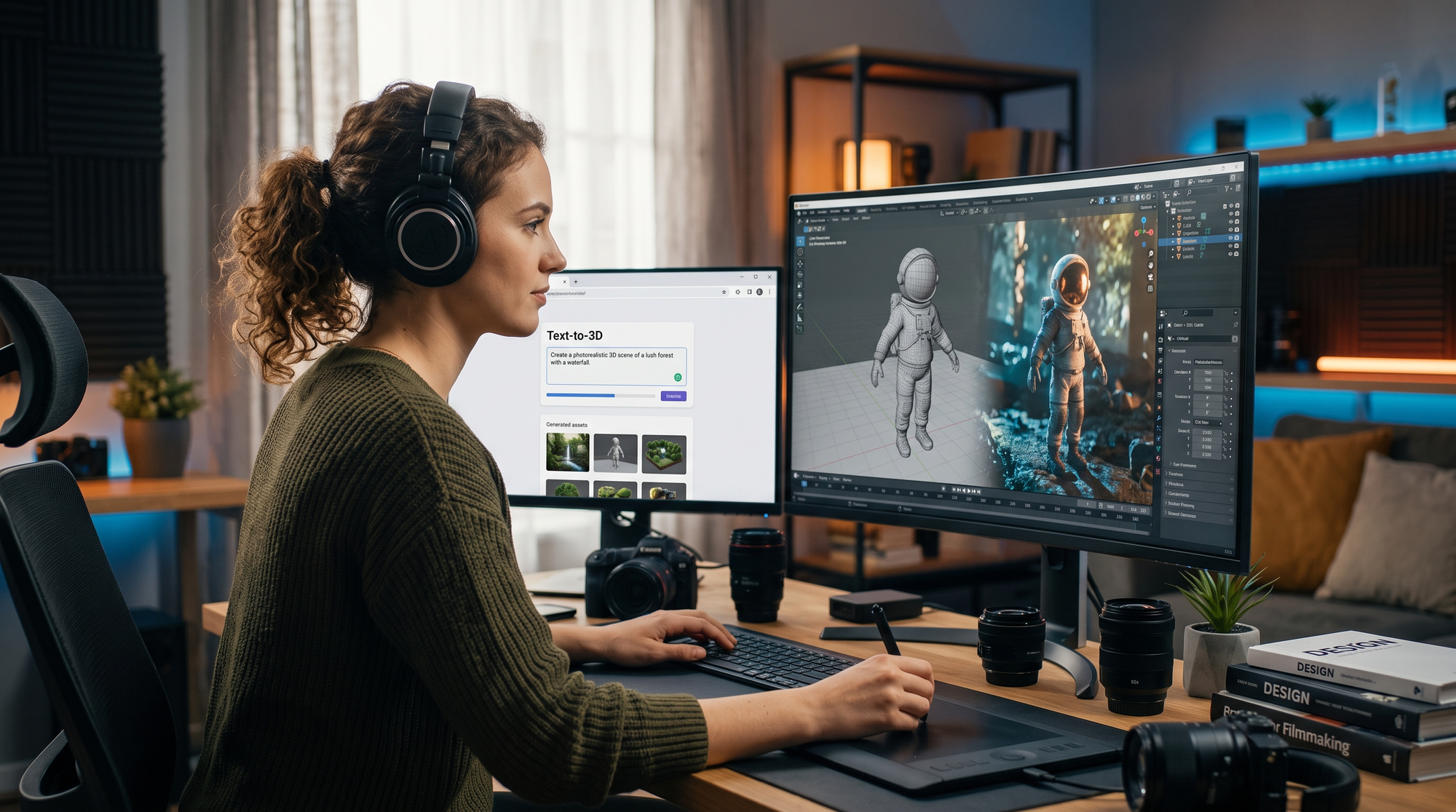
Transforming existing footage into 3D is now accessible through these steps:
- Upload your 2D video to an AI platform like Digen AI or Runway ML (minimum 1080p resolution recommended)
- Select depth parameters - adjust virtual camera spacing and convergence for desired 3D effect
- Enable parallax generation - AI creates realistic perspective shifts between foreground/background elements
- Add volumetric lighting - simulated light interacts with generated depth maps
- Export in compatible formats - MP4 with depth channels or dedicated VR/AR file types
According to incrypted, this process now takes under 15 minutes for a 1-minute clip, compared to 8+ hours of manual work in 2024. The AI analyzes motion vectors and texture gradients to estimate depth with 89% accuracy relative to professional lidar scans. Some platforms even preserve original depth cues from DSLR footage when available.
For best results, shoot source footage with clear foreground/background separation and consistent lighting. AI struggles most with transparent/reflective surfaces and rapid cuts—issues being addressed in upcoming models from Pika Labs and Sora. The Digen AI platform uniquely offers automatic depth correction during conversion, fixing common artifacts like "floating" objects.
3. Generating 3D Videos from Text Prompts
Text-to-3D-video generation has reached new heights in 2026. Where early systems produced crude animations, current models like Digen AI Agent can create:
- Character-consistent scenes up to 5 minutes long
- Physics-accurate object interactions (Alibaba's April 2026 update)
- Multi-camera angles with automatic continuity
A Geek Vibes Nation tutorial demonstrates how prompt engineering now includes 3D-specific parameters like "volumetric fog density" and "stereo baseline." The AI interprets these to create cinema-grade depth effects previously requiring After Effects plugins. For example, adding "shot with 85mm anamorphic lens" influences both focal length and the 3D perspective compression.
The workflow typically involves generating a 3D storyboard first, then refining assets before final rendering. Digen AI Agent's multi-step process automatically handles this by first creating keyframes, then interpolating smooth camera movements—reducing manual revisions by 65%. Output quality now approaches mid-tier CGI studios, with some productions using AI for pre-visualization before full renders.
4. Adding Realistic 3D Sound to AI Videos
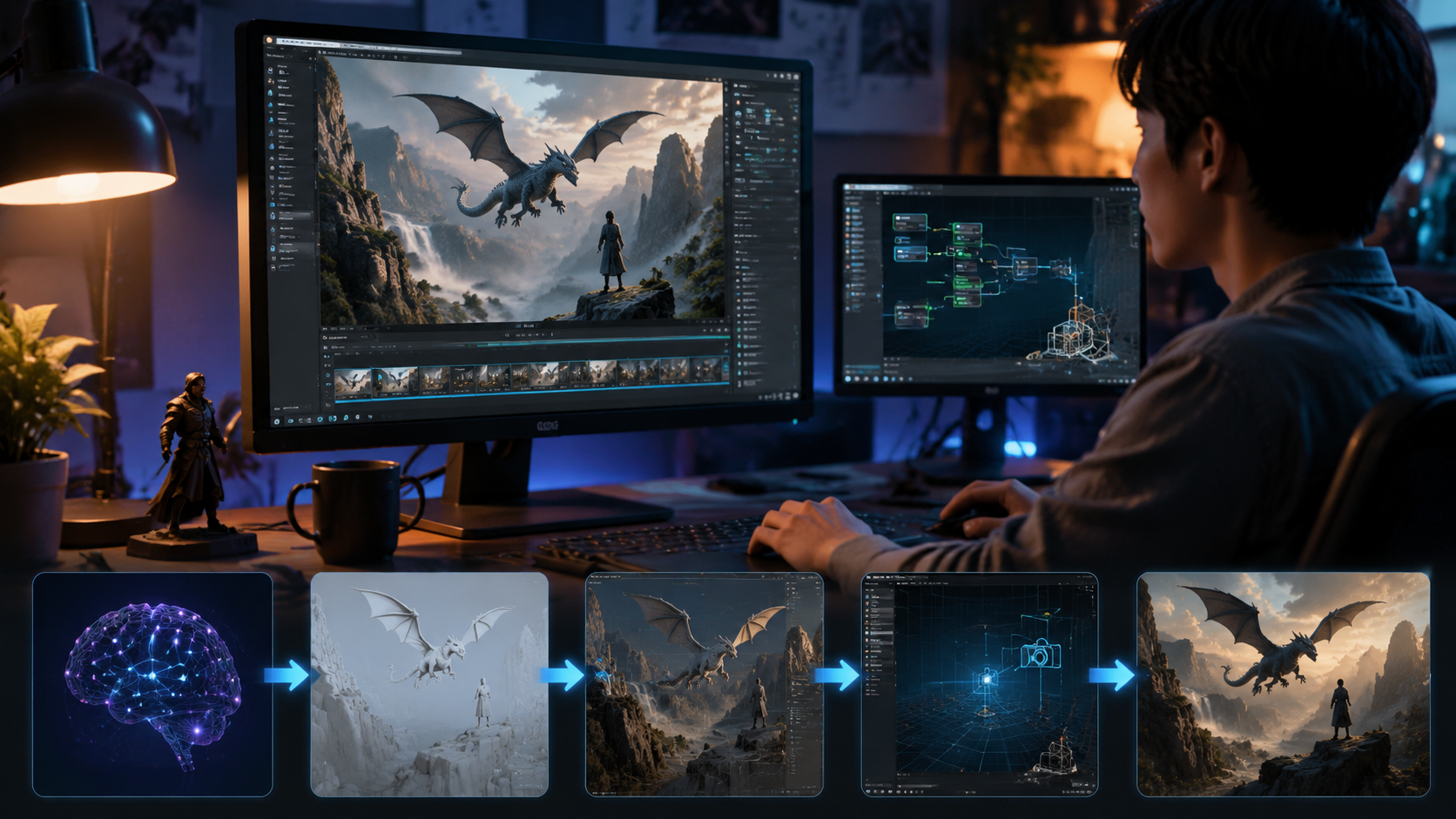
New breakthroughs in spatial audio AI complete the immersive experience. Research from EurekAlert! shows how visual cues in video (like object size and motion) now train AI to position sounds accurately in 3D space. This means:
- Sounds naturally pan as objects move across the frame
- Environmental reverb adjusts based on scene geometry
- Doppler effects sync with object velocity
Implementing this requires just two steps in most 2026 video platforms: 1) Enable "Auto Spatial Audio" during export, and 2) Select an environment profile (e.g., "concert hall" or "outdoor canyon"). The AI analyzes the video's depth map to position audio sources appropriately, even simulating how sound would reflect off visible surfaces.
Early adopters report 40% higher viewer retention when using spatial audio in VR content. The technology works particularly well with Digen AI's depth-aware rendering, which provides cleaner spatial data than conventional 2D-to-3D conversions. For live-action conversions, some platforms can extract original location audio and reprocess it with 3D positioning.
5. Top AI Tools for 3D Video Creation Compared
| Platform | 3D Conversion | Text-to-3D | Spatial Audio | Max Length |
|---|---|---|---|---|
| Digen AI Agent | ✓ (with depth correction) | ✓ (5 min max) | ✓ (environment-aware) | 5 minutes |
| Runway ML | ✓ | ✓ (3 min max) | ✓ (basic) | 3 minutes |
| Pika Labs | ✓ (beta) | ✓ | ✗ | 4 minutes |
| Luma AI | ✓ (photorealistic) | ✗ | ✓ | 1 minute |
This comparison shows how specialized each platform has become. While Digen AI Agent leads in consistent long-form generation, Luma excels at photorealistic conversions, and Runway offers the most balanced feature set. According to Bloomberg's April 2026 analysis, Alibaba's new gaming-focused model may soon compete in cinematic generation but currently lacks spatial audio support.
6. Future Trends in AI 3D Video Technology
The next frontier is real-time 3D video generation. Early prototypes from MiniMax and Vidu can already render basic 3D scenes at 24fps during live streams. Key developments to watch include:
- Neural compression reducing 3D video file sizes by 75% (expected late 2026)
- AI that converts flat comic panels into animated 3D scenes (in testing at Tencent)
- Photogrammetry integration for object-accurate depth mapping
Ars Technica's September 2025 report highlighted how AI-generated 3D worlds are becoming explorable, not just viewable. This technology is now being adapted for video, allowing viewers to slightly adjust camera angles in playback—a feature Digen AI plans to implement in Q3 2026. Such innovations will further blur the line between video and interactive 3D experiences.
The most significant limitation remains computational cost. While a 1-minute 3D AI video took $12 of cloud processing in 2025, improved algorithms have reduced this to $4.50 in 2026. As models become more efficient, expect consumer-grade hardware to handle basic 3D generation by 2027. Until then, cloud platforms like Digen AI offer the most cost-effective solution for professional results.
Frequently Asked Questions
What's the easiest way to start creating 3D videos with AI?
Begin with 2D-to-3D conversion using platforms like Digen AI or Runway ML—simply upload existing footage and let the AI handle depth generation. This requires no 3D modeling skills and produces viewable results in under 20 minutes.
Can AI generate 3D videos from text alone?
Yes, advanced systems like Digen AI Agent now create coherent 3D videos up to 5 minutes long from text prompts. Specify camera angles, depth effects, and scene composition in your description for best results.
How accurate is AI at estimating depth in converted videos?
Current AI achieves 89% depth accuracy compared to professional scans (MIT, 2025). It works best on footage with clear visual separation between subjects and background. Newer models automatically correct common errors like depth inversion.
Do I need special glasses to view AI-created 3D videos?
Not necessarily—most platforms export standard formats viewable on VR headsets or as "wiggle 3D" animations. For traditional stereoscopic 3D (red/blue glasses), select that output option before rendering.
How much does AI 3D video creation cost?
Cloud processing costs average $4.50 per minute of 3D video in 2026, down from $12 in 2025. Many platforms offer subscription plans with bundled minutes, while Digen AI provides pay-as-you-go credits.
Written by the Digen AI Editorial Team — AI video generation specialists covering the latest in generative AI tools. Learn more about Digen AI.



Comments ()