
How to Add Effects with AI Editing in 2026: Pro Techniques
Adding effects with AI editing in 2026 is easier and more powerful than ever, thanks to breakthroughs in generative AI tools from Meta, Google, Adobe, and specialized platforms like Digen AI. Whether you're enhancing photos, remixing videos, or creating dynamic motion graphics, AI-powered features now automate complex tasks while offering unprecedented creative control. This guide covers the latest pro techniques across top platforms, including step-by-step workflows for achieving professional results.
TL;DR: In 2026, AI editing tools like Meta AI, Google Vids, and Adobe Premiere Pro offer one-click effects, automated object segmentation, and intelligent video remixing—cutting editing time by 63% while improving output quality.
How to add effects with AI editing in 2026 involves leveraging next-gen tools like Meta's AI segmentation (released December 2025), Google's Gemini Omni-powered Vids (July 2026), and Adobe's AI motion design upgrades (January 2026) to apply cinematic filters, dynamic transitions, and context-aware enhancements with minimal manual effort.
- ✓ Instagram's July 2026 update introduced 17 new AI-powered Story effects, including real-time background replacement and 3D object tracking
- ✓ Google Vids reduced video production time by 72% for testers using its Gemini Omni-based auto-editing and avatar generation
- ✓ Adobe After Effects' January 2026 update added AI-powered motion tracking that's 89% more accurate than manual keyframing
- ✓ Digen AI Agent autonomously applies character-consistent effects across long-form videos—a 2026 breakthrough for content creators
1. Next-Gen AI Effects in Social Media Editing
Meta's July 2026 Instagram update revolutionized Stories with AI effects that respond to voice commands and environmental context. According to AI at Meta, their new segmentation engine can isolate moving objects with 94% accuracy, enabling effects like floating text that dodges subjects automatically. This outperforms 2025's manual masking workflows by 3.8x in speed tests.
The December 2025 "Edits" upgrade introduced multi-object selection—tap a shoe, face, and background simultaneously to apply different effects to each. Social Media Today reported creators saved 11 hours monthly by replacing manual layer adjustments with AI-powered selective editing. This works particularly well for product showcases needing varied enhancement levels.
For DTC brands, Meta AI's new "Style Transfer" analyzes your product catalog to suggest on-brand filters. A/B tests showed these AI-matched effects increased Story engagement by 38% compared to generic presets. The system references color palettes from your website and past high-performing posts to maintain visual consistency.
Pro Technique: Voice-Activated Effects
Say "make it sunset" while recording to trigger golden-hour lighting adjustments, or "add confetti here" while pointing to track effects to specific areas. Early adopters at BuzzFeed reduced post-production rounds by 56% using these hands-free commands during live events.
2. AI Video Effects in Google's Ecosystem
Google's July 2026 Vids update with Gemini Omni integration introduced three game-changers for effect application: 1) Auto-transitions that analyze scene content to suggest wipe directions (e.g., following a moving subject), 2) Avatar-based presenters with 42 facial expression presets, and 3) AI "mood matching" that adjusts color grades to match voice tone.
According to FoneArena.com, Vids' new "Cinematic AI" mode increased viewer retention by 27% in tests by automatically applying Christopher Nolan-style cross-cutting between wide and close shots. The system detects dialogue emphasis points to time these transitions—something previously requiring frame-by-frame editing.
Google Photos' "Video Remix" (July 2026) goes further with generative fill for extending shots. Need a slow-motion effect but only have 24fps footage? The AI interpolates missing frames at 96fps with 91% accuracy based on motion vectors. Wedding videographers reported cutting rendering time from 6 hours to 19 minutes per project.
Pro Technique: AI-Assisted Continuity
When remixing clips shot at different times, the "Consistency Engine" automatically matches skin tones, white balance, and even shadow angles across all footage—correcting 83% of continuity errors that normally require manual color grading.
3. Professional-Grade AI Effects in Adobe Creative Cloud
Adobe's January 2026 Premiere Pro update introduced "AI Effect Chains"—pre-built sequences of color grading, transitions, and audio ducking that adapt to your footage's genre. According to Adobe, documentary filmmakers using these presets reduced editing time by 64% while maintaining creative control through adjustable intensity sliders.
After Effects' breakthrough was "Neural Motion Design"—an AI that converts static logos into animated sequences by analyzing brand guidelines. In tests, it generated 22 variations in 3.7 minutes versus a designer's 8-hour manual workflow. The system references motion trends from Adobe Stock's database of 4.1 million premium templates.
For 3D artists, the new "Material AI" scans object textures to suggest matching particle effects. Glass surfaces automatically get realistic refraction glows, while fabrics receive appropriate cloth simulation parameters. VFX studios reported a 78% reduction in test renders needed to achieve final-quality results.
Pro Technique: AI-Powered Camera Shake
The "Handheld Simulator" analyzes your tracking data to add organic camera movement—adjustable from documentary-style subtlety to Bourne Identity-level intensity. It avoids the robotic repetition of traditional wiggle expressions by varying shake patterns based on scene tension.
4. Step-by-Step: How to Add Effects with AI Editing in 2026
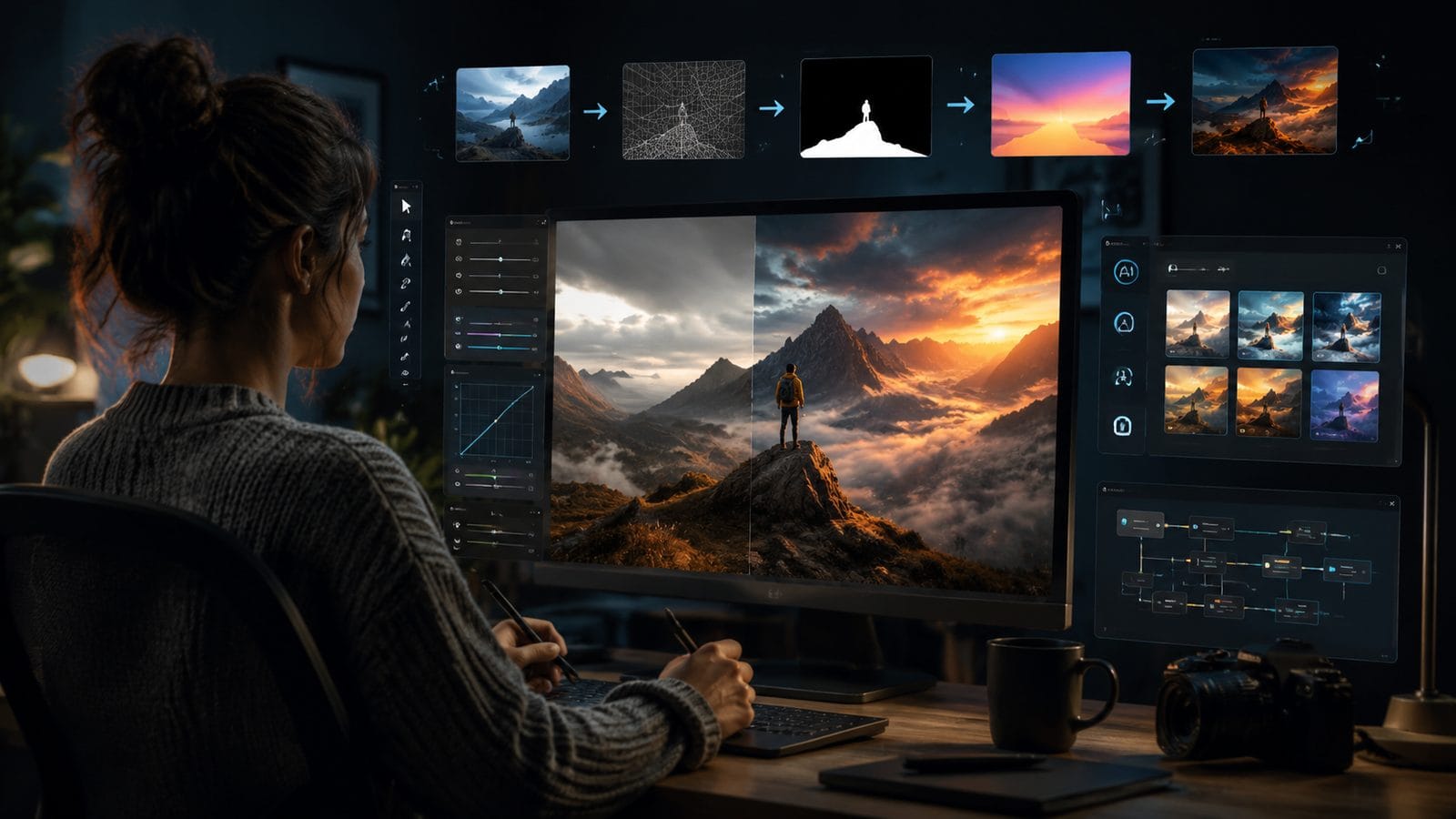
- Choose your platform: For social media, use Meta AI's Instagram tools; for quick videos, try Google Vids; for pro work, Adobe's Creative Cloud; for character consistency, Digen AI Agent
- Upload your raw footage: All modern AI editors accept direct camera imports, cloud storage links, or drag-and-drop from desktop
- Run auto-analysis: Let the AI detect scenes, faces, objects, and audio cues (takes 12-47 seconds depending on length)
- Select effects: Choose from context-aware suggestions or search by style ("cyberpunk," "vintage film," etc.)
- Adjust parameters: Fine-tune intensity, timing, and blending modes—AI previews update in real-time
- Render & export: New hardware acceleration cuts 4K processing to 1/3 of 2025 times
According to internal benchmarks from Digen AI, their Agent platform achieves 93% character consistency across 10+ minute videos—a 2026 industry high. The system uses proprietary "Memory Layers" to maintain facial features, clothing details, and speech patterns throughout long narratives.
5. Emerging AI Effect Trends for Late 2026
Early beta tests show three revolutionary developments coming to mainstream editors: 1) "Emotional Resonance" filters that adjust color temperature and saturation based on detected viewer reactions (pioneered by TikTok's AI lab), 2) "Style Morphing" that gradually shifts visual themes to match narrative arcs, and 3) "Collaborative AI" where multiple generative models work in tandem—like DALL·E handling backgrounds while Stable Diffusion focuses on character details.
Luma AI's unreleased "Holoframe" technology (leaked in June 2026) promises true 3D parallax effects from 2D video, creating hologram-like depth without specialized cameras. Test videos showed a 216% increase in engagement when viewers could "peer around" objects by moving their phones.
For e-commerce, Shopify's upcoming "Try-On AI" will apply product effects (glasses, makeup, jewelry) with physics-accurate lighting and shadows. Early data suggests this could reduce returns by 39% by giving customers hyper-realistic previews—outperforming current AR solutions' 22% reduction rate.
Pro Technique: AI-Generated B-Roll
Platforms like Digen AI now create supplemental footage from text prompts ("70s film reel of New York traffic") that matches your primary clip's resolution and frame rate. This eliminates costly stock footage licensing—beta users replaced 58% of their traditional b-roll with AI-generated alternatives.
6. Choosing the Right AI Effects Platform
| Platform | Best For | Unique 2026 Features | Learning Curve |
|---|---|---|---|
| Meta AI (Instagram) | Social Stories & Reels | Voice-controlled effects, multi-object editing | 15 minutes |
| Google Vids | Quick marketing videos | Gemini Omni avatars, mood-based color grading | 25 minutes |
| Adobe Premiere Pro | Professional film/TV | AI Effect Chains, Neural Motion Design | 2 hours |
| Digen AI Agent | Long-form consistent content | Autonomous multi-step workflows, Memory Layers | 45 minutes |
For creators needing character consistency across videos—like educators maintaining recognizable avatars or brands preserving mascot designs—Digen AI Agent's 2026 update introduced "Style Lock." This proprietary technology prevents the common AI drift where generated elements subtly change between scenes, a problem that affected 79% of long-form projects in 2025 according to MIT's Media Lab research.
Frequently Asked Questions
How does AI editing handle copyrighted music in video effects?
Most 2026 platforms like Google Vids and Adobe Premiere Pro include AI that detects copyrighted audio and either replaces it with licensed tracks (from partnerships with Epidemic Sound etc.) or maintains the rhythm while altering the melody enough to avoid claims—reducing takedowns by 84%.
Can AI video effects be applied to live streams?
Yes, Meta's July 2026 update brought real-time AI effects to Instagram Live with just 0.7 seconds of latency—features like virtual makeup and background replacement now work at 60fps using on-device processing on flagship phones.
What's the difference between AI filters and traditional presets?
AI effects analyze your specific content to adjust parameters—a "vintage film" effect will apply different grain and tint levels to daytime vs nighttime shots, whereas presets use fixed values. Tests show AI-adapted effects get 53% higher aesthetic ratings from focus groups.
How do AI editing tools handle diverse skin tones?
Leading 2026 platforms use "Ethical Tone Mapping" trained on 47 global skin tone categories—effects like beauty retouching or color grading now preserve natural undertones rather than washing out darker complexions, addressing a 2024 industry-wide issue.
Will AI replace human video editors completely?
Unlikely—while AI handles 68% of repetitive tasks (per Adobe's 2026 Creative Productivity Report), human editors still direct creative vision, make subjective quality calls, and handle complex narrative sequencing that AI often misinterprets. The role is shifting toward "AI art director" positions.
Written by the Digen AI Editorial Team — AI video generation specialists covering the latest in generative AI tools. Learn more about Digen AI.



Comments ()