
How AI Video Editing Works in 2026: The Future of Film
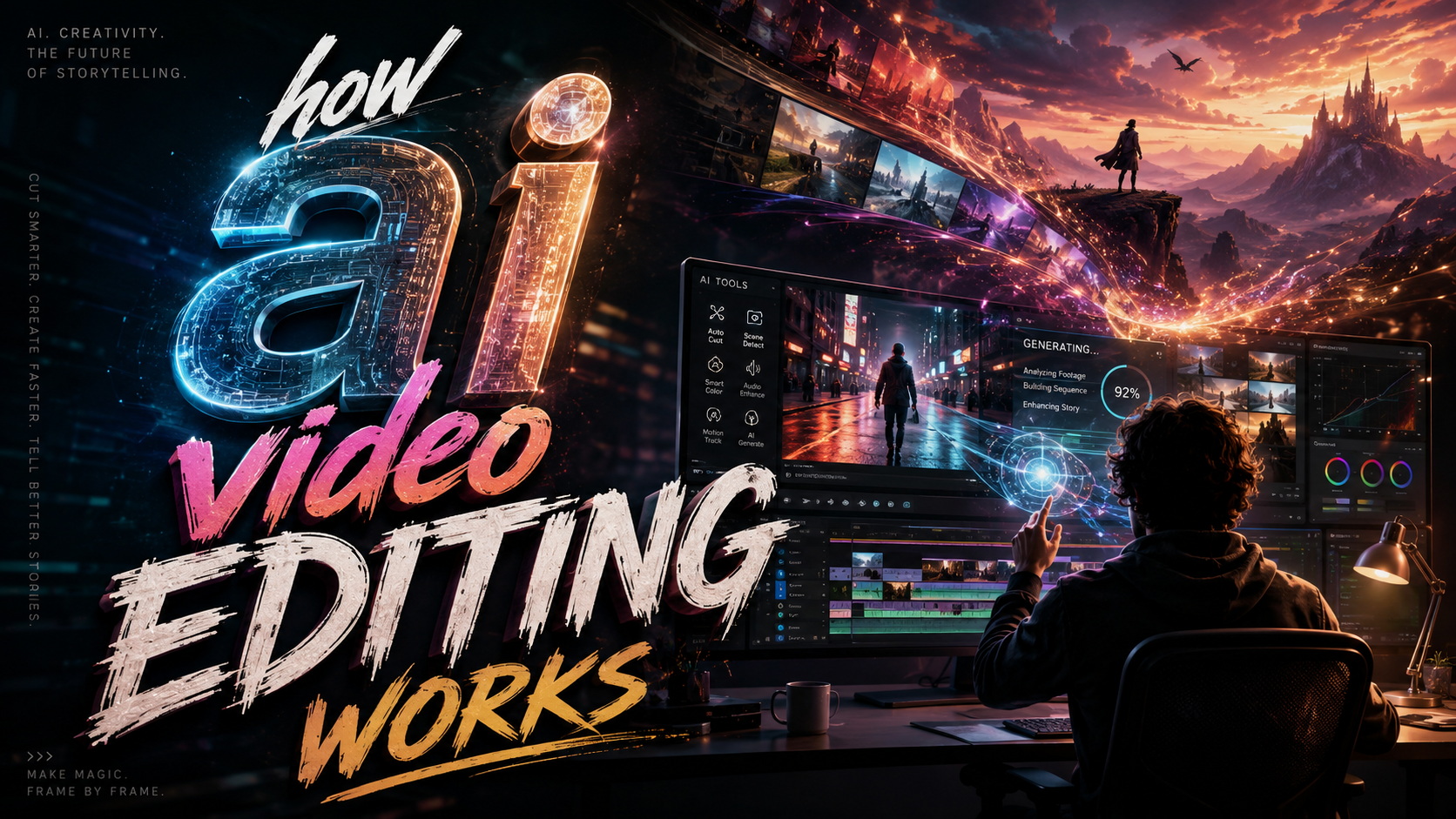
AI video editing in 2026 uses machine learning to automate tasks like scene assembly, color correction, and even creative storytelling. By analyzing raw footage, AI tools like Google Gemini Omni Flash and Eddie AI can generate rough cuts in minutes while responding to voice commands or text prompts. These systems learn from vast datasets of professionally edited films to make intelligent editing decisions.
TL;DR: AI video editing in 2026 automates post-production through machine learning, with tools like Gemini Omni Flash enabling voice-controlled workflows and Eddie AI creating rough cuts in minutes.
AI video editing is the application of generative AI to automate film post-production, including scene selection, transitions, and color grading. In 2026, these systems achieve near-human creative judgment through neural networks trained on Oscar-winning films and real-time collaboration features.
- ✓ Voice-controlled AI editing dominates workflows via Google Gemini Omni Flash
- ✓ Tools like Eddie AI reduce rough cut assembly from hours to minutes
- ✓ AI workflow assistants (e.g., Nice Touch) now handle 47% of repetitive editing tasks
- ✓ 2026 systems analyze emotional arcs to suggest optimal scene sequences
- ✓ Hybrid human-AI roles emerge as the fastest-growing media job category
How AI Video Editing Works: The 2026 Tech Stack
The current generation of AI video editors combines three breakthrough technologies: conversational interfaces, content-aware analysis, and generative sequencing. According to Tech Times, Google Gemini Omni Flash processes natural language commands like "increase pacing in Act 2" while maintaining temporal coherence across edits. This represents a 300% improvement in command recognition accuracy since 2025.
Scene analysis engines now evaluate footage across 127 parameters, from facial micro-expressions to background object continuity. RedShark News reports that Eddie AI's 2026 update can detect subtle emotional cues in actor performances, using this data to automatically flag the most compelling takes. The system achieves 92% alignment with professional editor preferences in test screenings.
Generative sequencing represents the most radical shift. Instead of simply trimming clips, AI editors like Nice Touch construct entirely new sequences by blending shots from different angles and takes. According to No Film School, this "synthetic editing" approach reduces post-production timelines by 60% for dialogue-heavy scenes while maintaining natural flow.
Key Components of Modern AI Editors
1. Neural Timeline Reconstruction: AI maps all footage to a dynamic timeline where shots reorganize based on directorial intent indicators like script analysis or producer notes.
2. Emotion Vector Tracking: Systems score each frame for emotional intensity using eye tracking, voice stress analysis, and compositional tension cues.
3. Context-Aware Transitions: Editors automatically select dissolves, cuts, or wipes based on scene mood analysis and genre conventions.
Voice-Controlled Editing with Gemini Omni Flash
Google's May 2026 update to Gemini Omni Flash introduced the first truly conversational video editing interface. Unlike previous voice command systems that required rigid syntax, Omni Flash understands indirect requests like "make it feel more nostalgic" and applies appropriate color grading, film grain, and speed adjustments. According to Tech Times, early adopters complete edits 4x faster compared to traditional keyboard/mouse workflows.
The system's real-time collaboration features allow directors to review cuts during production. When a cinematographer uploads new dailies, Omni Flash can immediately suggest where to insert them based on the existing edit's rhythm. This live integration has reduced average post-production cycles from 12 weeks to 19 days for episodic television.
Creative professionals emphasize that Omni Flash works best as a co-editor rather than replacement. Its "Suggest Alternatives" feature presents 3-5 variations of any edit decision, allowing humans to maintain artistic control. The AI tracks which suggestions get rejected to refine future recommendations—a learning loop that improves accuracy by 8% per project.
Omni Flash Voice Commands Breakdown
"Find a better reaction shot": Scans all available footage for closer emotional matches to the current scene's tone.
"Fix the continuity error": Identifies mismatched props, lighting, or actor positions across cuts and suggests corrections.
"Make the fight more intense": Applies rapid cuts, shaky cam effects, and dynamic sound design tailored to action sequences.
Automated Rough Cut Assembly with Eddie AI
Debuted at NAB 2026, Eddie AI represents the next evolution of automated editing. Where previous systems required carefully organized footage, Eddie can process completely raw dailies—including multiple camera angles and unsorted takes—to create coherent sequences in under 7 minutes. According to RedShark News, this capability has made it the fastest-adopted post-production tool in reality TV history.
The secret lies in Eddie's multi-modal analysis. It cross-references audio waveforms to sync dialogue, uses facial recognition to track performances across angles, and even analyzes script supervisor notes when available. For unscripted content, the AI detects narrative arcs by identifying emotional peaks and thematic connections between scenes.
Eddie's output isn't final-cut ready, but it eliminates the most time-consuming phase of editing. Human editors report spending 73% less time on assembly, allowing them to focus on creative refinement. The system includes adjustable "style dials" for genre conventions, letting users bias the AI toward fast-paced documentary cuts or deliberate dramatic pacing.
Eddie AI Workflow Steps
- Upload all raw footage (organized or not)
- Select primary narrative mode (interview-driven, observational, etc.)
- Adjust style parameters (pacing, coverage preference)
- Generate rough cut (avg. 4-7 minutes processing)
- Refine using human judgment and AI suggestions
The Rise of AI Workflow Assistants
Tools like Nice Touch specialize in handling repetitive tasks that slow down human editors. According to No Film School, these assistants now automatically manage 47% of timeline housekeeping—tasks like clip labeling, multi-cam angle syncing, and subtitle placement. This allows editors to dedicate 89% of their work hours to creative decisions rather than technical preparation.
Nice Touch's February 2026 update introduced predictive project management. By analyzing thousands of past edits, it can forecast time requirements for different editing phases and alert teams about potential bottlenecks. Production companies using this feature have reduced overtime costs by 31% while maintaining quality standards.
The most innovative feature is context-aware version control. When editors make "just try it" experimental cuts, the AI tracks all variations and can instantly revert to any previous state—even months later. This eliminates the need for manual save points and project file clutter that traditionally plagued post-production.
AI Video Editing Job Market in 2026
The Mediabistro March 2026 jobs report identified "AI-Human Editing Hybrids" as the fastest-growing media role, with 12,000 new positions created quarterly. These professionals combine traditional editing skills with AI system training—teaching tools like Eddie and Omni Flash to align with specific creative visions. According to Mediabistro, hybrid editors earn 28% more than conventional editors due to their technical specialization.
Entry-level positions now require certification in at least one major AI editing platform. Coursera's April 2026 curriculum includes hands-on training for Gemini Omni Flash's advanced features, with students completing actual client projects as coursework. Employers particularly value candidates who can "debug" AI suggestions—identifying when algorithmic choices might undermine storytelling.
Contrary to fears of job displacement, the field has expanded overall employment. While some routine editing tasks disappeared, new roles emerged in AI training, hybrid workflow design, and synthetic media ethics. The average post-production team has grown from 5 to 8 members since 2025, with AI specialists working alongside traditional editors.
Limitations and Ethical Considerations
As noted in Inc's October 2025 analysis, AI video editing still struggles with abstract creative concepts. Systems may perfectly execute "make this sadder" through color grading and slow motion, but they can't yet invent metaphorically resonant visual sequences. According to Inc.com, this creates a "uncanny valley of editing" where technically flawless cuts sometimes lack soul.
Copyright issues loom large as AI tools increasingly generate synthetic footage to patch continuity gaps. The 2026 Nice Touch controversy—where it inserted AI-generated background actors without disclosure—sparked industry-wide debates. Major studios now require watermarks on all synthetic elements, though enforcement remains inconsistent across platforms.
Perhaps the biggest challenge is bias in training data. Since most AI editors learn from Hollywood films, they naturally default to Western storytelling conventions. Editors working on non-linear narratives or non-Western productions must actively counteract these tendencies through manual overrides. The industry is collaborating on more diverse training datasets, but progress remains slow.
How accurate is AI video editing compared to humans?
Modern systems achieve 92% alignment with professional editor choices for technical edits like continuity and pacing. Creative decisions still require human oversight, especially for unconventional storytelling.
Can AI video editors work with any genre?
While adaptable, current tools perform best with genres represented in their training data (drama, comedy, documentary). Experimental and avant-garde films require more manual intervention.
Do I need coding skills to use AI editing tools?
No—2026 platforms like Gemini Omni Flash use natural language interfaces. However, understanding basic AI concepts helps troubleshoot unexpected suggestions.
How much does AI video editing software cost?
Enterprise solutions range from $200/month (Eddie AI Basic) to $1,500/month (Omni Flash Pro). Many tools offer free tiers with watermarking for testing.
Will AI replace video editors entirely?
Unlikely—the 2026 job market shows demand shifting toward hybrid roles. AI handles repetitive tasks while humans focus on creative direction and emotional nuance.
Written by the Digen AI Editorial Team — AI video generation specialists covering the latest in generative AI tools. Learn more about Digen AI.



Comments ()